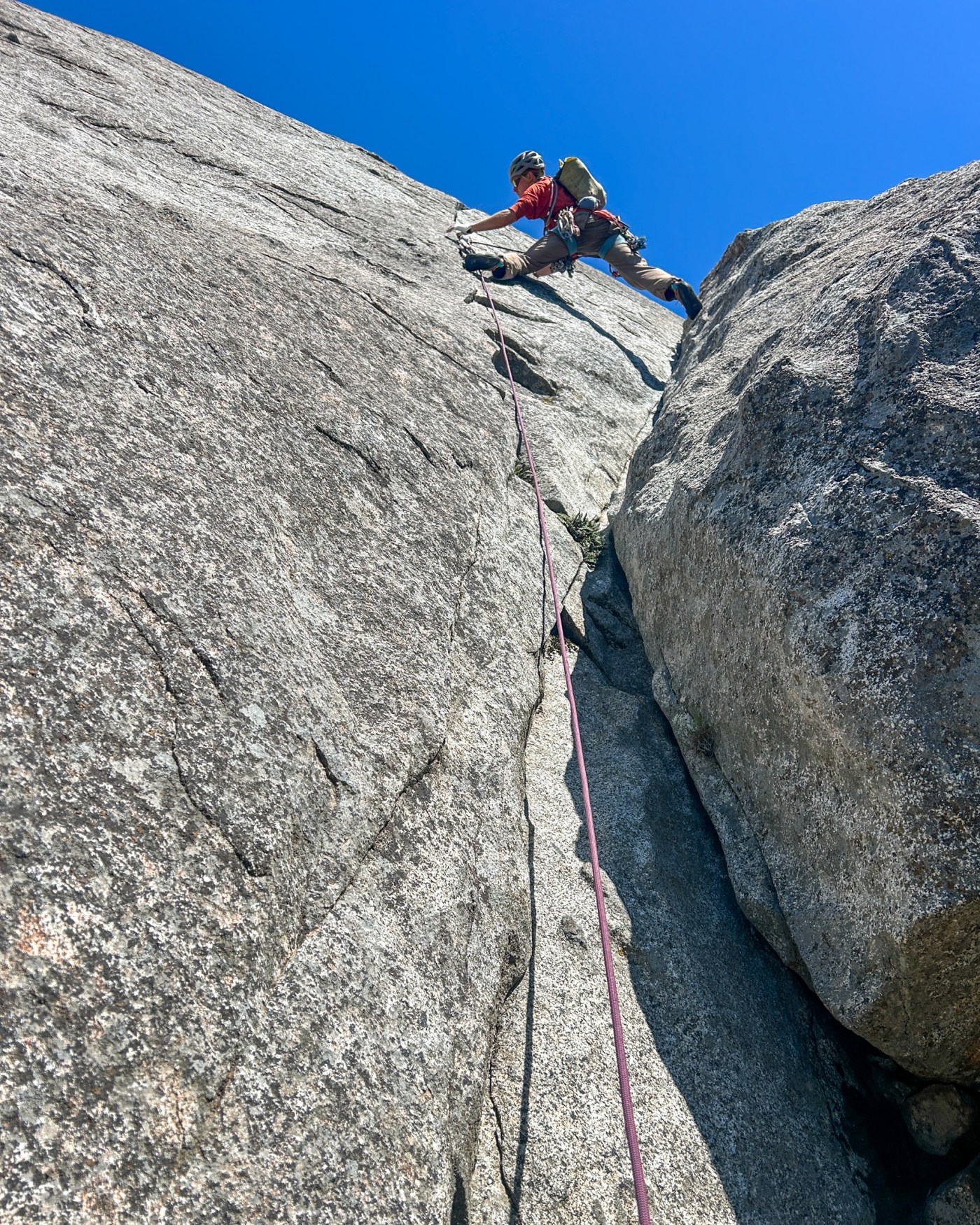
On Monday, June 15th, the Alpine Peanut and I climbed the South Cracks of Moro Rock, one of the largest frontcountry rock climbs in the absolutely breathtaking Sequoia National Park.
The South Face of Moro Rock is difficult to photograph, so I have no topo or long shot of the route. A topo and picture for the South Cracks and South Face can be found at: http://www.sekiclimbing.com/moro—south-face.html
Rock climbing in Sequoia National Park (SEKI) came onto my radar last year while panning for alpine climbing objectives near Southern California, our newest seasonal work location. I’d visited Sequoia once, five years ago, as a trail runner. Much like my self supported fast-pack of the John Muir Trail, I left Sequoia with extreme admiration and inspiration for future adventures. The High Sierra is incredibly sprawling. From the runner or backpacker’s perspective, Sequoia, Kings Canyon, Yosemite and their adjacent wildernesses offer eons of alpine lakes, remote peaks, and stretching valleys. From the alpinist angle, ski mountaineering, ice climbing, ridge traversing and alpine rock climbing potential is infinite. With our relocation to Southern California and close proximity to places like Sequoia and Whitney Portal, I’m beyond excited to become intimately acquainted with the Sierra’s trails, couloirs and towering granite walls.
Unfortunately, this maiden Sequoia voyage followed a two month work block devoid of outdoor rock climbing. We retained some fitness by surveying over 400 miles of rugged desert terrain on foot, having a free-standing pull-up bar and hangboard at camp, and scoring the occasional climbing gym session, but for alpine rock climbing we were out of prime shape. We also had only five days before starting a new project, and didn’t have backpacking equipment. The best and most inspiring Sequoia climbing is deep in the backcountry, with approaches ranging from 10-25 miles, and routes craning upwards of 3,000 feet. Between our lack of time and gear, such grandiosities were tabled. Instead, we aimed for the biggest available frontcountry adventure climbs.
Moro Rock – South Cracks
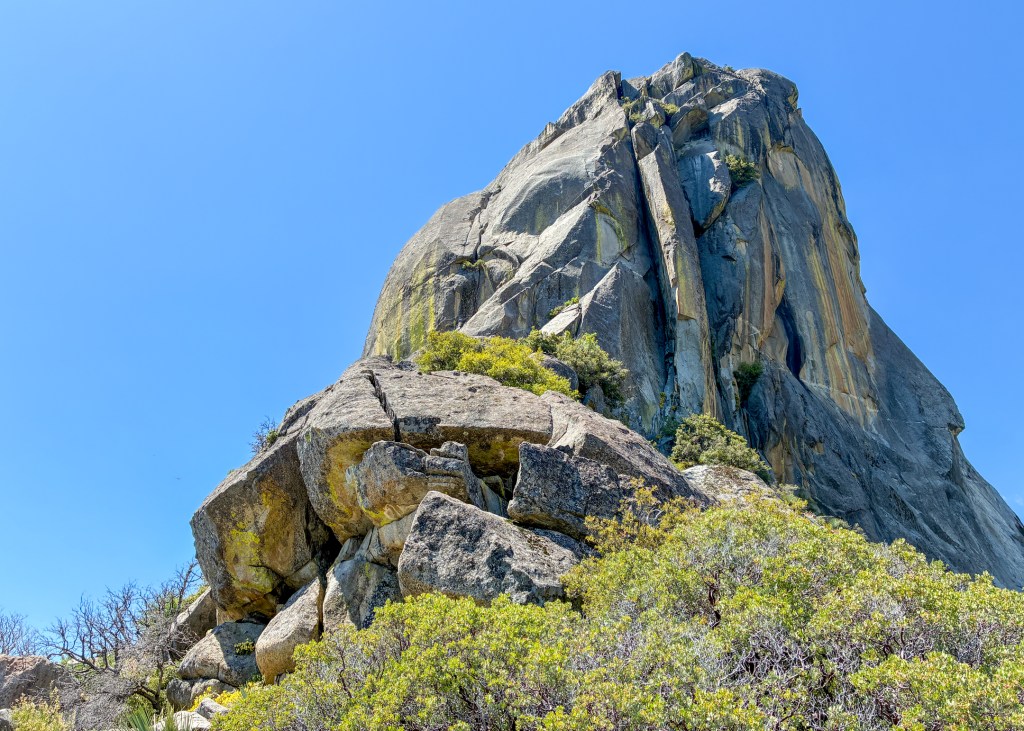
Our first objective was Moro Rock, Sequoia’s most popular peak due to road access within 200 vertical feet of the summit. But, like many of Sequoia’s famous domes, there’s a broad side and steep side. On the north aspect, where the parking lot and tourist trail lives, Moro sports a piddly prominence of granite slabs emulsified with a forested hillside. But to the south, east and west, Moro cascades like a waterfall, serving massive granite faces up to 1,400 feet. Approaches to all technical routes start by directly descending vicious brush gullies or confounding ledge systems for varying amounts of soul crushing time, and top out on the guard railed-observatory deck ten minutes from the car. We chose Moro’s highest rated moderate classic, the South Face via the South Cracks Variation (5.9 PG13, III, 1400’), which coincidentally happens to be the peak’s longest route. Given the 100% downhill approach, proximity to the car, gentle grade, ten minute walk-off and Mountain Project declared length of 800 feet, we did little planning, packed light and expected an afternoon parking lot picnic. Turns out Moro held a stronger hand.
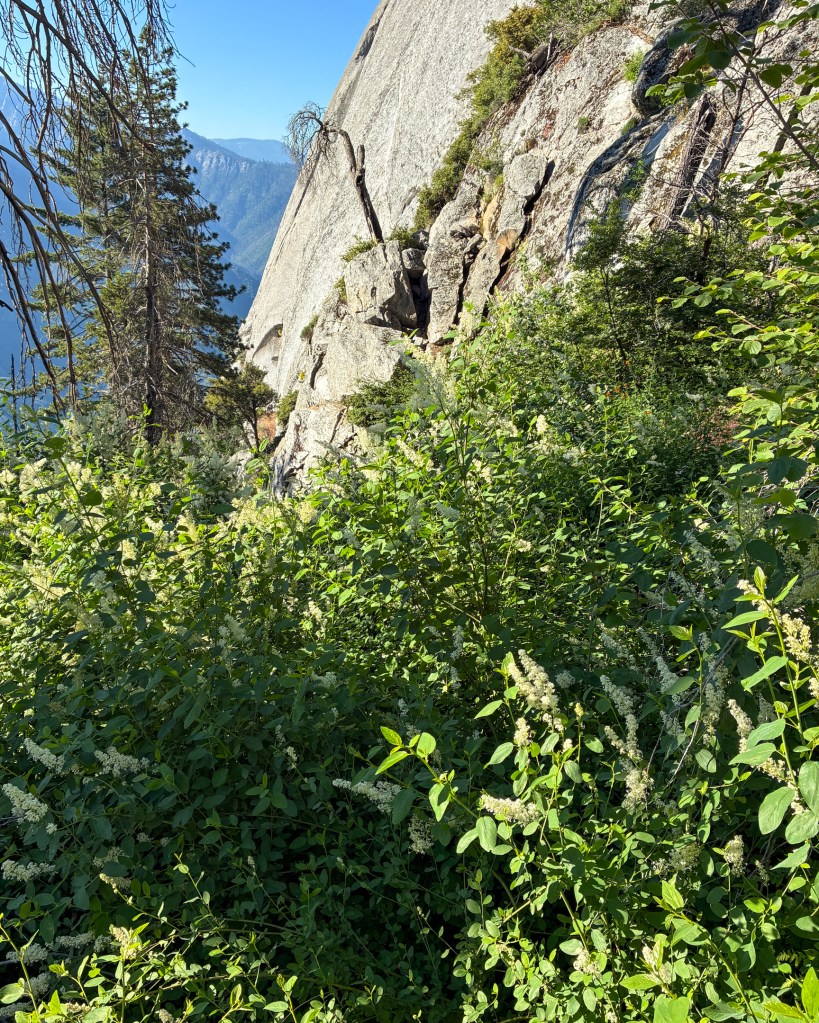
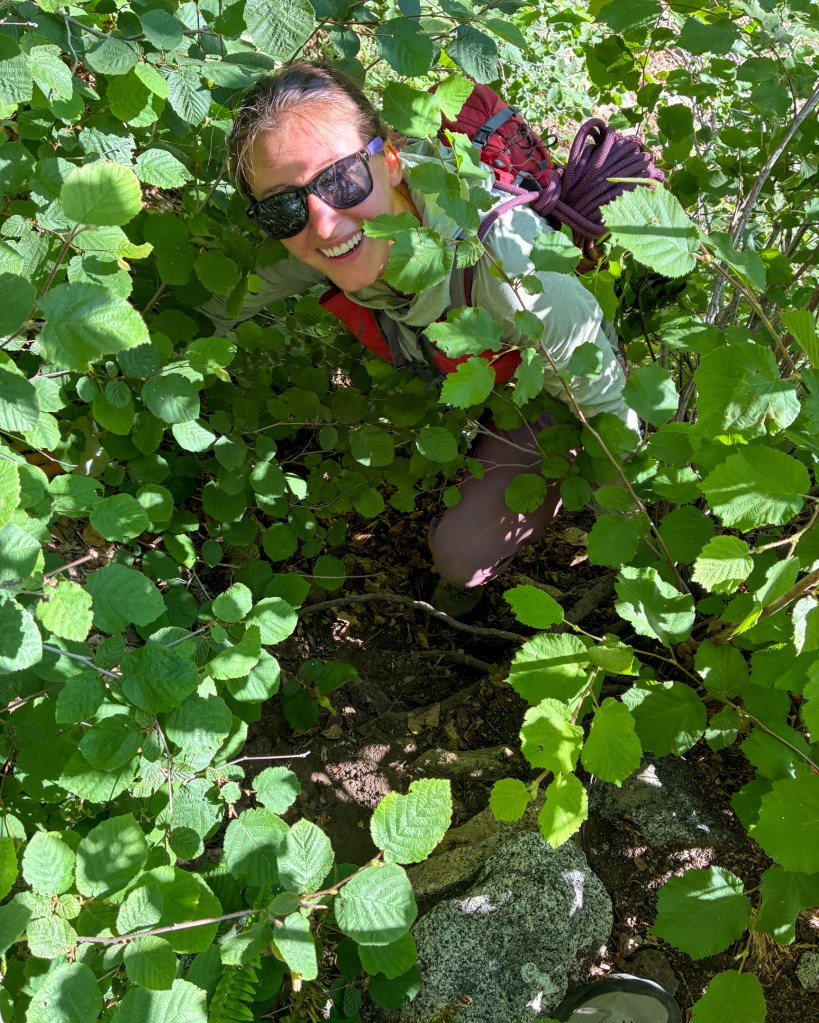
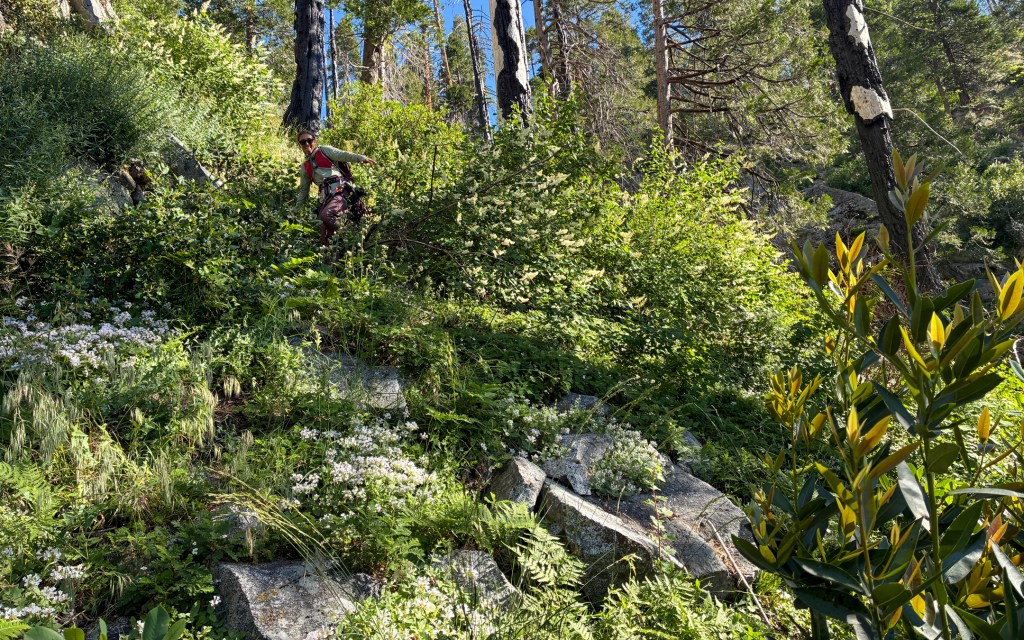
Our day commenced sometime well after sunrise, with a pilgrimage down an overgrown forested gully akin to Borneo. Two whole hours were lost hacking 1,100 feet straight down the East Gully, combatting loose rock, angry bees, false climber’s trails and rotten fourth class foolery at every turn. Upon reaching the South Face we were as dehydrated as a Joshua Tree, itchy from vegetation, and shell shocked to discover we’d only traveled 0.64 miles. And by the time we found the first pitch, no small task mind you, Moro Rock was baking in the muggy, unfiltered, 82 degree summer sun.
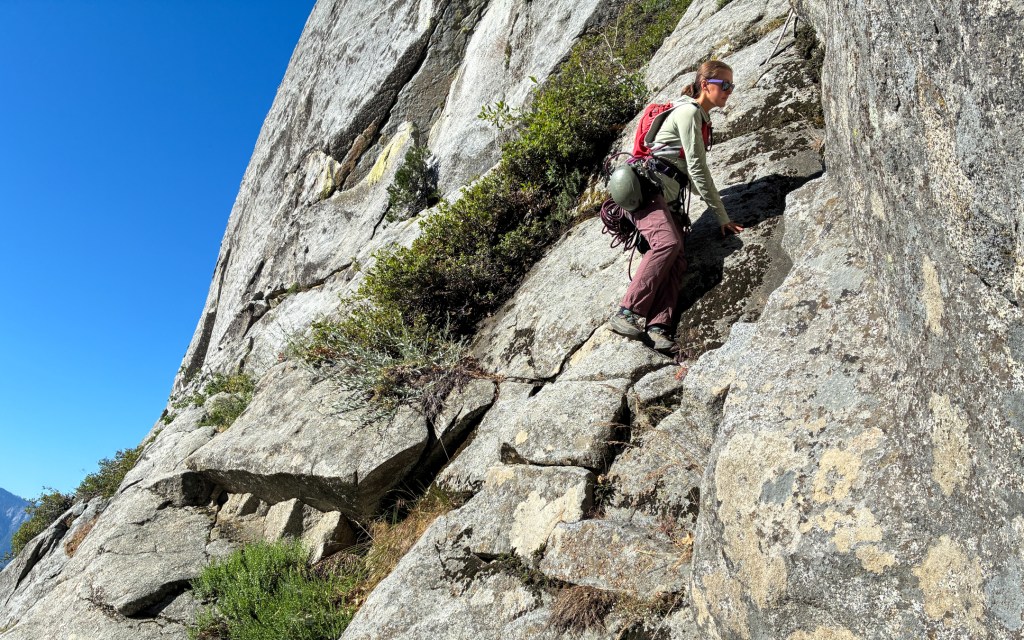
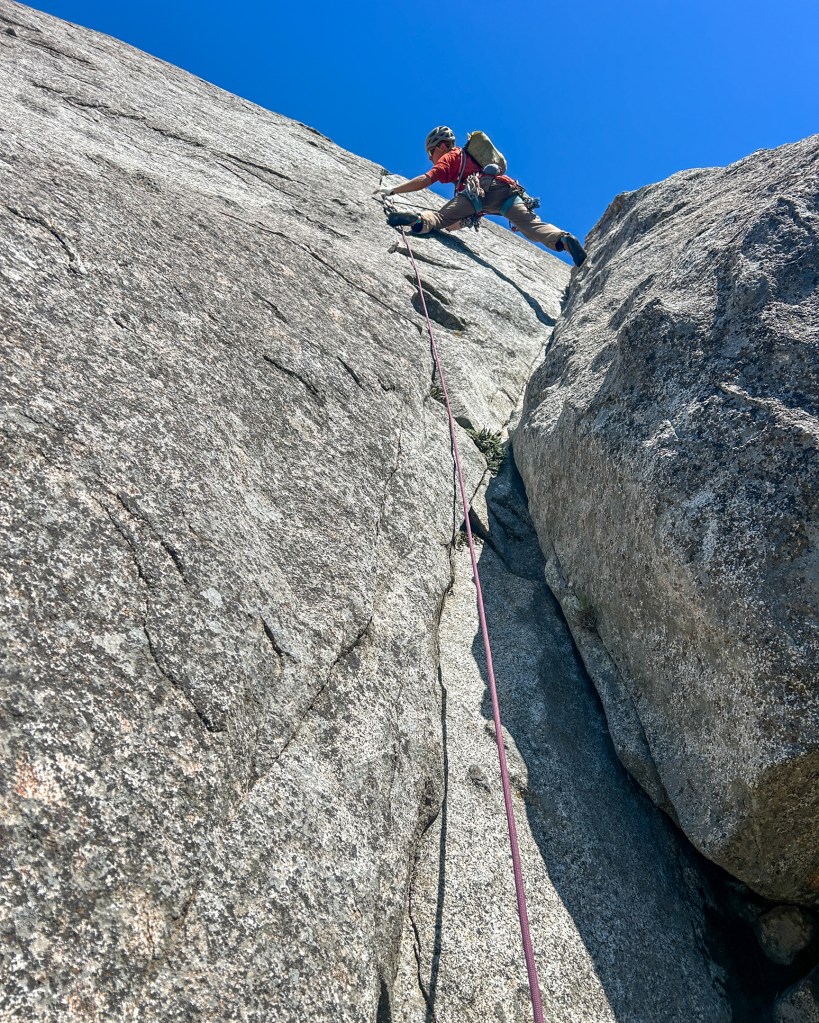
While often wrongly listed as its own route, the South Cracks is actually a three pitch variation to Moro’s trade route, the South Face (5.8, III), offering three pitches of high quality crack and face climbing instead of the South Face’s first three vegetated pitches. Pitch one dropped like a breeze, an excellent 30 meters of splitter finger locks to a hanging belay. But the second pitch? Not so much. What began as a slabby 5.9 seam I couldn’t protect because no beta spoke of RP’s and micro-cams quickly ended at a blank face with no protection. Two parralel crack systems 20 feet apart led up 20 feet before dead ending in a sea of black knobs. At the base of the right crack system I had two choices. Traverse to the left crack with no protection and follow it towards the giant right facing corner of pitch three, or climb the right crack and traverse left to the same corner with no protection. Donning no beta other than two chalked holds and courage, I followed the chalk left. Unfortunately, this serious mistake dwindled into an unprotectable flaring flake capped with a blank section of dirty 5.9 slab. If a hold crunched off, or I blew a smear in the baking full sun, Search and Rescue would be on the menu. On what was supposed to be a carefree half-day romp, I unknowingly wandered into the most precarious pickle of my climbing career.
Appreciate Ten Thousand Too Far? Support independent mountain journalism with $5.10 per month through Patreon (and receive extra bonus content), or with a one-time donation. Any and all support is greatly appreciated. I do not have any paid sponsorships.
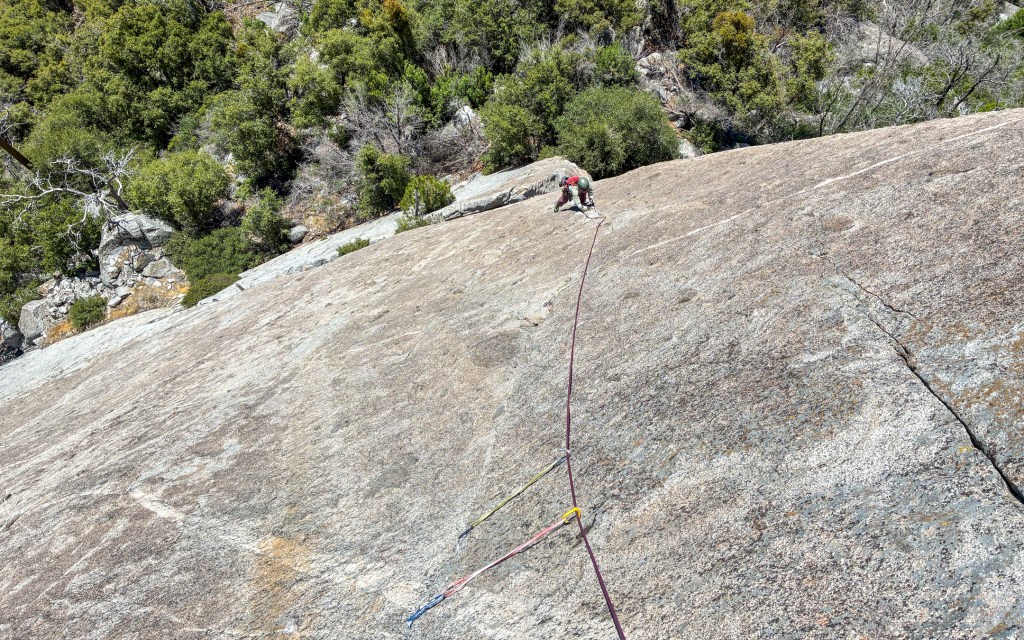
As I pondered my existence perched on golfball sized diorite knobs that dug into my sweaty feet like drywall screws, 30 feet out and diagonal from my last protection in the rightmost crack, my psyche quickly unraveled. I wanted so desperately to finish the last ten feet to bigger knobs, but in my heart I knew I was off-route, and trusting life to flaky no-holds smears without so much as a fingernail handhold was too risky. Reluctantly I began downclimbing sequence after terrifying sequence of 5.9 friction. Somehow, by the grace of adrenaline and Dean Potter himself, I rejoined my last gear without pitching. I slumped onto a small ledge the size of a pizza box, ripped off my shoes, chugged water, and contemplated the fact I was both alive and intact. Had the approach been anything other than the most hellish bushwhacking of our lives, we would have bailed. But sacrificing gear and spending hours thrutching up shrubbery seemed somehow worse than braving another life threatening runout. On second try I unlocked the code, laybacking the right crack to its terminus, placing a bomber #0.3 cam, and questing left on a different network of unprotected knobs which indeed reached the belay. In comical cosmic jest, the hardest move was the last, a committing mantle 20 feet horizontal from that last lonely cam, as if the South Cracks were screaming – “don’t let the door hit you on the way out!”
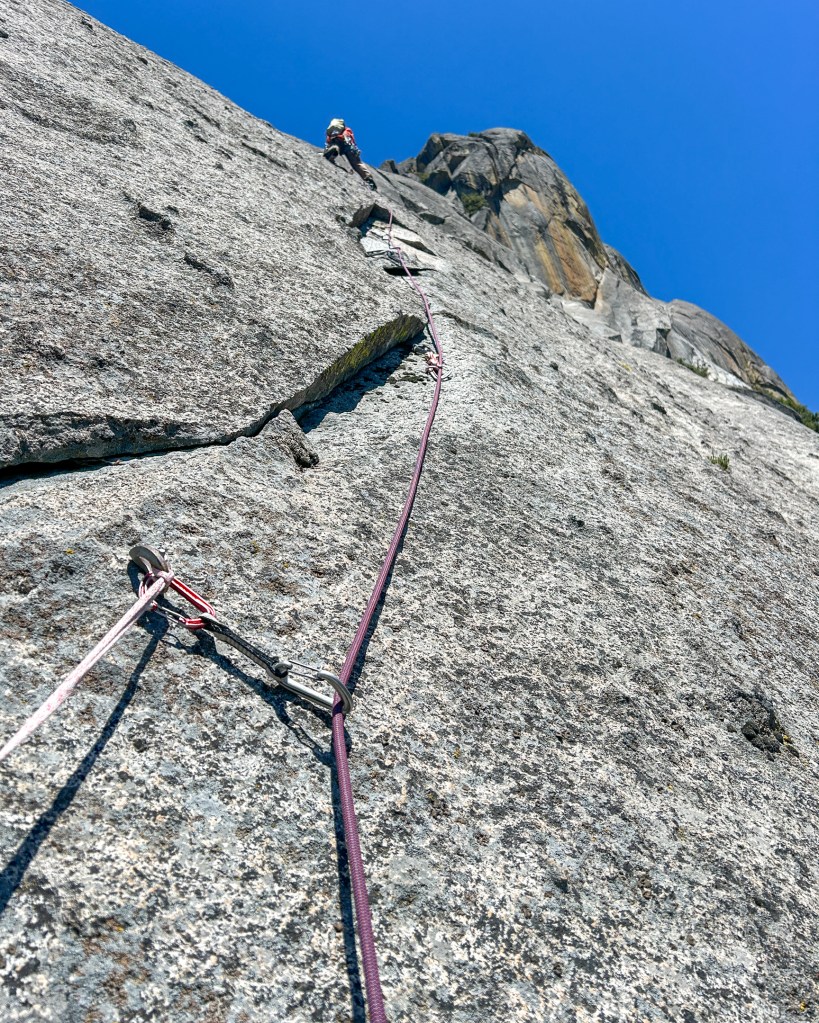
The third pitch was more of the same – an off-width I couldn’t protect because my “standard rack” doesn’t contain a six inch cam, and a bottoming 5.9 seam corner I could barely protect because my “standard rack” doesn’t include RP’s and #00 cams. If I could find whoever wrote “standard rack” in the South Cracks route description I would beat them brazenly with the six inch cam in my truck. Stagnated by route-finding and unforecasted runouts, we didn’t reach Jungle Ledge – the ledge connecting the South Cracks to the South Face – until nearly four hours after tie in. And even from Jungle Ledge, finding the standard South Face took at least another hour. The route description through these pitches may as well been written in Chinese, because finding key features in a maze of body piercing yucca, teetering death blocks, grass, lichen, toppled trees, house sized boulders and weather hardened Mountain Mahogany is near impossible. By the time we located the South Face route we were entirely out of water, low on food, and ready to be anywhere other than Moro Rock. Unfortunately, 1,000 some feet of mountain still loomed overhead.
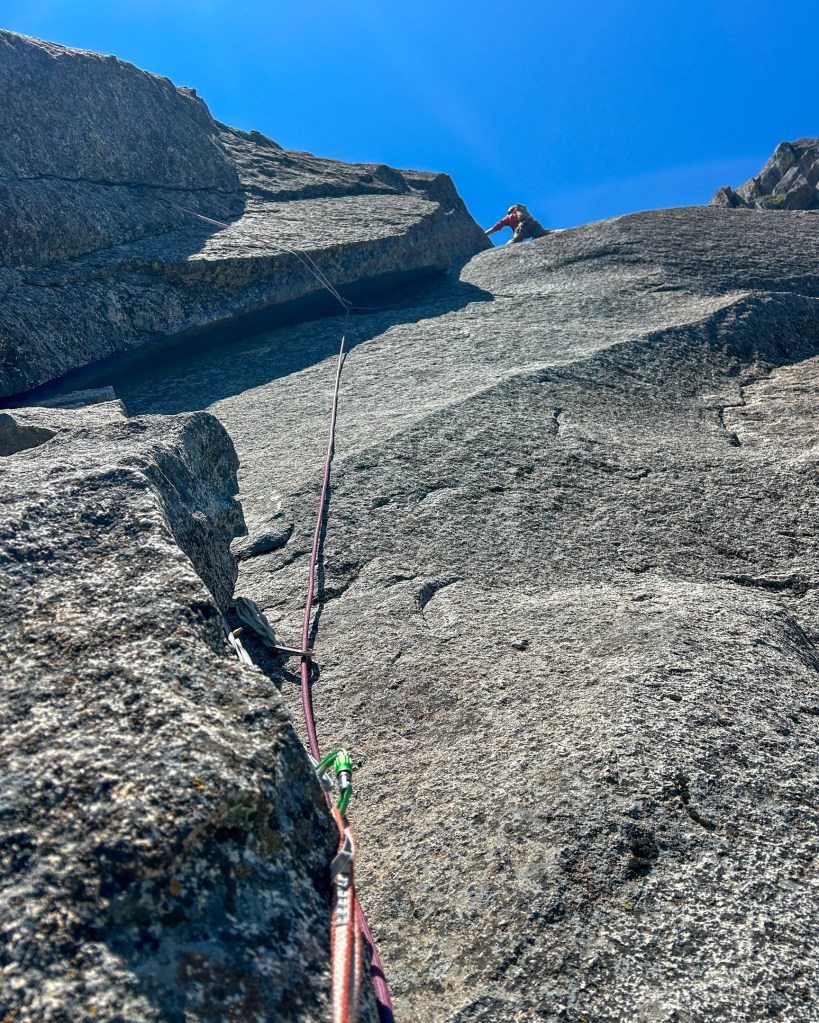
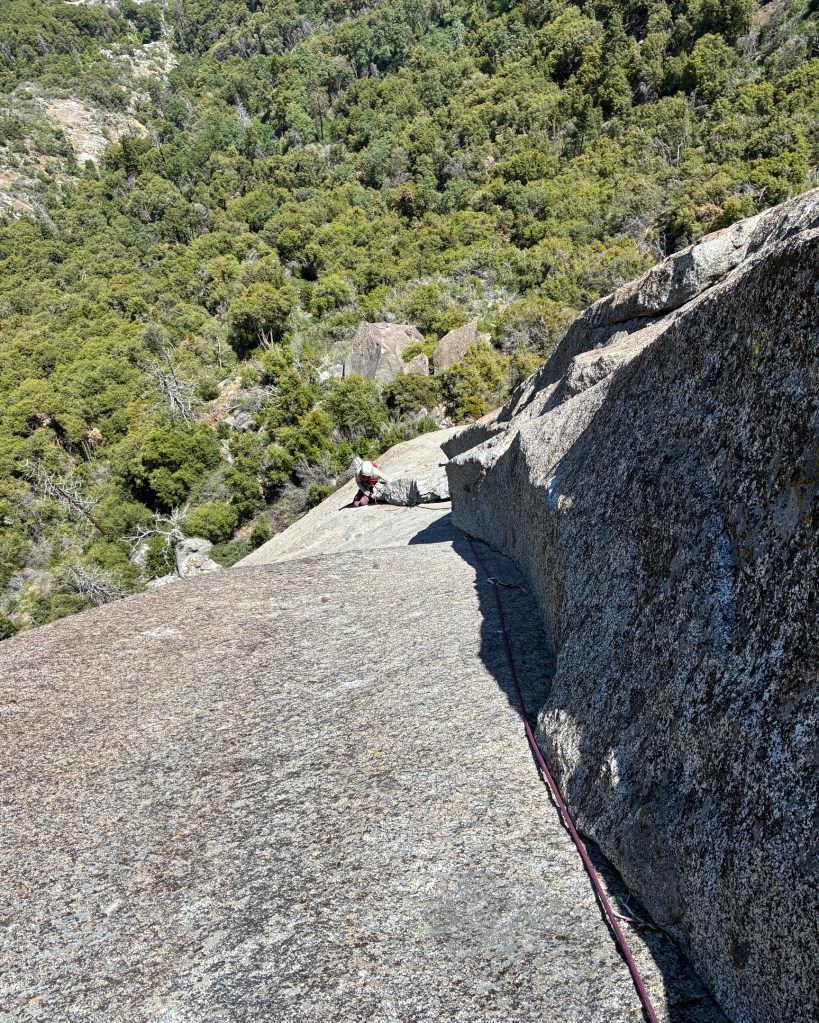
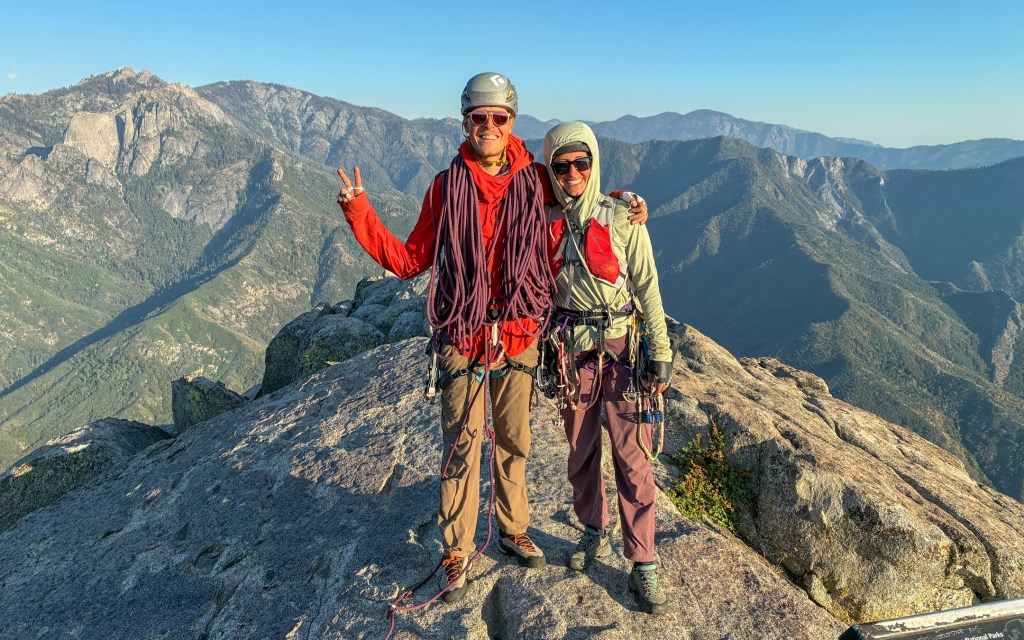
With bloody toes and a ringing dehydration headache I ran the rope up the next four techincal pitches as quickly as possible, which, despite parched throats, ended up being quite classic. Pitch five was the crux of the South Face, a 5.8 teetering off-width and handcrack with an exciting unprotected face crux, merging into another long vertical crack system. Linked with pitch six, a long 5.6 chimney, this was a truly stellar rope-length. Pitch seven was a brilliant yet very runout 5.7 knobby slab on perfect golden varnish, and pitch eight a scrappy 5.5 bombay chimney. From a spacious ledge above pitch nine we switched to approach shoes and simul-climbing, railing up the final 600 feet of jumbled terrain in under an hour. Supposedly this last push is 3rd class, but we found nothing easier than uber exposed 4th class. I would have been comfortable unroping, but didn’t complain when Bobbi beckoned a cord. Eight hours after tie in, accompanied by a backdrop of early summer sunset, I belayed Bobbi over the Moro Rock observation deck to the astonishment of a dozen dazzled tourists. The questions immediately ensued: “how the hell did you get up here?”
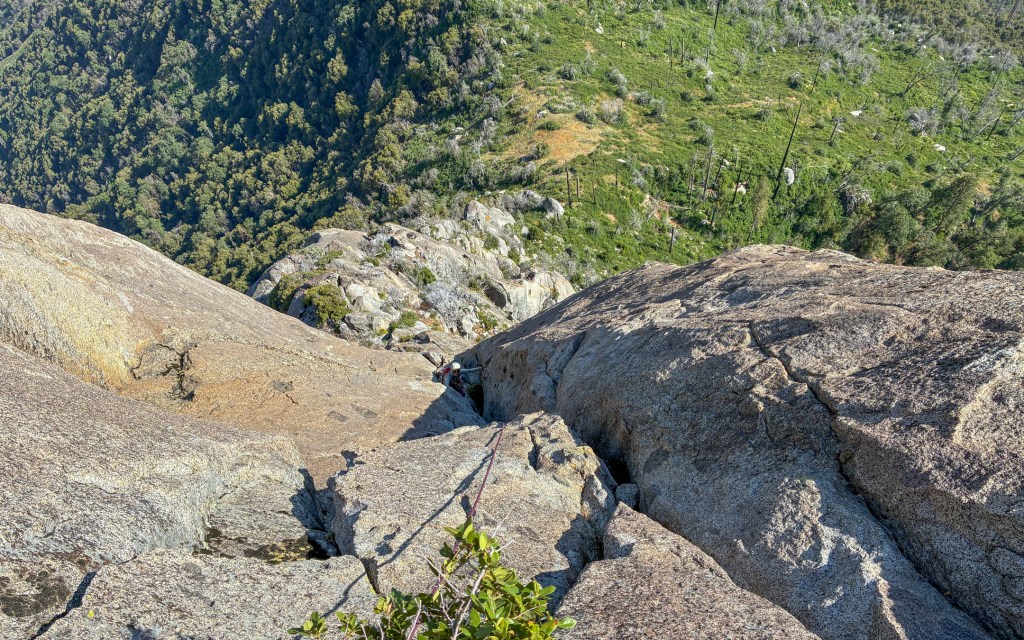
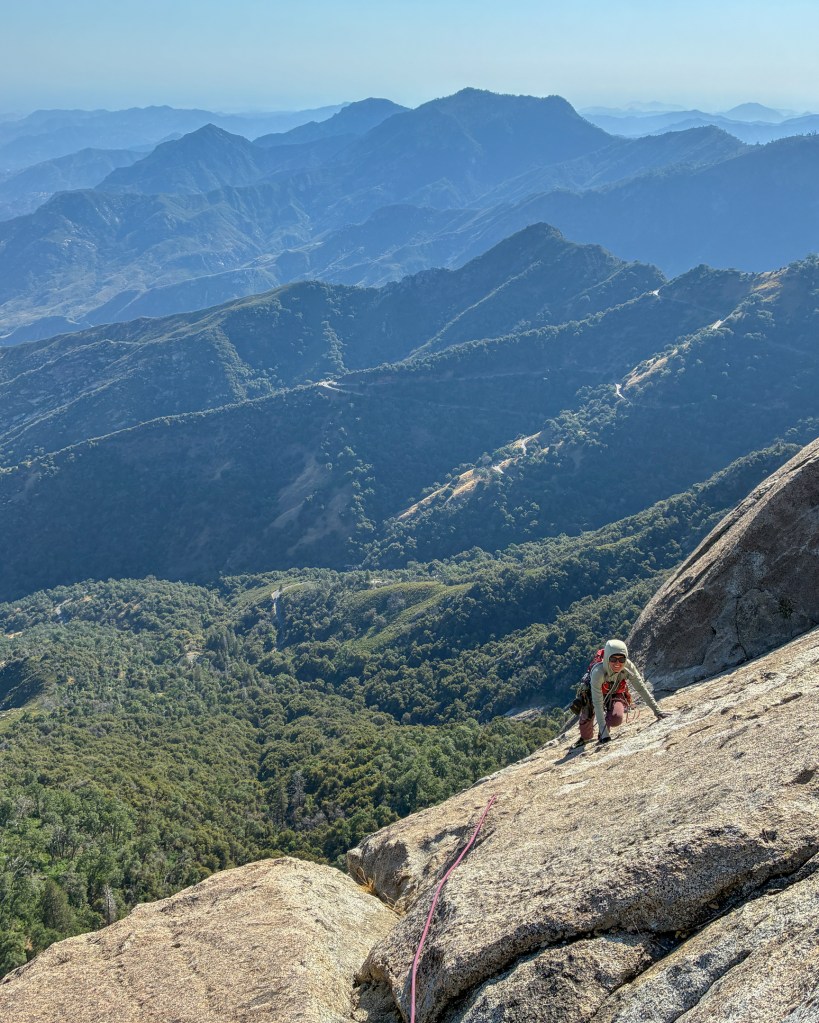
While the previous five paragraphs contain a fair bit of complaining, 50% of those complaints were hatched by our own wrongdoing, and 25% the product of bad beta. It’s hard to enjoy rock climbing when getting torched in humid 80 degree sun on an exposed South Face. We had blistered toes by pitch two, ran out of water by pitch three, and starved by pitch five. No topo and a very vague description, combined with an inherently wandering route, added constant logistical stress. Yes, there were stretches of ridiculously heavy vegetation – between the approach and Jungle Ledge we clawed through more bushes than an average person’s lifetime. But all three 5.9 pitches on the South Cracks, and pitches five through seven on the South Face, offered sustained and exciting climbing on perfect alpine granite. Had we better respected Moro Rock for the 1,400 foot alpine panel it is, starting earlier, packing more provisions and gathering beta beyond Mountain Project, we would’ve had a better time. And still, we had a damn good time.
Want to support? Consider a donation, subscribe, check out my Patreon page, or simply support our sponsors listed below.
Ten Thousand Too Far is generously supported by Icelantic Skis from Golden Colorado, Range Meal Bars, The High Route, Black Diamond Equipment and Barrels & Bins Natural Market.



enter your email to subscribe to new article updates
DISCLAIMER
Ski mountaineering, rock climbing, ice climbing and all other forms of mountain recreation are inherently dangerous. Should you decide to attempt anything you read about in this article, you are doing so at your own risk! This article is written to the best possible level of accuracy and detail, but I am only human – information could be presented wrong. Furthermore, conditions in the mountains are subject to change at any time. Ten Thousand Too Far and Brandon Wanthal are not liable for any actions or repercussions acted upon or suffered from the result of this article’s reading.


Leave a comment