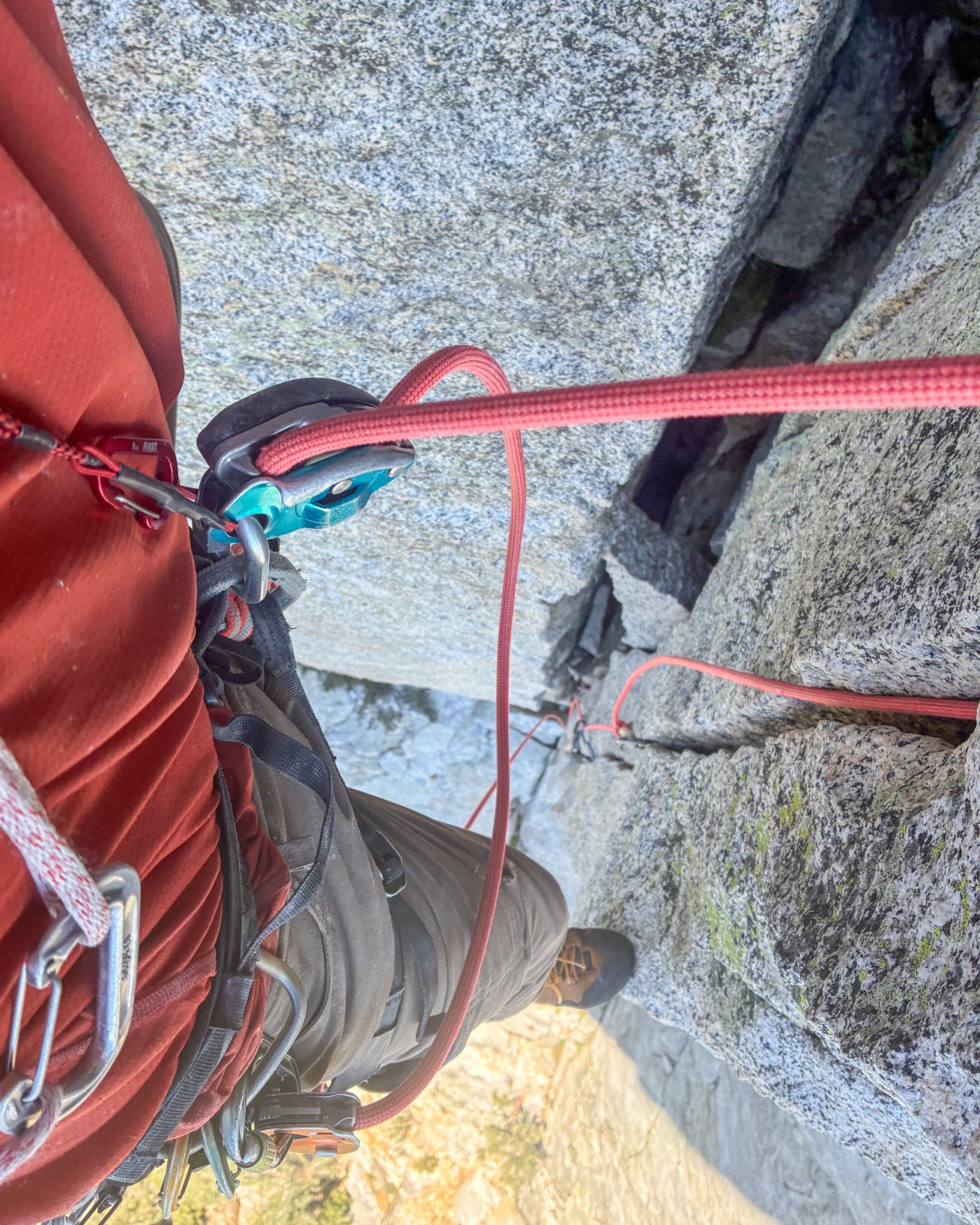
On Sunday May 17th I rope-soloed The Long Climb on Tahquitz Rock, a historic 800 foot 5.8 established by Royal Robbins and Don Wilson in 1952. It represents by far the longest and most sustained rope-solo of my career.
I did a remarkably poor job of photographing this route – I apologize.
Bobbi and I’s summer work block began on April 1st, and since then I have not climbed outdoors save for one lousy day of sun baked sport climbing outside Barstow, California. We’ve been surveying all around Southeastern California, with the bulk of our assignments nowhere remotely near climbable rock. While traveling we’ve managed a handful of gym sessions, but for the most part our climbing itch has been scratched through pull-ups and hang boarding on our new free standing pull up bar. Six weeks is by far the longest I’ve gone without tying into a rope in half a decade. Currently I’m working in Victorville, on the I-15 corridor two hours north of Joshua Tree and Idyllwild. However, as per usual, our work schedule has been unrelenting. Six day weeks, 10-14 hour shifts, and car camping every evening amongst the blazing hot desert sun is both terrible for recovery and motivation. Rest days are consumed with running errands and trying to score one measly shower. Exhaustion is an understatement.
On May 17th, 48 days into work, I got tossed a bone – a spontaneous day off whilst already stocked with supplies. My first thought? Sleep twelve hours, eat a glutinous breakfast, play banjo, and hopefully conjure an energy morsel to yank on some plastic. My second thought? Go big. I wasn’t sure which I’d choose until reaching I-15 after yet another tedious 13 hour shift. Veer north to camp, or south to Idyllwild? Two sleepy hours later I was curled into my camper beneath the incredible 800 foot monolith of pearly white granite that is Tahquitz Rock. Calls for partners landed on deaf ears, and while I could’ve easily enjoyed a day of carefree top-rope soloing at Suicide Rocks, adventure called.
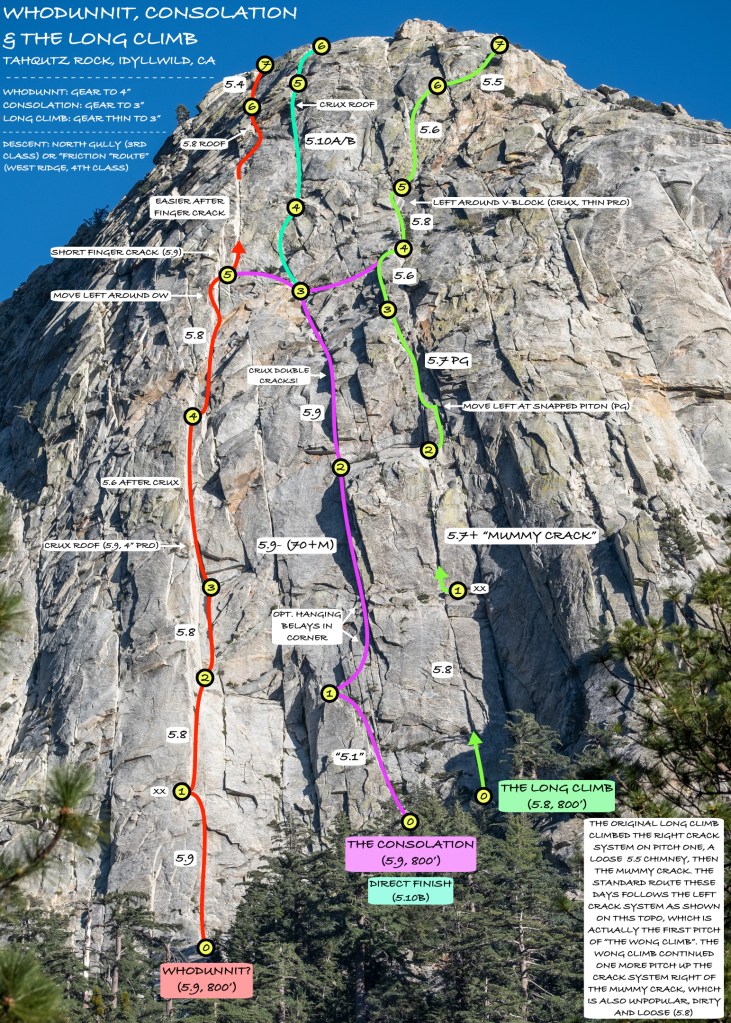
Ever since getting into rope soloing last summer I’ve envied soloing a route to the summit of Tahquitz. Last season I rope-soloed a handful of shorter routes on Tahquitz’s shoulder buttresses (Dave Deviation, The Jam Crack and El Grandote/El Whampo) – and now, 50 some pitches into rope-soloing, it seemed fitting to shoot higher. My objective was The Long Climb, a historic 800 foot 5.8 established by Royal Robbins and Don Wilson in 1952. Sure, it’s “only 5.8”, but anyone who has climbed in Southern California knows that a Royal Robbins 5.8 from the 1950’s is a different ballgame. I was prepared for battle, and battle I found.
On the furthest right side of the Northwest Recess, Tahquitz’s tallest face home to the North American classic Whodunnit (5.9, III, 800′), are two striking parallel crack systems. The original first pitch of The Long Climb took the rightmost crack, a grimy and loose 5.5 chimney, before transitioning to the left crack system via a ledge at 40 meters. A more common variation stays in the left crack exclusively, the first pitch of which is an excellent 40 meter 5.8 hand crack. I hadn’t rope soloed nor climbed polished granite in some five months, so I zipped the situation up and climbed timidly. Fortunately, I know how to hand jam so any perceived danger was purely a product of headspace. Climbing the pitch a second time on top-rope irrefutably highlighted my fractured psyche. While the lead took half an hour, following took five minutes. Before launching into the second pitch, a menacing looking squeeze chimney known as “The Mummy Crack”, I heavily considered bailing. 700 feet of towering granite still loomed, the time was already 11:30, and I was clipped into the route’s only fixed anchor. Bailing above this point would cost both money and a damaged ego, and running out an off-width on a rope solo rig was downright terrifying. Yet before I knew it, there I was – “dancing with the greased hog” – as John Long once said.
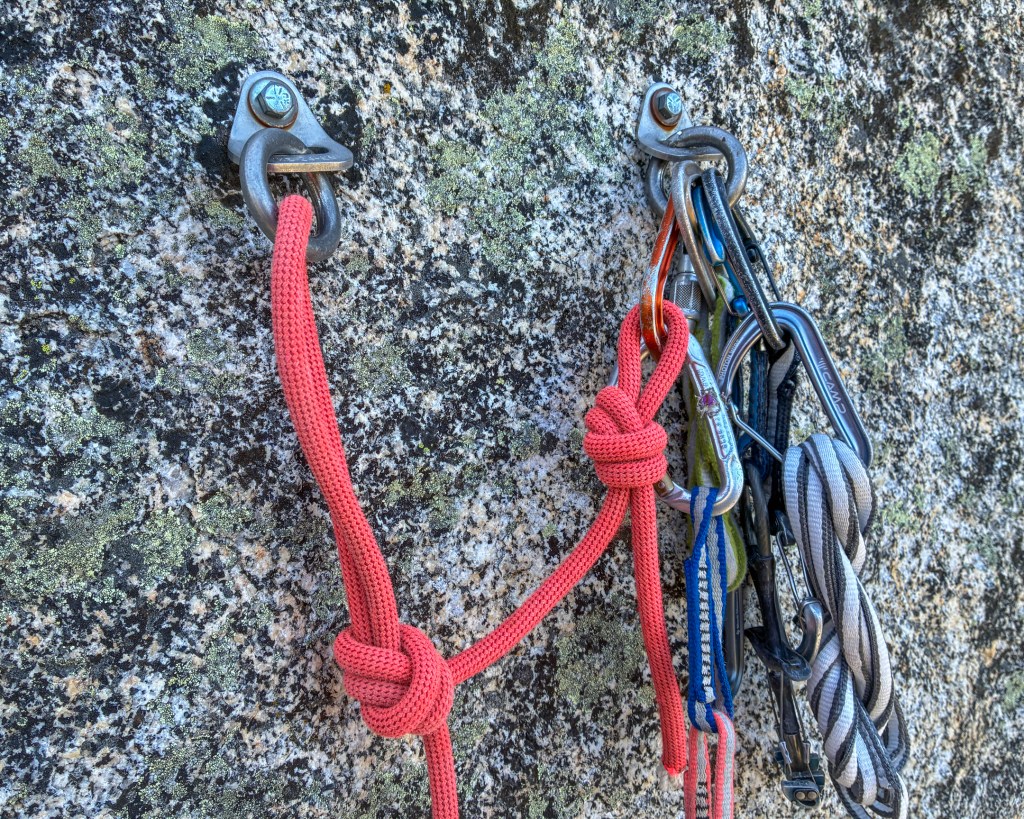
The aforementioned pitch two off-width is the infamous Mummy Crack, named for the mummification level squeezing required to worm up the inside with 1950’s mountaineering boots. Fortunately, a cheater rail inside the crack reminiscent of Joshua Tree’s White Lightening, and modern sticky rubber, means most 2026 climbers evade all wideness by laybacking the dead vertical left face. While the laybacking really is quite positive, rope-soloing made it feel electrifyingly feral. Pasting my Scarpa Generators high on small bumps, working systematically from rest to rest, and discovering abundant small protection within the crack made the Mummy a true standout. As mentioned earlier, fixed anchors disappear after pitch one, so the full shenanigans of rope soloing kicked into overdrive. I built a downward facing three-piece anchor with traditional gear, rappelled back to the previous anchor, re-climbed and cleaned the Mummy on a mini-traxion, built an upward oriented anchor below my previous downward pulling anchor, tensioned my upward pulling anchor to the downward pulling anchor with a clove hitch, re-flaked my rope, and cast into pitch three. And if the previous 60 word sentence sounds like a pain in the ass, it’s because it is. And if it makes less sense than pissing into the wind, that’s okay too. The distilled explanation is that when rope-soloing you function as both the leader and the belayer. I had to lead, rappel, clean and re-climb every pitch of The Long Climb, for a total of 14 pitches and 1,600 vertical feet of climbing, and 800 feet of rappelling, before cresting the summit of Tahquitz. Furthermore, I had to build twice the number of anchors and manage complex systems, all without a shoulder to weep on. There’s a reason rope-soloing is niche.
Love Ten Thousand Too Far? Support independent mountain journalism with $5.10 per month through Patreon (and receive extra bonus content), or with a one-time donation. Any and all support is greatly appreciated. I do not have any paid sponsorships.
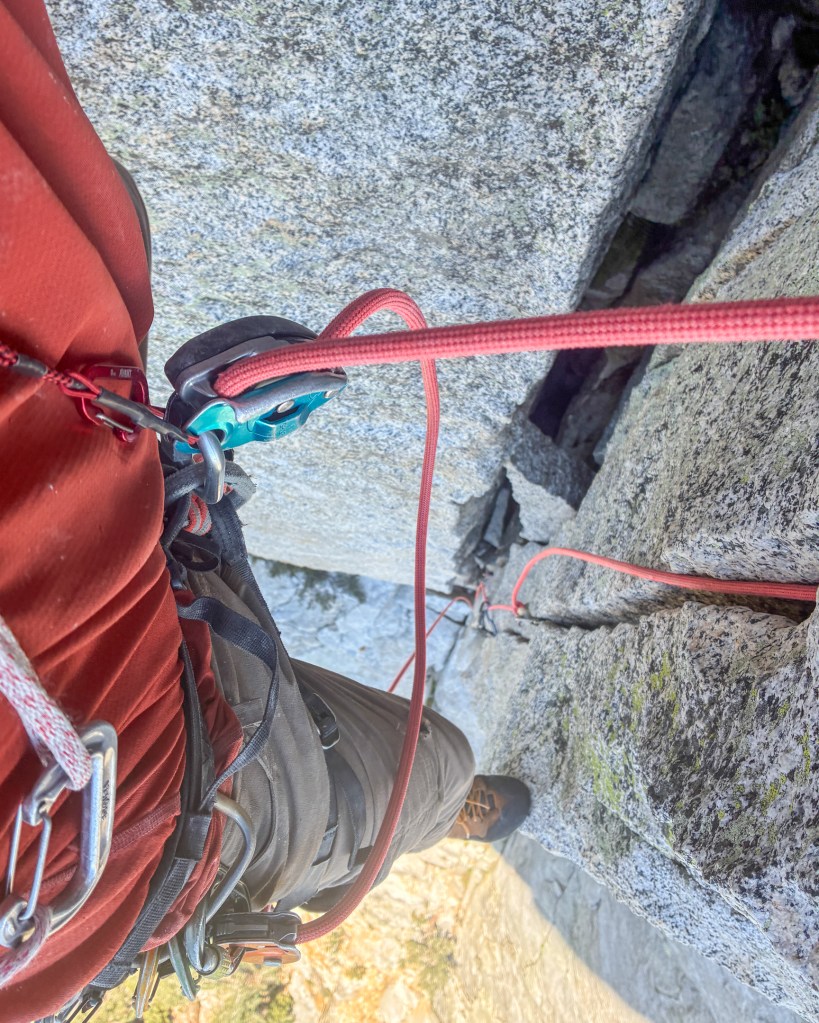
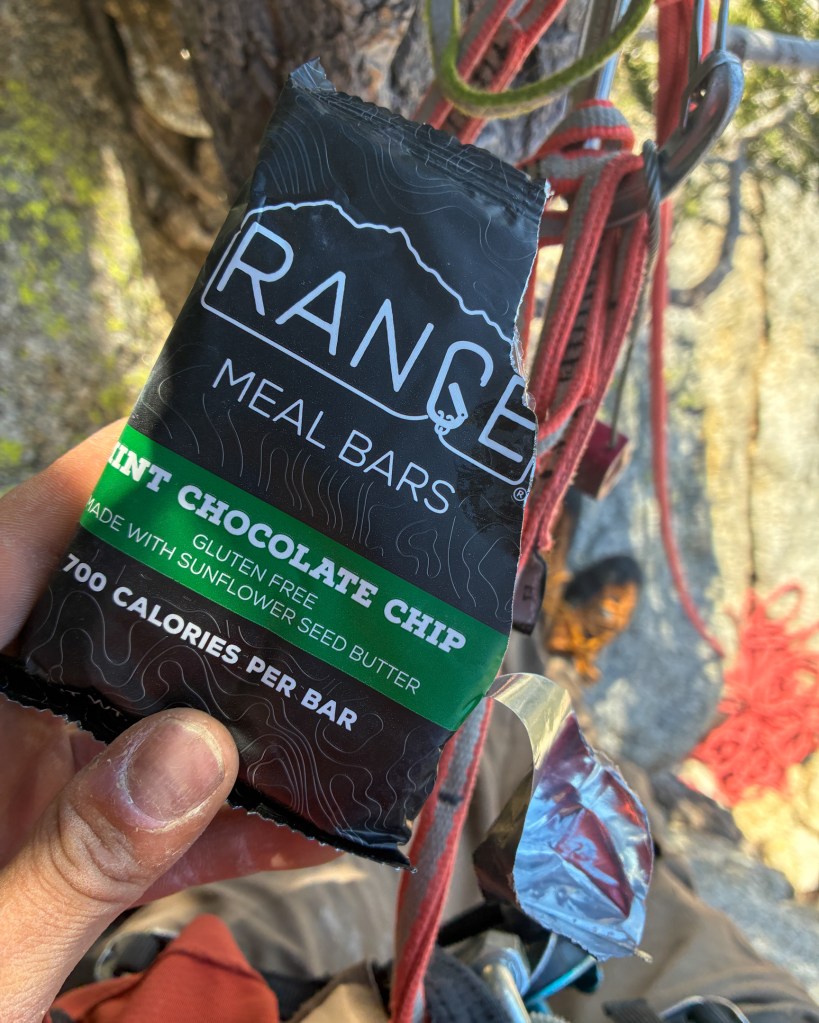
Pitch three was the unexpected sandbag I never saw coming, augmented by a scary off-route detour and poorly protected crux. Both the guidebook and Mountain Project for Tahquitz are remarkably inadequate and as such, straying from course, especially on nondescript moderate pitches, is commonplace. After exiting the Mummy Crack I moved to the “right crack system” as per the guidebook, seduced by a fixed cam in a square cut roof. Only after wagering my bacon on some dicy runout friction moves bypassing the roof did I realize I was conclusively questing through no man’s land. A deeper studying of online topos shows that continuing left of the roof, then moving right, is significantly easier. Higher I may have gotten off route again, climbing past a snapped angled piton into flaring tips jams before paddling left across a bold friction slab with poor feet. While following I moved left just below the piton with easier results. A final blocky overhang with captivating exposure capped yet another “epic for the grade” pitch. Luckily, pitch four was actually 5.7 and helped regain significant time. Pleasant banter with nearby climbers and a 700 calorie Range Meal Bar amped me for the crux, an awkward rounded layback around a v-shaped block protected by a micro-nut in a shallow flare – again, “only 5.8”, but plenty engaging for ninth pitch of the day. Pitches six and seven fell like dominoes, and before I knew it I was coiling ropes on the always awe inspiring Tahquitz summit.
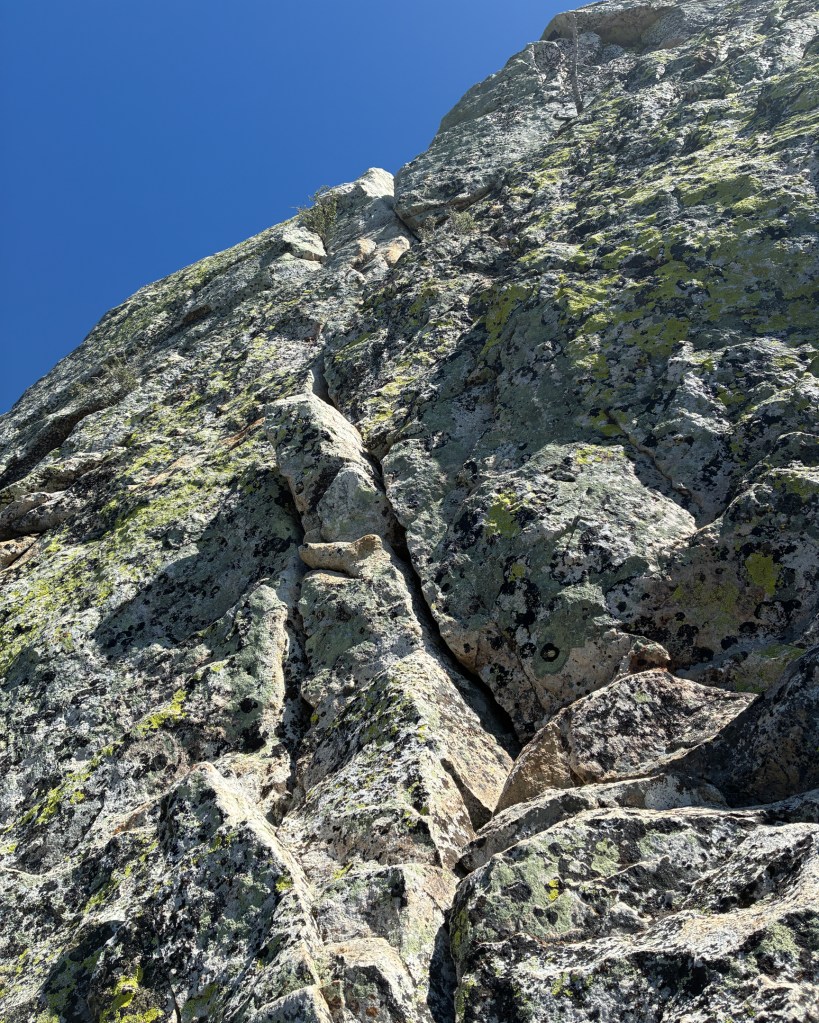
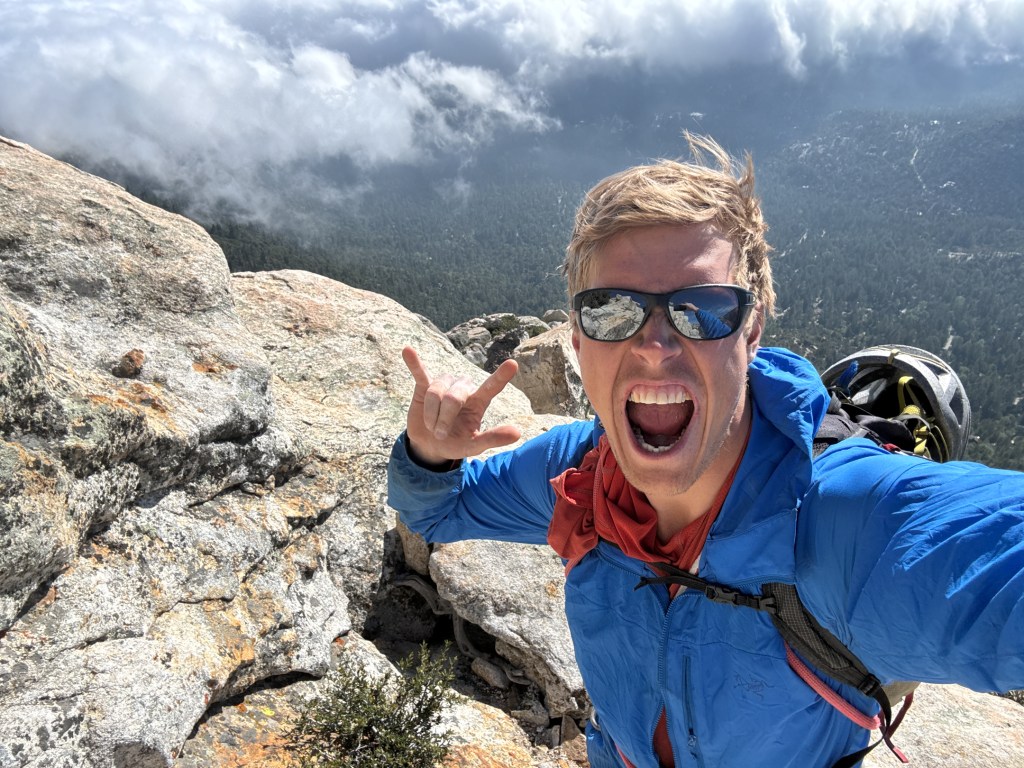
Six hours and thirty minutes from tie in to summit, 14 pitches and 800 vertical feet up to “Tahquitz 5.8” – not too shabby for my longest rope-solo and first 2026 granite multi-pitch. Halfway through pitch three, while committing to a tenuous friction sequence on flaring tips locks not certain if I was on route, I was convinced I hated rope soloing. While driving bleary eyed through dense fog down the winding Idyllwild road, I was jacked on stoke. Two hours later, well into night, I was downright wasted. And so it goes with rope-soloing – which I often joke is sometimes fun but more often lonely, scary and slightly depressing. I use those negative adjectives with exaggeration and jest, because there’s a reason I keep revisiting rope-soloing. Would I rather climb with a partner? Certainly. But rope-soloing facilitates a proper vertical adventure far beyond the grade and commitment level I would free solo. Plus, as a newly engaged gentleman, I am trying, albeit reluctantly, to ween off free soloing entirely. Blasting up the grandest face of Tahquitz by my lonesome – in constant motion while both free-climbing and managing complex systems, is rewarding. And when all goes smooth, a once fleeting rarity growing ever slightly more common – I experience a likewise feeling of transcendent mastery to ropelessness. As for The Long Climb – well, it’s a worthy adventure. The first pitch is one of the better 5.8 jam cracks I’ve climbed, the Mummy Crack is exceedingly unique, and the upper pitches have just enough character to keep overqualified climbers stimulated.
For the Rope Soloists
For climbers intrigued by rope-soloing, I made a few modifications to my rope-solo system and tactics. First off, I used a 10mm steel quick-link to attach the Gri-Gri to my belay loop. In the past I’ve had issues with carabiners cross-loading while leading. With the sharp corners of a steel quick link cross-loading was prevented, and a 10kn breaking strength in the extremely rare event of cross loading kept lingering fears at bay. Secondly, I did not entirely free climb every pitch on follow, which helped conserve energy. On the dangerous traversing slab of pitch three I simply jugged the bank slab to better holds, and on the pumpy Mummy Crack I rested on the rope once to de-pump. I employed these tactics not necessarily because I needed them on a route of this grade, but to set humble precedent for harder climbs to come. Lastly, I used back-up knots at the cruxes. Historically I’ve never used back up knots, but once had a close call with the Gri-Gri slipping the fun length of my cache loop on a low angle fall. Having a back up knot in the crux climbing, as well as climbing well below my ability level, somewhat mitigates this hazard.
Want to support? Consider a donation, subscribe, check out my Patreon page, or simply support our sponsors listed below.
Ten Thousand Too Far is generously supported by Icelantic Skis from Golden Colorado, Range Meal Bars, The High Route, Black Diamond Equipment and Barrels & Bins Natural Market.



enter your email to subscribe to new article updates
DISCLAIMER
Ski mountaineering, rock climbing, ice climbing and all other forms of mountain recreation are inherently dangerous. Should you decide to attempt anything you read about in this article, you are doing so at your own risk! This article is written to the best possible level of accuracy and detail, but I am only human – information could be presented wrong. Furthermore, conditions in the mountains are subject to change at any time. Ten Thousand Too Far and Brandon Wanthal are not liable for any actions or repercussions acted upon or suffered from the result of this article’s reading.

