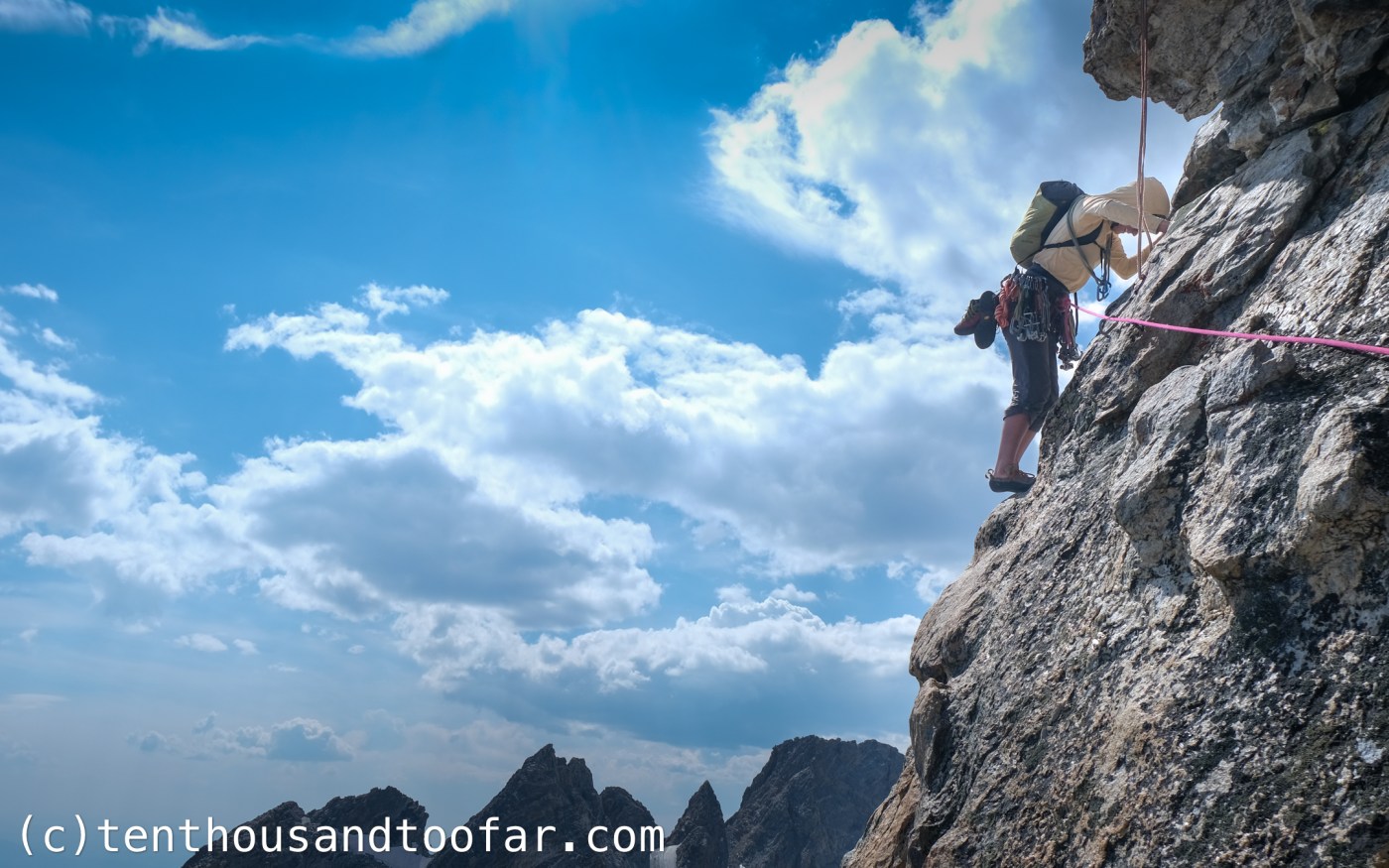
On September 8th, 2024, Bobbi Clemmer and I climbed the classic Southeast “Buckingham” Ridge on the 12,809 foot Middle Teton via an overnight camp in the South Fork of Garnet Canyon. It was Bobbi’s first time swinging leads on an alpine climb, at pretty darn high elevation no less.
The Buckingham Ridge can be heard alongside Irene’s Arete (5.8, III), East Ridge of Disappointment Peak (5.7, II), Direct South Ridge of Nez Perce (5.7+, III) and the Complete Exum Ridge (5.7, IV) when climbers postulate about the best moderate alpine climbs in Grand Teton National Park. Renowned for stellar rock quality and spectacular positioning on the upper reaches of the 12,809 foot Middle Teton, the third tallest peak in the Teton Range, I was told twelve times over not to overlook this gem. A few weeks earlier Bobbi climbed the Grand Teton via the Owen Spalding (5.4, II) to assist a friend completing the venerable Jackson Hole Picnic (a quick Google search will reveal all you need to know about this masochistic, unofficial, local’s triathlon). It was her first time roped alpine climbing without me, and she made great work of a few ice-clad 5.4 pitches on the tallest peak of the range. The adventure empowered her with a desire to swing leads on a more difficult alpine route – something long and adventurous we hadn’t climbed before. While Bobbi has led plenty of sport and traditional climbs, up to 5.10a and 5.8 respectively, onsight alpine climbing has always brought a road block. Several times she has casted off on pitches only to be stymied by the typical unnerving perils of big mountain stone – route finding issues, poor rock quality, unforecasted runouts, sandbagging and the like. On Buckingham she aimed to flip the script – not merely leading a few select pitches, but properly “swinging leads” – pitch for pitch – with her man. A perfect weather forecast entered the hopper and we were all systems go.
Love Ten Thousand Too Far? Support independent mountain journalism with $5.10 per month through Patreon (and receive extra bonus content), or with a one-time donation. Any and all support is greatly appreciated.

For prospective climbers, a detailed pitch for pitch topo and mini-guide, and a topo for the approach, can be found my Patreon page. Click this link: https://www.patreon.com/tenthousandtoofar/shop/buckingham-ridge-5-7-iii-topo-mini-guide-443036?source=storefront
While the Buckingham Ridge falls easily into our single-day-strike category, we decided to savor summer and score a Saturday afternoon workout by hiking camp into the South Fork of Garnet Canyon. We left the lot at 6:00PM and reached our bivy site just above the Cave Couloir at 9:30, approximately 10,400 feet. The night was surprisingly warm, leaving me resentful of a negative nine degree sleeping bag but grateful for clear skies which allowed an airy, cooler, cowboy camp beneath the stars. In typical mountain fashion we broke camp about one hour late – sprouted whole wheat bagels, peanut butter and jet black organic coffee – and set to work towards the Middle Teton by 8:00AM.
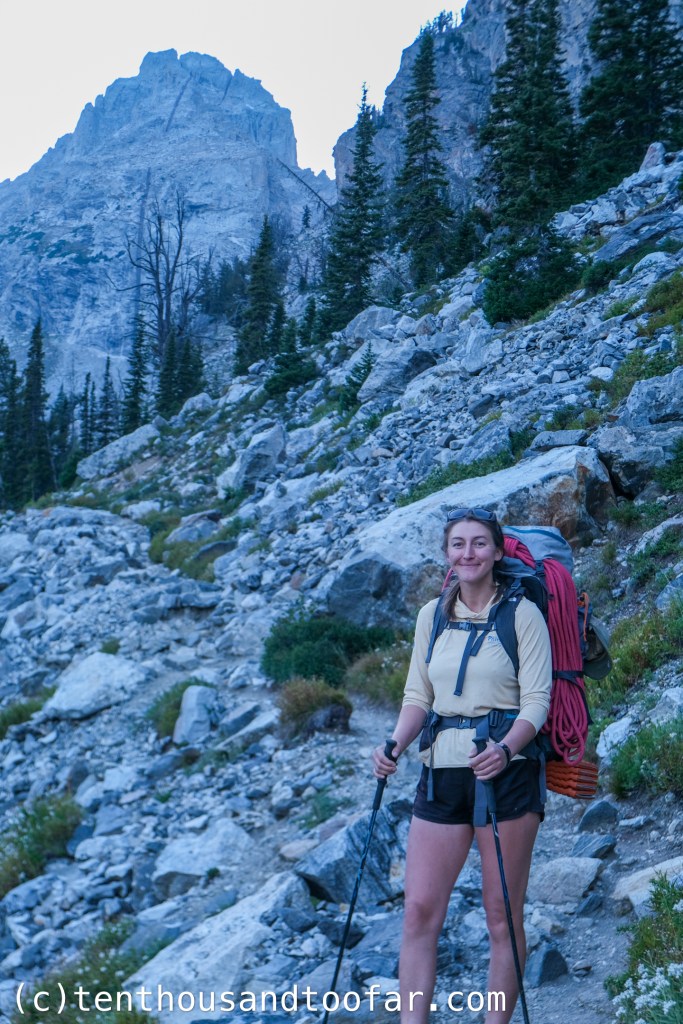


Having climbed the Chouinard Ridge (5.5, II) a few weeks ago, the next ridge west, I naively forwent detailed research of the Buckingham and assumed our “climb of at least seven leads” would simply begin at the confluence of the Ellingwood and Chouinard Couloirs on the lowest rib of exposed rock, as did my previous adventure. It wasn’t until I studied a guidebook picture at the base of the commanding Ellingwood I realized we were about to engage in some 1000 feet of scrambling in a dramatic, steep, choss-strewn gully just to reach the base of our “Grade III” climb. In 2022 I enjoyed a deep powder solo ski descent of the Ellingwood, remembering a glorious and unrelenting onsalught of sustained 50 degree turns above energizing exposure – today would be different. Without snow the Ellingwood is characterized by punishing steep kitty litter bisected with a half-dozen snow-polished headwalls of steep, bullet hard, alpine granite reminiscent of that found in Teton Canyon, offering pleasant soloing up to 5.5 in difficulty. At a few vertical cruxes I half expected Bobbi to call for the cord – not that there would have been many places for me to construct a safe anchor – but she dispatched the devil’s work with smiles and a calm demeanor. We began our climb at 11:30, two whole hours after leaving the South Fork, at the eastmost edge of the prominent south-facing triangular buttress – approximately 11,800 feet. The sun was shining, vibes high and looming pitches of golden granite looking mighty fine.

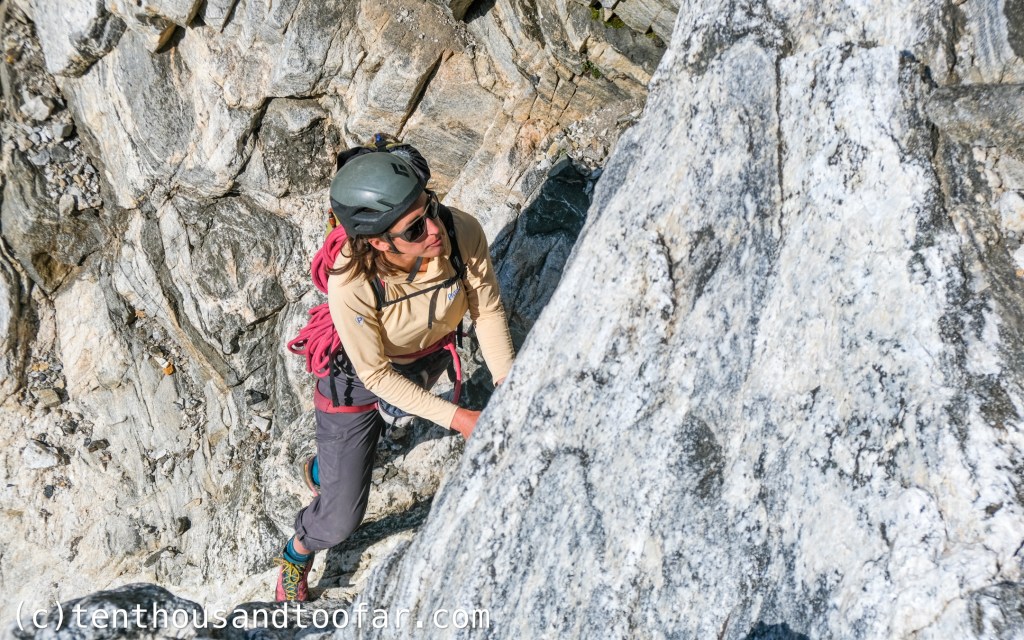

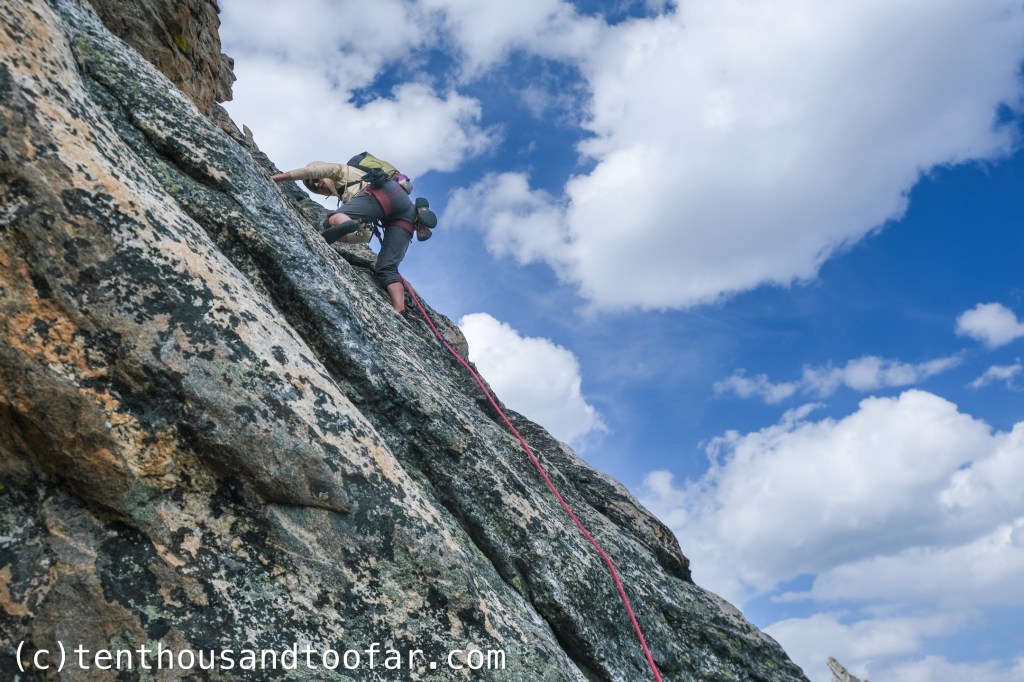
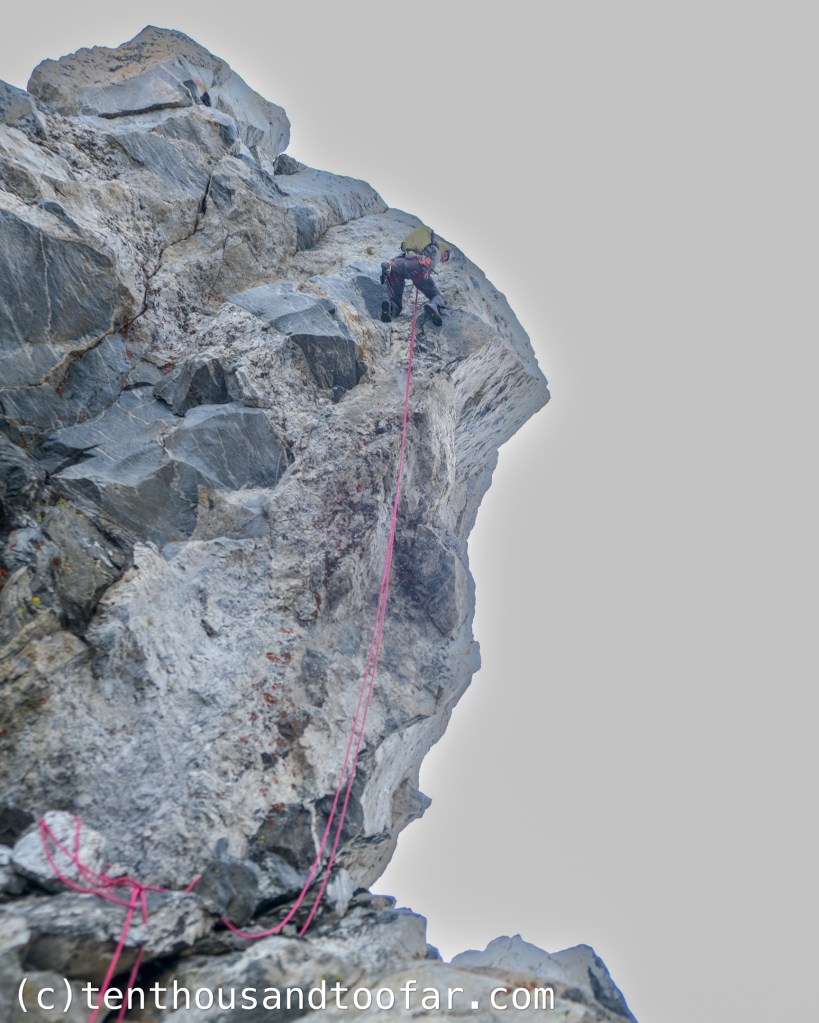
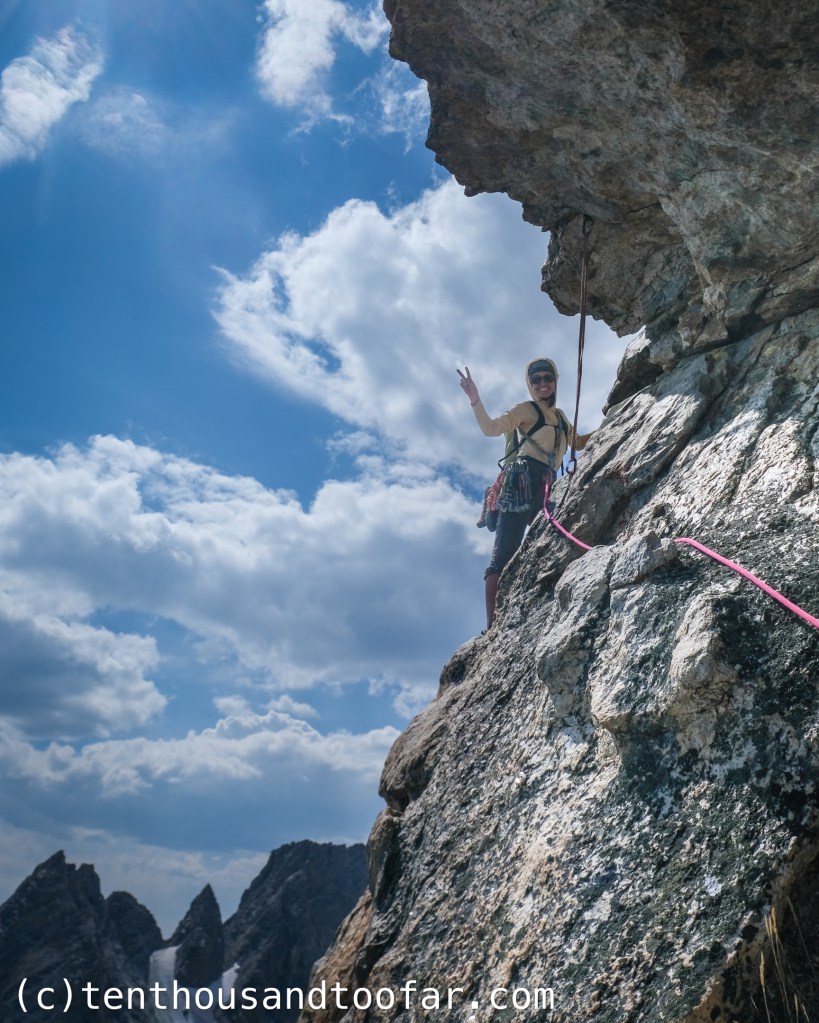
The existing topos and route descriptions available for the extremely featured and broad Buckingham Ridge are loose and open to interpretation, utilizing prominent and well spaced landmarks for orientation. We began with three 50 meter leads on either side of the broad southeast ridge, using a jutting roof with a gaping wide crack visible for the past few hours as our north star. The rock on these pitches was of slab, crack and flake nature, granite of golden varnish with intruding crystals and coarse texture – City of Rocks in the sky. Originally we’d planned our pitches so I would take the crux, an exposed overhang with a fixed piton on the aforementioned roof, but the alpine gods fated it to Bobbi – my third lead ended a stone’s throw from the piton. As I belayed her up I was almost certain she’d insist on me taking the roof pitch – the exposure was real – but as she evaluated the assignment I could tell she was steadfast on completing her mental mission. The Alpine Peanut was here to swing leads – no bail outs – roof pulls at 12000 feet be damned.


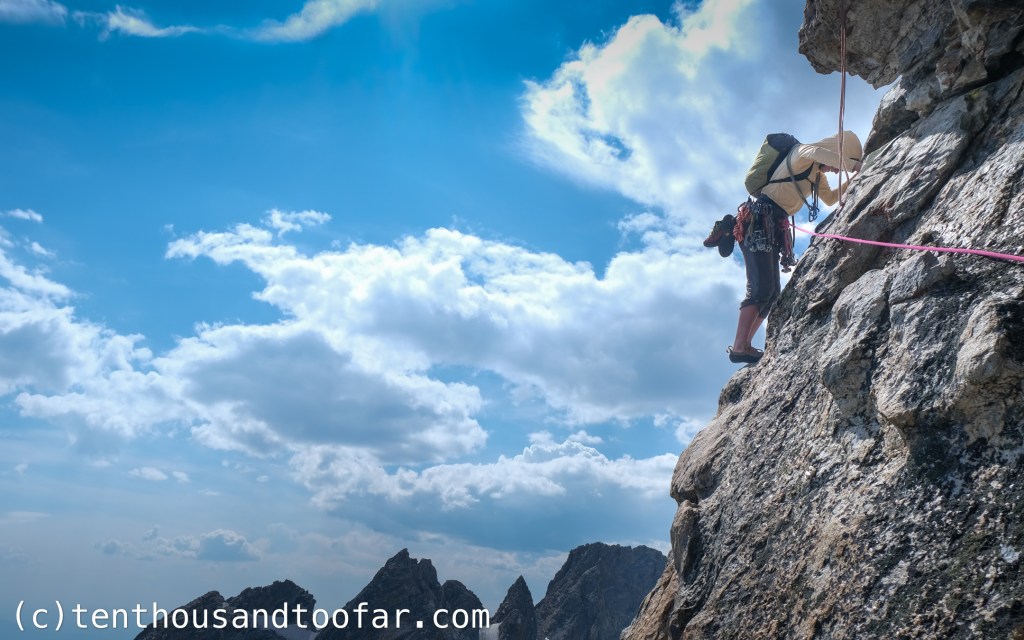
Watching Bobbi lead out and around the roof, clipping a sole fixed pin from the 1950’s with a double length runner, committing to a delicate slab traverse, exclaiming “I’ve got a good piece” and surging to the sky on chickenheads against a remarkable backdrop of the west Tetons stretching far below, eventually disappearing from sight, sent shivers down my spine. She was doing it! After years of bowing to apprehension the grasshopper had broken free, properly onsighting in big mountain terrain. The moves around this roof were no joke, a bit thoughtful for the grade, and while the maneuvers themselves felt trivial, the positioning, thousands of feet above the South Fork, was rattling. This fourth lead surmounted our first of two towers which needed to be negotiated. We bypassed a fixed rappel and down-climbed fourth class terrain into the notch separating the pitch four tower from the continuing ridge, then followed with what we deemed the crux, a long pitch up steep 5.7 blocks and cracks that eventually traverses the east face of a second tower into another prominent notch. The moves entering this second notch were precarious for the leader, following a rail of sloping holds and flared cracks, traversing diagonally downward, with much swing and rope abrasion potential – perhaps there is a better way. Bobbi ran our sixth lead through a sparsely protected 5.7 mantle, another slab traverse onto the east face and up a long, easy, 5.4-ish dihedral/chimney system, and I punched an easy solo up fourth class slabs to the broad, snow covered through mid-season, talus bench underpinning the final 200 foot crown of the Middle Teton’s South Summit.

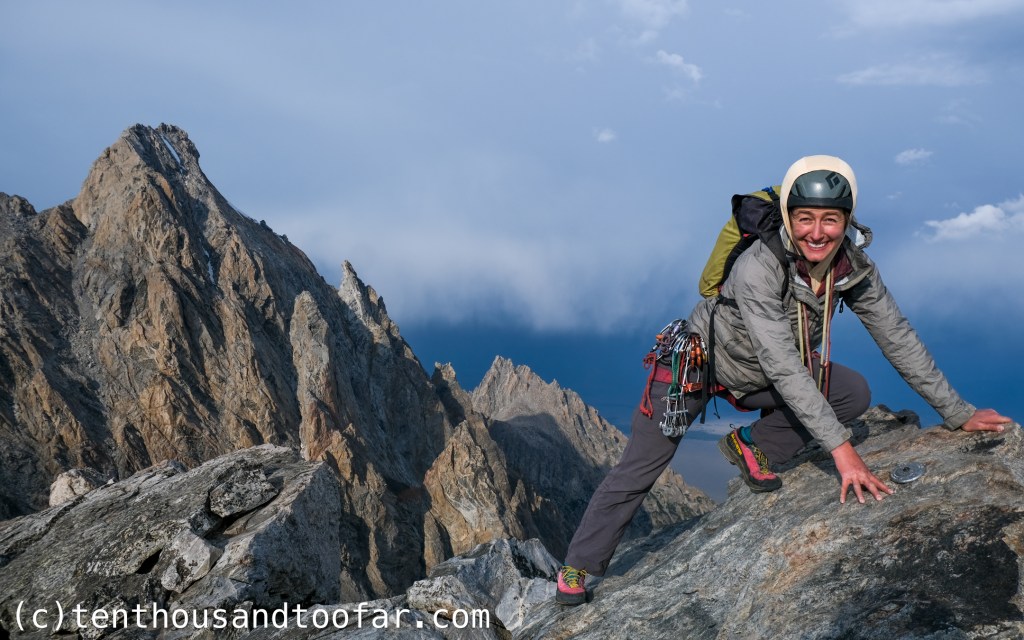
Our original intentions, before having a lazy morning and losing a whopping two hours to the Ellingwood Couloir, was to try the “South Chimney Finish” – an aesthetic variation which adds 2-3 pitches of 5.8/5.9 on the direct crest – however, in typical Teton fashion we were behind schedule and unforecasted dark clouds were beginning to build. While I was leading the final roped pitch on the traditional route, dealer’s choice of two low-angle chimneys on the east side of the ridge, thunder echoed. I soloed the remainder of the chimney with ferocity, draped the rope around a flake for a speedy belay, changed into tennies and called court with Peanut. After a few minutes of no thunder we decided to punch it up and over the South Summit, completing two short rappels into the notch separating the South from the main summit as a few sustained curtains of driving snow lashed from the west, and finished with a final pitch up fractured wet slabs to a 5:30 summit. Fittingly and magically, Bobbi scored the last lead while the clouds reverted back to bluebird crimsons of early alpine autumn. 12,809 feet baby!

As we skipped down the familiar Southwest Couloir, trying to make up every minute we could, we realized the obvious – we were in for a long night. Had we not a camp to deconstruct we could’ve jogged out Garnet Canyon by nightfall, but tonight we would pay our high camp luxury tax. We settled in to a humble dinner of local cheese, seed crackers and honeycrisp apples as darkness overtook the sky, and plodded to the car by 11:00PM with heavy packs tearing our shoulders and knees to smithereens. Much like every other time we’ve decided to camp in the alpine we resolved never to do a 24 hour strike with a tent again. Our new rule is stated here: Unless we have a full day to approach and a full day to descend, we will never carry a tent for an alpine climbing objective above 11,000 feet. A few years ago the shlep made more sense, we were worse endurance athletes and slower climbers, but times have changed – better off waking early in a cozy bed, doubling down on coffee and getting a predawn launch. As for Bobbi – this adventure was a huge milestone. Not only did she swing leads pitch for pitch on a ten pitch route at 12,000 feet, but also climbed efficiently – placing only the requisite amount of protection for her ability, building fast belays, making concise route finding decisions and assisting with speedy transitions. Lastly, while the Buckingham Ridge might deserve a seat next to Irene’s and the Complete Exum Ridge in terms of rock quality and positioning, there are some notable differences. While the climbing is memorable and the rock quality unjustifiably excellent, the lengthy technical approach, remote setting, lack of fixed gear, route finding intensive middle pitches and abundance of alpine obstacles – towers, notches, ledges and jumbled ridges where belays need to be shifted and moving simultaneously is rewarded – makes the Buckingham a more involved and less straightforward outing than other classics at the grade. If desiring of a comparison, the Direct South Ridge of Nez Perce comes to mind. Rather than quintessential multi-pitch alpine climbing, I think of this route as a four-star moderate adventure climb. In my opinion, the Grade III designation only applies when the Ellingwood Couloir is in full snow condition, which would entail steep but expedient 50 degree front pointing. In dry condition, prolonged and tedious fifth class rock solidify an easy Grade IV stamp. If unwilling to solo brief pitches of highly exposed fourth and low-fifth class stone, the Buckingham could quickly become a 15+ pitch endeavor. The Ortenburger-Jackson guide briefly mentions an alternative approach via the exposed rock rib west of the Ellingwood, which has equal capacity to provide fluidity or complexity – perhaps we’ll find out next time. All in all this was a very pleasant outing with the highest standard of company, a seminal climb for the Alpine Peanut and a perfect cap – save for a freak warm spell – to another fruitful high-alpine climbing season.
Want to support? Consider a donation, subscribe, or simply support our sponsors listed below.
Ten Thousand Too Far is generously supported by Icelantic Skis from Golden Colorado, Range Meal Bars, The High Route, Black Diamond Equipment and Barrels & Bins Natural Market.





enter your email to subscribe to new article updates
DISCLAIMER
Ski mountaineering, rock climbing, ice climbing and all other forms of mountain recreation are inherently dangerous. Should you decide to attempt anything you read about in this article, you are doing so at your own risk! This article is written to the best possible level of accuracy and detail, but I am only human – information could be presented wrong. Furthermore, conditions in the mountains are subject to change at any time. Ten Thousand Too Far and Brandon Wanthal are not liable for any actions or repercussions acted upon or suffered from the result of this article’s reading.
 Ten Thousand Too Far
LOVE this one!! Go Bobbi go! What a crusher.
LikeLike
Thought you might like this one. A crusher indeed!
LikeLiked by 1 person