
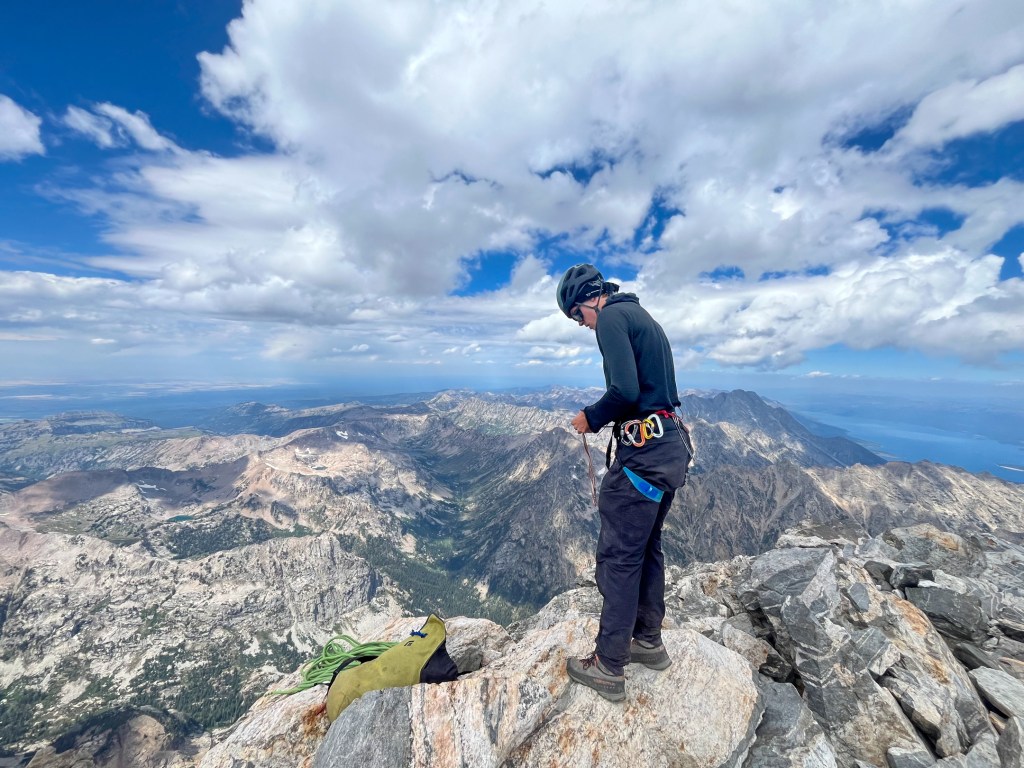
On August 15th Drew Grasso and I scurried the Upper Exum Ridge (5.5, II) for his first, and my thirteenth, Grand Teton summit. This was my third time on the route, but only the second with a rope. On this day we aimed to find the perfect balance between minimalism and security for a roped ascent. Here lies an exceedingly nerdy article oriented towards climbers, detailing our light rack and specific techniques for moving through this notoriously long 1000′ route with a short 30 meter rope.
The Upper Exum Ridge (UXM) is the uber-classic moderate on the Grand Teton, climbed by thousands every year, and therefor an overwhelming amount of information is available for any aspiring climbers. My first time on the UXM was solo in 2021, where I carried little more than rock shoes and a chalk bag. My second time was after climbing the Durrance Direct (5.7, III) with Bobbi Clemmer, which when linked with the UXM forms the world famous, 1700 foot, Complete Exum Ridge (5.7, IV). On that outing we had a full rock rack and 60 meter ropes from the Durrance, and simul-climbed most fifth class terrain after an afternoon electrical storm soaked the upper mountain and pesky lingering ice lurked in recesses. To avoid adding static to the collective we’ll begin our journey at Wall Street and focus primarily on the tactics I used as the leader of a rope team willing to solo the route, partnered with an endurance scrambling machine that devours fourth class for breakfast, yet was desiring of a rope for fifth-class business. On this journey we would be splitting the difference between my previous two UXM outings, aiming to strike the perfect balance between minimalism and security for a light-and-fast roped ascent.
Love Ten Thousand Too Far? Support independent mountain journalism with $5.10 per month through Patreon (and receive extra bonus content), or with a one-time donation. Any and all support is greatly appreciated.

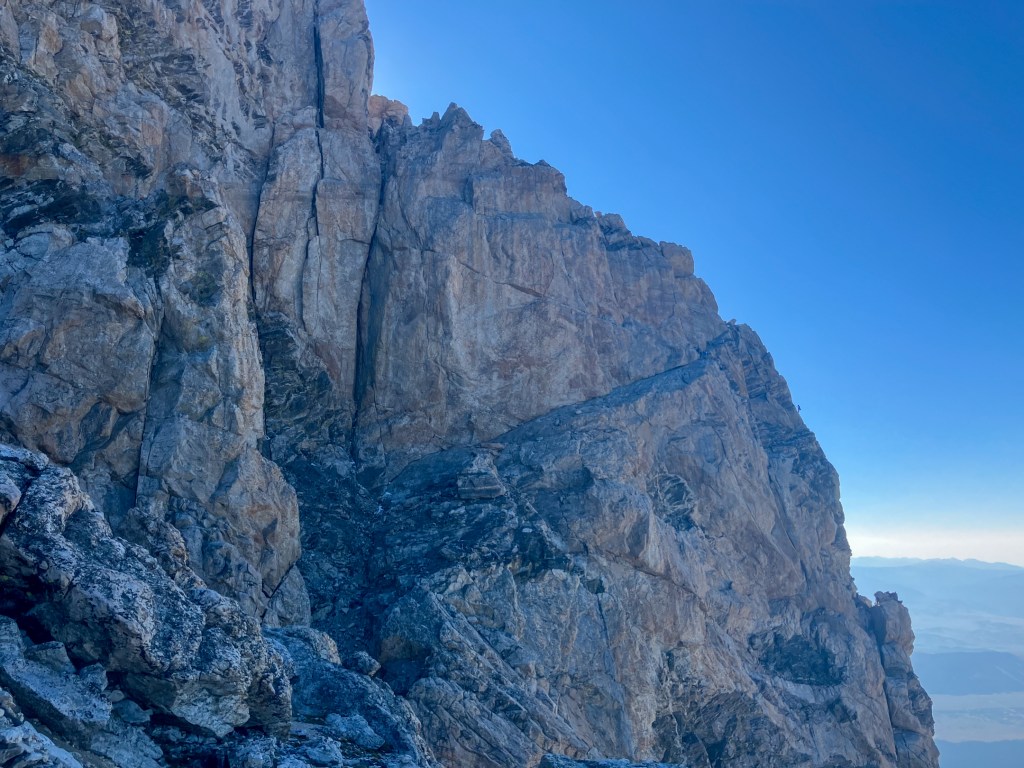
A week before launch I consulted a long time friend, partner and tenured EXUM guide who has been working on the Grand Teton for god know’s how long, almost certainly logging hundreds of ascents. I asked him how he, and guides in general, go about protecting clients on this committing, 1000 foot, 5.5 route in any way, shape or semblance of efficiency. Though providing the second “easiest” passage to the 13,775 foot summit and boasting an extremely moderate difficulty grade in the grand scheme of rock climbing, one scan of internet forums will reveal just how notorious the Upper Exum Ridge is for devouring the time of, and often benighting, unknowing parties expecting a standard multi-pitch rock climbing affair. Rather than traditional pitched climbing the UXM is a classic alpine mountaineering adventure, with short fifth-class difficulties interspersed by long stretches of third and fourth class terrain. On paper this may sound easier than negotiating sustained pitches, yet because the path of least resistance is far from linear, navigating a metaphorical sea of dizzying alpine obstacles while dancing on either side of an enormous and heavily featured alpine ridge, the time of roped parties is often lost transitioning between scrambling and roped climbing – coiling and uncoiling the rope, building and deconstructing formal belays and exchanging hardware between the dozen or more commonly belayed bits of fifth class climbing. In other words, the UXM is quintessential “guide” terrain, where fast and light tactics combined with competency in exposed roped scrambling techniques – terrain belaying, short-roping, simul-climbing and the like – are rewarded. If a poor soul was to formally “pitch out” this entire route they cloud be looking at twenty pitches or worse. In my opinion, UXM’s Grade II designation assumes parties are moving unroped or simultaneously for the bulk of the route.

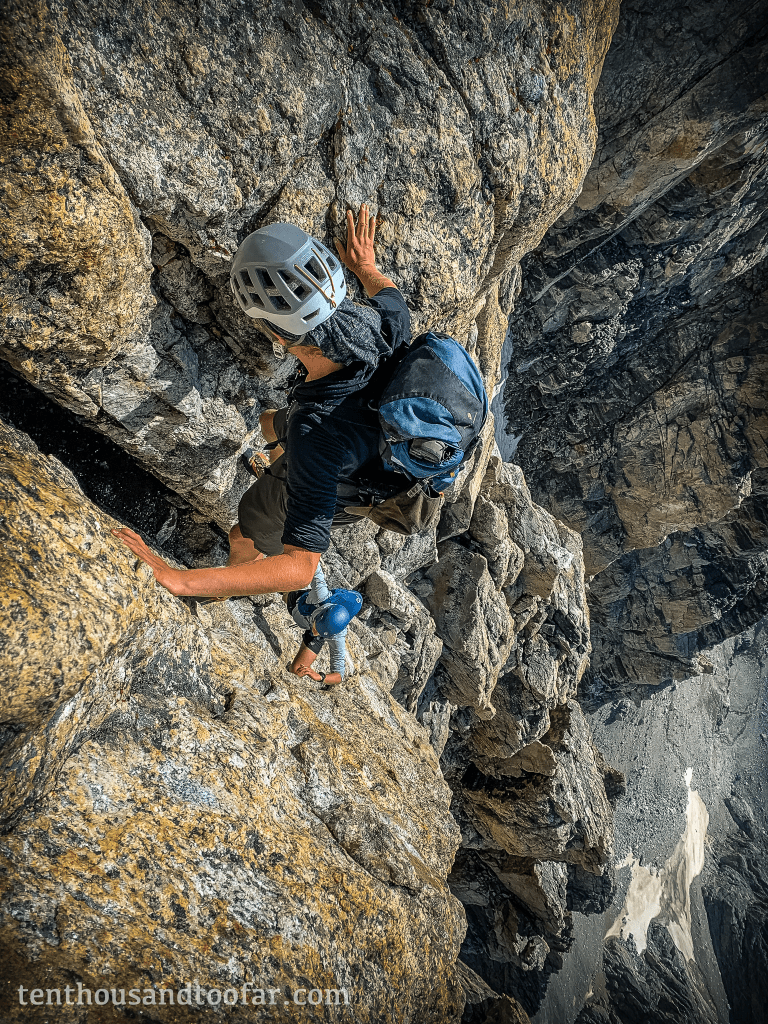

Usually 5.5 rockwork falls into my ropeless wheelhouse, so many of the aforementioned mountaineering rope techniques are unpolished tools in my arsenal. My guide friend generously left an extended voice message of how he works the route with a single #2 Camalot and 30M rope – that’s right, a single #2 Camalot – no nuts, slings or other lead protection, utilizing specific belay locations and terrain features he’s identified and memorized over decades. While ripping up the 6000 foot UXM approach with a 30M rope and single piece of lead protection sounded nothing but dreamy for my knees, I quickly realized that traveling so light could actually hinder our pace if I were unable to efficiently locate suitable terrain belay features and/or the specific placements for my sole camming device. Instead I opted to use his rope beta – a scant 30 meters – but freestyle my own light rack: two cams (#1 and #2), two medium tricams, four nuts and four slings (two 60cm, one 120cm, one 180 cm). Originally I postulated using a thinner rope, a single 7.5mm half rope or even 6mm Edelrid Rap Line, but was urged towards cutting weight via rope length rather than diameter because of abrasion risk on the famed Wall Street Step Across pitch, a shady and polished 5.5 slab traverse with meager protection to reach the ridge. (It should be noted that the aforementioned ropes are NOT rated for lead climbing on a single strand. I have chosen (at times) to defy manufacturer recommendations by leading specific routes on such ropes, but this is dangerous, not standard practice, and should only, if ever, be considered after learning the limiting safety factors of skinny ropes). As a result we opted to keep it UIAA certified and roll with a 30 meter, 8.7mm, fully rated lead line. Other load lightening elements of our kit included ski mountaineering bikini harnesses (also not certified for lead rock climbing, but in my opinion “super strong enough”), approach shoes and no chalk. Let’s get on with the climbing.
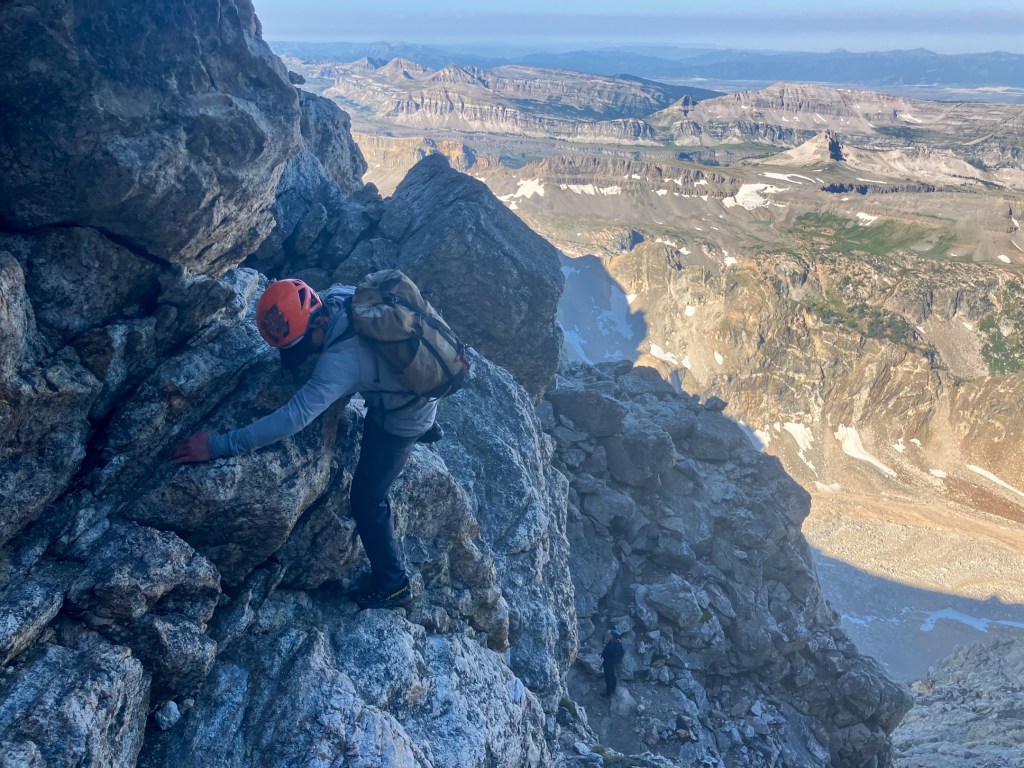
The brief footnotes of our approach included perfect late-summer weather and about five hours of steady yet mellow uphill marching. We reached Wall Street around 10:00AM and waited for two rope teams to clear the Step Across. We began climbing around 10:45 and reached the summit around 2.5 hours later, passing two parties and beating a brief pulse of afternoon thunder snow. Our lead system worked just about perfectly, with the 30 meter rope allowing access to comfortable belays on every pitch besides the V-Pitch (we did about five meters of simul-climbing). I was happy to have a brought a few pieces of extra hardware, for in a few places it felt more efficient build a quick two piece anchor than search around for a suitable natural belay. Additionally, a proper lead rack allowed us to bypass the Golden Staircase via a 5.6 crack to the east when we encountered a two party traffic jam, and be less discerning about sniffing the easiest path through the Double Cracks area which proved again to be quite confusing. I also appreciated a formal belay and lead protection on the “Awkward Left Leaning Crack” above the V-Pitch, where I once again encountered some ice in the always unpleasantly weird slot. Basically, a light rack allowed us to travel fluidly with less problem solving for a very small weight penalty. In full we belayed 11 pitches which I will list formally below, and scrambled with a scant 15 meters between us on all the intermediate terrain. I placed minimal or no lead protection every pitch. The majority of my belays were natural belays (draping the rope around boulders or over ridges), seated harness belays or slung features, often combined with a munter hitch for added friction. Because the UXM is generally low angle with many large ledges we rarely needed to formally anchor the belayer. In the proceeding days I talked with another tenured EXUM guide about my UXM experience and their preferred guiding method. He also leads on a 30 meter rope, yet uses five ultralight cams (#0.4 through #2) and no nuts, hexes or tri-cams. His reason for ditching the passive gear centered around the time it takes his clients to remove the protection, stating the obvious fact that cams are easier and more intuitive to both place and remove for newer climbers. Next time I end up on the UXM with a less experienced party I will certainly be trying this strategy – I doubt the weight difference would be significant. In an ideal world I would substitute the 30 meter rope for something five or ten meters longer, but another option would be to simply skip the V-Pitch altogether via the Unseold’s Lieback variation which would almost certainly be shorter. While we’re on the full nerd-train it’s also worth noting that 30 meters rope is insufficient for the traditional Owen-Spalding descent rappels. We carried a Beal Escaper which would have allowed us to rappel on a single 30 meter retrievable strand, but as common on the Grand Teton ran into multiple other parties who simply unclipped and dropped our rope down for us. All in all we cleared the ridge about as efficiently as I ever could’ve dreamed, for my thirteenth, and partner’s first, Grand Teton summit. Dream time in the high alpine.
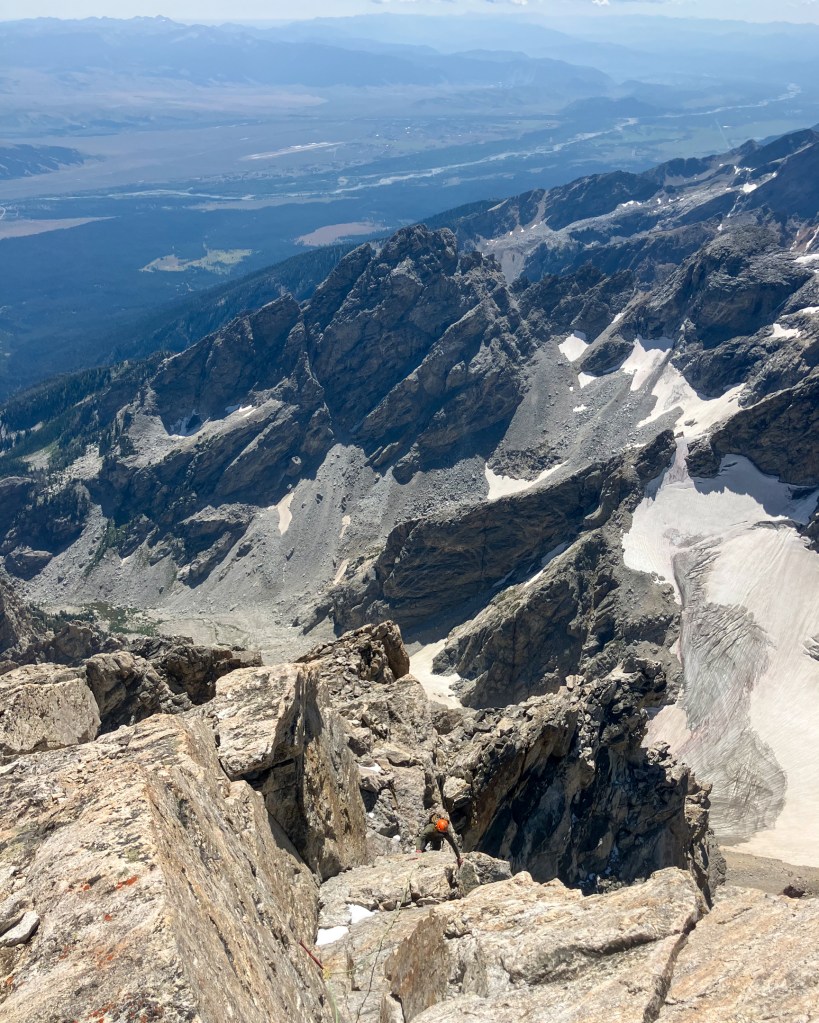

Hopefully this article provided some useful insight to parties desiring of light and fast roped ascents on the Upper Exum Ridge. I put a lot of thought into planning this specific trip and climbing strategy, so it seemed only logical somebody else could benefit from this write up. If desiring of more specific information on the Upper Exum Ridge, consult my other two articles on Ten Thousand Too Far, Google or any Teton climbing guidebook. If this information was useful to your ascent, please consider subscribing, dropping a comment or even leaving a small donation of appreciation using the link provided below.
Want to support? Consider a donation, subscribe, or simply support our sponsors listed below.
Ten Thousand Too Far is generously supported by Icelantic Skis from Golden Colorado, Range Meal Bars, The High Route, Black Diamond Equipment and Barrels & Bins Natural Market.





enter your email to subscribe to new article updates
DISCLAIMER
Ski mountaineering, rock climbing, ice climbing and all other forms of mountain recreation are inherently dangerous. Should you decide to attempt anything you read about in this article, you are doing so at your own risk! This article is written to the best possible level of accuracy and detail, but I am only human – information could be presented wrong. Furthermore, conditions in the mountains are subject to change at any time. Ten Thousand Too Far and Brandon Wanthal are not liable for any actions or repercussions acted upon or suffered from the result of this article’s reading
 Ten Thousand Too Far
Leave a comment