
On Saturday July 13th Bobbi Clemmer and I attempted a Cloudveil Traverse, a classic seven peak link up following the skyline ridge connecting the South Teton to Nez Perce. Due to a few unexpected steep snow crossings and a critical route finding mistake by your’s truly we were forced to retreat 150 feet from the summit of the final peak.
The Cloudveil Traverse is a linkup of seven peaks following the geologic extension of the South Teton’s East Ridge to it’s terminus at Nez Perce. The traverse begins at the South Teton (12,519′), climbing the Ice Cream Cone (12,400′), Unnamed Blob, Gilkey Tower (12,320′), Spalding Peak (12,240′), Cloudveil Dome (12,026′) and Nez Perce (11,906′). The route features a seemingly endless amount of 4th and low-5th class climbing on a remarkably exposed ridge network, and one formal 40 meter pitch of 5.6 rock climbing on the West Face of the Ice Cream Cone. According to a SummitPost article the route contains approximately 8000 feet of elevation gain. We attempted something of a Cloudveil Traverse two years ago, the day after climbing the 3000 foot Dike Route (5.6, IV) on the Dike Pinnacle, with continuation to the summit of the Middle Teton via the East Face (5.4, II). We slept in the South Fork of Garnet Canyon and made our bid for the traverse the following day, but fatigue combined with an early thunderstorm assault rushed us back to terra firma from the summit of the Ice Cream Cone. Today we aimed to travel light, move swiftly and complete the traverse car-to-car. The weather was totally splitter and the vibes high. Plus, we were better climbers. We kinda thought we had it in the bag.
Love Ten Thousand Too Far? Support independent mountain journalism with $5.10 per month through Patreon (and receive extra bonus content), or with a one-time donation. Any and all support is greatly appreciated.

A pitch by pitch topo and mini-guide for the Cloudveil Traverse, and topo of the West Face of the Ice Cream Cone, can be found at: https://www.patreon.com/tenthousandtoofar/shop/cloudveil-traverse-5-6-iv-topo-mini-444132?source=storefront
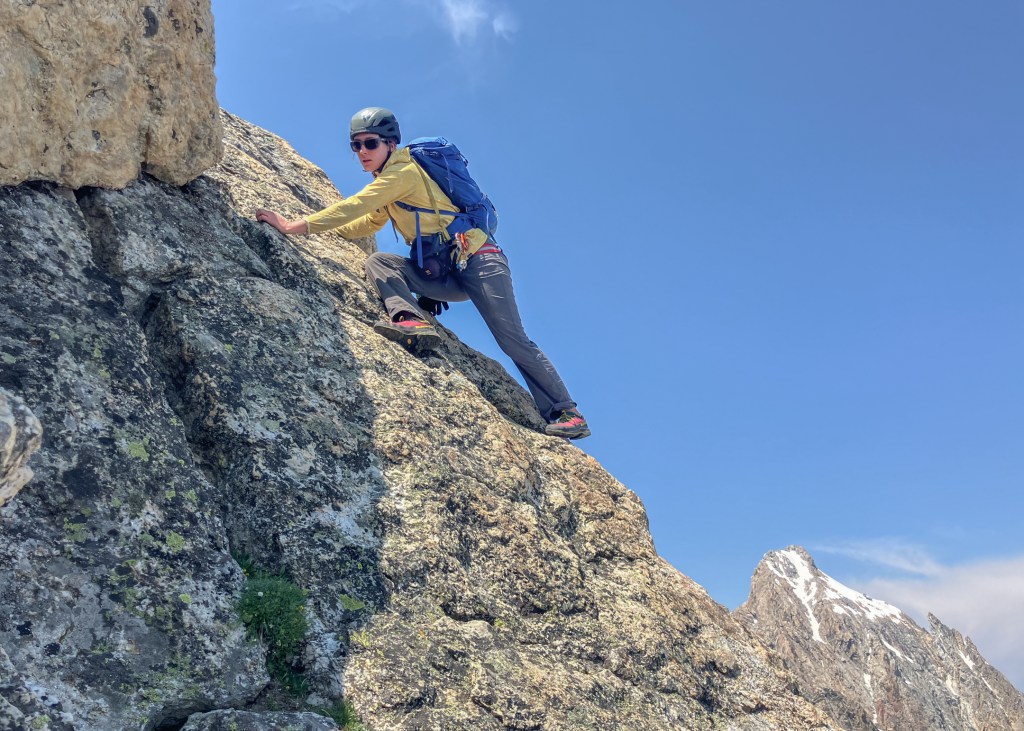
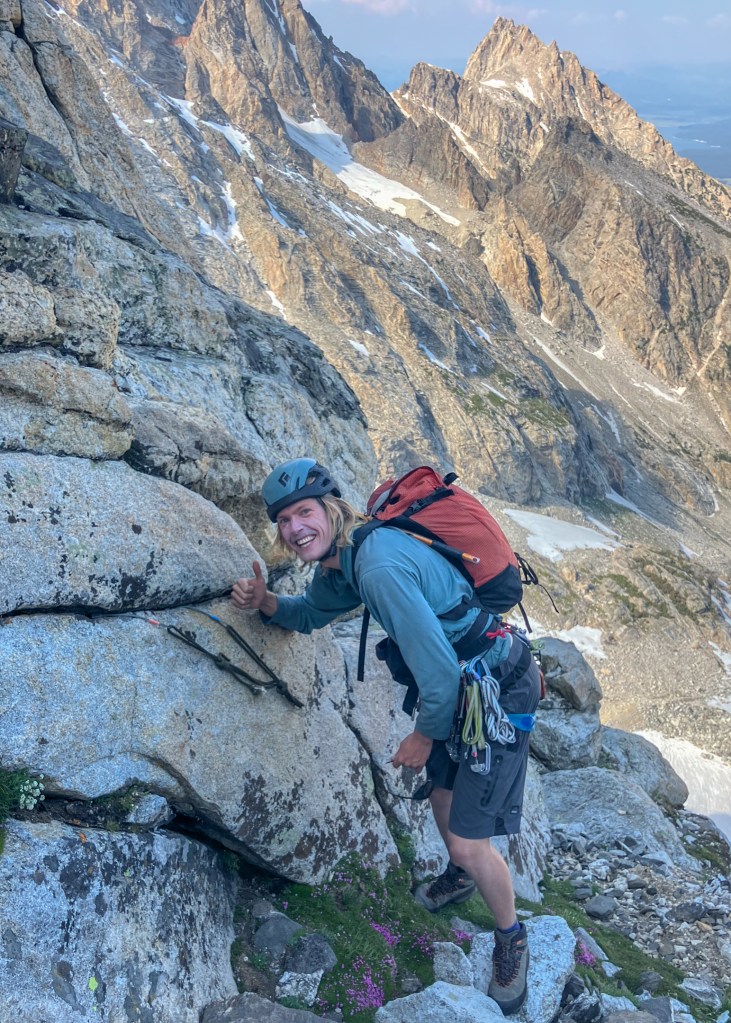
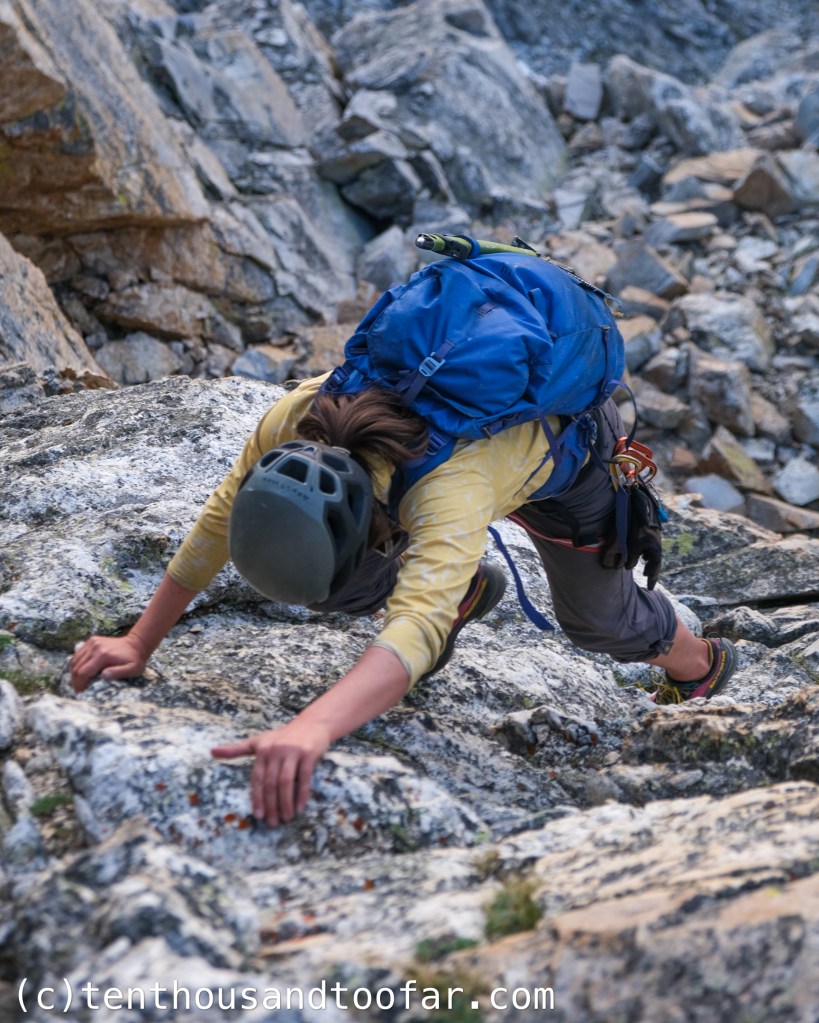
We conveniently intersected with two friends at the Lupine Meadows Trailhead, so we approached the Meadows as a conversation filled team of four. They were headed to attempt the Gold Face (5.10-, III) on the Grand Teton, a valiant goal, and we bid them adieu at the confluence of the North and South Forks. A few pesky snowfields in the South Fork, and some surprise high winds coupled with dark clouds that forced us to meticulously check weather multiple times, delayed our South Teton summit time until approximately noon, some five hours after leaving the car. We encountered our first technical terrain down-climbing the East Ridge of the South Teton (4.0), and stayed engaged with steady exposed scrambling of at least fourth class for the next few hours. We climbed the West Face of the Ice Cream Cone (5.6) in approach shoes with a single 35m, 7.7mm half-rope and light alpine rack of five cams, five nuts, one tri-cam, four 60cm alpine draws and two 60cm shoulder slings. Once again, both Bobbi and I marveled about how incredibly loose and steep the West Face looks from the summit of the South, juxtaposed against how solid the rock, and manageable the climbing, actually is. We made quick work down the gentler East Ridge of the Ice Cream Cone (4.0) and over the Unnamed Blob (4.0) until hitting a steeper step on the West Ridge of Gilkey’s Tower. In my opinion this step registered in the low-5th class range, and I was incredibly impressed by Bobbi’s ability to calmly negotiate a body length or two of vertical climbing with multi-thousand foot free fall potential. A foot pop here provides an express shuttle to Lake Taminah, and I certainly felt the air. No more than 100 feet higher Gilkey’s threw another curveball, a knife’s edge false summit where a lone shiny bolt with rappel rings, presumably upkept by local guides, will be found. The bolt helps facilitate another wildly exposed 5th class step, this one a polished and slabby downclimb along a thin seam with longer reaches between quality footholds than desired. Bobbi opted for the rope, and since a line was already rigged I did the short rappel too, but after pulling the cord I free-soloed up and down this seam just to open the door for potential future rope-less exploits on this ridge. Turns out there’s just enough handholds to feel secure, but for a “fourth class” ridge I thought this particular downclimb was a significant sandbag, and coupled with the preceding step forms an obstacle more technical than anything on the Grand Teton’s Upper Exum Ridge (5.5, II). One thing is for sure, the seam would be a nightmare in wet conditions.
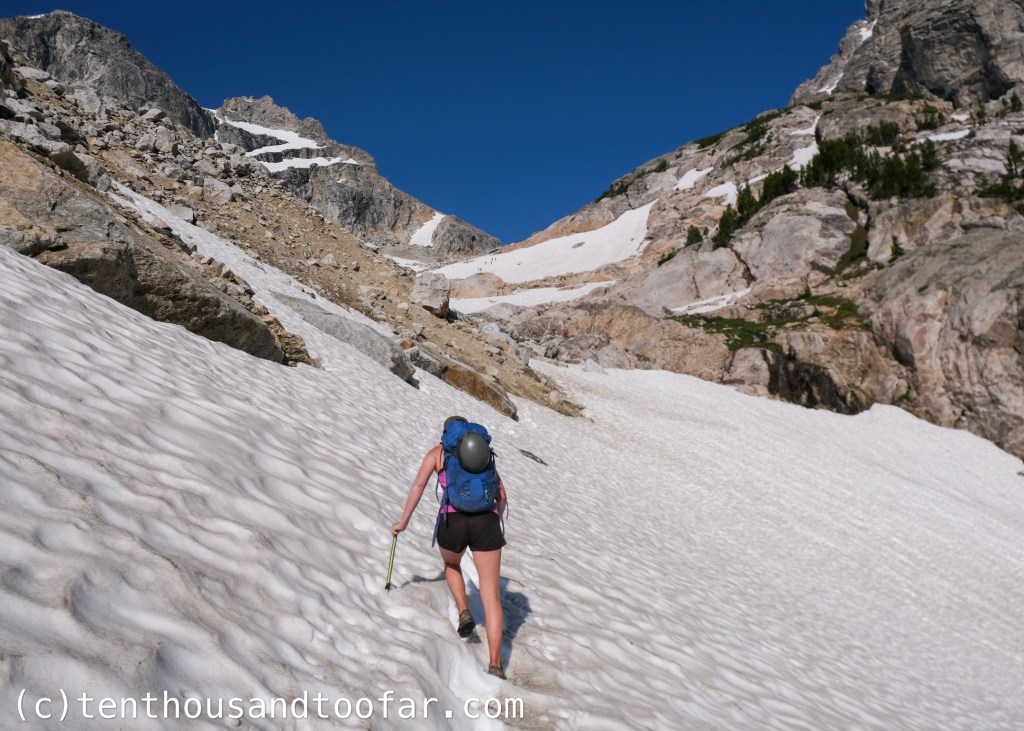
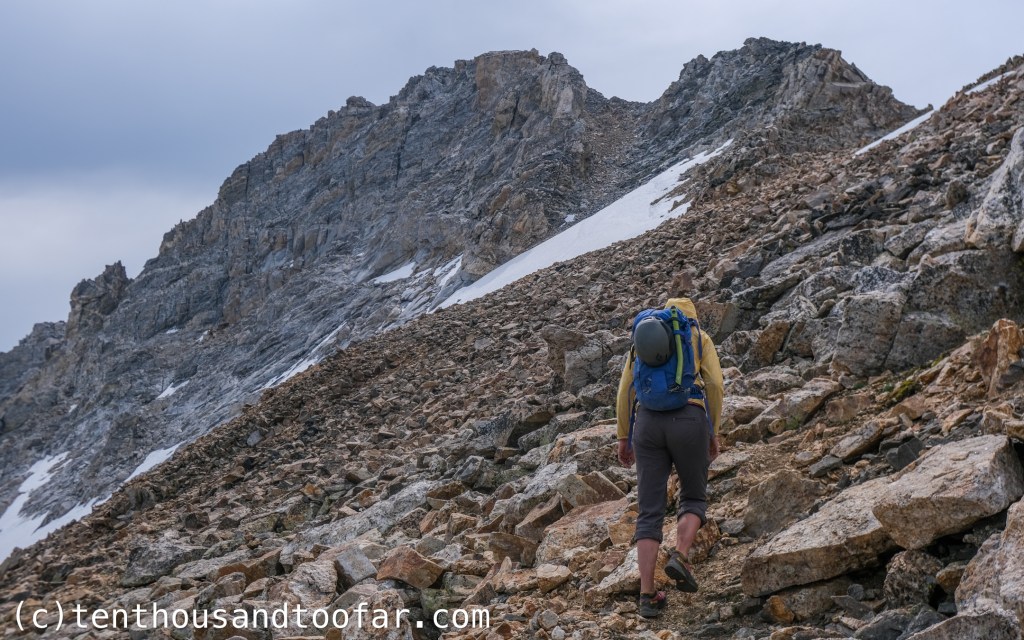

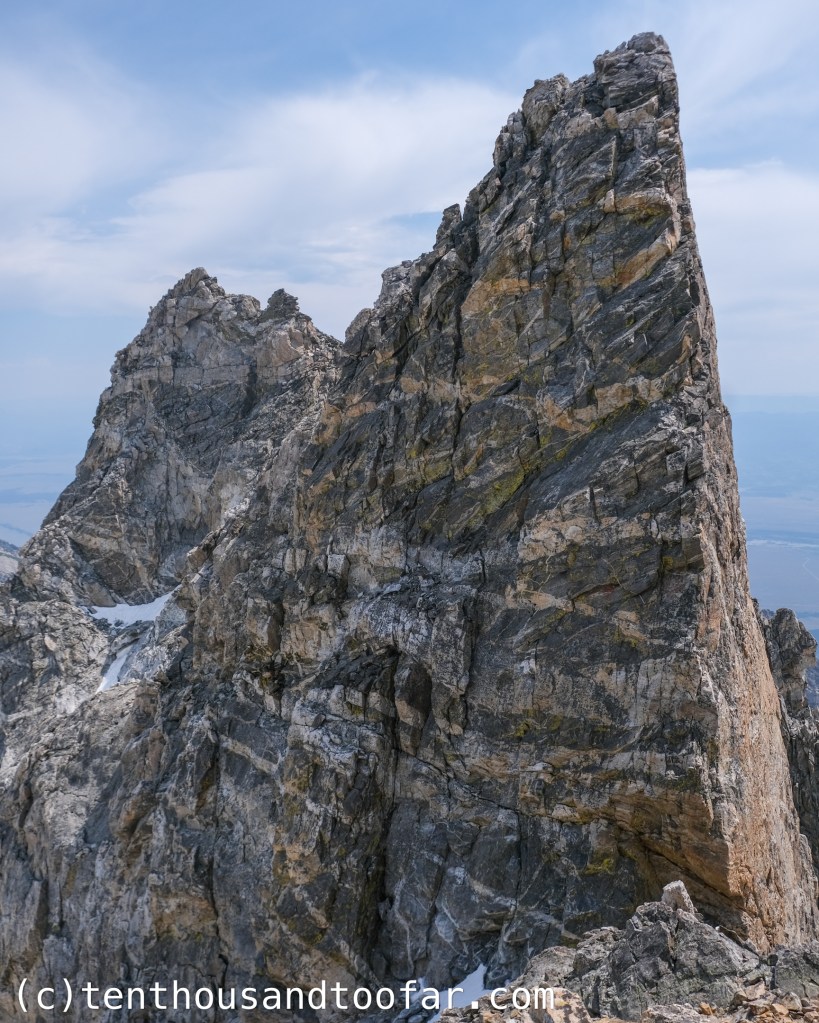
From the mini-rappel we gained the true summit of Gilkey’s Tower easily and descended to the Spalding Peak col expediently (4.0). To this point we encountered no snow on the technical portion of the traverse, but that good fortune was about to hit a screeching halt. Steep and isothermal snow barred the standard fourth class route on Spalding’s West Ridge, forcing us to break out the cord and belay a pair of loose, dirty and friable fifth class pitches on the direct ridge crest. A mandatory steep snow crossing on the East Ridge of Spalding beckoned a belay given our lack of crampons and Bobbi’s limited snow climbing experience. The descent between Spalding and Cloudveil Dome was wet, slicked with loose rock, running water and mud. Fortunately, the ensuing col spanning to the West Ridge of Cloudveil offered a remarkable sidewalk-width passage behind a cornice on nearly flat, squeaky clean, rock slabs. We called this magical section the “sidewalk in the sky”. We hit the summit of Cloudveil Dome at exactly 6:00PM and descended the East Ridge (5.1) without rappels by 6:43PM. Our shoes and pace were equally dampened by the remains of loitering winter, and a light drizzle even sputtered from the darkening sky, yet stoke still reigned supreme.


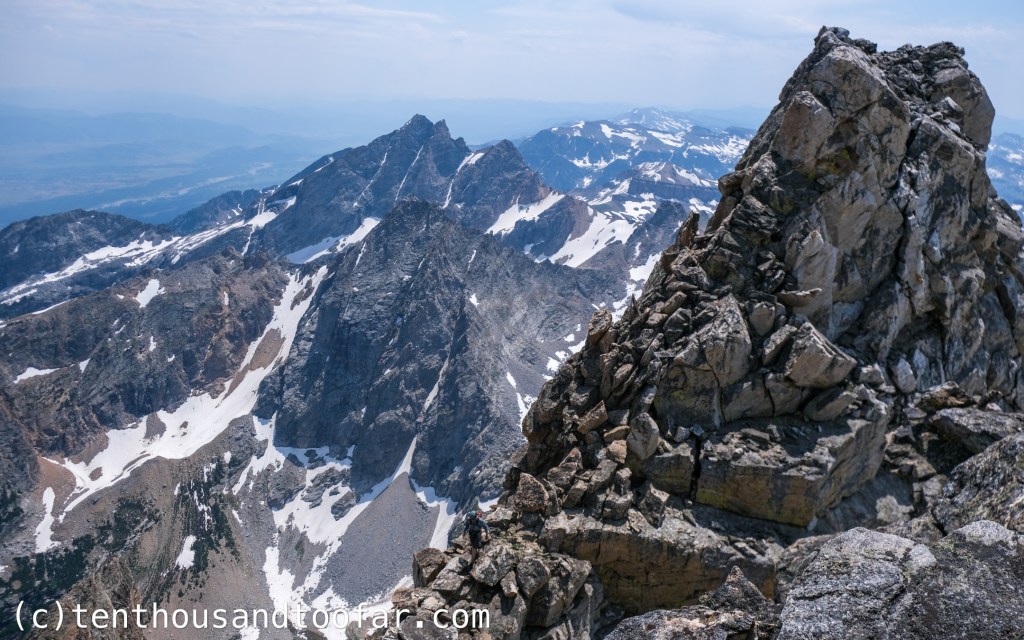


Our original cut-off time for continuation to Nez Perce, the final peak of the traverse, was 5:00PM – we were 103 minutes behind schedule. A quick scan through Mountain Project reveals the eastern col of Cloudveil as the bailing point for many. A convenient snowfield and climber’s trail descends directly from this point into the South Fork of Garnet Canyon, and unlike the other six peaks of the traverse, all packed together like sardines, Nez Perce is a fair distance and several hundred feet of climbing away. Frankly, given it’s extreme separation from the other six peaks continuation to Nez Perce almost feels contrived, and there are a few attractive towers on Nez’s West Ridge that are not formally included on the traverse, but almost seem criminal to skip. Hyper focused on the objective we decided to forge on, but ended up clipping our own wings two different ways. First, we decided on purism and attempted to traverse the two or three small towers on the West Ridge, the first successfully and the remaining to no avail, which appeared to require difficult fifth class climbing with no guarantee of anchoring opportunities. At this point we jumped off the crest and resolved to continue along the standard route, but by now the sun was fading. The standard Northwest Couloirs route is notoriously difficult to follow, and despite having descended the route once before I made a critical and common error, climbing to a false summit on the West Ridge instead of following a ledge system further east. This highpoint, separated from Nez Perce by a deep notch and 100 foot vertical wall, harbors a formidable rappel anchor suggesting we weren’t the only ones to make this mistake. By the time we rappelled from the false summit and course corrected the final waves of daylight crimson were being replaced by stars and blackness. Despite standing a mere 150 feet from the summit, we realized the eminent need to fold our cards and escape from the technical, route-finding intensive upper mountain before headlamp hour.
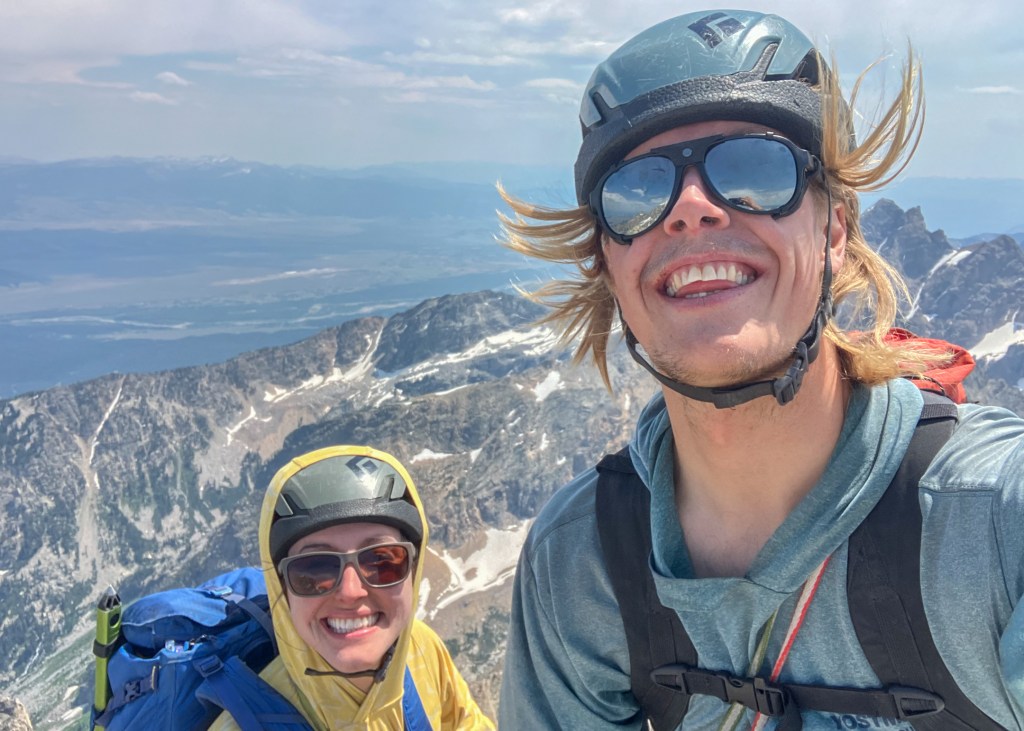
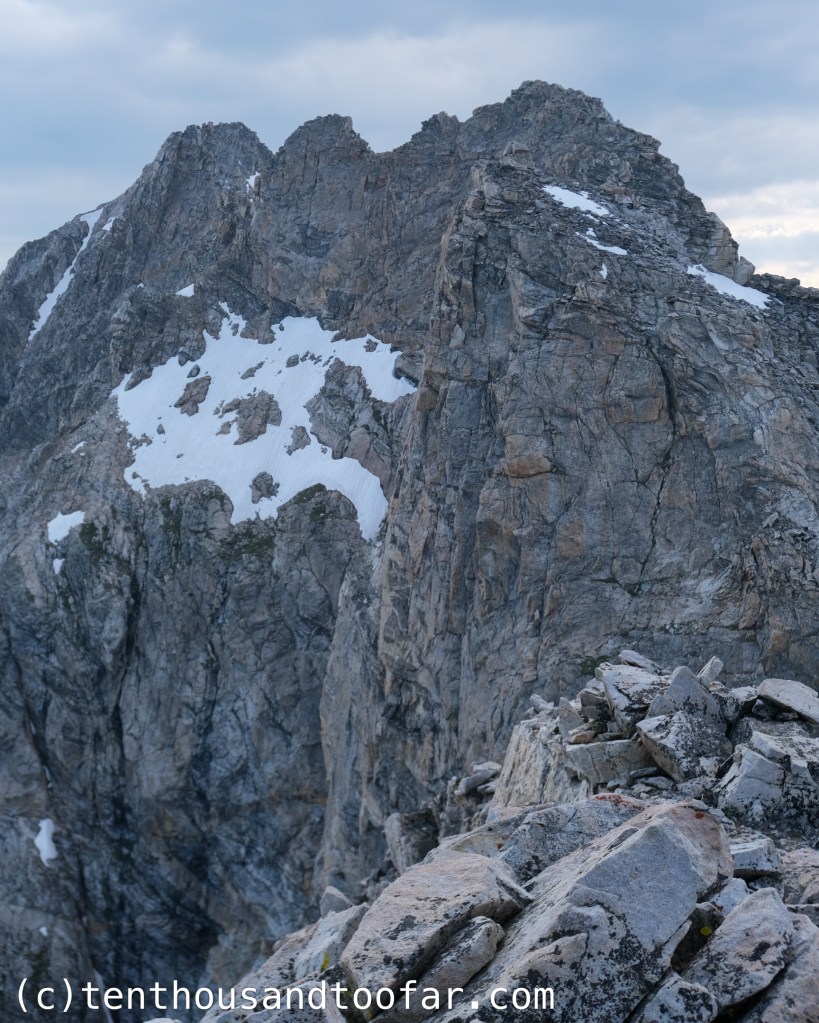
We successfully escaped Nez Perce before true nightfall, but still suffered through a brutal egress that included never-ending talus hopping, fourth class down-climbing through a waterfall, a sustained and steep snowfield and hours of knee-shredding hiking to the car. Instead of rushing we kept the pace light and casual, reaching the lot at 2:30AM. As it turns out, following the multi-thousand foot talus climber’s trail from Nez Perce is a hell of a lot easier without darkness or snow. Contrary to similar late evening exploits of year’s past this nighttime jaunt felt significantly less stressful, owed in large to Bobbi’s increasing grit, fitness and alpine ability, however it was still quite taxing. While staring heavy eyes into a deep mug of coffee Sunday morning we debated incessantly about whether the decision to forge up Nez Perce at the helms of darkness was “right”. Ultimately the answer was inconclusive. Had we bailed after Cloudveil we would have had two full hours of daylight to negotiate the climber’s trail to the Meadows, which probably would have saved us exponential amounts of time, in the realm of four hours. That said, had we decided to skip the unofficial West Ridge towers and not made the critical route finding error leading to the false summit we almost certainly would have succeeded, thereby justifying the tedious evening retreat. Perhaps there fell our greatest misstep – there’s a reason those towers aren’t on the official route and we should have known better than to think otherwise – and, we drastically overlooked the notorious complexity of Nez Perce’s Northwest Couloirs route. However, when we realized our pace was slowing significantly at the hands of unexpected lingering snow we set one firm goal: to be off the technical portion of the descent before nightfall. Ultimately we achieved exactly that, flicking on our headlamps at the conclusion of the fourth class climbing on Nez Perce. We escaped perfectly healthy with nothing more than a few hours of type three fun and an exciting story, by any metric that’s a booming success.

Resources
- A highly detailed pitch by pitch topo and mini-guide for the Cloudveil Traverse, including a topo for the West Face of the Ice Cream Cone can be found by following this link.
Want to support? Consider a donation, subscribe, or simply support our sponsors listed below.
Ten Thousand Too Far is generously supported by Icelantic Skis from Golden Colorado, Range Meal Bars, The High Route, Black Diamond Equipment and Barrels & Bins Natural Market.





enter your email to subscribe to new article updates
DISCLAIMER
Ski mountaineering, rock climbing, ice climbing and all other forms of mountain recreation are inherently dangerous. Should you decide to attempt anything you read about in this article, you are doing so at your own risk! This article is written to the best possible level of accuracy and detail, but I am only human – information could be presented wrong. Furthermore, conditions in the mountains are subject to change at any time. Ten Thousand Too Far and Brandon Wanthal are not liable for any actions or repercussions acted upon or suffered from the result of this article’s reading.
 Ten Thousand Too Far
Leave a comment