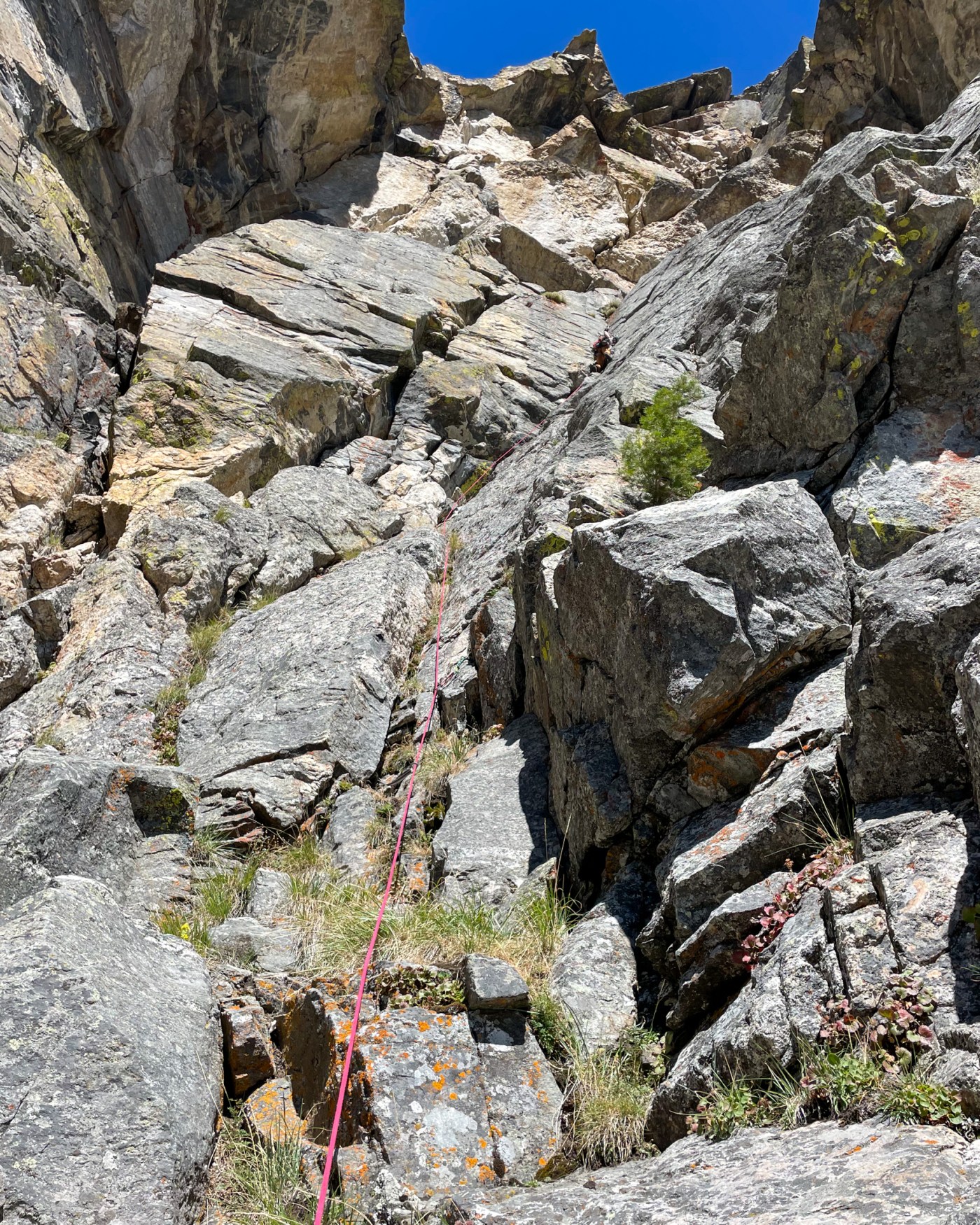
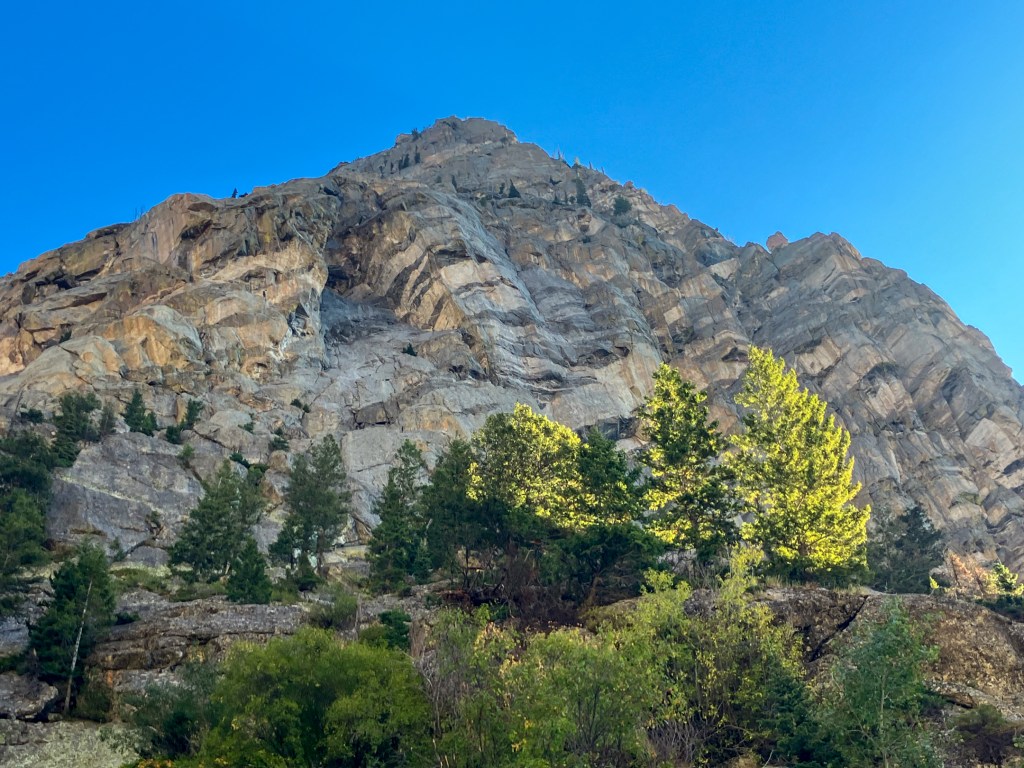
On Saturday September 21st, 2024, Greg Gwinn and I attempted to repeat the long forgotten Vas Defrens on Cathedral Rock, a 1000 foot “5.9 R” established by the legendary Jim Beyer and Buck Tilly in 1978.
I was long overdue for an alpine soul quest. This season I’ve reverted back to climbing mostly classic routes, stacking the odds in my favor for predictable difficulty with my injured right shoulder, but my dark side finally bubbled over – it was time to go rogue. Jim Beyer is a mythical hard-man who has established some of the most difficult and daring routes across the Teton Range, both free climbs and technical aid lines, from the early 1970’s through present day. By all accounts Beyer was rough around the edges and beat to his own drum, a prolific soloist, outspoken promoter of bold style and notorious sandbagger with an eccentric personality. His Teton routes range from timeless classics like the Grand Teton’s Beyer East Face (5.9) and Death Canyon’s Caveat Emptor (5.10b/c), to fringe odysseys like Lookin’ For Trouble (5.10, A3) on the North Face of the Enclosure, which he established solo over two days while dispatching runout 5.10 free climbing near 13000 feet and sustained A3 rockcraft on copperheads and thin beaks. Beyer’s resume extends to the prominent meccas of Utah sandstone and Yosemite big walls, where he has famously claimed to have established the first A6+ routes in the world. Whether A6+ exists or is meaningful in any way is a different story – but I can say this: very few of Beyer’s vigilante aid exploits have seen any repeats, equal nods to the man’s vision, talent and sanity. Those who follow Ten Thousand Too Far know I have an abnormal thirst for rediscovering forgotten routes in my home Teton Range, and a proclivity towards climbing lore. Over the years I have noticed interesting trends between route styles and their opening members, yet had never attempted a Beyer route. September 21st, 2024 was my first peek into his wild world.
Aside from the first ascent party, atypical name and daring grade, Vas Defrens packs attraction by ascending the most interesting rock feature I’ve seen in Grand Teton National Park – a massive multi hundred foot wide, and at least 200 feet long, hanging cave-like cirque with overlapping arced roofs known as “The Amphitheater”. Only two routes have entered and exited The Amphitheater, Lot’s Slot (5.10, IV) and Vas Defrens (5.9R, IV). The former tackles a more logical line by way of a wild black chimney on the east side of the roofs, but features a pitch of “5.9 serious” on very loose rock and thereby is not recommended and has likely never seen a repeat. Vas Defrens comes in from the west, joins Lot’s Slot for a few pitches but traverses to the west side of The Amphitheater where three near horizontal pitches surmount a tidal wave of roofs via “5.9” overhangs and unprotected slab traverses. Getting to The Amphitheater is no easy feat in its own, requiring 5-6 pitches and 800 feet of vertical rock up to 5.9 in difficulty. Sprinkle in the loose rock, route finding issues and heady dose of the unknown synonymous with “old-routing” and you have the breeding grounds for a character building adventure.
Love Ten Thousand Too Far? Support independent mountain journalism with $5.10 per month through Patreon (and receive extra bonus content), or with a one-time donation. Any and all support is greatly appreciated.
There are two documented variations for beginning Vas Defrens, each with the common goal of reaching the toe of the eastern (climber’s right) wall of The Amphitheater. The first ascent party climbed the first two pitches of Lot’s Slot following a chimney feature with 5.8 climbing and much loose rock beginning about 100 feet west of the Snaz. The second ascent pioneered a new variation known as the August 11th Variation in the Ortenburger-Jackson guidebook, noted as the recommended start. The variation begins several hundred feet west of Lot’s and climbs three non-descript pitches on pleasant cracks, slabs and ramps, generally traversing rightward to the eastern toe of The Amphitheater. Despite the hand drawn topo provided in the guidebook we found this variation difficult to locate, however, passage through the broken terrain west of Lot’s was never overly difficult. Gregory Gwynn was my partner for the day, and together we climbed three pitches between 5.4 and 5.6 to the center doorstep of The Amphitheater, where we hoped to find the depicted 5.9 pitch serving passage back east but were met with blank granite. Instead we pioneered a new two pitch variation to reach the upper left corner of The Amphitheater, which offered enjoyable climbing on overwhelmingly sound stone. The first, Greg’s lead and the fourth pitch of our day, was a low angle water groove which appeared trivial from the belay but ended up throwing a haymaker of 5.8 friction business with sparse protection, though fortunately on perfect knobby granite. My ensuing lead followed the west edge of The Amphitheater for 50 full meters, climbing an attractive right facing corner in black rock with excellent 5.8 stemming and jamming reminiscent of a miniature Open Book, rolling over into low angle slabbing and a semi-hanging belay at a pinched block. By now we’d been rolling for a couple hours, intersected the main route at the commencement of the crux climbing on the upper west extremity of the Amphitheater, and despite the intimidating tier of roofs looming overhead were encouraged by the seamless travel thus far.
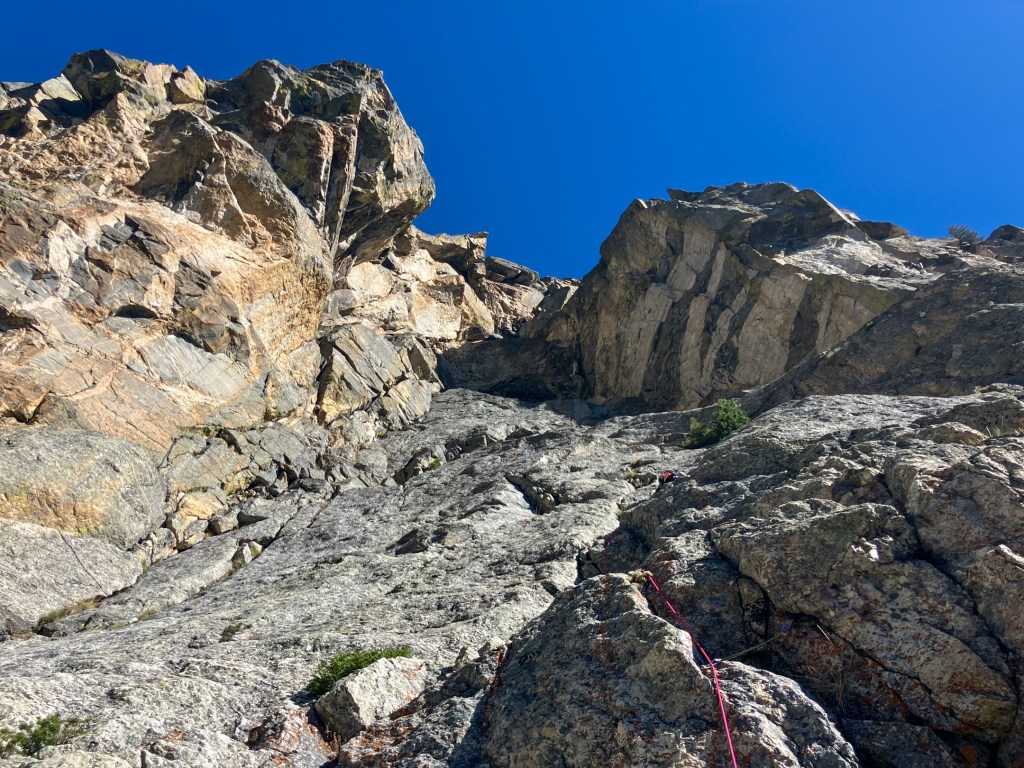
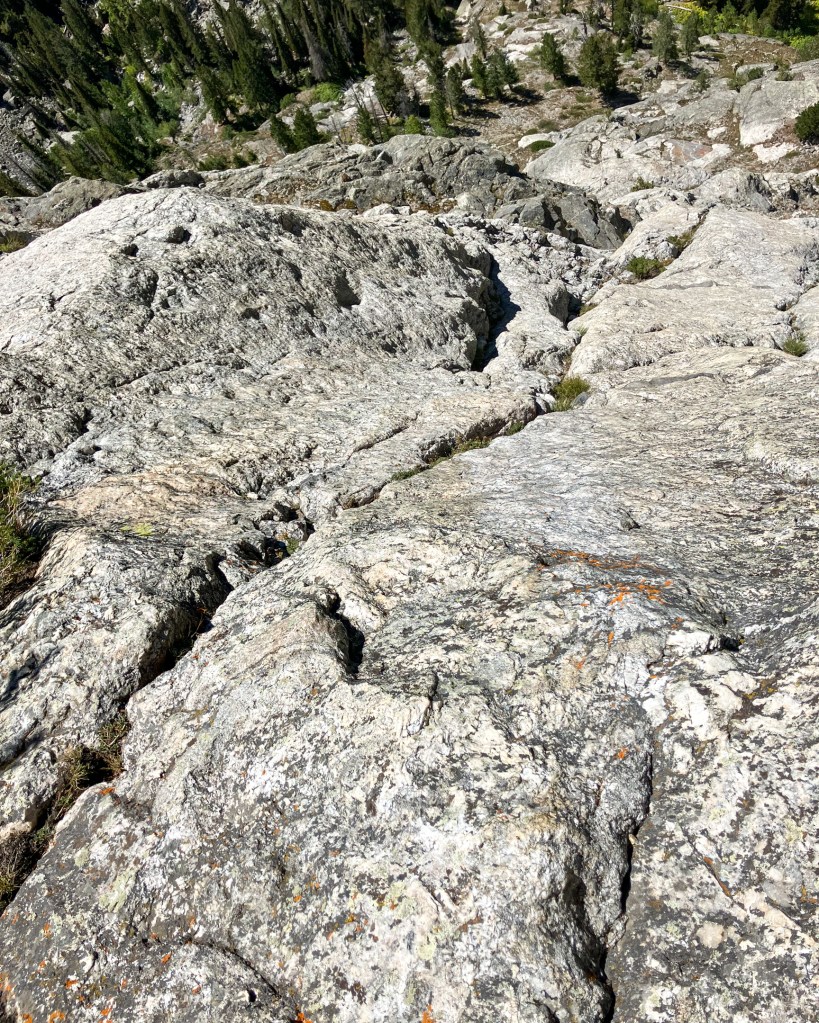
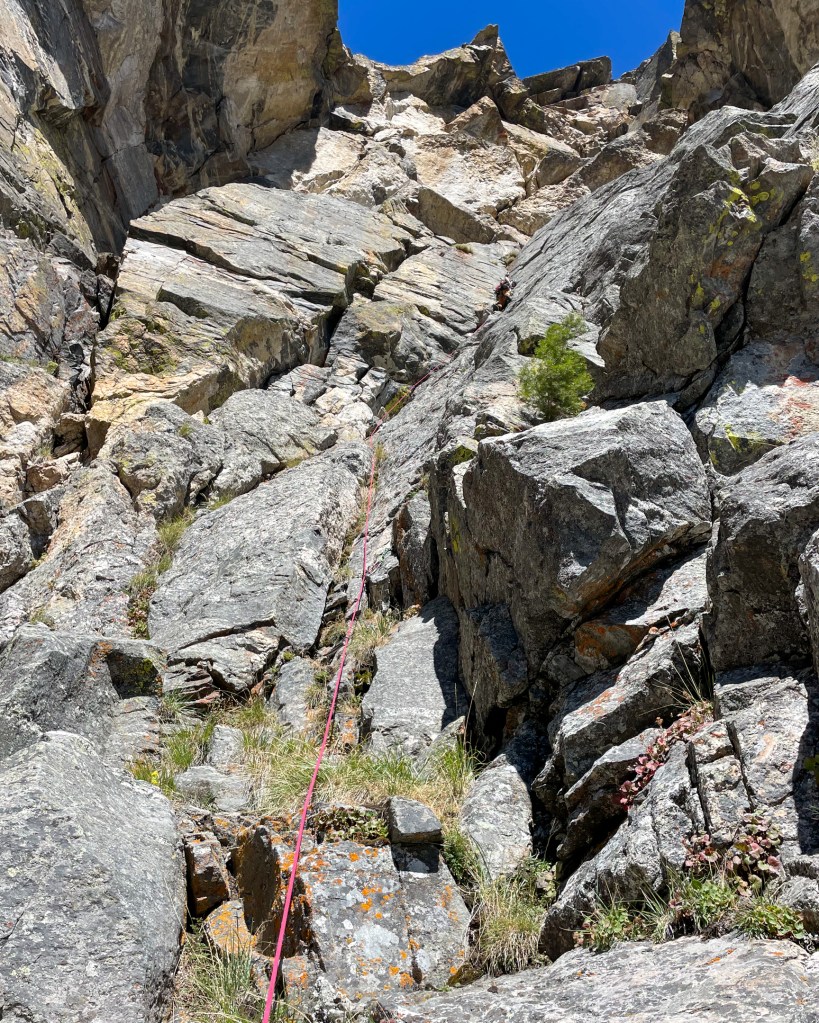
Our sixth lead, which began as Greg’s work but eventually fell into my hands after botched route finding communication, was where we slammed headfirst into the brick wall of Beyer madness. The goal was to reach the upper westmost corner of the first Amphitheater roof via slabs and a 5.9 layback which both Greg and I free climbed successfully, then pass the roof by traversing a sequence of overhanging flakes to a small stance only 30 feet above our belay. It’s a tough pitch to explain in words, but imagine a 30 foot tall number seven, with the bottom diagonal leg being the layback and the horizontal “top of the seven” being the traverse, and you’ll somewhat get the point. The final flake traverse was on par with the headiest and most feral leads of my life, sporting horizontal cam placements behind massive flakes and bold sport climbing style movement. Despite both of us having free-climbed up to 5.11- on traditional gear the final body length downclimb saw two climactic falls. On lead I took a sizeable lob into free air, lowered to the slab below and used a running 20 foot pendulum to snatch a jug block on the belay ledge. To ensure Greg’s safety I tensioned off a hanging five piece belay in a thin seam to place two cams after the crux to shorten his swing potential. He fell at the same spot as I, pinging off the flakes and using the back-placed cams to aid up to the belay. Worst of all, after all these shenanigans we had two grown men dangling off a five piece anchor atop a roof 800 feet above Death Canyon Creek. The ambiance was commanding.
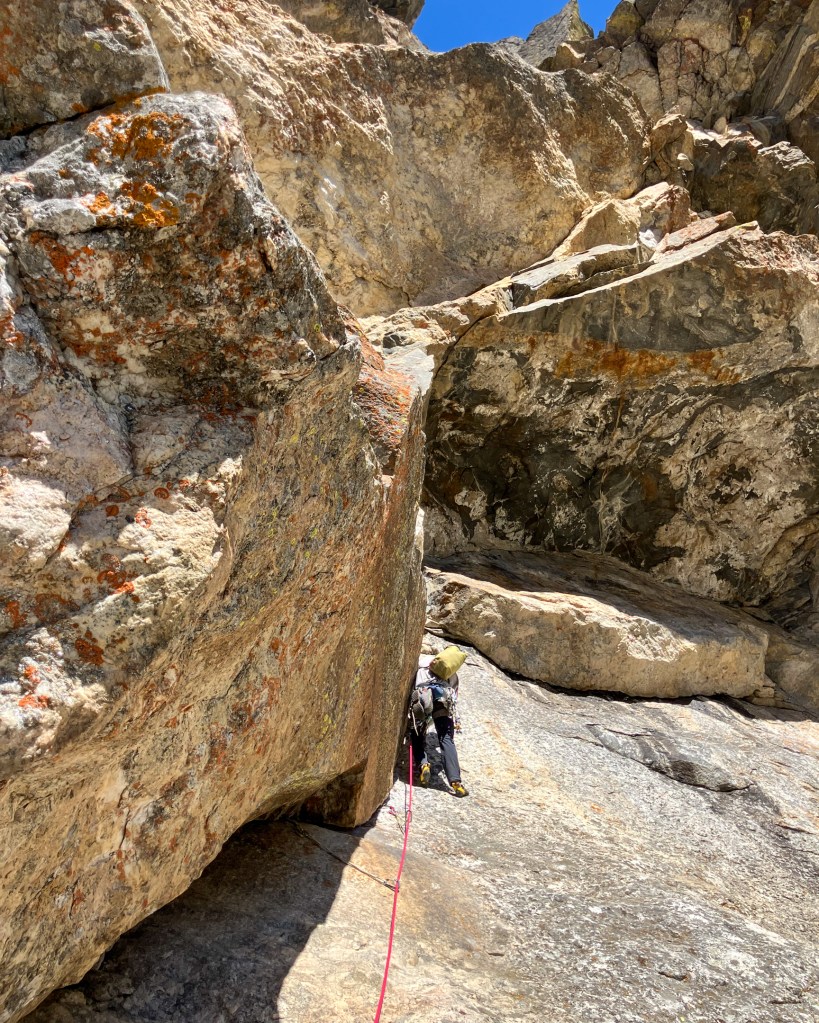
The following pitch, the second to last of the climb and final of 5.9 difficulty, was a 30 foot protectionless slab traverse. The topo noted this obstacle clear as day, stated “runout 5.9”, yet often I find old-school friction cruxes easier than the stated grade due to developments in modern climbing shoes. While this slab certainly seemed to register in the 5.9 realm, friable rock and uninspiring protection to safeguard our sacred hanging belay was disconcerting. Greg offered the lead to me. I climbed up to some shattered white rock in another imposing roof, quasi-equalized two thin wires and a shallow black totem, and down-climbed to an optimal stance to evaluate the traverse. Magical edges oscillated between periods of blankness, and a gentle convexity prevented scouting of any holds further than 15 feet away. The goal was to reach an obvious wedged flake a spitball away, but should I fall en’ route I’d be risking a severe pendulum if my uninspiring gear held, and a significant factor-two onto the belay with potential for raining some small blocks onto Greg if the gear failed, which seemed about coin toss probability. I paddled back and forth onto the first few moves of the slab, brushing lichen off crux footholds and retreating whenever I wasn’t 100% certain. Eventually I identified an in-cut crimp a few moves along I could use for a rest, yet the instant my fingers latched over the edge the scaly white rock sheered away. I watched the best hold on the R rated crux pitch careen into the abyss and barely arrested a fall on body tension alone. I looked back to Greg and his face told 1000 words. 50 feet from the summit of Vas Defrens we were headed down.
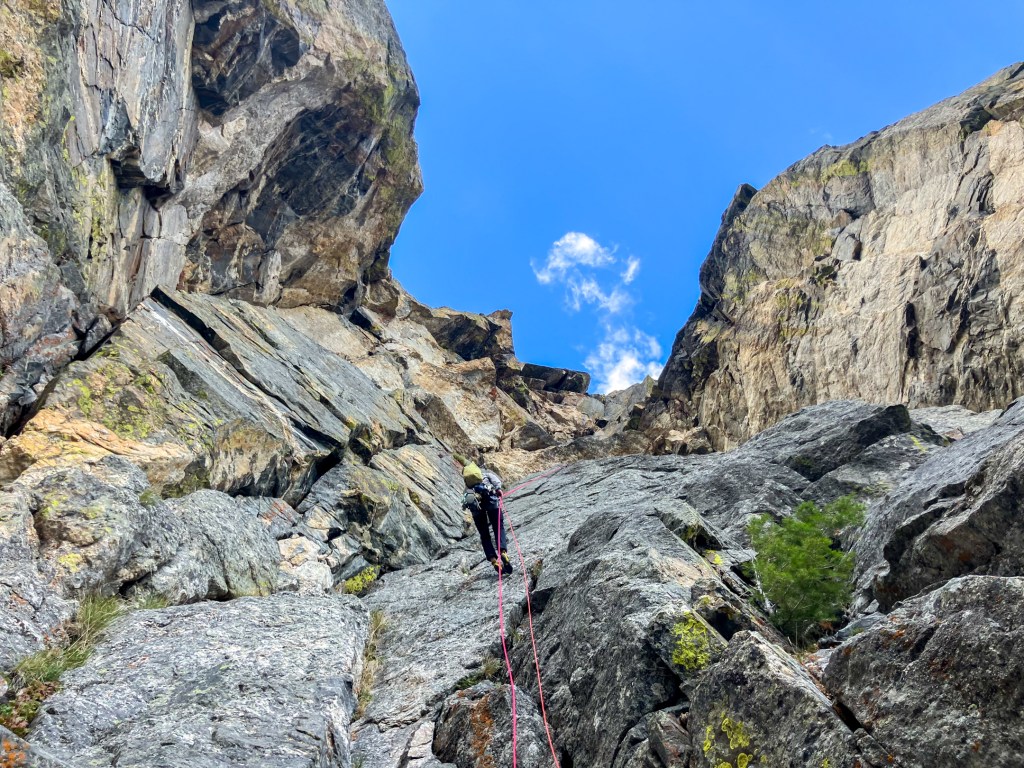
Five double rope rappels got us back to the Snaz approach trail, and due to a gracious offering of boulders, chockstones and trees we only needed to desecrate Cathedral Rock with one formal gear anchor and a handful of slings. Somehow, someway, Vas Defrens is the first alpine route I’ve ever bailed from due to sheer difficulty. What began as a somber “tail between the legs” descent ended as a character reinforcing feeling of responsibility. While the romantic allures of dispatching bold runout climbing high on a rugged wall are intoxicating, I’ve learned after many such leads that the experience is only rewarding if done with complete confidence, poise and obviously, success. Merely “getting away with it” feels unequivocally irresponsible, and falling… well… I haven’t done that yet, and certainly never want to. After retelling our adventure to a fellow alpine climber he replied “bailing when you should is the best feeling” – and as Vas Defrens faded into the limelight that sentiment echoed resoundingly. As for Greg – I’m inspired by our maiden voyage and eager for the furthering of our partnership. As for Beyer – hats of to you sir – it’s hard to imagine a bolder onsight effort. As for anyone who wants to repeat Vas Defrens – best of luck. There’s a fixed anchor at the crux and a high five waiting in Teton Valley. Penduluming across the steep upper reaches of Cathedral Rock and points-off leaping for a distant jug, only to pull over a roof into a vague seam for a five piece hanging belay is not an experience I will forget anytime soon.
Resources
- A detailed topo, overlay and vague description for Vas Defrens is provided in A Climber’s Guide to the Teton Range by Renny Jackson and Leigh Ortenburger.
Want to support? Consider a donation, subscribe, or simply support our sponsors listed below.
Ten Thousand Too Far is generously supported by Icelantic Skis from Golden Colorado, Range Meal Bars, The High Route, Black Diamond Equipment and Barrels & Bins Natural Market.





enter your email to subscribe to new article updates
DISCLAIMER
Ski mountaineering, rock climbing, ice climbing and all other forms of mountain recreation are inherently dangerous. Should you decide to attempt anything you read about in this article, you are doing so at your own risk! This article is written to the best possible level of accuracy and detail, but I am only human – information could be presented wrong. Furthermore, conditions in the mountains are subject to change at any time. Ten Thousand Too Far and Brandon Wanthal are not liable for any actions or repercussions acted upon or suffered from the result of this article’s reading.
 Ten Thousand Too Far
Leave a comment