
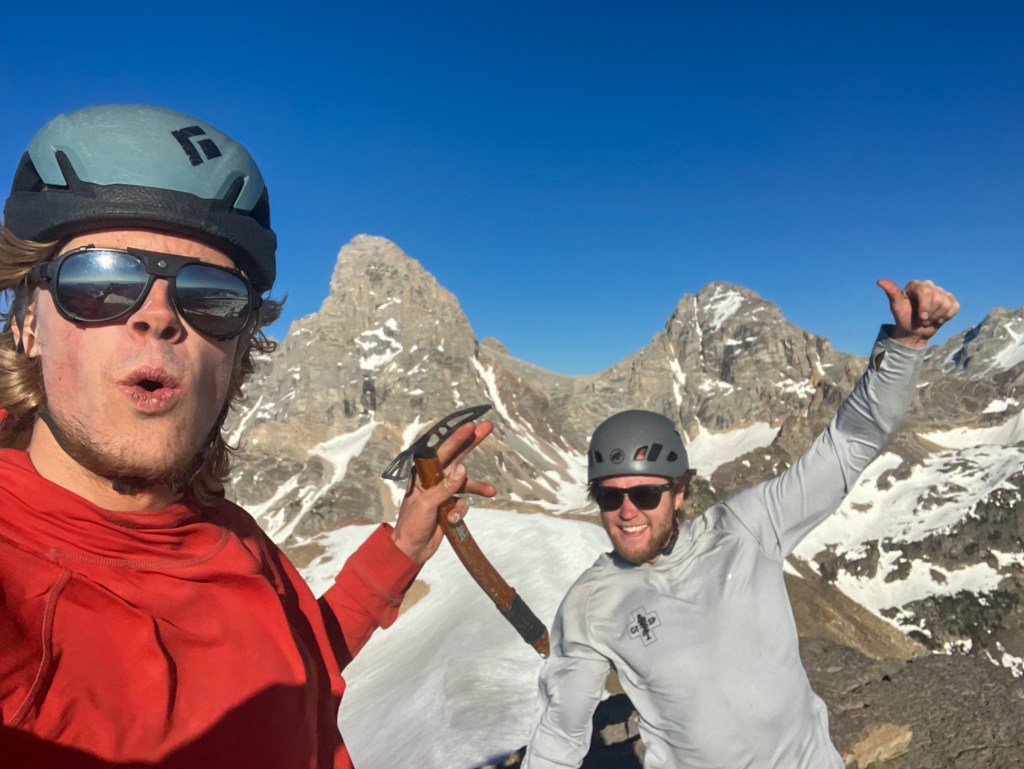
On Sunday June 23rd, 2024, Justin Gilbert and I clawed up the equally remarkable and unexpectedly difficult 1961 South Buttress route on the 1400 foot East Face of Table Mountain. 10 pitches, 15 hours, 15 miles and 5000 vertical feet later we were slightly busted, but far more stoked.
I added a pitch by pitch breakdown of this route to Mountain Project, including details about approaches from the east – found here.
Let’s keep it real – this route kind of worked me. The 2024 ski season was a big one, and I only put down the sticks after a successful descent of the Grand Teton’s Ford-Stettner Route on June 11th, leaving my poor knee ligaments a lousy 12 days for recovery. The typical annual summer routine involves a few short-approach missions in Death and Cascade Canyon to calibrate the body for the specific demands of alpine climbing, but Teton Pass remained closed after a catastrophic failure on June 8th and as such, the “backside” of Table Mountain was the closest practical venue for Teton Valley climbers to scratch an alpine itch. Having climbed Heartbreak Ridge on the East Face of Table last year with Neil Gliechman, I knew a bit of the impending fiasco. When approaching from the west, a 7-8 mile approach begins at the Teton Canyon South Fork trailhead, following the unofficial Roaring Fork trail before delving overland to the saddle between Table and Peak 10,635. From here a descent is made along the base of the East Face, home to pesky steep snow by early season and unconsolidated talus later. The face itself is a proud 1400 feet tall, buttress with remarkable steepness and golden precambrian granite of renowned quality, home to a handful of new routes, two well reputed moderates and several forgotten relics hanging high above the head of Cascade Canyon with a world class backdrop of the core Teton range. This is rugged, raw and remote alpine terrain where the odds of passing other humans, or signs of previous travel on rock, are almost zero. From the 11,111 foot summit, valley climbers follow a knee crushing 4500 foot descent down the mercilessly steep and loose Face Trail to the car. Round trip stats wrap up somewhere in the realm of 13-14 miles and 5000 feet of vertical gain, with 1400 feet of technical rock climbing sprinkled in – not exactly how I envisioned breaking in my summer body, but you play with the cards you’re dealt.
Love Ten Thousand Too Far? Support independent mountain journalism with $5.10 per month through Patreon (and receive extra bonus content), or with a one-time donation. Any and all support is greatly appreciated.
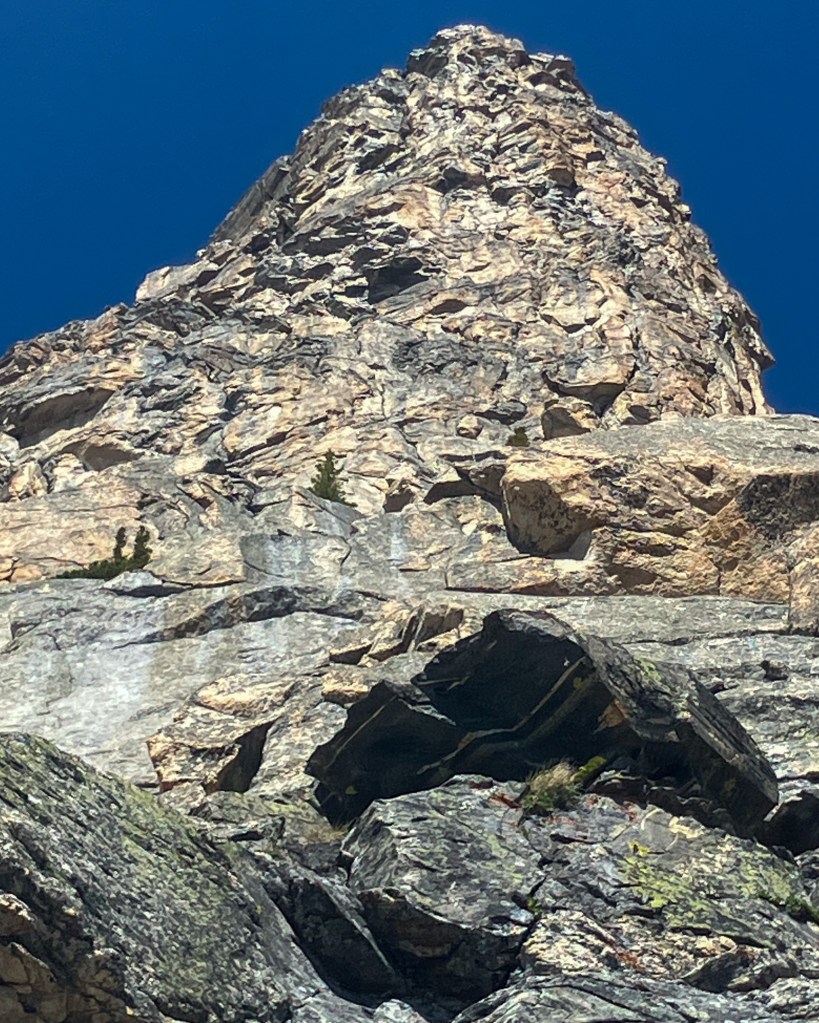
My partner for the day was Justin Gilbert, someone I climbed with for the first time four days earlier on a unique Teton Canyon linkup, where we climbed all five multi-pitch traditional routes on the Grand Wall, totaling 11 pitches and 900′ of climbing up to 5.10b. We gelled equally well in personality, pace and a thirst for never ending climbing – a good omen for higher places. For our maiden alpine voyage I selected the 1961 East Face, South Buttress Route from A Climber’s Guide to the Teton Range, attracted by the moderate 5.8+ grade, descriptions of good rock and lots of pitches clocking 5.7 and under. The goal was a lengthy but fast mission suited to a light rack and early season vertical fitness – a day focused on efficiency, mileage and breaking in a new partnership. We left the trailhead at 5:45AM, hiked one mile up the South Fork Trail, forded the thigh deep, ice cold and precariously fast Teton Creek and marched up the Roaring Fork with intention. We hit our first sustained stretches of snow approaching the col separating Table from Peak 10,635, and our first axe-worthy slopes traversing the base of the East Face. Fortunately the day was forecasted to eclipse 80 degrees so the snow surface was already soft enough for kicking steps in approach shoes come 9:00AM – no crampons here. The Southeast Couloir is the first obvious landmark passed on the southerly approach, an ominous and striking vertical gash unfit for skiers and barred by a few massive chockstones. Heartbreak Ridge forms the north wall of this couloir, and the southern terminus of the neck-craning South Buttress. From the base of Heartbreak a ledge ascends up and right across the face, which we confused for the “wide bench at base of east face” listed on the original topo – the launching point for our route. Too many minutes of monkeying around on fifth-class slabs later we corrected our error, down-climbing and traversing mountain terrain with one short rappel to the proper ledge. In hindsight the wide bench is unmistakeable, home to several large trees and broad enough for a twenty person barbecue, easily reached by hiking along the base of the cliff from Heartbreak Ridge. We located the obvious second pitch vegetated corner, set a belay at the very last tree, on the literal terminus of the bench, and began climbing at exactly 11:00AM.

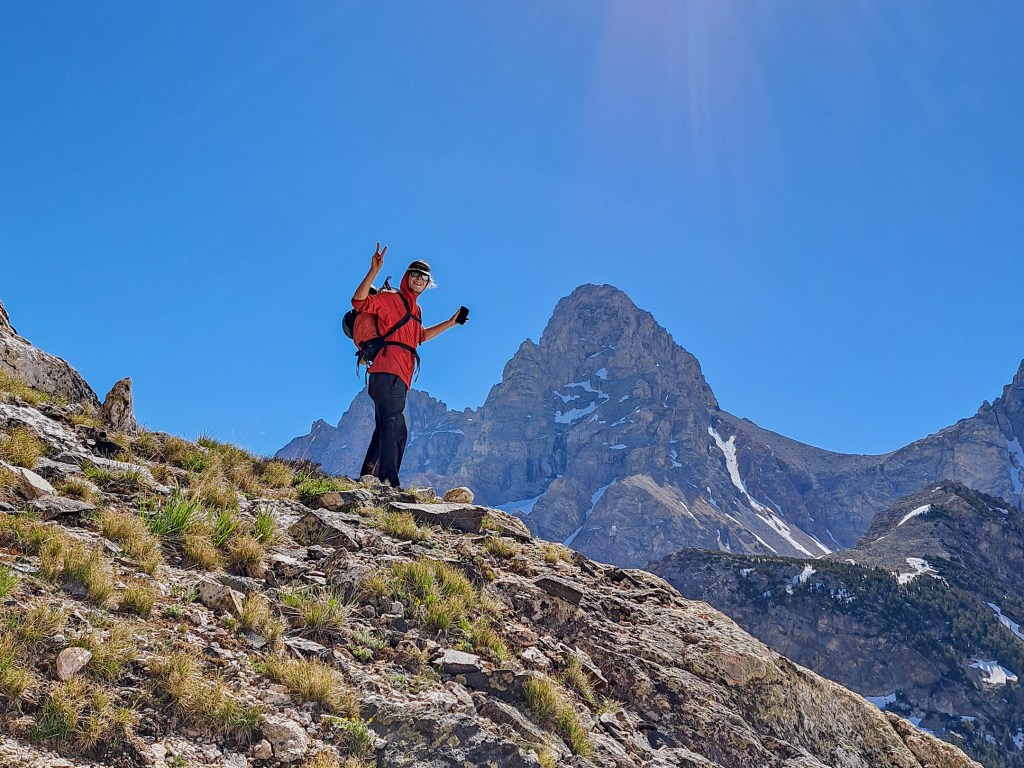
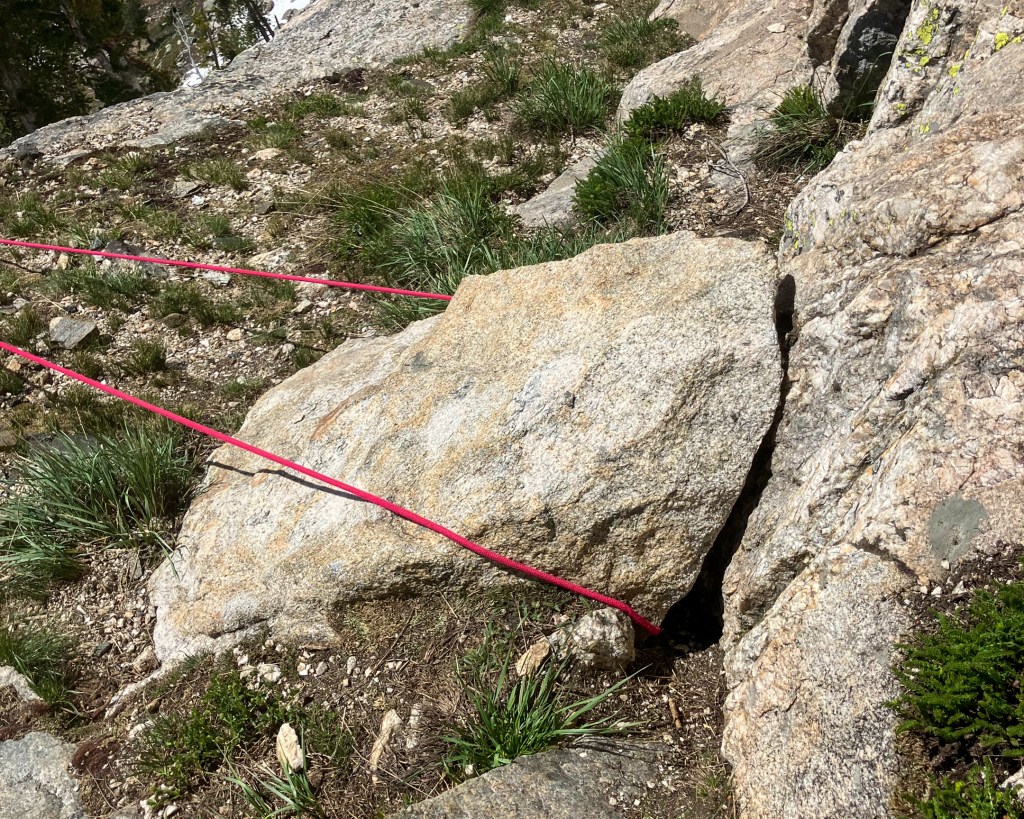

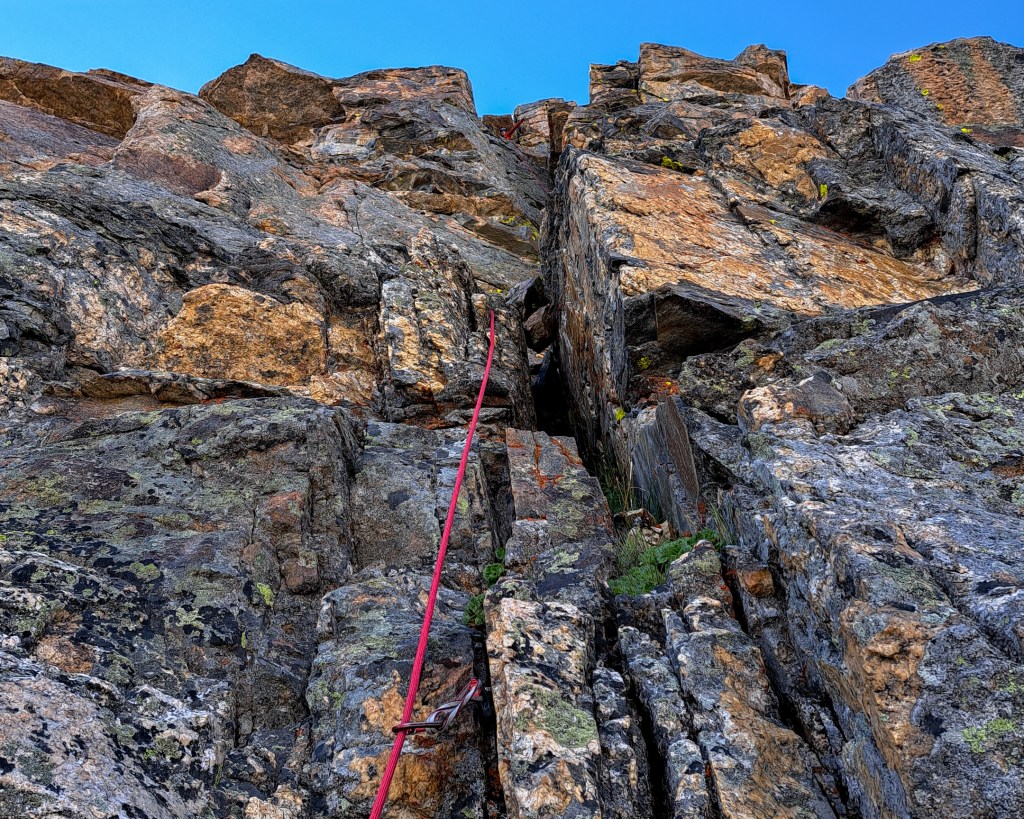
The first three pitches fell easy. Justin led the first, a gentle approach pitch to the base of a noticeably long 60 meter vegetated corner trending up and slightly right. I led the corner, which turned out a little more difficult than expected for the stated 5.6 grade, but offered better climbing than imagined based on the amount of exposed grass – a nice mix of squeeze, crack and stem climbing. A short third pitch of scrambling brought us around a large boulder to a ledge with snow and a dead tree, eye-to-eye with the crux 5.8+ off-width. Having sought out many notorious old-school wide cracks and squeeze chimneys up to 5.10 on an extended trip to Joshua Tree National Park this winter, I felt reasonably confident I could make handier work of this beast than others of similar grades across the range in years passed (cough cough… the “5.8 squeeze” on the Chouinard-Frost Chimney). A thin double-crack system provided modern passage around a 5.7 squeeze chimney in the beginning of the pitch, but eventually both paths convened at the off-width. I tied my backpack off to a cam with intent to tag it up from the belay ledge, blasting into the void unencumbered. The work was proper vertical off-width and squeeze climbing for the first few body lengths, with chicken wings and knee bars a crucial part of upward progress. I power-screamed my way through a small roof with a fixed ring piton, requiring tenuous overhanging jamming in a cupped hands and fist crack. A convenient no-hands ledge rest allowed just enough recovery to blast into one final crux, climber’s choice of a flared thin hands crack, six inch off-width or both, that run through a heartbreaker bulge to a cozy belay ledge. I chose thin hands over heel-toe cams, let loose another slew of primal yelling and pulled through on desperately thin jams to the belay woozy with adrenaline. This thing was a true ass kicker, and despite being an off-width novice I find it nearly impossible that most parties wouldn’t think this crux is a significant sandbag at 5.8+. Justin offered 5.10b. In the name of humility and venerable Teton sandbagging I offered 5.9+. However – don’t misconstrue this sandbag banter as a complaint. Unlike most Teton alpine off-widths, best described as dark, dingy and grimy unprotectable chasms of doom, this rig was clean as a whistle on bulletproof polished granite, refreshingly well protected with a variety of gear sizes and reminiscent of a three-star pitch in the City Of Rocks – a truly unique gem anywhere, let alone halfway up an alpine wall at 10,500 feet. This was hands down one of the proudest onsights of my life, even if it took me an hour to lead with perpetual screaming that had us fearing someone far below in Cascade Canyon might call Search and Rescue. Pack hauling worked well for this pitch and is highly recommended if you somehow stumble this way, and a lovely blue DMM Dragon cam has now become a bolt at the crux.


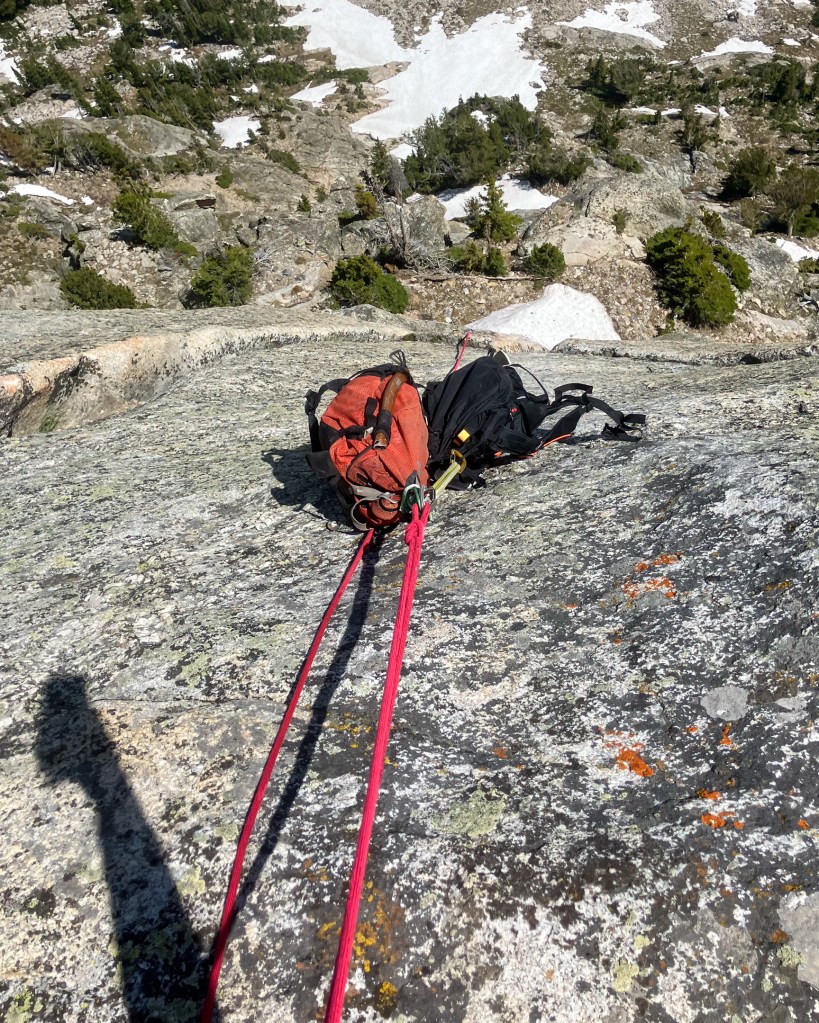
Above the off-width we climbed two micro-pitches that could’ve easily been linked as one if we weren’t having such a hard time route finding – an awkward but clean left trending 5.8 crack to a short blocky chimney, and a four meter 5.8+ boulder problem up a grainy orange layback flake ending at a large ledge with a house-sized detached flake. This middle zone becomes highly featured and offers other variations of easier difficulty on the topo. From the house-sized flake ledge a dooming multi-hundred foot buttress of steep rock stretches overhead, and the topo depicts a horizontal pitch passing behind the flake, including a fixed pin for belay and some downclimbing. Neither the piton nor passage behind the flake made sense to us, so we belayed an airy but easy slab pitch around the outside of the flake and back onto the same long ledge, building an anchor near the southern terminus. Above was a striking 400 foot corner and chimney system stretching to the summit ridge – we had our work cut out for us. Two long leads on 5.7+ rock, occasionally dirty but never too loose, completed the South Buttress with some incredible exposure and aesthetics – our eighth and ninth pitches. The world looked small below.

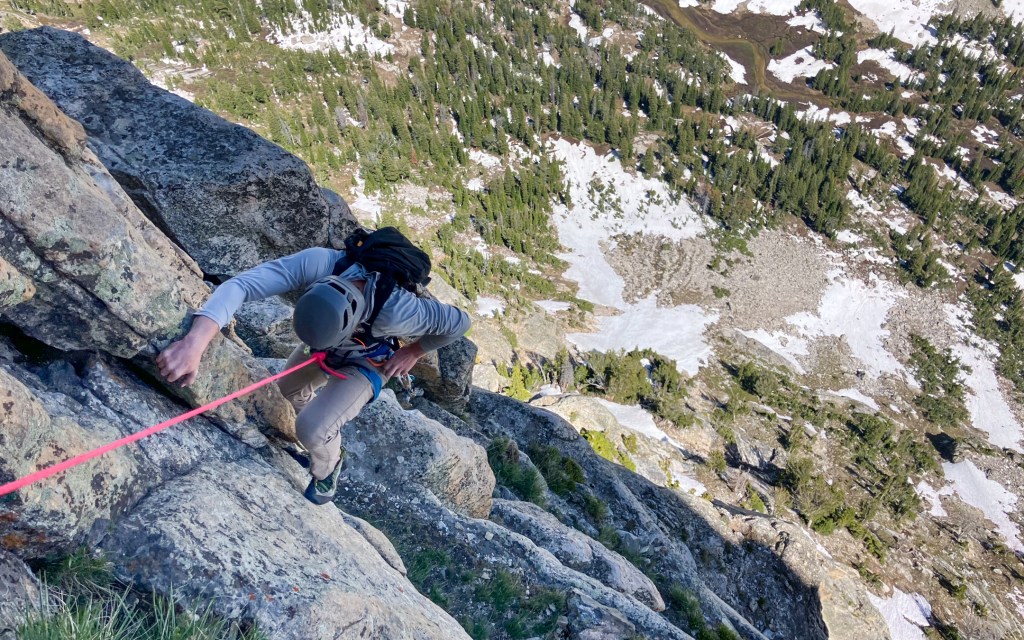
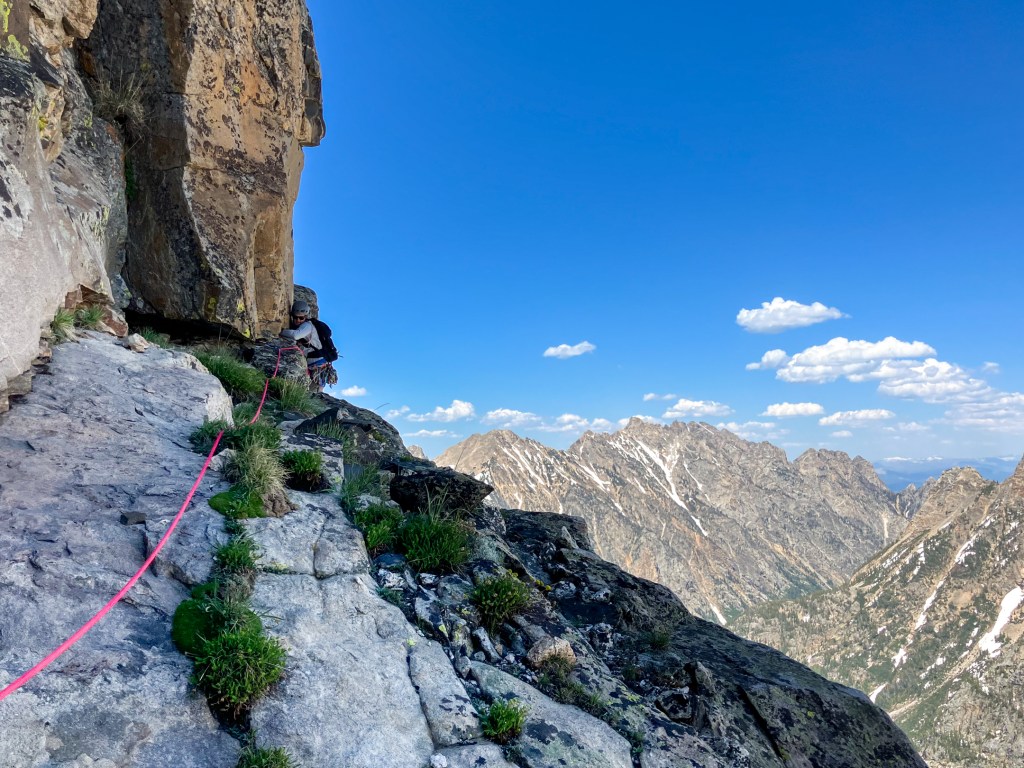

On the sunny summit ridge I belayed from the same mess of giant boulders I used for Neil on Heartbreak Ridge. The guidebook lists “fourth class to the summit” and a hand-drawn topo from modern climbers lists “5.6 past a fixed pin”, yet neither of these were apparent to Justin and I this day, or Neil and I last September. Instead, Justin and I finished on the same final pitch Neil and I used for Heartbreak, a short chimney boulder problem with an overhanging 5.8 chockstone on the direct crest, and 30 some meters of pleasant face climbing up 5.7 cracks and corners to the top of the ridge. The rock on this final pitch is regal, the golden veneer granite characteristic of the Grand Teton’s Upper Exum Ridge, with panoramic views of the entire range. A long fourth class scramble up slabs and ledges to Table’s true summit provides the final technical difficulties and a brilliant way to unwind from seven hours of non-stop work on the wall. Serious winds rapped the summit pyramid as a crimson hue of sunset danced off the fractured sedimentary rock and surrounding forests. Though I try not to make a habit of catching unplanned sunsets in the high peaks, the scenery never dissapoints.


Reflection
Alas here we are – alpine climbing season! While the South Buttress was a bit more difficult and sustained than we originally intended, it felt good to get reacquainted with the feeling of trying hard in high places, and drain the tank towards empty for the first time in two weeks. Cragging is just a bit too cozy… don’t you think? With only a handful of 2024 climbing days on the belt I was excited to onsight the crux pitch, which as stated earlier felt closer to 5.9+ or even 5.10 than the stated grade. Long pitches of sustained difficulty on sound rock, in a remote, inspiring and scenic alpine environment characterize this proud route, which save for some dirty rock and ledge wandering would have four-star potential. With perfect views towards the friendly south faces and crags of Cascade Canyon, we mused to ourselves after each ass kicking pitch – “this ain’t no Guide’s Wall!” A mantra was born. Climbing with Justin was refreshing. We never complained, stayed steadily motivated despite consistent bludgeoning from the rock and thorough dehydration, and kept an average pace of 42 minutes per pitch on an alpine wall above 10,000 feet – pretty sweet for a first date. Aye’ captain, we are ready for the seas of golden granite!
Resources
- East Face of Table routes can now be found on Mountain Project
- A Climber’s Guide to the Teton Range (Leigh Ortenburger, Renny Jackson) – topo, overlay and description
Want to support? Consider a donation, subscribe, or simply support our sponsors listed below.
Ten Thousand Too Far is generously supported by Icelantic Skis from Golden Colorado, Range Meal Bars, The High Route, Black Diamond Equipment and Barrels & Bins Natural Market.




enter your email to subscribe to new article updates
DISCLAIMER
Ski mountaineering, rock climbing, ice climbing and all other forms of mountain recreation are inherently dangerous. Should you decide to attempt anything you read about in this article, you are doing so at your own risk! This article is written to the best possible level of accuracy and detail, but I am only human – information could be presented wrong. Furthermore, conditions in the mountains are subject to change at any time. Ten Thousand Too Far and Brandon Wanthal are not liable for any actions or repercussions acted upon or suffered from the result of this article’s reading.
 Ten Thousand Too Far