Adventure Punks is a rarity for Red Rocks, with five straight crack pitches, little face climbing and no lead bolts. The first pitch is 30+ meters of the best flake laybacking you’ll ever do, but weighs in at the eye catching grade of 5.10b R/X, thereby limiting traffic on this otherwise classic line.
Jed Porter is in town… Jed Porter is in town… Christmas came early! Jed and I average one climbing day per summer and winter season. I get the honor of sharing a rope with a 20 year professional mountain guide free of charge, and he gets the benefit of a partner with an unusually high suffering tolerance. Together, we make a great team and have shared some peak climbing experiences, including blasting up the venerable Astro Elephant on “Idaho’s El Capitain” last fall. For our first Red Rocks outing we chose Adventure Punks, a particularly attractive 550 foot natural line on the right margin of Jupiter Peak’s Challenger Wall. All five pitches weigh in at 5.10 something. The first is explicitly dangerous with a gatekeeper 5.9 X slab void of trustworthy protection for the opening 50 feet. The last is a haunting 5.10d off-width visible from the approach. Anomalous for Red Rocks, there are exactly zero lead bolts on the entire route. The previous three sentences explain why Adventure Punks, despite incredible aesthetics and notoriously classic climbing, will almost always be empty. Timeless old routes sprout cobwebs in 21st century Las Vegas, falling further from vogue with each released generation of quad touting, green smoothie drinking, plastic pulling pad sniffers. This phenomena has upsides and downsides. Us increasingly rare adventure climbing zealots benefit from no lines on exciting all-time classics like Rock Warrior, Risky Business and Adventure Punks. The downside is altruistic: these routes are too damn good for more people not to enjoy! Whatever – the Mount Charleston chert crimpers and Calico Hills jug monkeys, with their bulging biceps and Instagram worthy cave acrobatics, don’t care about my archaic reverence for historical trad climbing anyways, just as they shouldn’t.

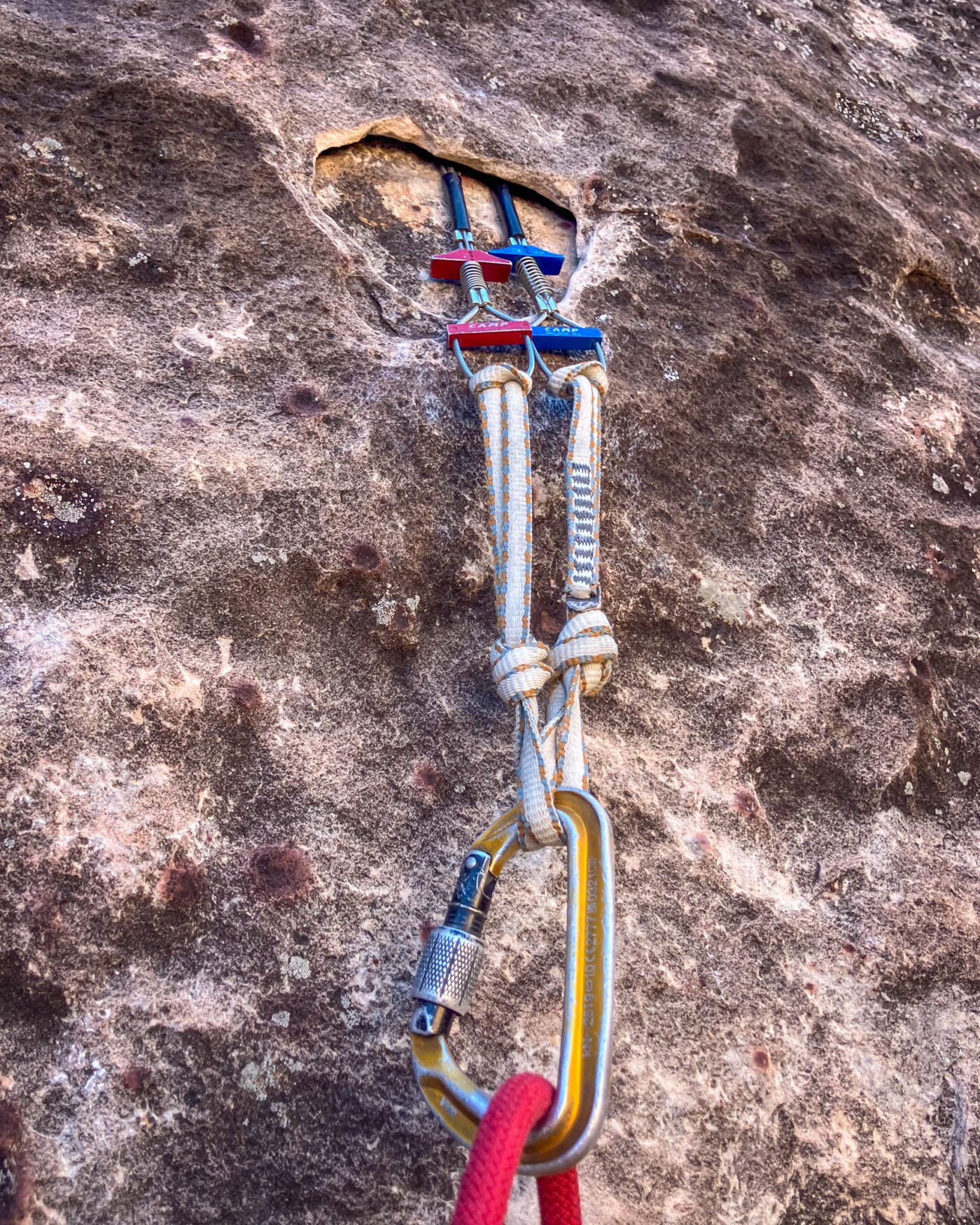
Having spent the last three months between Idyllwild and Joshua Tree, and fresh off onsighting Black Velvet Canyon’s psychological testpiece Rock Warrior (5.10b R, 800′), I offered my neck for pitch one. We agreed on two lead blocks, with pitch three a game time decision. In the days before I obsessed over the gatekeeper slab, which offers no reliable protection for the first 50 feet save for a pair of equalized inverted ballnuts in a shallow centimeter thick hueco. I like to think I’m a pretty solid slab climber, but hitting the deck from 50 feet would be a surefire life changer. I took the assignment seriously, gathering as much beta as possible. The most useful was a short Youtube video which made the crux look thoughtful but relatively short. From the base it seemed even less daunting, but as I edged towards the crux and meticulously placed my blue and red ballnuts equalized with a sliding X, limiting knots and a locking carabiner, I understood why so many climbers, even solid 5.11 trad climbers, have backed down. Even if the ballnuts magically held, I’d be awfully close to a sloping ledge. If they blew, I’d bounce off the ledge, surely breaking a few bones, then rag-doll another 25 feet into a forest of spiky desert flora and talus.

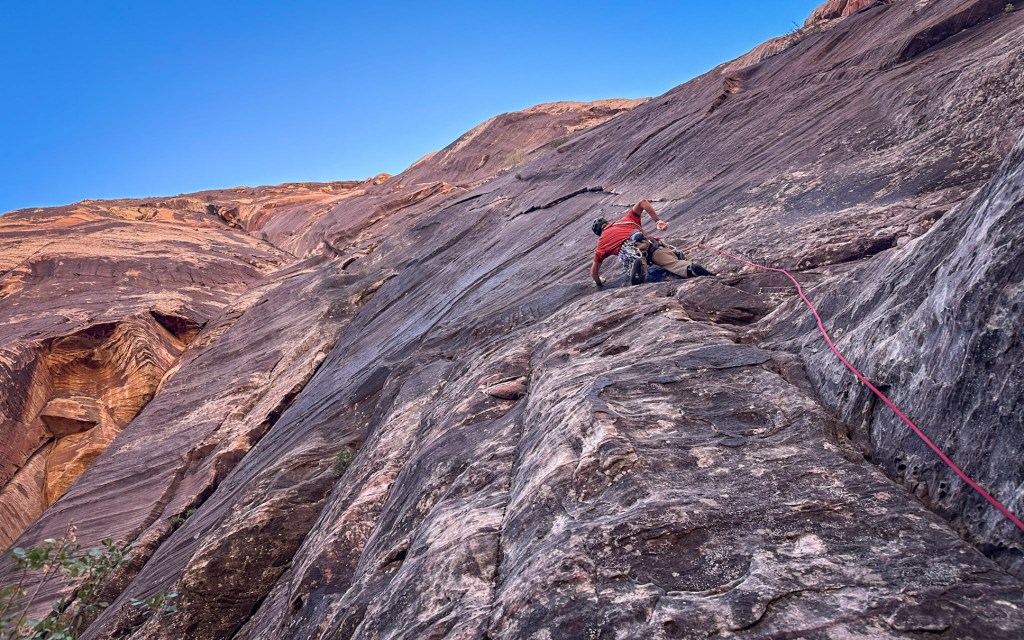
I ticked a few crucial smears and micro-edges before casting off. Fortunately, rumors of “no handholds” were exaggerated. I wouldn’t be able to catch myself on the sloping crimps present, but there was always something available for balance. Two or three precision tip-toes led to a flat six inch edge to regain full composure. As I wrapped my fingers over the edge Jed offered words of warming encouragement: “very smooth”. Mantling onto the edge was the final task, involving a particularly high step with a very hollow flake for balance. If the flake was thicker I’d have mindlessly cranked up, but this disc of flimsy sandstone beckoned a delicate touch. As I pistol squatted onto the ledge a cam lobe caught the racking loop of my climbing shoe, arresting upward progress at exactly the worst time for a freak occurrence. Fortunately, the edge was secure enough to reach down and unhook my gear without wavering. I placed two RP’s in the bongo flake even though I knew they wouldn’t hold a falling interest rate, and finished the final easier laybacking on larger edges into solid rock where I sunk an unquestionably bomber #2 cam. Phew – the devil’s work was through. The remainder of the pitch maintained a serious demeanor, with 30 meters of 5.10b laybacking on an otherworldly sequence of discontinuous, thin, varnished flakes. While gear was abundant to the anchor, the overwhelming majority was in expanding bongo rock and liable to fail beyond appearance. My strategy was two fold: place as much gear as possible, and don’t fall. This was the unequivocally the best singular layback pitch of my climbing career, a surreal gift from the climbing gods.

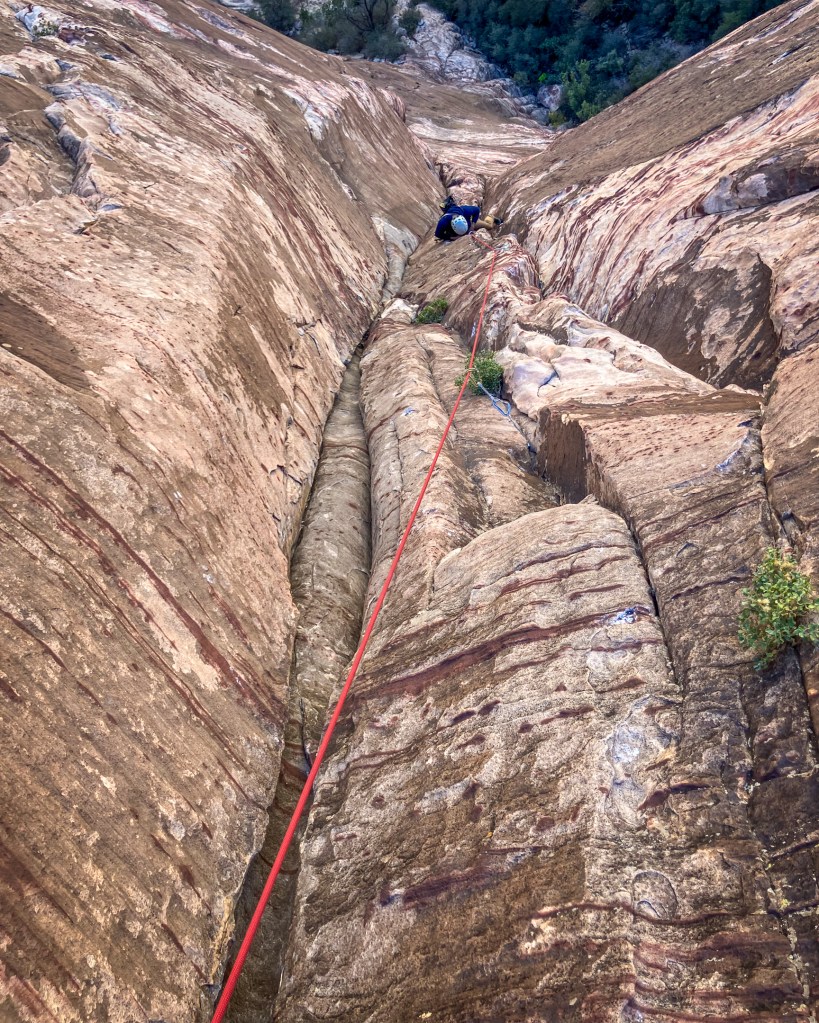
Above pitch one Adventure Punks assumes a more traditional “granite esque” style unique to Red Rocks, following a singular crack system for 450 feet. However, unlike granite the cracks have a sinister tendency to flare, especially on the softer gray, pink and white sandstone of pitch two. This was another serious lead, with the most insecurity and worst protection in the cruxes. A few bushes compounded an alpine vibe, and a penultimate rounded layback through a unique gray whaterchute was a geologic delicacy. I gladly accepted Jed’s offer to extend my lead block through pitch three, a beautiful chocolate corner with interesting jams and more steep laybacking. Though shorter and graded easier than the previous two pitches, we both agreed it was the hardest and most sustained of the first three.


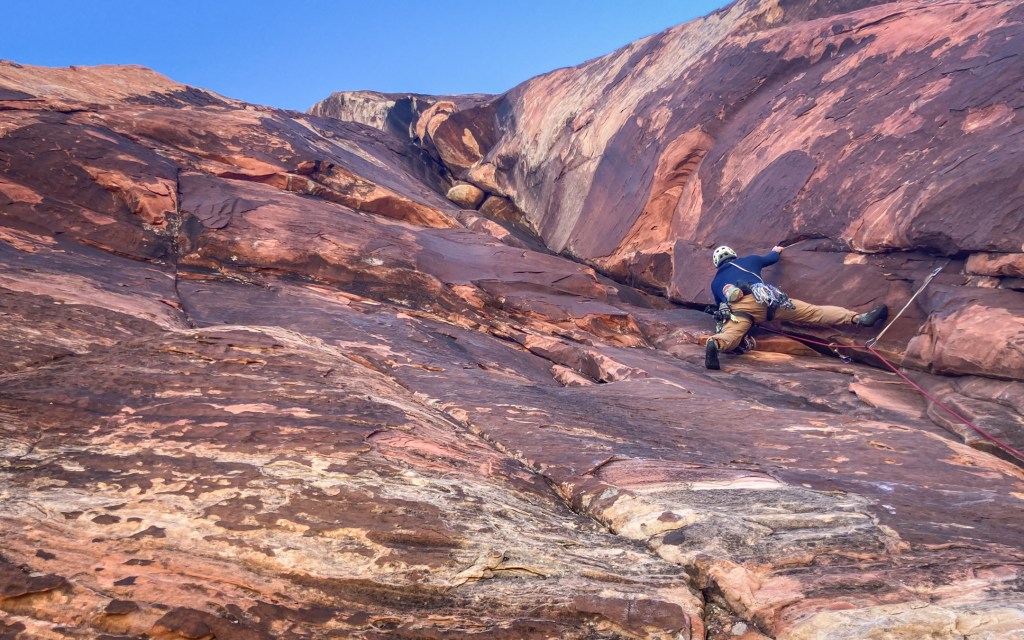
Jed took over on pitch four, which has two options. Staying in the corner is only 5.9 but passes some loose blocks. We chose a 5.10b variation, which exits the corner into a steep varnished finger crack on the left face. This was the best protected pitch of the route with a clean wall for safe falls, but the gear was fiddly and small, and the climbing style bold. Shortly after leaving the belay I slipped on a mundane stretch of mid-fifth class slab. I’m notoriously poor at top-roping. Once risk is removed I struggle with focus, hastily engaging in outrageous beta I would never do on lead. This is a major growth opportunity in my climbing, with parallel benefits to the real world. Had we more time I would’ve lowered back to the belay, but our short November daylight window urged continuance from a no-hands ledge just below. I found the crux of pitch four particularly demanding on my tender toes after several weeks of consistent climbing, but the jams were just good enough to over-grip and skate by.
Appreciate Ten Thousand Too Far? Support independent mountain journalism with $5.10 per month through Patreon (and receive extra bonus content), or with a one-time donation. Any and all support is greatly appreciated.
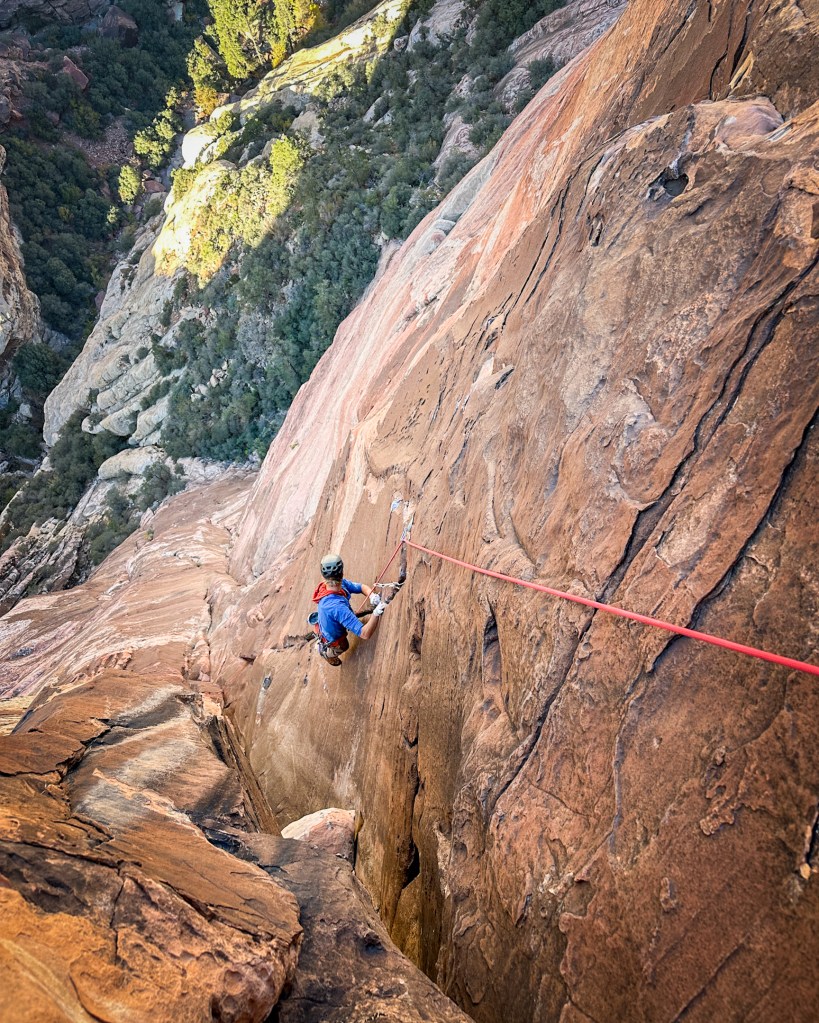
From a unique belay atop a small tower we scrutinized pitch five, the menacing and fabled 5.10d off-width. With a long history of alpine granite, Jed is far better at the masochistic craft of wedging, worming and wrenching a human body upward through inconceivably claustrophobic slots. I on the other hand, despise wide cracks. He was willing to take the pitch, but noticed my excitement and offered it away. Uplifted by the confidence of Rock Warrior and the previous four pitches, I snatched our hulking wide rack of two #6’s, two #5’s and one #4, dumped much of the smaller gear, flipped on some Rage Against the Machine, and set sail to test my metal. I was able to stem around the five inch crack directly off the belay, but as the off-width widened and face edges vanished I was cordoned into the beast. A tenuous crux of arm barring and cursing through a six inch section gave way to a tight squeeze chimney. I burrowed deep into the mountain but quickly got stuck, with no godly idea how to make upward progress. I tried right side in, then left side in… then right side in again… then left side in again. The crack was now too wide for our #6’s. Each effort I zapped significant energy, lurching a few moves only to slither back down via panic induced self arresting. Facing a surefire whipper from pure exhaustion if I continued to dick around, onto a lonely #6 Camalot too far below, I conclusively decided to attack the hell taco right side in and racked accordingly. With use of some desperate face smears and an embarrassingly imprecise display of heel toe cams, arm bars and chicken wings, I grunted, cursed and wormed through the squeeze to a second vital #6 placement. Just I began to peel, sweat pouring into my eyes and Rage Against the Machine still blasting, I kicked out to some button sized edges on the face. A desperate lunge on razor crimps led to a bottoming seam with just enough handholds to mantle onto a thank god ledge. Through with the blue collar stuff, but staring down a still very long pitch with tighter cracks, I lowered a loop of rope to tag up all the tiny gear I left at the belay, subsequently asking Jed to “never let me lead a hard pitch of 5.10 without a full rack of gear again.” Back in my happy place on the thin and technical, the rest of pitch five fell with smiles, void of expletives. Reaching the belay was magical. Watching Jed levitate through the squeeze chimney showcased how much technique I still have to learn. On routes like Adventure Punks, steely fingers and tight shoes aren’t enough.

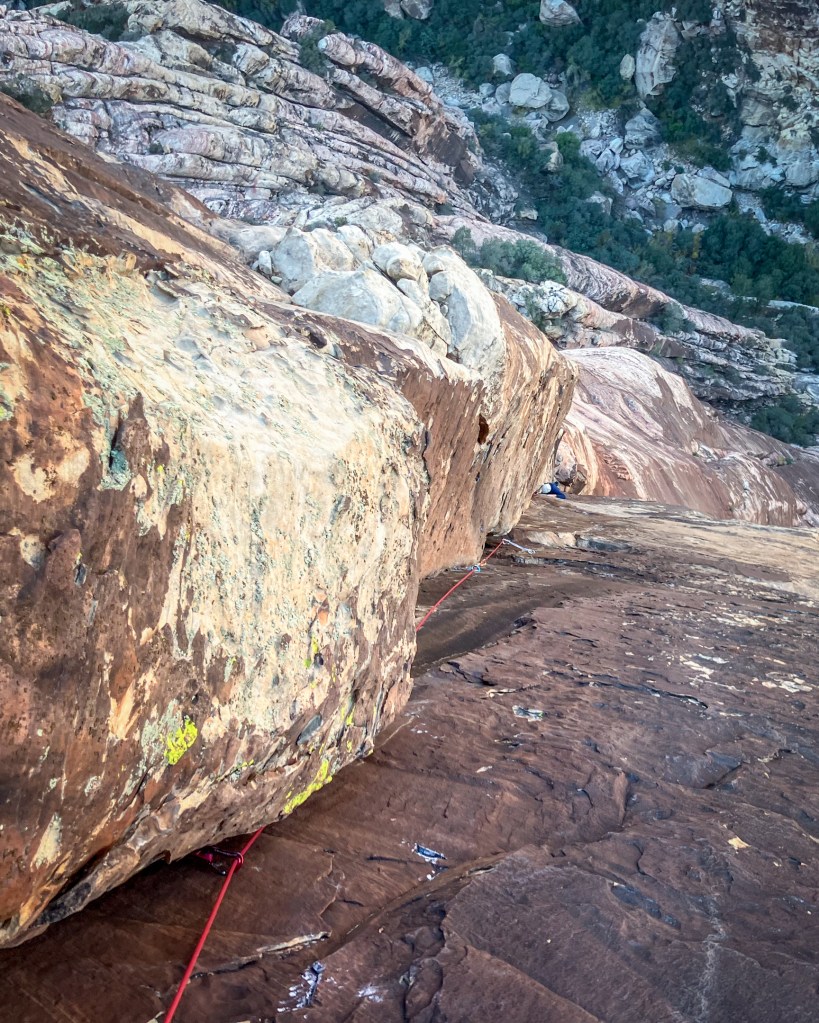
Vegas climbers have a love-hate relationship with Adventure Punks. The old guard, runout tested and alpine initiated, frequently tout it one of the best 5.10’s in Red Rocks. Others eschew it for uncharacteristically bold runouts, stretches of fragile rock, and of course… the dreaded wide crack. As an adventure driven Teton boy with a reverence for the increasingly unfashionable but once inherent mental component of climbing, I loved it. While the first pitch is the only truly runout pitch, every pitch is demanding of a different skillset and makes leaders “earn their gear”. “If this were a Urioste route, It would have a dozen bolts or more” said Jed, who’s climbed in Red Rocks for nearly two decades. After all, this route is not only named Adventure Punks, but was established by THE Adventure Punks, a clique of prolific anti-establishment 1980’s hardmen adroit at, and appreciative of, ground-up traditional climbing, where bolts are the last resort and not the first option. This is the same crew that established Rock Warrior and Sandstone Samurai, the areas most severe mental testpieces. Adventure Punks, while offering better protection than the latter, follows the same vein. In my entirely irrelevant opinion, it’s a spectacular line that I look forward to revisiting again… and again.
Want to support? Consider a donation, subscribe, check out my Patreon page, or simply support our sponsors listed below.
Ten Thousand Too Far is generously supported by Icelantic Skis from Golden Colorado, Range Meal Bars, The High Route, Black Diamond Equipment and Barrels & Bins Natural Market.



enter your email to subscribe to new article updates
DISCLAIMER
Ski mountaineering, rock climbing, ice climbing and all other forms of mountain recreation are inherently dangerous. Should you decide to attempt anything you read about in this article, you are doing so at your own risk! This article is written to the best possible level of accuracy and detail, but I am only human – information could be presented wrong. Furthermore, conditions in the mountains are subject to change at any time. Ten Thousand Too Far and Brandon Wanthal are not liable for any actions or repercussions acted upon or suffered from the result of this article’s reading.
 Ten Thousand Too Far