
On October 30th I redpointed the notorious Run For Your Life (5.10b R) in Joshua Tree National Park, after taking a huge fall from the final move 24 hours earlier. This article is brief trip report woven into a longer scoped essay, exploring the polarizing topic of traditional climbing ethics.
Traditional climbing ethics are nuanced and polarized. Sport climbers won’t understand. At modern sport crags routes are bolted on rappel with safety in mind, stick clipping the first bolt is commonplace, and runouts are shunned. The entire ethos of sport climbing revolves around removing danger and focusing on pure athletic performance. However, in traditional venues such as Yosemite, Joshua Tree and Idyllwild, objective danger is embraced as part of the puzzle. Routes were predominantly established “ground up”, with bolts placed on lead at no-hands stances, or while hanging from bodyweight gear such as steel hooks. When conceived this style, even fully bolted routes are anything but sport climbs.
Run For Your Life, a highly regarded and runout 5.10b face climb in Joshua Tree National Park, is a prudent example. The route was established ground up by the legendary Charles Cole, with six bolts protecting 90 feet of climbing on the monolithic varnished headwall of the Tumbling Rainbow formation. The first bolt is roughly 15 feet off the deck, defended by atypical 5.9 edging. The second bolt is well into the afterlife zone at 35 feet. And the third is 10 feet above a nasty 5.10 bulge which would surely produce an ankle crushing fall if one muffed the committing layback and mantle preempting the clipping stance. Then you have the last bolt, about six feet below a cryptic and steep 5.10 crux. Many bones have been maimed by this final move, with falls in the realm of 20 feet onto a lower angle slab. To remove all danger a climber could use a 90 foot painter’s pole and stick clip the anchor – but could they claim a successful lead? I don’t think so, that’s called top-roping. What if you stick clipped the third bolt, top-roping through the first crux and out of the ground-fall zone before leading on? I don’t think that wouldn’t sit well with many. So, is there any compromise?

Two weeks ago I attempted to onsight, and ultimately redpointed, Run For Your Life in a style that resonated with me. After crimping and edging a few moves off the deck on slick-as-snot black granite chips, I was faced with a long and insecure move to the clipping stance. Below the sticky rubber soles of my new Scarpa Generators was a stout ledge ready to shatter my already fragile ankles. The concerned eyes of my loving belayer stared longingly upwards. In that split second I forwent ego, down-climbed carefully, and reluctantly stick clipped the first bolt. By the time I entered ground-fall territory nearing bolt two I was accustomed to the climbing style, properly warmed up, and working with larger edges. The fall potential at bolt three hardly registered. I ended up muffing the top-out crux and taking the notorious ripper onto the black slab below, soaring and bouncing nearly a quarter of the climb, but thanks to an attentive belay and some reflexive instincts to turn sideways while airborne, waked away with a few minor scrapes. I jugged back up to the bolt, found two marginal wires in a thin seam to hold my weight while puzzling the last move, and climbed through.

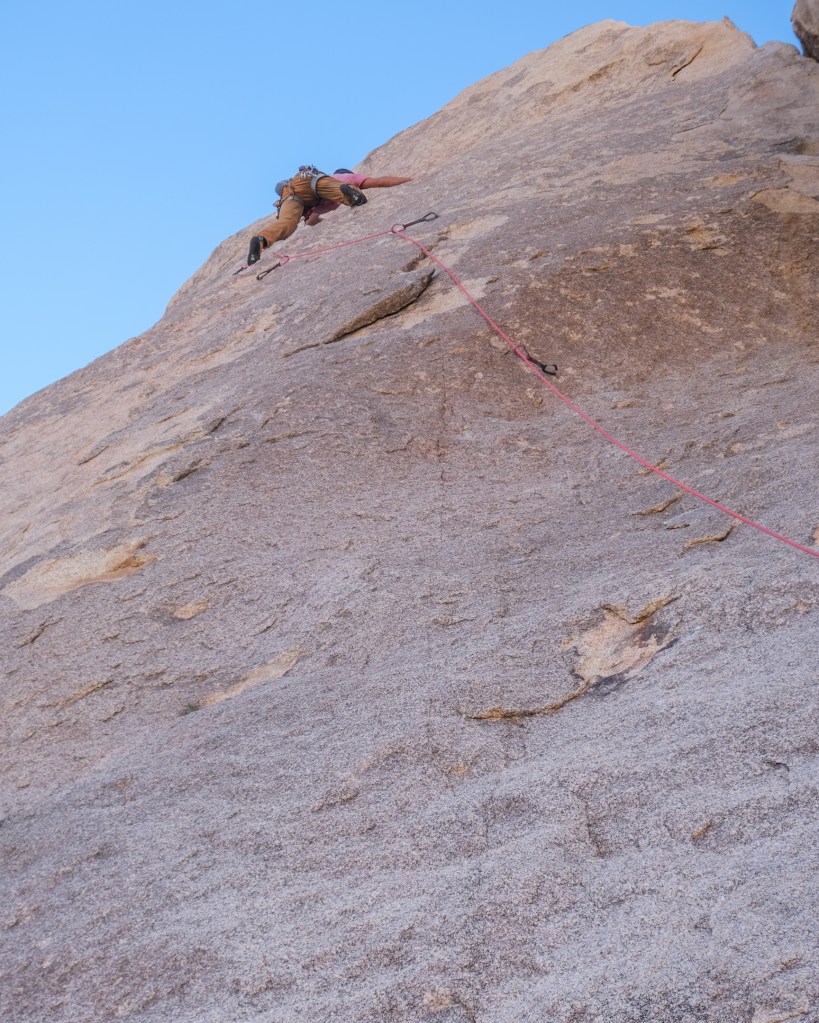
After much contemplation, caloric repletion, and one deep night’s sleep, Bobbi and I returned to the beautiful high perch underpinning the Tumbling Rainbow. With the first bolt stick clipped I climbed back through the disorienting 90 foot maze of sloping edges, matchstick crimps and slippery smears, lifted by the confidence of yesterday’s near perfect effort. Some moves felt easier, others harder, and soon I was shaking out before the final crux. I placed the same two wires as the day before, pre-loaded from the ground on separate quick-draws, even though their chance of arresting a fall was near zero. Two tenuous pebble smears later I snatched the jug, releasing an elated scream which echoed from the Mojave Desert to Los Angeles. I’d aspired to climb Run For Your Life since first coming to Joshua Tree in 2023, but wondered when, or if ever, I’d have the confidence. Between truly flawless rock, regal positioning above the Real Hidden Valley, sustained runouts that blur the line between exciting and dangerous, and a crescendoing finish that gives full meaning to the route name, Run For Your Life makes a solid bid for the best single pitch face climb of my life.
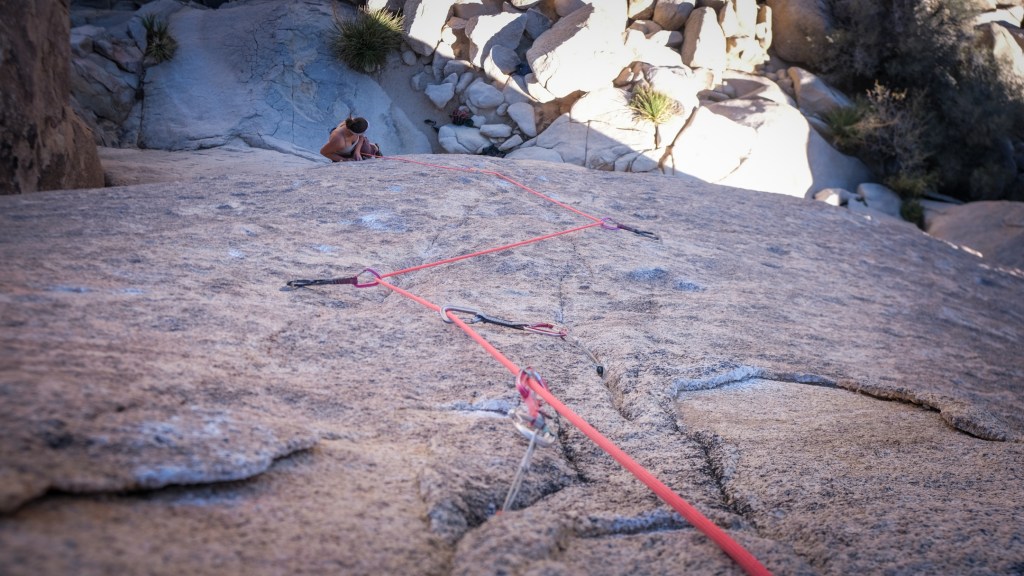
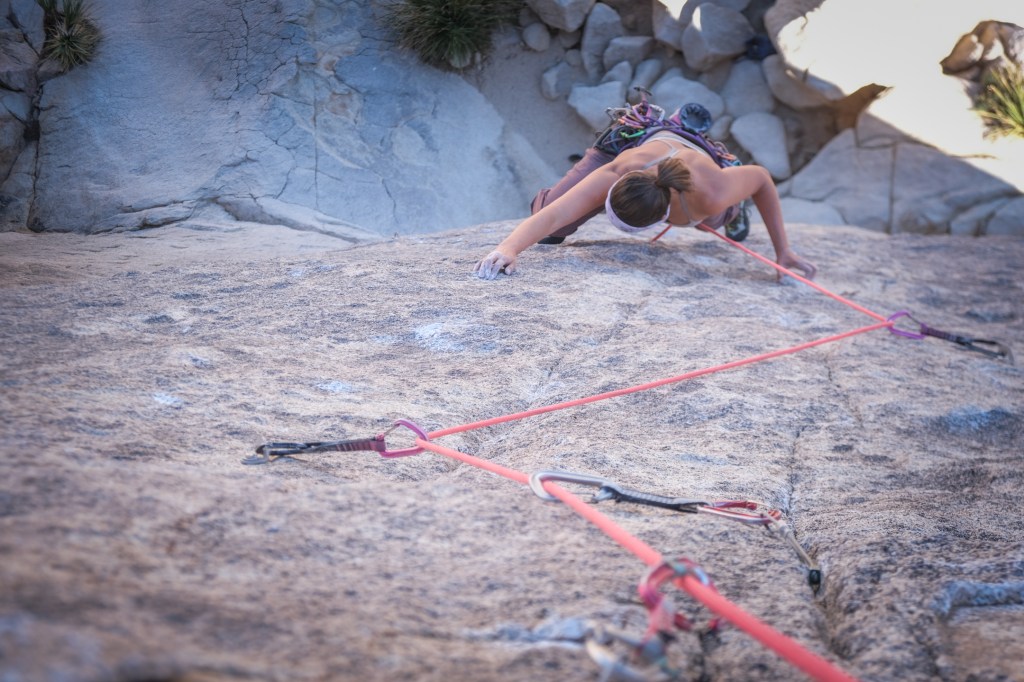
In the proceeding days my mind waffled back and forth from those first 15 feet of sinister soapy edges. Did I drop this historic test-piece to my level by using a stick clip? After all, the first ascentionist Charles Cole wagered ankles, spinal fluid and skull to reach that no-hands stance, only to tap in a lousy quarter inch bolt by hand. I on the other hand, clad in brand new sticky rubber slippers with a roadmap of chalked edges and half inch bolts overhead, couldn’t even muster the courage to creep up to the first bolt. If I couldn’t emulate the style of first ascent, could I really say I “sent” the route? Anyone with an aversion to overly granular climbing rabbit holes, turn back now.
Striving for ethical purity is the rightly gold standard of traditional climbing, and a value I hold dear. However, after a few too many quiet hours of campfire contemplation, I also realized this: fully emulating the style of first ascent will never be possible. Charles Cole had many disadvantages over 2025 Run For Your Life climbers, but also a few advantages. The disadvantages are obvious. He almost certainly had worse climbing shoes, had no pre-identified climbing line or knowledge of the challenges above, and had to tirelessly drill protection bolts by hand. But, he also had advantages. Run For Your Life has seen thousands upon thousands of pairs of climbing shoes. In 1987, those virgin varnished edges bit into shoe rubber like razorblades. Anyone who has climbed the timeless Joshua Tree edging and friction routes such as Heart and Sole (5.10a), Chalk Up Another One (5.10a) and Papa Woolsey (5.10b), then sampled lesser traveled gems such as Penny Lane (5.8), Dial 911 (5.10a) and Pumping Ego (5.10b R) which still boast velcro-esque friction, understand the profound effect 50+ years of residual shoe rubber and finger grease has on climbing grades. Mountain Project comments from Josh veterans confirm this phenomena. Cole also carried a bolt kit, giving him the availability to place protection in accordance with his ability. The first three bolts were undoubtedly drilled from no-hands stances, but the rest stances for the last three are so heinously insecure that I’d bet an entire rack of Totem Cams hooks were used for drilling. Herein lies the great conundrum of all ground up routes: first ascentionists had jurisdiction over the amount of protection they placed, and subsequent parties do not. There are copious edges which would accept a sky hook en’ route to the first bolt. The luxury of having an option to place that bolt, and hooks to hang on, can not be understated. On routes protected fully by traditional gear there’s even more nuance. No modern day climber, myself included, will ever understand the commitment of launching up a virgin crack with a rack of homemade pitons, slung hardware store nuts and a few clunky hexes, with a static hemp rope tied around their waist. Imagine what Yvon Chouinard, Royal Robbins, John Long and John Bachar would’ve been capable of with a svelte selection of ultra-light Camalots, RP’s, Ballnutz and TC pros. I shudder to conceive the possibilities. By this comparison all modern climbers are aid climbing to some unquantifiable extent. Since Royal Robbins led the first 5.9 in North America (pitch one fist/offwidth of Open Book on Tahquitz Rock) using solely homemade wooden wedges for protection, should we all just leave our big cams on the ground, and head to the sawmill before tying in?
This esoteric rant has only one logical conclusion: no ascent of a route will ever fully emulate the first ascent. Try as we may, all ethical climbing debates always settle in the vague realm of personal style. Eschewing a stick clip is undoubtedly a purer method to repeat classic routes, but to quote honorary Stone Monkey and North American climbing legend Cedar Wright: “climbing with a disregard for life is also bad style”. At the end of the day, every climber needs to define their version of acceptable style in accordance with their personal values. I’ve climbed routes with runouts exceeding 100 feet where if I had a bolt kit, hooks and a daisy chain, I could’ve manufactured a clip-up. The way I see it, climbing is dangerous enough. No route is worth dying for. I value my body and the sanctity of life, and plan on enjoying the sacred gift of rock climbing until old age. The best we can do as traditional climbers is to is be firm in our resolution, and disclose our style in full transparency while spraying around the campfire. The rest is out of our hands.
Want to support? Consider a donation, subscribe, or simply support our sponsors listed below.
Ten Thousand Too Far is generously supported by Icelantic Skis from Golden Colorado, Range Meal Bars, The High Route, Black Diamond Equipment and Barrels & Bins Natural Market.





subscribe for new article updates – no junk ever
DISCLAIMER
Ski mountaineering, rock climbing, ice climbing and all other forms of mountain recreation are inherently dangerous. Should you decide to attempt anything you read about in this article, you are doing so at your own risk! This article is written to the best possible level of accuracy and detail, but I am only human – information could be presented wrong. Furthermore, conditions in the mountains are subject to change at any time. Ten Thousand Too Far and Brandon Wanthal are not liable for any actions or repercussions acted upon or suffered from the result of this article’s reading.
 Ten Thousand Too Far