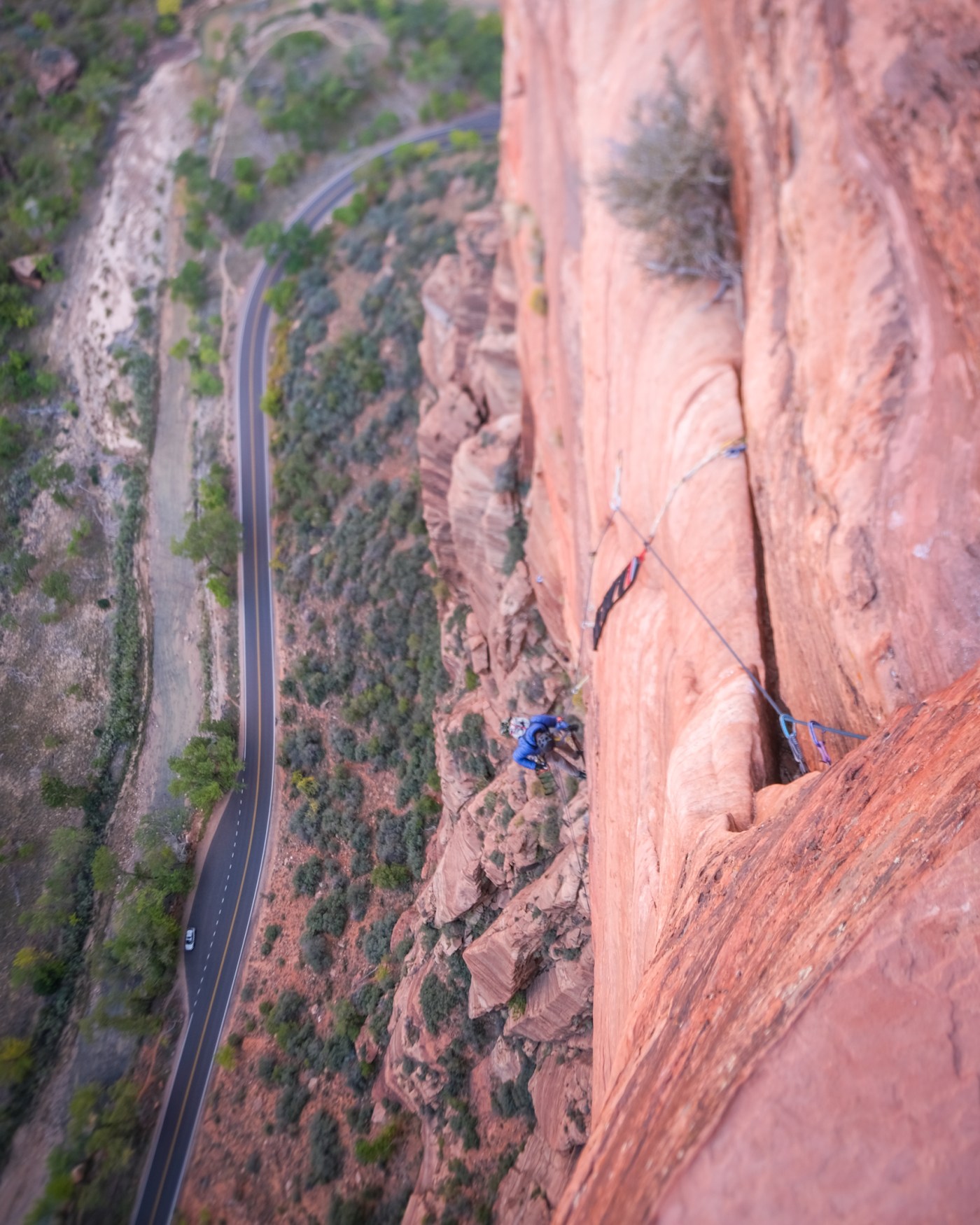
Spaceshot is one of the classic moderate clean aid routes and introductory big walls of North America, following a continuous 900 foot crack system in the heart of Zion National Park.
Big wall climbing has always captured my imagination. I can’t picture an adventure more outrageous, grandiose and profound than working tediously, using every ounce of daylight and more, to scrape and claw up an imposing multi-day wall. While Yosemite Valley is the undisputed motherland of North American wall climbing, with infamous formations such as El Capitan, Half Dome and Mount Watkins, Zion National Park is a close second. One 6.2 mile shuttle ride through Zion Canyon will reveal lifetimes of soaring multi-thousand foot sandstone walls begging to be climbed – but there’s a catch. Unlike the glacially carved granite of Yosemite, which tends to be extremely high quality and offer a wide array of climbing styles equally suited to free and aid climbing at every difficulty, Zion’s Navajo Sandstone is soft and erosion prone. Sculpted by the mighty Virgin River, walls here are smooth, steep and sinister. Moderate free climbs on sound rock are rare, because sub-vertical terrain is usually plagued by sandy and loose rock, few face holds, and bottoming cracks void of protection. The bulk of Zion free climbing begins around 5.12, on sustained vertical or overhanging cracks where effects of erosion are minimal. For mortals, climbing such objectives are either distant pipe dreams or entirely unattainable. On other formations, such as the venerable Shining Wall and Desert Shield, even the world’s strongest fingers wouldn’t stand a chance. Cue stage right: ladders, jumars and daisy chains. Aid climbers are the apex predator of Zion’s biggest and baddest walls.
Explaining the bizarre craft of aid climbing is beyond the scope of this article. A quick Google search will fill in the blanks. But basically, whenever the task gets too difficult for free climbing, aid climbers use retractable nylon ladders clipped to fixed or self placed gear to ascend. The seconding climber on a given pitch uses mechanical ascenders to climb the rope itself, joining the leader at the belay. The uninitiated may perceive aid climbing as “cheating” until they try the sharp end. In reality, it’s just another iteration of traditional climbing, laced with the unifying elements of technicality, physicality, adventure and danger inherent to free climbing.

Spaceshot is one of North America’s classic moderate aid climbs, following a singular wild arcing crack system on the incredible 1,200 foot Leaning Tower. The route has been free climbed via a bolted variation to the fourth pitch at 5.13a. The original aid grade was 5.6 C2, but as with most sandstone trade routes, the aid difficulty becomes more severe with traffic. Every placement, clean or otherwise, gradually weathers the Navajo Sandstone. On splitter crack pitches this effect is negligible, but in thin seams, pockets and edges, protection placements become “blown out” – less secure or entirely useless. Many folks think the crux pitch of Spaceshot is nearing C3 in 2025. One person on Mountain Project called it a “burning building”, liable to devolve into impossibility. Three free climbing pitches up to 5.7 defend five long aid pitches. Only one ledge is present on the entire upper headwall. Otherwise, Spaceshot is the land of merciless free hanging belays amidst wicked exposure. The line’s traversing nature prevents easy retreat. On paper, eight pitches sounds like an honest day’s work. But Spaceshot isn’t your ordinary eight pitches.

My partner for the day was Greg Gwinn, a good friend from Teton Valley, Idaho. Bobbi and I drove seven hours from Southern California after a long work week to meet Greg, who drove a similar distance. Bobbi originally planned to join us on the wall, but bailed after recognizing an incoming tidal wave of suffering. Greg had climbed two Zion walls and made a storm spoiled attempt on El Capitan earlier this year. I’d never climbed a proper wall, and prepared for this hasty trip by solo-aiding a measly two 50 foot cracks in Joshua Tree up to C2. Neither Jim Bridwell nor John Mittendorf was on the roster. When discussing logistics, we threw a multi-day ascent out the window. Most parties take two days on Spaceshot, fixing the first few pitches and returning after a night’s rest to finish. Some take three days, complete with haul bags and portaledges. We chose “Teton style” – single push, pack light, don’t stop. Having never jugged a fixed line, climbed a bolt ladder nor bounce tested an RP in sandstone, I naively pinned 10 hours as our target. Greg recognized my flawed ideology, and suggested leaving some bivouac gear at the base. I obliged.

The logistical crux to wall climbing in Zion is the shuttle system. Cars are not allowed in Zion Canyon without the parking permit we failed to obtain.As such, we were beholden to the public shuttle system. The first shuttle departs the visitor center at 7:00AM, and the last leaves the canyon at 8:15PM. By the time we stepped from the shuttle door, we had 12 hours to approach, climb and descend the most daunting wall of my life. Finding the base proved more difficult than expected. We used a down canyon public trail, roughly in line with the descent rappels, to access the cliff. We stashed overnight gear and extra water here, lest we flub the shuttle. Half an hour of cactus, yucca and holly bushwhacking later we tied in. The first pitch was a low-fifth class ledge grovel to the base of a gaping chimney marked by a large tree. This chimney was supposedly 5.6, but with a quadruple rack, ladders, jumars, two ropes, six liters of water and enough cordalette to lasso the Eifel tower, I thought it closer to 5.9. Unable to properly chimney because of a hulking backpack, I struggled through a strenuous, sandy and poorly protected grovel complete with leg locks, chicken wings, much bitching, and everything else you don’t need to start a good climbing day. Greg’s next lead took a “5.4 trough”, another harsh, dirty, and non-backpack conducive wide crack on junk rock. We reached the first aid pitch by 10:30, delighted to see anything other than a crumbling off-width. Neck craning views up the most incredible, impressive and imposing wall I’d ever laid eyes upon immediately quelled all prior traumas. Captain, we are ready for takeoff.

As the experienced aid climber, Greg signed up for the crux pitch five. I was thereby assigned pitch four, a sustained bolt ladder into a thin seam originally rated C1. After clipping one lone bolt off the belay, I was confronted with a blank section of sandstone edges defending the second bolt. “I thought this was supposed to be a bolt ladder!” I whined. Hooking was the only option, but I had never placed a hook and wasn’t much above a ledge. Timidly I preformed two consecutive hook moves, gingerly weighting each and keeping sole focus on maintaining downward tension. Clipping the second bolt was a tremendous relief, and I hastily began chugging past well spaced bolts to the seam. The initial transition to the seam was painless as it devoured solid small cams, but at a break in angle the crack flared. The crux was a brutal section of worn out pods which demanded the dark art of high stepping on small brass off-sets. On my first attempt I ripped a 2kn RP while getting into the third ladder step, resulting in a heroic 20 foot fall onto a fixed nut. Equally exhilarated as terrified, I jugged back up to the same move, only to face the same problem. These pods weren’t going to take anything besides tiny RP’s, no matter how much I stared them down. I placed the exact same piece, taking care to set it deeper in the flare with a gentle nut tool tap. I gingerly wiggled up into the second, third and eventually fourth step, only to meet another sea of shallow pods. My next RP held a gentle weighting, but spat grains of sand with every bounce test. I shuddered at the idea of taking an even larger fall. In an act of desperation I fiddled in the worst tri-cam I’ve ever placed, gave it a good bounce, and was blown away it didn’t pop. I equalized it with the RP below, took a deep breath, and walked as high as possible in my ladder careful not to sneeze, cough, or blink. I stabbed a #0.3 into a solid slot, strangulated it with a fistful of fear, and proceeded up easier climbing to a hanging belay. This entire paragraph represents a 2.5 hour lead which felt closer to 30 minutes. Apparently “dissolving time” is a phenomena in wall climbing.
Appreciate Ten Thousand Too Far? Support independent mountain journalism with $5.10 per month through Patreon (and receive extra bonus content), or with a one-time donation. Any and all support is greatly appreciated.

Greg’s next lead was the crux, and the sole C2 pitch of the route. It began much as the previous, with a half rope length of straightforward C1 before the business. A short tension traverse from an intermediate belay led to two dodgy fixed pieces and the crux bottoming seam. In this distinct few body lengths time froze entirely. Greg handled the work with patience and fortitude, engineering an inspiring sequence of committing moves between RP’s, two lobe Totems, and tiny ballnuts. He said this pitch was harder than any C2 on Lurking Fear. After another 2.5 hour lead, this time in a back crushing hanging belay, I set off to jug and clean my first ever aid pitch. Luckily, I found my YouTube training and one day of field practice more than sufficient. With a little attention to detail, following a vertical aid pitch is pretty straightforward. I arrived at another hanging belay, with nothing but more steep wall and hanging belays above. The sun was barely hanging above the canyon rim. Any hope of nailing the last shuttle was long extinguished. We were headed towards a night shift.
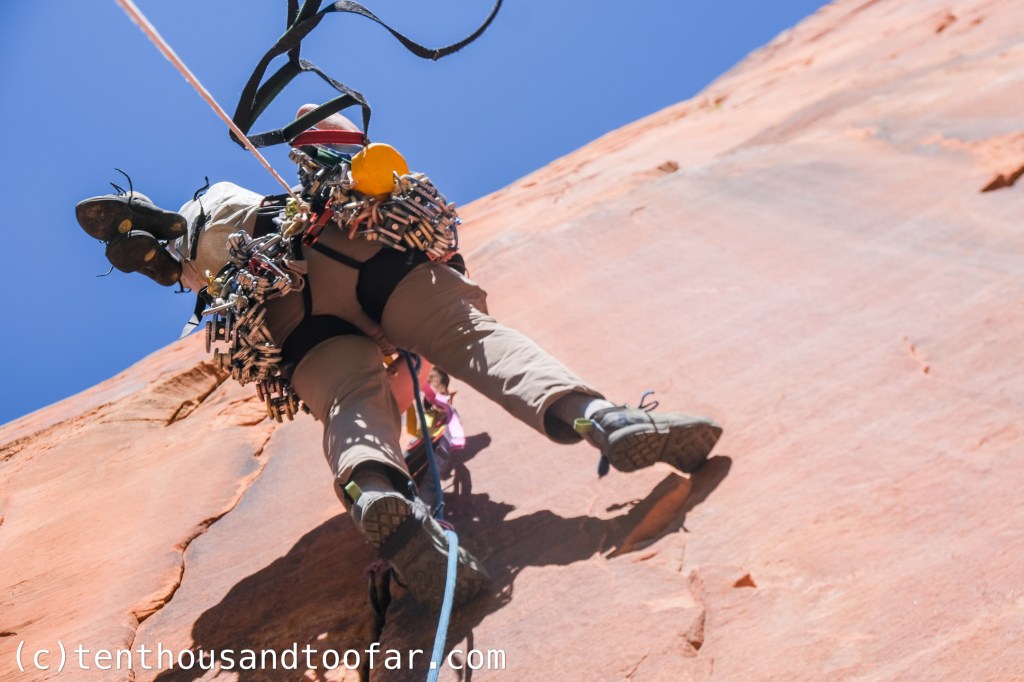


Pitches five and six were refreshingly gentle compared to the tip-toe-tech below. Each was plug and chug C1 with incredible exposure. Back cleaning 20 feet between cams on a bulging hand crack 1,000 feet above the rushing Virgin River and technicolor Zion ecosystem is a feeling unfit for words, unlike any climbing experience I’d had before. Greg finished pitch six in the dark, and I had the ensuing pleasure of jugging a slightly overhanging and traversing hand crack by headlamp. Every piece I cleaned ricocheted me horizontally into space. At first this was utterly terrifying, but quickly I felt like a child on a playground swing. A final steeper and sharper traverse forced a bit of re-aiding before pulling onto Earth Orbit Ledge, our first ledge since stepping into aiders seven hours ago. My heart swelled at the simple prospect of sitting on flat ground. After her own solo canyoneering adventure, Bobbi bussed into the canyon and watched our last two pitches, cheering and photographing us from the road. Hearing your girlfriend yell “I love you!” from 1,000 feet below a hanging belay is special. She’s a gem.

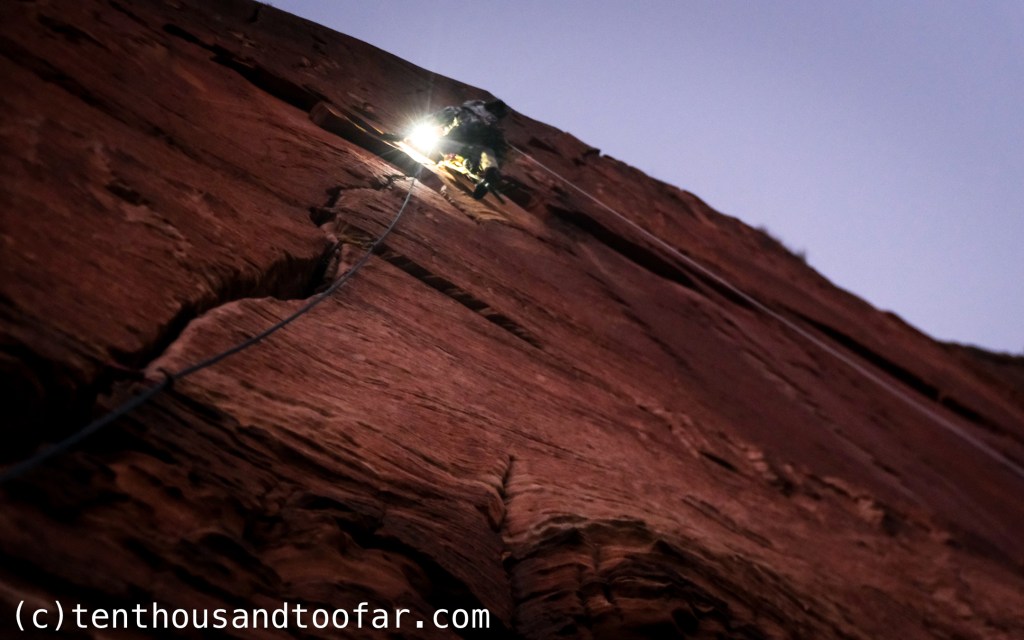
We took half an hour at Earth Orbit Ledge to lie horizontal and get juiced the final C1 pitch. Sure, it’s “only C1” – but involved a committing free traverse over insane exposure to a bolt ladder we couldn’t quite spot by headlamp, and reportedly had a few snapped pins that beckoned witchcraft to pass. Preparing to launch I cranked my headlamp to the highest setting, but was met with dim light. “You’ve got to be kidding me”. I replaced the batteries a few days prior, but it was already low. Neither of us had a spare. I had a high powered flashlight to help locate distant fixed rappel anchors, but that was low too – I really didn’t think I would need it save for a few quick blasts to supplement a headlamp. Mountain Project is rife with warnings about a convoluted and confusing descent of exposed scrambling and five double rope rappels. Without a second light or descent familiarity, we feared a nightmare. Reluctantly we opted to shiver through the darkness on Earth Orbit Ledge. Shivering turned out an understatement. The ledge is about five feet by ten feet, stepped, and sloping 10 degrees. Early sleep was elusive, and by 1:00AM temperatures plunged too low for anything besides cuddling. We spent spent the next five hours wrapped in a two person space blanket eating candy and solving existential problems of humanity. Periodic calisthenics aided warmth. Signs of first light brought ecstasy. In eleven years of traipsing around the high mountains I’d successfully avoided the unplanned bivouac. I always wondered what it would feel like. Now I know: Chinese water torture. Seconds turned into minutes, minutes to hours, and hours to days. At one point I was convinced the sun would never rise, and October 18th, 2025, would mark the start of our next ice age.

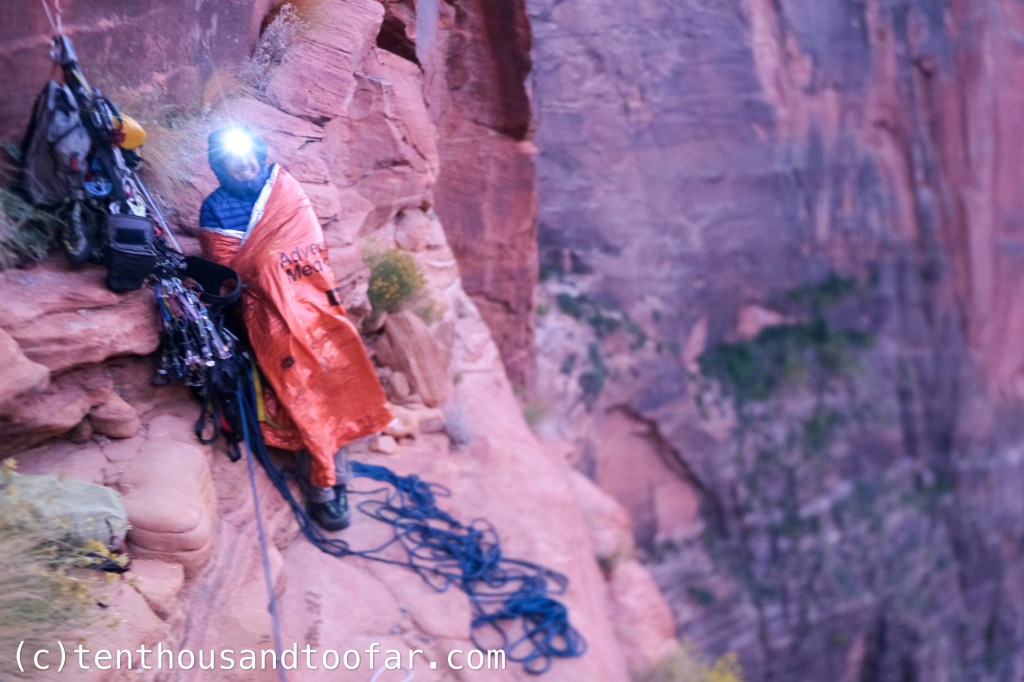
At first light I finished the lead I began 10 hours earlier. The C1 felt more like C1+, and the mandatory 5.6 free climbing, while accurately stated, was sandy as all hell. The pitch traverses directly off Earth Orbit Ledge with mind bending exposure. Awkward and committing free moves surmounting a claustrophobic roof defended the bolt ladder, and the aforementioned snapped pins required a few hook moves between the remaining pins waiting to snap. Combined with sleep deprivation, leading pitch eight felt like lucid dreaming. A penultimate friction slab and mantle with our hulking rack forced a changeover to rock shoes at the final bolt. Sadly, even my sticky rubber slippers couldn’t conquer ball bearing sand. My second smear blew just as I snatched a jug rail, and suddenly I was dead hanging from two hands, nipples to sandstone, at the tippy top of the Leaning Wall. Thoroughly adrenalized I scurried back onto my feet, took a few deep breaths, lurched into a final sandy mantle with crippling rope drag, and French-freed a short hand crack to the top. I fixed the rope and collapsed onto a brilliant ledge while Greg swung into space and jugged to freedom. Spaceshot was ours.


Fortunately the descent 100 times easier than it’s grizzly legend. Every anchor was intuitively located, and the “fourth class scrambling” between them wreaked of second class. 27 hours after stepping from the shuttle we were back on pavement. Three courses at the Spotted Dog Cafe never tasted so good, and the seven hour car ride home with Bobbi was bleary. I arrived to work at 6:00AM the following morning in a yawning haze of dazed gratitude.
All in all, Spaceshot was everything I expected and more. Had we obtained a parking permit for an alpine start, we would’ve definitely finished the route in about 18 hours and enjoyed a restful night of excess calories in our cozy campers – not too shabby for a first wall. As it played out we had just enough food, water, and safety provisions to make our unplanned bivouac character building, but safe. While lying pancaked on the summit waiting for Greg to jug the final pitch, I decided wall climbing was too exhausting, and I would be waiting until 2026 to try another. Fast forward 72 hours: I’m planning my next. The entire big wall experience encapsulates audacity and adventure to the highest degree. Where free climbing is an action movie, aid climbing is a suspense thriller. Bounce testing and tip toeing up a string of hooks and bodyweight gear may not be too physically demanding, but it sure is engaging. Jugging a free hanging line while dangling over 1,000 feet of air is electrifying. Working with great company to accomplish a unified goal of epic proportions is gratifying, and the memories we brought home will last a lifetime. In a few days I’ll forget that second pitch chimney ever existed, until I’m wedged in it again.

Want to support? Consider a donation, subscribe, or simply support our sponsors listed below.
Ten Thousand Too Far is generously supported by Icelantic Skis from Golden Colorado, Range Meal Bars, The High Route, Black Diamond Equipment and Barrels & Bins Natural Market.




subscribe for new article updates – no junk ever
DISCLAIMER
Ski mountaineering, rock climbing, ice climbing and all other forms of mountain recreation are inherently dangerous. Should you decide to attempt anything you read about in this article, you are doing so at your own risk! This article is written to the best possible level of accuracy and detail, but I am only human – information could be presented wrong. Furthermore, conditions in the mountains are subject to change at any time. Ten Thousand Too Far and Brandon Wanthal are not liable for any actions or repercussions acted upon or suffered from the result of this article’s reading.
 Ten Thousand Too Far
Leave a comment