
On Thursday June 19th, 2025, I climbed Irene’s Arete with new-to-the-Tetons desert coworker Kenzi Stemp, including a two pitch direct start which has surely been climbed before, but is undocumented and often skipped. Higher, we explored a few harder variations with pleasant rewards. This article will focus solely on the variations we climbed, and others I’ve climbed over the years, which add tremendous value to this already great route.
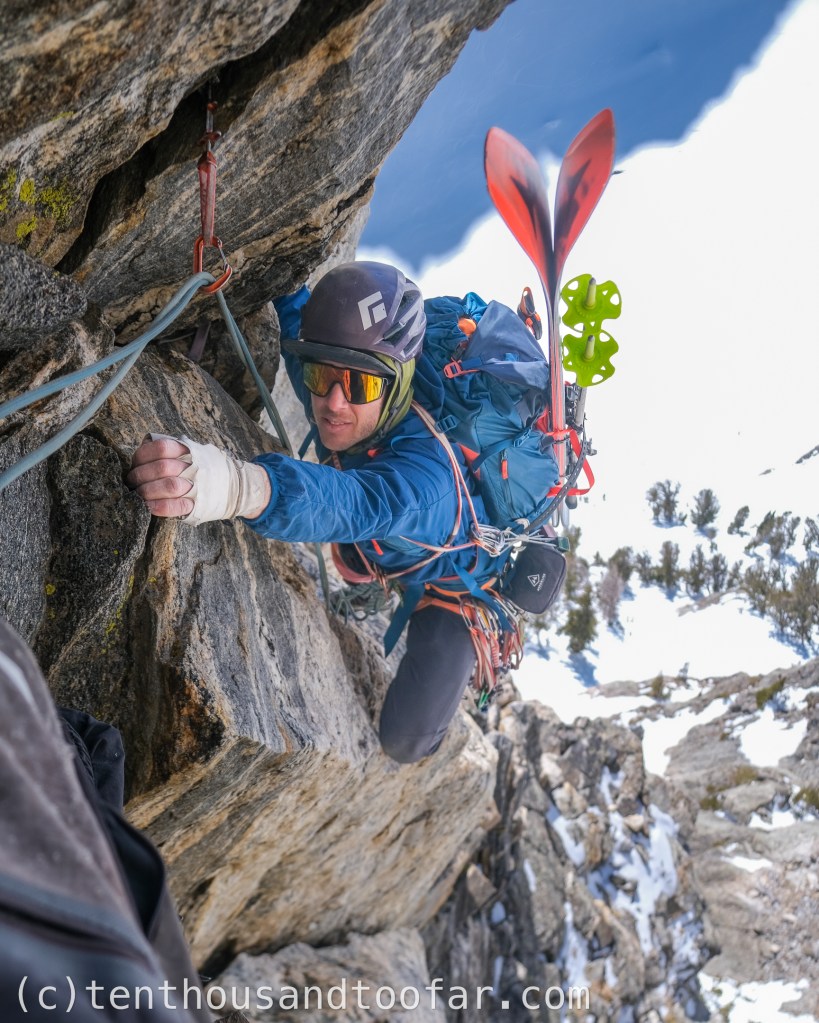
Irene’s Arete is often considered the best moderate rock climb in the Tetons. With over 1,000 feet of flawless golden granite, it’s certainly among the elite. By the path of least resistance, Irene’s can be climbed with a single pitch of 5.8, and is traditionally 6-7 pitches. I have made both a summer and calendar winter ascent (with skis!) of Irene’s. Today I was climbing with new partner Kenzi Stemp, whom I met doing Desert Tortoise surveys in the Mojave Desert this spring. We ended up climbing three harder variations to the original route, and added two pitches at the geological inception of the arete which are commonly skipped. These modifications transformed an already classic route into a truly exceptional nine pitch adventure. Because Irene’s has been covered on 10K2Far twice already, this article will focus specifically on the variations. As for Kenzi and I’s day, it was all smooth sailing and an absolute blast. If you want other Irene’s beta, including approach and descent stuff, see these articles:
- Irene’s Arete Trip Report – Summer – (07.30.23)
- Irene’s Arete Trip Report – With Skis in Winter, Linked with Spoon Couloir – (03.17.24)
Direct Start (5.5, 2 pitches)
Guidebooks warn of unsavory rock on the lower arete, advising a convoluted and confusing journey up ledges east of the crest to to reach a small belay ledge about 100-200 feet above the geological toe of the ridge. After botching this recommended approach twice already, I decided we tackle the lower ridge head on. Soloing in approach shoes, we began on the east side of the ridge and climbed a slanted blocky weakness, eventually becoming vegetated, with difficulties up to 5.4 for approximately a full rope-length to a large grassy ledge on the west of the ridge. Our second “pitch” was a 5.5 hand traverse back to the east side, intersecting the standard route about 50 feet above the official start to pitch one. Had we been using a rope, we would have set a belay at one of the many available small stances on pitch one, but instead we downclimbed a 5th class corner to the original pitch one belay tree for a spacious changeover. I’ll never do the recommended approach again. While our direct line was slightly dirty, we encountered no relevant loose rock, route finding was intuitive, and scored two bonus pitches of fun climbing!
Pitch Two – 5.8+ Tooth/Flare Variation
It’s unclear whether or not this “variation” was the original path of first ascent. However, because it can be easily skipped to the east via a short 5.7 hand traverse (Chase and I’s choice in winter with skis), I’m calling it a variation. The downward “golden tooth” described in many guidebooks marks the start, visible from the pitch one belay. This variation follows a clean and attractive flaring hand crack with fixed pins on the left margin of the tooth. The climbing was awkward for the grade, favoring technique over strength. The crack’s flaring nature provided poor jams and constantly tried to snag my backpack. That said, it provides a far more sustained, aesthetic and engaging pitch compared to the 5.7 hand traverse, which moves right from below the tooth into low angle terrain. This is a long pitch. I burned nearly a full rack and a half!
Pitch Four – 5.9 Hand Crack Variation
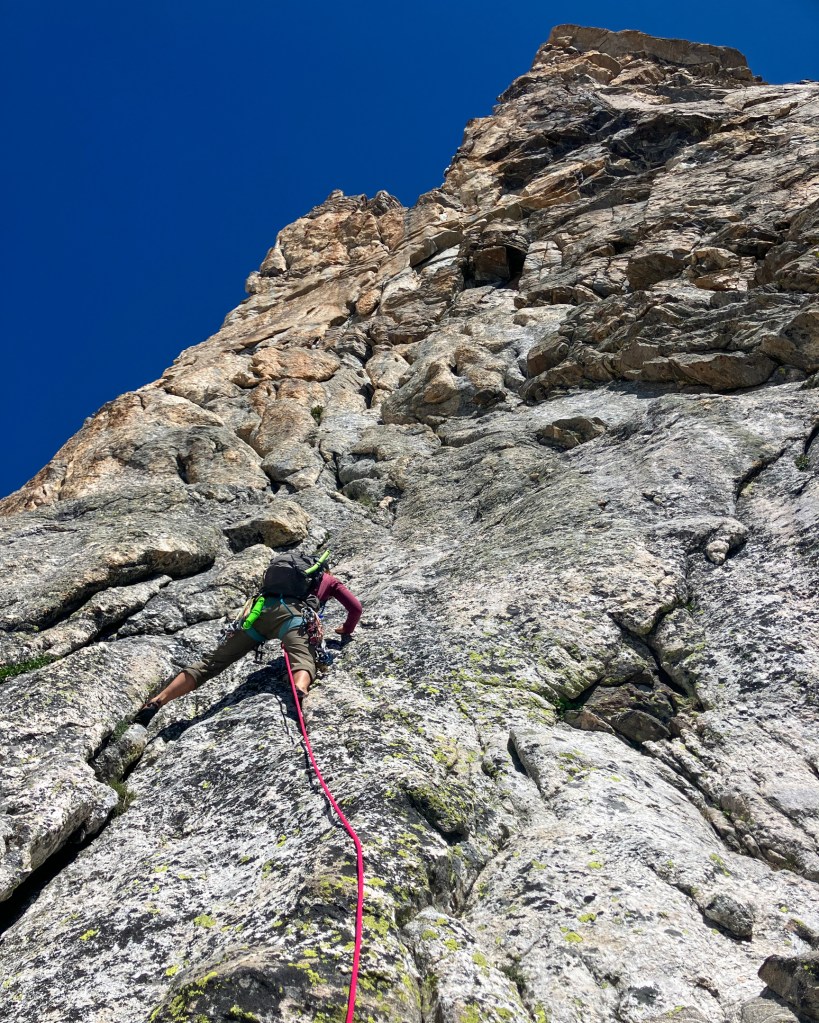
Above pitch three lies a spacious belay ledge with two choices for continuance. To the left is the standard route’s crux, a tenuous and reachy 5.8 hand traverse over massive exposure to the left. Instead, we followed a beautiful 5.9 hand crack straight up, which provided the best climbing I’ve done on Irene’s. The steep and varied weakness offered sinker jams and bold movement, culminating in an awesome double finger crack, and exciting stretch left to easier terrain. This pitch is semi-sustained, well-protected, and highly recommended.

Pitch Six – 5.10- Direct Arete Variation
Pitch six offers three variations. The first two begin from a vegetated notch which requires a short down-climb or rappel to reach. In this notch is a large tree. A 5.5 hand traverse begins below this tree, moving right across a short steep section into easy slab terrain on the east side of the ridge. A notoriously unpleasant 5.8 crack, which I’ve never climbed, begins directly behind the tree. Today, Kenzi and I wanted to avoid the down-climb and attempt the direct finish, characterized by 5.10- laybacking over immense exposure at 11,000 feet! Protection was tricky right of the deck, and I struggled to commit to intense granite laybacking over small gear I didn’t fully trust. After climbing into and out of the crux too many times, I eventually forged into serious fall territory, got a sloppy hand jam, and fiddled in another nest of decent-ish gear. Facing a raging early season pump, I attempted to climb the crack head on, frothing for the jug I never found. A short whipper left me hanging on the rope dejected. It’s been a long time since I’ve fallen on 5.10- in the Tetons. I should’ve hauled my pack! While hang-dogging I spotted a sweet camouflaged monster jug 10 feet left of the crack, and worked out a neat foot sequence to snag it. This stellar variation is recommended to those comfortable protecting tricky and pumpy alpine 5.10.
Appreciate Ten Thousand Too Far? Support independent mountain journalism with $5.10 per month through Patreon (and receive extra bonus content), or with a one-time donation. Any and all support is greatly appreciated.


Other Variations
- Another popular variation is an obvious 5.9 dihedral directly above the pitch five belay. I have not climbed this, but it stares you straight in the face and begs to be climbed. The standard route bypasses this dihedral on the left via a “round the corner” traverse to a 5.7 crack with a fixed pin.
- There are two ways to finish pitch four. After starting via the 5.8 leftward hand traverse or 5.9 hand crack (detailed above), the traditional route wanders right of the crest to a flaring off-width with a few fixed pins in the back – old-school 5.7. In the winter of 2024 when Chase Krumholz and I climbed Irene’s with skis, Chase was onsighting this pitch and accidentally finished on the direct crest via a poorly protected and thin slab. The guidebook lists this unpopular variation as 5.9R. “5.13 Chase”, who climbs 5.13, doesn’t recommend it!
- Lastly, there’s a 5.10- dihedral/crack somewhere on the left side of the crest accessed via a ledge system from pitch three or four. I’ve neither climbed nor seen this, or heard of anyone climbing it. Teton Rock Climbs by Aaron Gams (book) has more information.
Pitch by Pitch Summary
Here’s the condensed lowdown on the above. I’m unsure of where the 5.10- variation to pitch four or five exactly is, so I omitted it. I do know it’s on the left (west) side of the crest. Consult Teton Rock Climbs (book) if interested. Hope this helps give you a perfectly customized and awesome adventure.
- Direct Start Variation (5.5, 2 pitches)
- Beginning on the east side of the geological inception of Irene’s Arete, climb a blocky pitch up and left to a belay on the west side of the crest (5.5). From the belay, traverse horizontally right over big exposure with a slab crux (5.5) to the right side of the crest, intersecting the standard route about 50 feet into the original “pitch one”. Set a belay at one of many small stances.
- Original Approach Scrambling Crap (vegetated and confusing 4th-ish class)
- From the toe of the ridge (start of Direct Variation), use ledges and vague climber’s trails right of the crest to bypass the initial steeper rock of the direct crest. I’ve tried twice, and still don’t know where to go. Once Bobbi Clemmer and I accidentally soloed up to the belay ledge beneath pitch three. Another time Chase Krumholz and I got lost and found again, eventually down-climbing some dicy slabs and traversing back left to the “proper” belay ledge for pitch one, which begins at a small tree about 50 feet east of the crest, directly inline with the golden tooth of pitch two. Consult a guidebook, or better yet try the direct start!
- Pitch One (5.6-ish)
- Identify the “golden tooth” of pitch two and climb non-descript cracks towards it. Set a belay below the steepening terrain of pitch two, or link into pitch two.
- Pitch Two (5.7)
- Climb up to the golden tooth via steeper cracks. At the tooth, move right along a steep but juggy hand rail (5.7) and mantle into lower angle terrain. Scramble up and back left to a spacious belay on the direct crest.
- Pitch Two Tooth Variation (5.8+)
- Climb a flared hand crack directly up the left side of the golden tooth past a couple of fixed pins (5.8+). Very sustained, and liable to snag backpacks. Belay at the same ledge described for pitch two above.
- Pitch Three (5.7+)
- Start on the left side of the crest. A few poorly protected slab moves (5.7) lead to the right side of the crest, where pleasant double cracks (5.7) continue up the crest. Above these cracks, move back left of the crest to a crack with a fixed pin in a slippery left facing corner. Follow this corner (5.7+) and mantle onto another spacious belay ledge.
- Pitch Four (5.8)
- Hand traverse directly left off the belay following a horizontal crack with thin protection. Exiting the traverse is the crux and hard to protect. Continue above on easier terrain until the wall gets blank and it makes sense to trend back right. Use long slings generously, or consider an intermediate belay somewhere in this area. If you chose the right path, you’ll eventually reach a flaring slot with some fixed pins in the back. Grunt up this awkward slot (5.7) and continue up easier cracks to another spacious belay ledge with a fixed pin.
- Pitch Four Hand Crack Variation (5.9)
- Climb a sweet and obvious 5.9 hand crack straight off the belay. Trend slightly left where logical, following protection in narrowing cracks back to the main route.
- Pitch Four Death Slab Variation (5.9R)
- Where pitch four moves right about halfway up the pitch, continue directly up via thin slabs with terrible protection. Don’t fall. Better yet, just don’t climb it.
- Pitch Five (5.7)
- Move left around an unlikely corner to a short crack with a fixed pin and a 5.7 move. Continue straight up to the crest on blocky alpine terrain (5.6). Follow the low angle crest to a fixed belay on the direct crest.
- Pitch Five Variation (5.9)
- Stem and jam the dihedral directly above the belay (5.9) to the direct crest. Follow the low angle crest to the same belay described above.
- Pitch Six (5.5)
- Down-climb or rappel into the notch separating the rest of the ridge. Move down and east, beyond a lone tree, and set a belay. Hand traverse right around the arete (5.5) onto a low angle slab, which is followed back to the ridge,
- Pitch Six Hand/Fist Variation (5.8)
- Down-climb or rappel into the notch separating the rest of the ridge. Move down and east to a lone tree and belay. Climb a notoriously unpleasant hand and fist crack directly behind the tree. Join pitch six on the low angle slab and continue to the crest.
- Pitch Six Direct Arete Variation (5.10-)
- Do not down-climb into the notch. Instead, meander across a bridge of wedged boulders to stay on the crest. Bold laybacking with thoughtful protection on the left side of the crest (5.10-) leads to a sloping ledge. A final steep mantle defends access to the direct crest. Belay at a small ledge above.
- Pitch Seven (5.0)
- A rope length of exposed scrambling on the crest leads to the top of the climb. The chossy summit pyramid is easily gained (4th class) from the north side.

Want to support? Consider a donation, subscribe, or simply support our sponsors listed below.
Ten Thousand Too Far is generously supported by Icelantic Skis from Golden Colorado, Range Meal Bars, The High Route, Black Diamond Equipment and Barrels & Bins Natural Market.





subscribe for new article updates – no junk ever
DISCLAIMER
Ski mountaineering, rock climbing, ice climbing and all other forms of mountain recreation are inherently dangerous. Should you decide to attempt anything you read about in this article, you are doing so at your own risk! This article is written to the best possible level of accuracy and detail, but I am only human – information could be presented wrong. Furthermore, conditions in the mountains are subject to change at any time. Ten Thousand Too Far and Brandon Wanthal are not liable for any actions or repercussions acted upon or suffered from the result of this article’s reading.
 Ten Thousand Too Far
Leave a comment