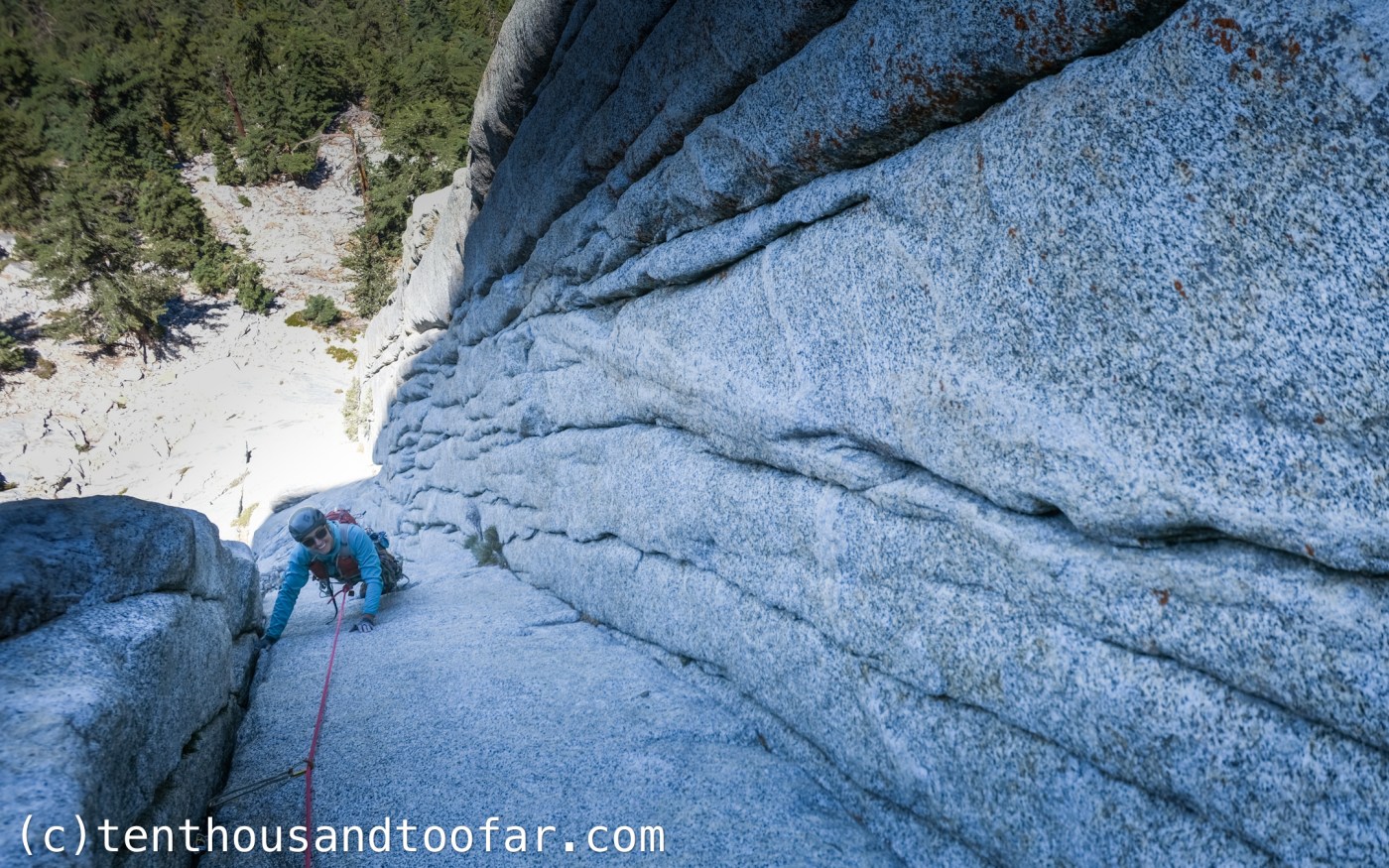
Whodunnit is a physical, varied, sustained, and historical quest up the plumb line of Tahquitz Rock. Since its first ascent in 1957 by Joe Fritschen and Royal Robbins, this route has been climbed by thousands, including about every United States climbing legend imaginable, and is revered as possibly the best route on Tahquitz. A topo and detailed route description is included for prospective climbers.
The overlooked Idyllwild California stands in solidarity with Joshua Tree and Yosemite as a keynote venue of American rock climbing. Every “larger than life” character worth a shake, including Royal Robbins, Yvon Chouinard, John Long, John Bachar, Bob Gaines, Micheal Reardon, Lynn Hill, Alex Honnold, and Brad Gobright, to name only a fraction, have graced this granite. Through millions of jams, edges and dicy smears, legend has been carved. And while dozens of excellent granite crags litter Idyllwild’s dense Ponderosa Pine forest like sprinkles on a chocolate donut, Tahquitz Rock is the centerpiece: a crystal white shark’s fin slicing through a sea of deep green. With Bear Lodge gravitas, Little Cottonwood Canyon caliber granite and lore rivaling Yosemite, this 800 foot monolith of stretching cracks and sweeping slabs, visible from anywhere in town or the surrounding mountains, is magnetic. August 2025 was Bobbi and I’s maiden voyage to Idyllwild. With four days to climb before starting a new work project in the Moreno Valley Badlands about one hour away, we were not only eager to sample a handful of classics, but also to get acquainted with our new home crag. Coming from the cozy land of ample bolts, forgiving sandstone and ego-stroking grades known as Red Rocks, we sensed a sucker punch was coming… boy did it ever.

We spent our first two Idyllwild days wandering blindly around Tahquitz’s cross-valley sister crag Suicide Rock, complete with a terrifying journey up the Weeping Wall characterized by route finding difficulties, rusted 5/16″ SMC bolts, long runouts and epoxy reinforced buttonheads on a supposed “classic three pitch 5.10 face climb”. By the end of two short days we climbed eight pitches and learned two lessons about the area. First, the gatekeeping traditions of pre-1980’s rock climbing are alive and well in Idyllwild. Locals appear dedicated to vague route descriptions and preserving antiquated grades. We had a difficult time locating routes, an even harder time staying on them, and much like Joshua Tree – the grades felt stiff. Second, albeit less of a shocker and likewise akin to Josh, almost every route here was established with ground-up traditional ethics. Bolted routes aren’t synonymous with safety, and save for a few extreme outliers, sport climbing doesn’t exist in Idyllwild.
Love Ten Thousand Too Far? Support independent mountain journalism with $5.10 per month through Patreon (and receive extra bonus content), or with a one-time donation. Any and all support is greatly appreciated.
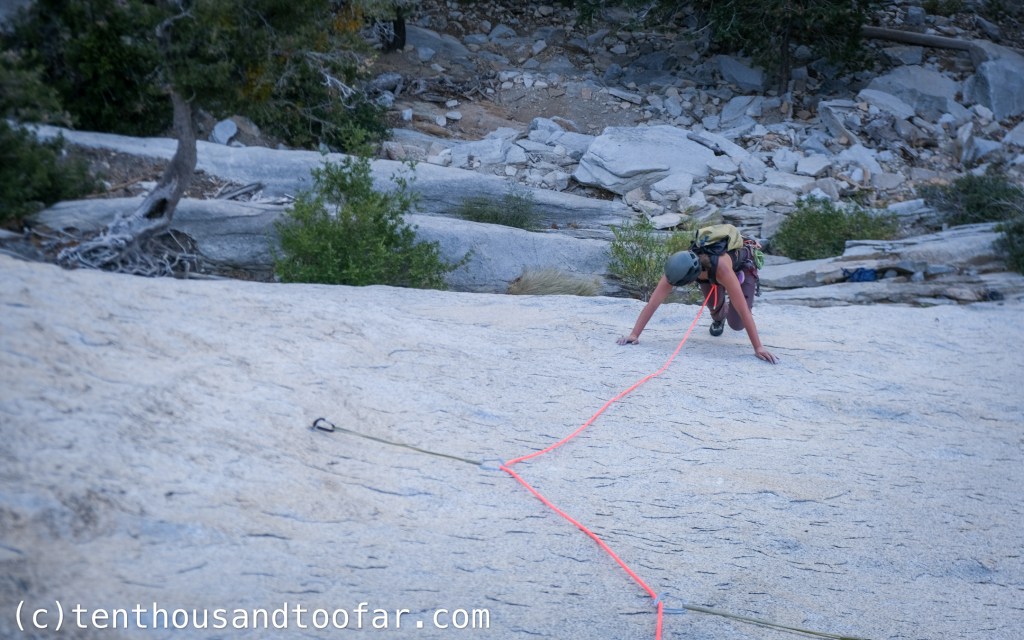
Both Bobbi and I have ample experience climbing in traditional areas of staunch ethic and rich history, so we probably should’ve anticipated a greater battle when selecting the area classic Whodunnit (5.9, 8 pitches, 800′) as our first route on Tahquitz. First climbed by Joe Fritschen and Royal Robbins in 1957, Whodunnit ascends the unquestionable plumb line of the entire peak – a white top-to-bottom corner system on the Northwest Recess visible from eons away – and was given the grade 5.8 A1. Nine years later the first pitch seam went free, and Whodunnit was upgraded to 5.9. Any 5.9 from 1966 should raise eyeballs from the discerning traditional climber. After all, Royal’s Buissonnier in Joshua Tree may be the world’s hardest 5.7, and 5.9 basically represented the theoretical limit of human performance at the time. We weren’t impervious to the impending sandbag storm – we knew it was coming – but having come from the Tetons, land of multiple hour approaches and long routes up to 13,000 feet, we underestimated the scale of Tahquitz. It seems most folks who climb Whodunnit tie in earlier than 11:00AM mid-summer, but not us. I so cavalierly told Bobbi we’d top out in five hours, and make it back to town for ice cream by seven. This didn’t happen.
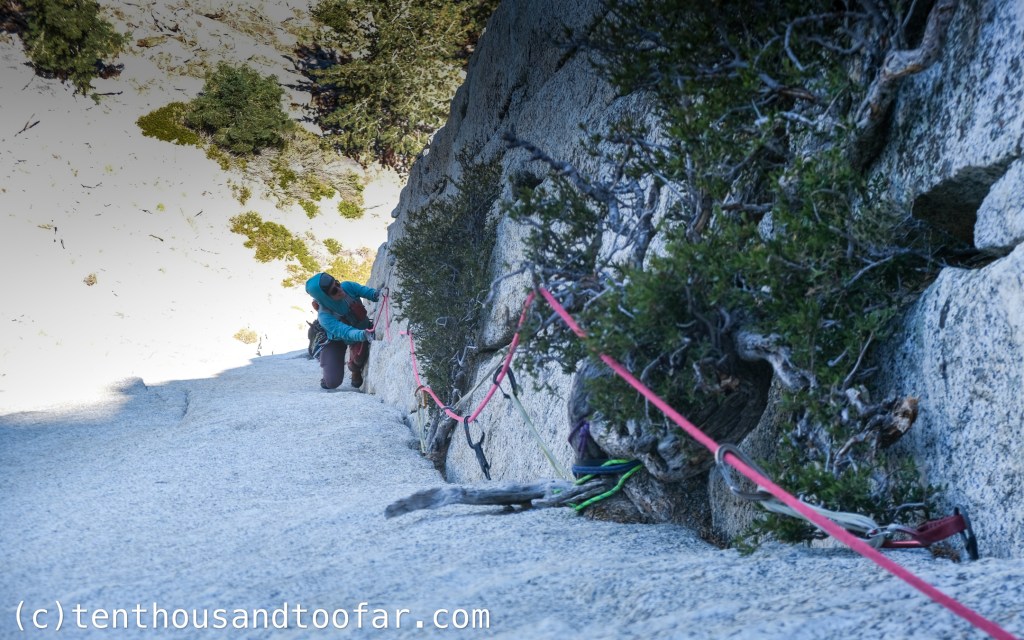
A combination of route finding difficulties and unrelenting physical climbing smacked us in the face pitch after pitch… after pitch. An utterly useless three sentence Mountain Project route description blindfolded us, and while you’d think following an 800 foot corner system would be simple, there’s always nuance on a mountain this big. We swapped a 5.9 slab for the unbelievably blank 5.10- first pitch of Edgehogs, the crux of which is a 30 foot fingernail seam protected by two knifeblades, one lone bolt with a homemade aluminum hanger, and a tipped out RP. 500 feet higher we climbed a vicious flaring off-width with shoddy protection instead of skirting it via inobvious flakes. In simpler terms: we made an already hard route harder. Despite each freeing every pitch, we got our asses kicked. Cresting the summit we were beaten, battered and bruised… hungry, thirsty and tired… but smiling ear to ear. The exposure, rock quality, and climbing variance on this route approaches flawlessness, and every pitch offers moments of magic. The full arsenal of swords, from slippery slabs, tenuous laybacks, bombay chimneys, physical off-widths, flaring finger cracks, steep hand cracks, inobvious face climbing and committing roof pulls are required. Much like Yvon Chouinard’s mighty “The Snaz” in the Tetons, Whodunnit feels like a benchmark test-piece at the grade. I was extremely proud to onsight this route, and watch the Alpine Peanut follow free. We topped out at 6:00PM, hustled down the North Gully, and reached the car by sunset.
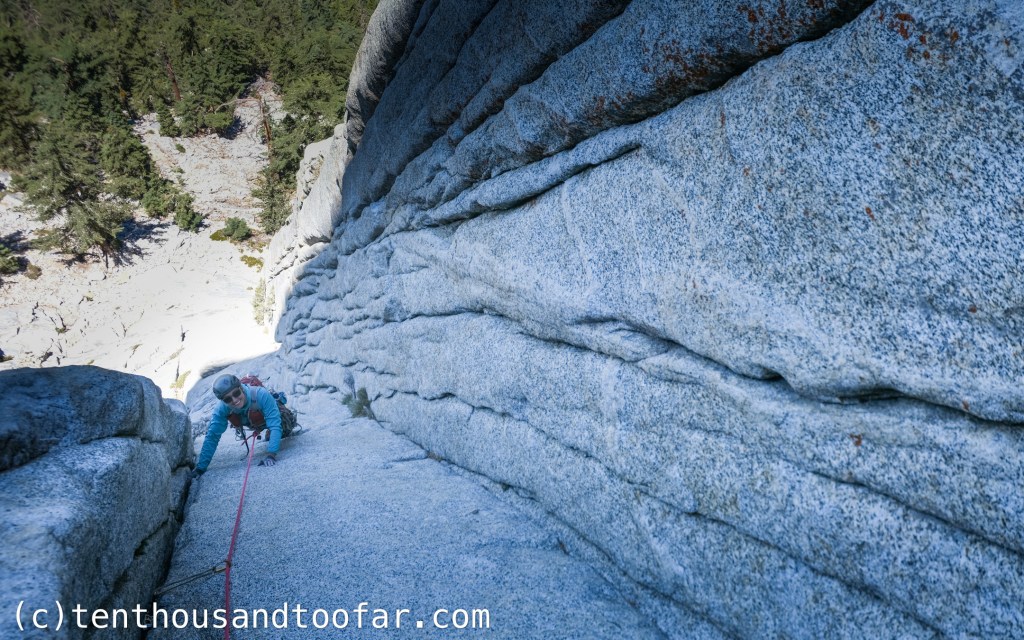

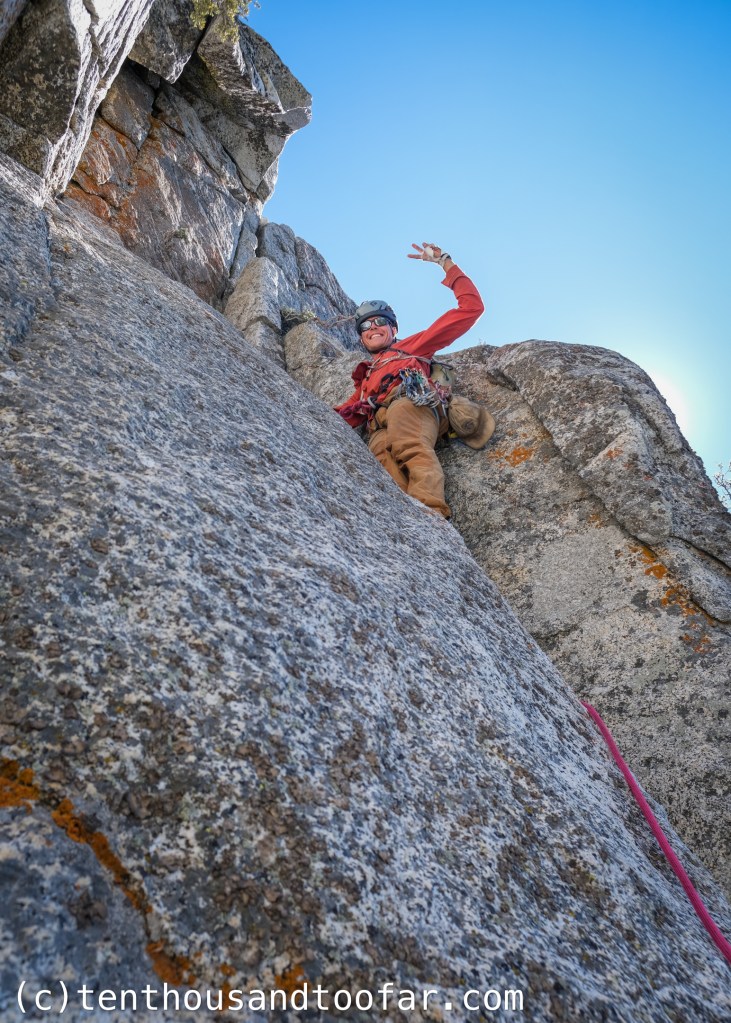

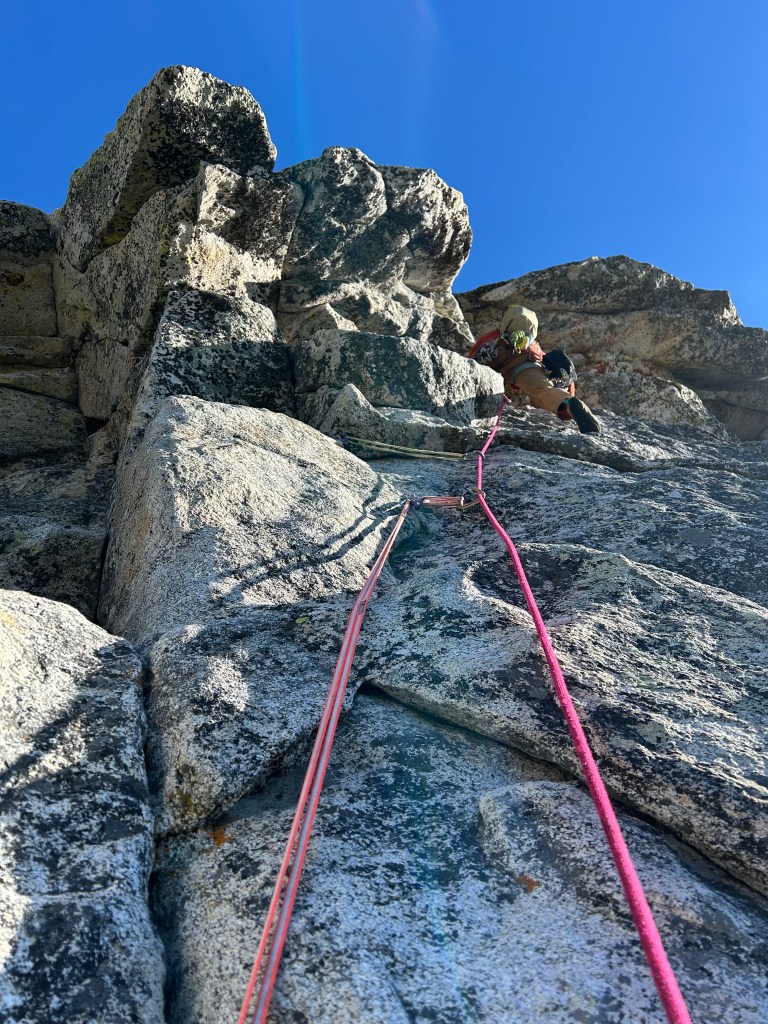
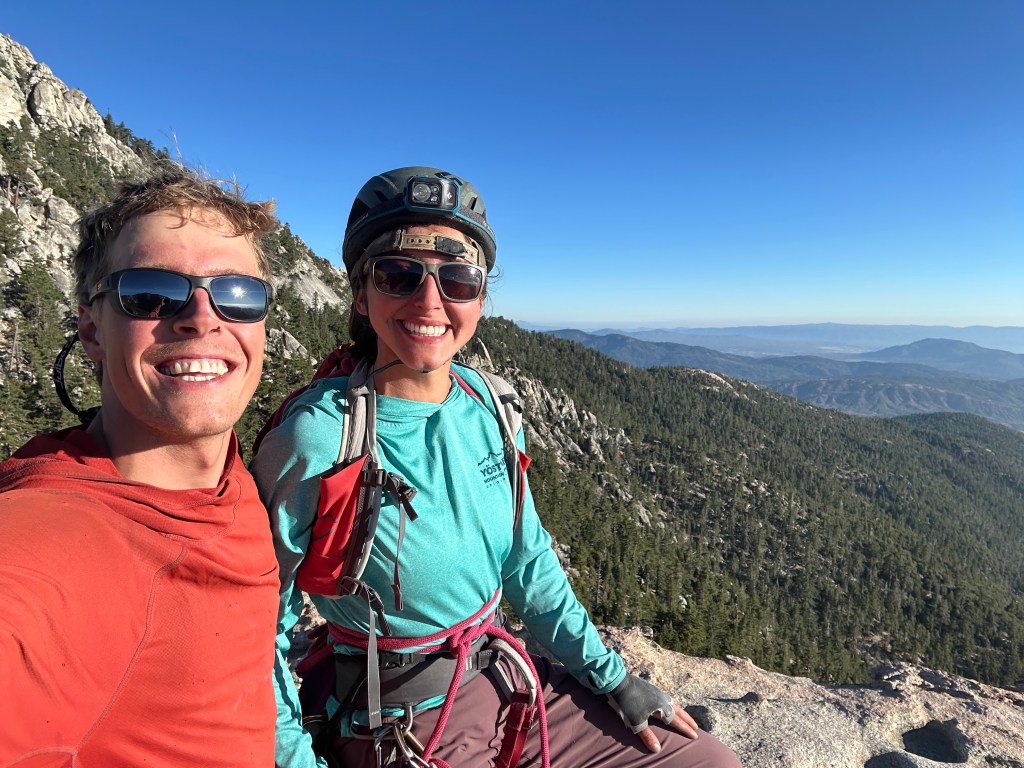
Boy oh boy do I love granite. While Peanut and I were excited to get stronger on Mount Charleston limestone and Red Rocks varnish, splitter granite cracks and thin technical slabs are our bloodline. For the next two months at least, Idyllwild and Joshua Tree will be our Tetons. You won’t catch us complaining.
Below is a full guidebook style route description for prospective climbers. If you use this topo and description for an epic adventure, consider kicking in a one-time donation, or supporting Ten Thousand Too Far with $5.10 per month on Patreon. Your contribution helps keep Ten Thousand Too Far free of paywalls and advertisements.
Whodunnit (5.9, III, 800′) Route Description
Note: To pay homage to history, I left the original 5.9 grade intact. However, I could easily see this route being rated mid-5.10 in other venues. The 5.9+ grade is used to denounce the crux, pitch four. Some parties have reported as few as 4-5 roped pitches with a 70 meter rope. We climbed 9 pitches with a 50 meter rope. From other reports, pitches one/two, three/four, and seven/eight are commonly linked.
Approach: The standard approach to Tahquitz uses the Ernie Maxwell Scenic Trail beginning on the west side of the Humber Park parking lot. Wander downhill from the lot, cross a seasonal stream, and keep your eyes peeled for a steep but obvious climbers trail cutting straight uphill within 100 yards. This trail will land you at “Lunch Rock”, where you can veer right (west) for the west face routes or left (east) for the “Northwest Recess” and north face. If descending the Friction Route (see “descent” below), packs can be left at Lunch Rock. For Whodunnit, contour east along the base of the rock until the obvious right facing corner system stretching from base to summit comes into view. An alternative approach begins at the Devil’s Slide Trail on the eastern side of the Humber Park lot. Leave the trail almost immediately on a well worn climber’s trail, which drops quickly to a stream bed. Cross the stream, continue along the creek and eventually up towards Tahquitz on a good trail. As you approach the base you will come to a short wall with protruding sticks for hanging packs. If planning to descend via the North Gully (see “descent” below), packs can be stashed here. The North Gully and Hinterland Wall is to the left (east), and the Tahquitz climbing routes are to the right (west). For Whodunnit, hike and scramble west to the base of the route. Reaching the base from either approach will take 30-60 minutes depending on fitness.
Pitch One (5.9): Locate three belay bolts on a clean wall just left of the main corner, about 100 feet off the ground. Follow the path of least resistance up easy blocky slabs trending left towards the bolts, past a small tree/bush growing out of the base of a shallow right facing corner. Layback and jam the corner and a sweet hand crack (5.7) on the face to an overlap with a slabby seam above. Climb the seam (5.9) to another overlap, and traverse back left to a belay at the bolts. (The referenced three bolt anchor technically belongs to Edgehogs, but is now most commonly used to break up the first pitch of Whodunnit. The original first pitch continued into pitch two.)
Pitch One Variation (5.10a): Because the three bolt anchor used for the first pitch of Whodunnit actually belongs to Edgehogs, the first pitch of that route is a logical variation for those who enjoy desperate 5.10 granite paddling. Above the tree/bush, place a piece in the right facing corner and swing left onto a clean slab with a right facing stepped flake feature. Climb the flake past a fixed pin, mantle onto a small perch, and clip a funky looking bolt with a homemade aluminum hanger (can be backed up by a small RP). Tip toe up the desperate slab with exactly zero holds (5.10a), clip a second piton in a fingernail seam, and smear to salvation.
Pitch Two (5.8): A tricky slab move off the belay (fixed pin) leads to a low angle corner with interesting laybacking and jamming. Pass a sturdy bush with fixed slings and belay on a comfy ledge above.
Pitch Three (5.9): Follow the corner to a double crack system with right and left facing corners, which narrows to a chimney above. Move right into the left facing corner which has excellent protection and four-star crack climbing from locker fingers to sinker hands. Belay at a sloping stance with a fixed chockstone anchor (backed up by hand sized cams) or continue into pitch four.
Pitch Four (5.9+): Zoom up the easy bombay chimney to an exciting exit sequence (5.9+) protected seamlessly by a #4 Camalot. Jam up the easy crack above to a small sloping stance which takes hand sized gear for a creative belay, or continue into pitch five.
Pitch Five (5.8): Harder than it looks. Crank an awkward mantle off the belay and continue up a varied low angle hands and fist crack with a brief section of off-width. Belay on the first large ledge above.
Pitch Six (5.8/5.9): Move right and climb a short gully passing some wedged blocks, then climb a juggy vertical crack (5.8) back into the main corner system. Pass a dirty slab with a rock scar where a huge belay ledge fell in 2025, and continue up the steep wall above in one of three ways. The guidebook recommended route climbs the first half of the obvious off-width/squeeze above the missing ledge, and then moves left to bypass the narrowing upper half via layback flakes at a supposedly easier grade. Unaware of this variation we climbed the entire off-width, which was a difficult, albeit clean and short, grunt (5.8+). A third variation climbs a crack to the right of the off-width. No matter your path, belay on a small ledge above and right of the off-width.
Pitch Seven (5.9): Climb an insecure flaring finger crack with thoughtful protection (5.9) right off the belay into a long pitch of juggy corner climbing (5.6). Belay at a slab ledge using small cams and wires (can be backed up by a #2 Camalot lower) at 45 meters, or link into pitch eight.
Pitch Eight (5.8): Face climb up a heroic slab with gear in miracle flakes (5.6) to a fixed pin in a daunting roof. Fortunately, this roof is easier than expected. Crank to the promised land (5.8) and belay somewhere above in your choice of many small stances.
Pitch Nine (5.4): One wonky mantle over a six foot tall square cut roof defends an otherwise fourth class ramble to the summit.
Descent: The “Friction Route” down the west face is supposedly the fastest. I have never done this. We descended via the North Gully which was straightforward third class scrambling, intuitive to onsight, and not too long. We didn’t time our descent, but we definitely reached the base of Whoduunit in less than one hour.
Rack: A selection of cams from fingers to four inches, and a full set of nuts, should get the job done. I carried a double set of cams from #0.4 to #2 Camalot, with one each #0.3, #3 and #4, and a standard assortment of about 10 nuts. I would probably use this same rack again as a confident Teton 5.10 alpine trad leader. A #5 Camalot or equivalent could be used at various points, but isn’t necessary. If climbing the first pitch of Edgehogs, consider some RP’s/small nuts to back up the old bolt.
Want to support? Consider a donation, subscribe, check out my Patreon page, or simply support our sponsors listed below.
Ten Thousand Too Far is generously supported by Icelantic Skis from Golden Colorado, Range Meal Bars, The High Route, Black Diamond Equipment and Barrels & Bins Natural Market.



enter your email to subscribe to new article updates
DISCLAIMER
Ski mountaineering, rock climbing, ice climbing and all other forms of mountain recreation are inherently dangerous. Should you decide to attempt anything you read about in this article, you are doing so at your own risk! This article is written to the best possible level of accuracy and detail, but I am only human – information could be presented wrong. Furthermore, conditions in the mountains are subject to change at any time. Ten Thousand Too Far and Brandon Wanthal are not liable for any actions or repercussions acted upon or suffered from the result of this article’s reading.
 Ten Thousand Too Far
Amazing climb! Great photos!
Thanks for sharing and greetings from Greece!
LikeLike
You’ve got it. Thanks SO much for the continued support!
LikeLike