
On July 4th, 2024, Chase Krumholz and I completed the first ascent of Chilly Dogs (5.10-, III), a six pitch extension of Hot Dogs (5.9, I) on the south face of Storm Point. The route features a nice selection of exciting and adventurous pitches in an accessible area, with a streamlined descent.
On October 7th, 2024, Micheal Gardner tragically passed away while attempting a new route on Jannu East (7469m) in Nepal. While I somehow never met Mike in person, we communicated about Teton objectives over the internet and ran in many of the same circles. Mike was a longtime Jackson local, EXUM mountain guide and visionary alpinist, known for pushing the standards of climbing and ski mountaineering on every canvas, from our small Teton microcosm to the distant sprawl of Alaska, Himalaya and beyond. Mike was a direct inspiration to many of the adventures on this website and will be deeply missed. If you have some extra money and would like to support Mike’s family in this time of mourning, click this GoFundMe link.
Both Chase and I had been dreaming of doing a first ascent in the Tetons for many years. While easy to cast longing eyes at the commanding titans of the range, we figured a more practical approach would be to aim towards the readily accessible crags of Cascade Canyon. In 2023 I climbed Hot Dogs, a single pitch 5.9 crack opened by Paul Gagner and Jim Woodmency in 1986. The 40 meter route featured inspiring laybacking and jamming on a steep angling crack formed by large overlapping flakes – a four star experience in its own. While replacing the fixed anchor with modern hardware I noticed the potential for excellent climbing overhead, and according to a thorough overlay depicting all the routes on Storm Point’s south face in A Climber’s Guide to the Teton Range (Ortenburger/Jackson) this particular stretch of attractive rock above Hot Dogs remained unexplored.
Love Ten Thousand Too Far? Support independent mountain journalism with $5.10 per month through Patreon (and receive extra bonus content), or with a one-time donation. Any and all support is greatly appreciated.
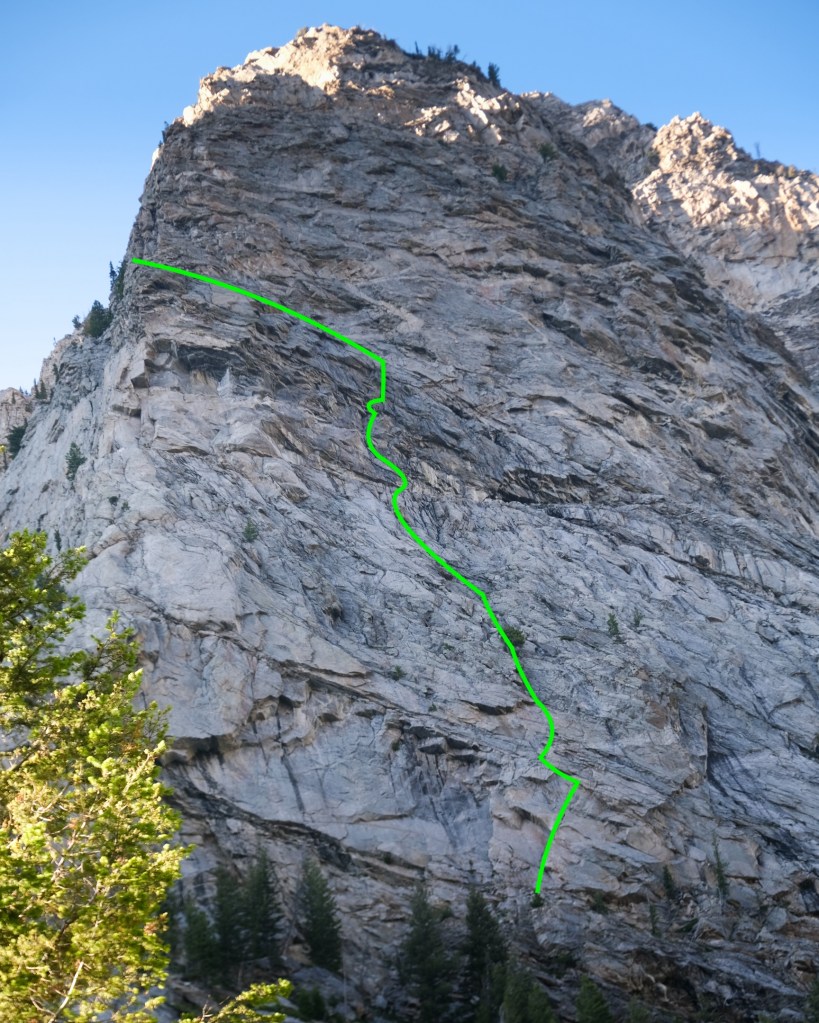
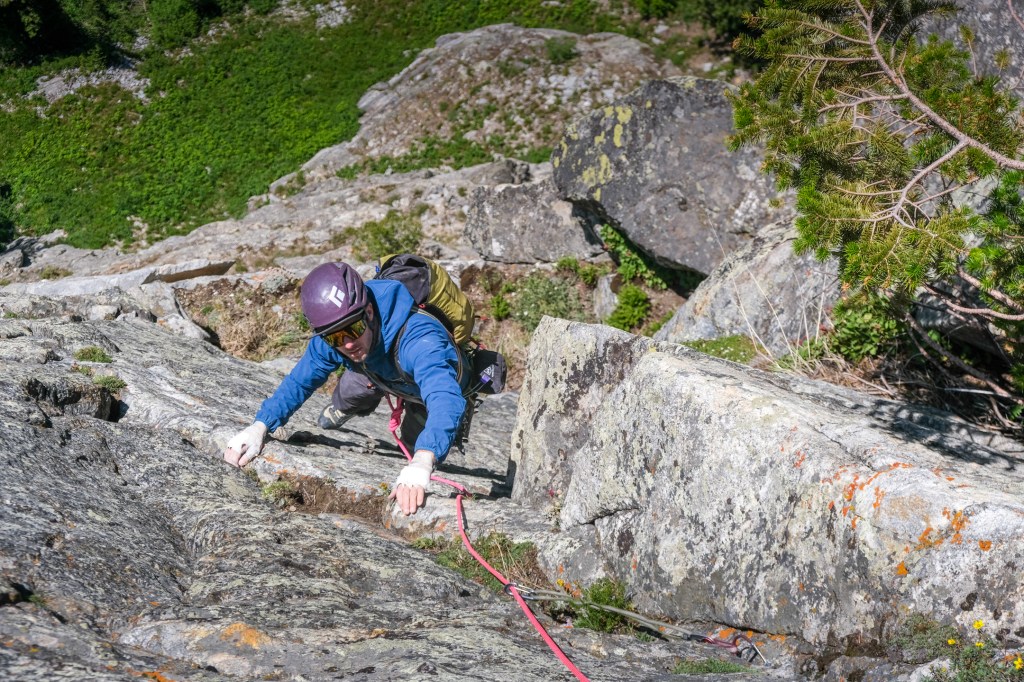
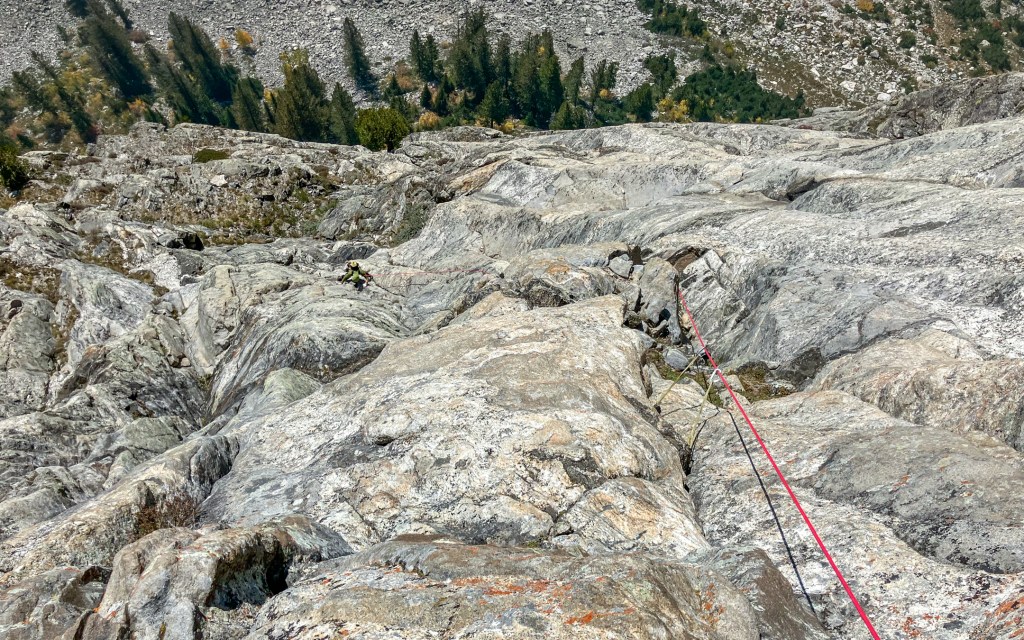
On July 4th, 2024, we set out to make Chase’s dream, and my vision, a reality. As a 5.13 climber Chase onsighted Hot Dogs in half a second and brought me up. Above lied a wild sea of virgin granite like I’d never casted into before. An otherworldly cabin-sized flake provided stellar 5.7 stem and layback climbing to a small ledge with a tree and fixed slings. Due to the tree’s proximity to the sandbagged first pitch of Vieux Guide, and the flaky critical footholds we cleaned off the wall while climbing pitch two, we believe these slings were likely used to bail from Vieux. Two more pitches, one a non-descript 5.5 ramble and the next a long and pleasant, yet slightly runout 5.7/5.8 slab fiasco we named the Sea of Dihedrals, brought us to the quarter mile long ledge system which underpins the majority of the face, connecting to Guide Wall’s Flake Ledge at its western extremity. Originally we’d assumed our short route would end here, as a massive, also quarter-mile wide and at least 100 feet tall, overhanging wall of menacing black rock capped the entire ledge system. According to the guidebook, of all the half-dozen or so routes established on this wall have ended on this ledge system, and traversed to the Guide’s Wall rappels for descent. Why would our experience be any different?

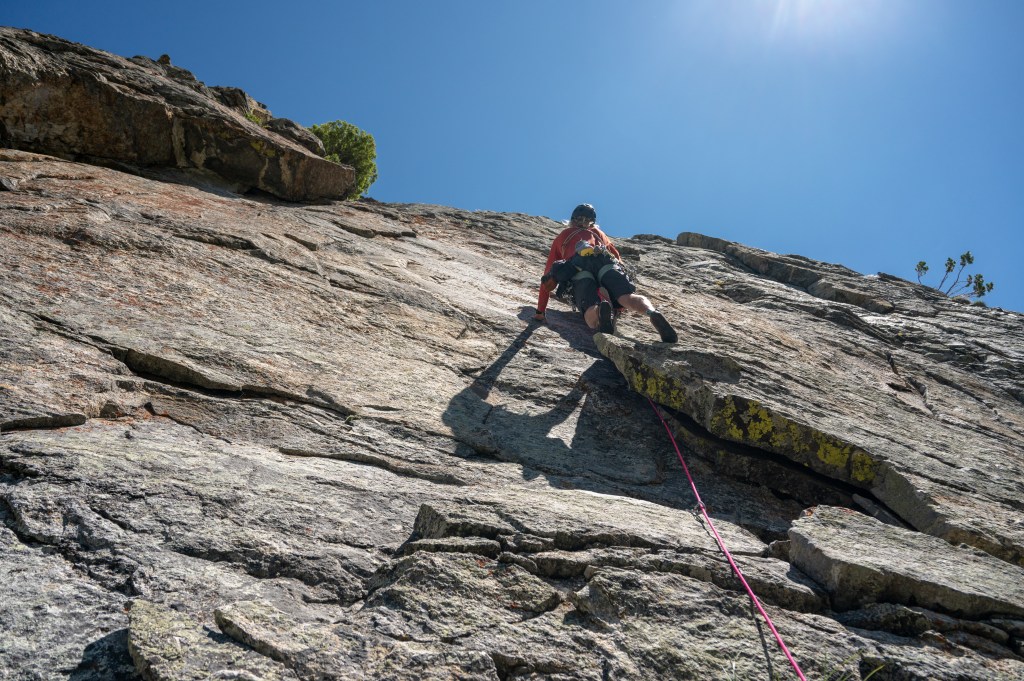
📸 : Chase Krumholz
📸 : Chase Krumholz
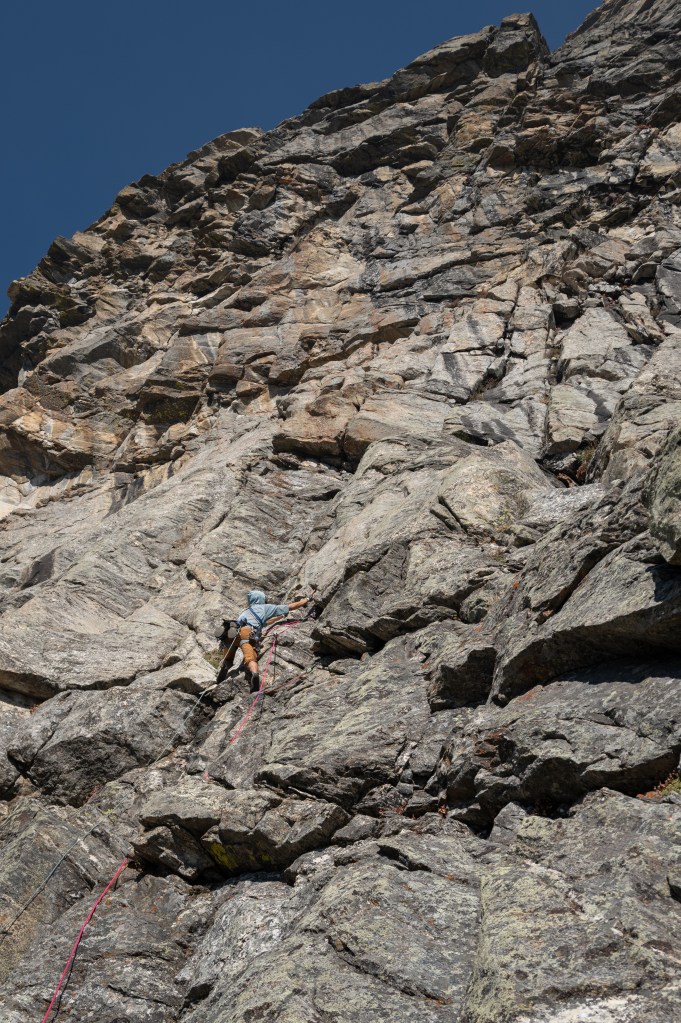
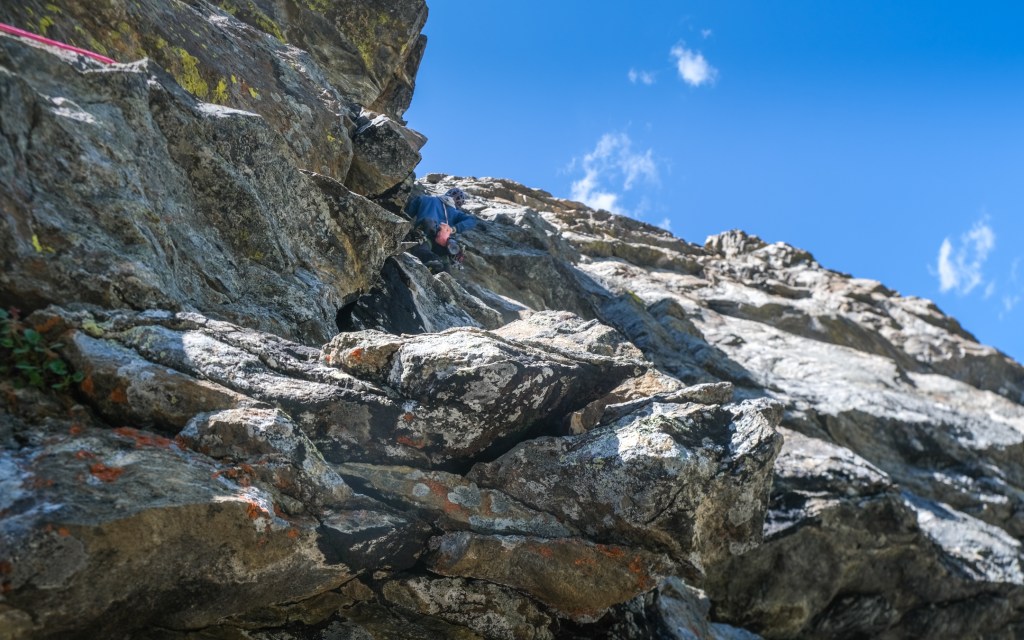
As I finished following the Sea of Dihedrals Chase analyzed the slim possibility for free climbing on the overhanging wall, pointing out a few ledges bisected by daunting roof pulls. At first glance I didn’t share his vision. There were no continuous crack systems, and roof-sheltered low elevation rock in the Teton Range is notoriously poor quality. After traversing around the broad ledge looking for the path of least resistance we identified a short black crack leading to a large no-hands platform the size of an apartment bathroom. It was my pitch, and I vowed to just “go have a look”, as there would almost certainly be some way to retreat from the ledge if passage above looked unreasonable. I placed some marginal gear in a crumbly orange flake and bouldered a committing vertical step using the shallow crack for footholds. From the ledge I investigated a few different places it looked feasible to pull the roof, eventually choosing a subtle black corner leading to another ledge system traversing back west. “If I could just get to that ledge…” I thought to myself. I meticulously equalized three uninspiring pieces – a small horizontal nut in a shallow pocket and two micro cams in a pizza thin flake – which I hoped would amount to something of value should I screw the pooch. Pulling the roof involved a few body lengths of 5.10- climbing with an especially heady layback sequence into near certain ledge fall terrain – and that’s only if the aforementioned gear held. Fortunately my shoes were feeling as sticky as my mind was centered, and the rock, albeit dirty, was bomber. The corner offered my first pieces of trustworthy protection some 40 feet off the deck, and the subsequent ledge granted a miraculous 30 foot slab traverse back west to easier terrain. A final easy finger crack followed a ramp east to an adequate belay stance on a sloping ledge below a final overhanging headwall. The feral “S-Pitch” was established – one the most unique and memorable pitches of my life, and the first half of our puzzle.

📸 : Chase Krumholz

📸 : Chase Krumholz

📸 : Chase Krumholz
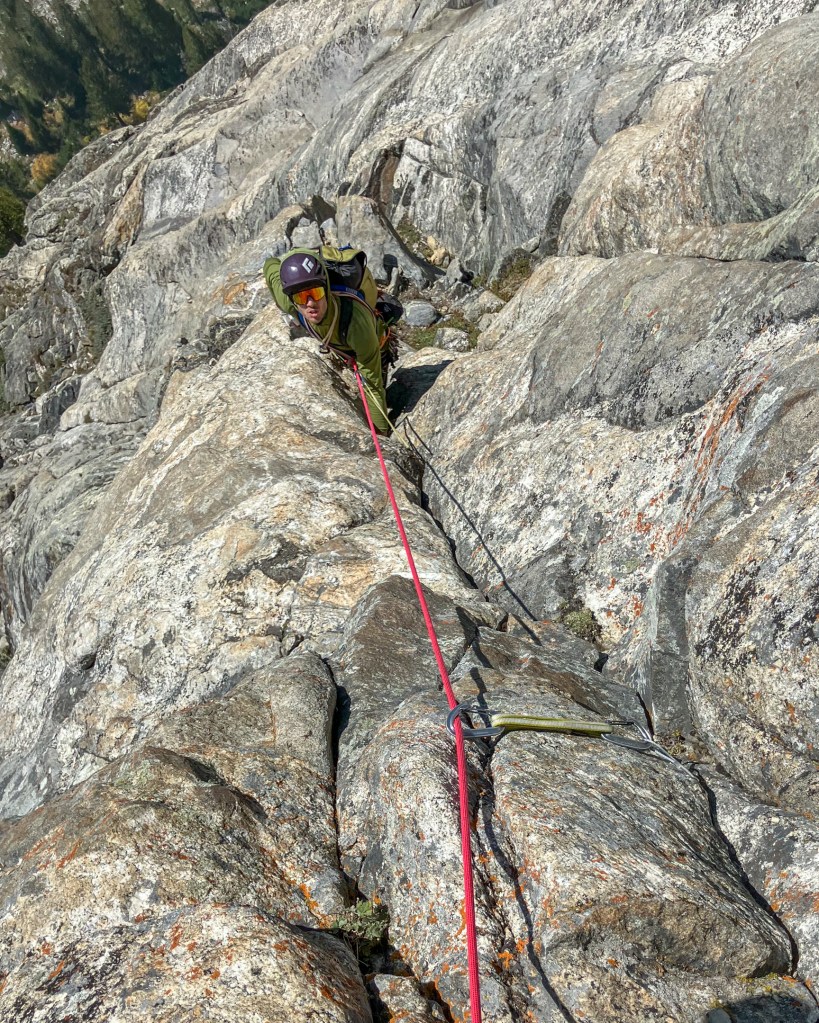
From the S-Pitch belay only some 80 feet of rock remained, another labarynth of ledges and slabs haunted by scaly roofs. Chase took his turn forging into the black beyond, with a short 5.8 boulder off the ledge and a bold protectionless 5.6 traverse east to a final reprieve of glorious, consistent, vertical 5.10- crack climbing in a right facing dihedral with dizzying views of the east Teton foothills. This final crack had it’s fair shake of filth – moss clumps, lichen and the like – but sported solid rock and heroic jams in an excellent location, splitting the lip of the overhanging headwall and securing our mission. A final ropelength of scrambling brought us to a small pinnacle on the Southwest Ridge of Storm Point, a logical point to end our adventure. As a nod to Gagner and Woodmency’s Hot Dogs, and how unexpectedly cold we were climbing mostly in the shade with a brisk wind, we chose to name our route Chilly Dogs.
Before opening Chilly Dogs to the world, we returned on September 28th to tie up some loose ends. On the first ascent we fixed five anchors to facilitate a direct rappel descent, but photo recon later revealed we could leave far less gear on the mountain by descending directly to Guide’s Wall. Chilly Dogs is now free of all fixed anchors. We brought an entourage of wire brushes and scrubbed the crux pitches incessantly, cleaned dirt from cracks and removed loose rock wherever possible. In an effort to make the route more attractive and civilized, we repeated the S-Pitch and fixed two inspiring pitons on lead, a Lost Arrow in the black crack just off the ledge and an angle just before the crux roof pull. While still a sporting endeavor, this pitch is now significantly safer. A third piton was left from our original rappel anchor above the S-Pitch to supplement the adequate and solid, yet picky thin cracks available for belay. Chase also free-climbed a Direct Variation to the S-Pitch (V3, 5.9), but unfortunately a very large, very loose and very difficult to avoid large block tainted this alternative. While Chilly still hosts a healthy dose of alpine obstacles including hollow flakes which shouldn’t be used for protection and a few large blocks that must be avoided, it is sufficiently sanitized and prepped for enjoyment by the 5.10 alpine climber. We quite enjoyed establishing this route, and hope it provides a more challenging yet equally accessible alternative to Guide’s Wall.
for prospective climbers, a formal route description, location and rack recommendation copied from Mountain Project is provided below

📸 : Chase Krumholz


Route Description
(copied from my post on Mountain Project)
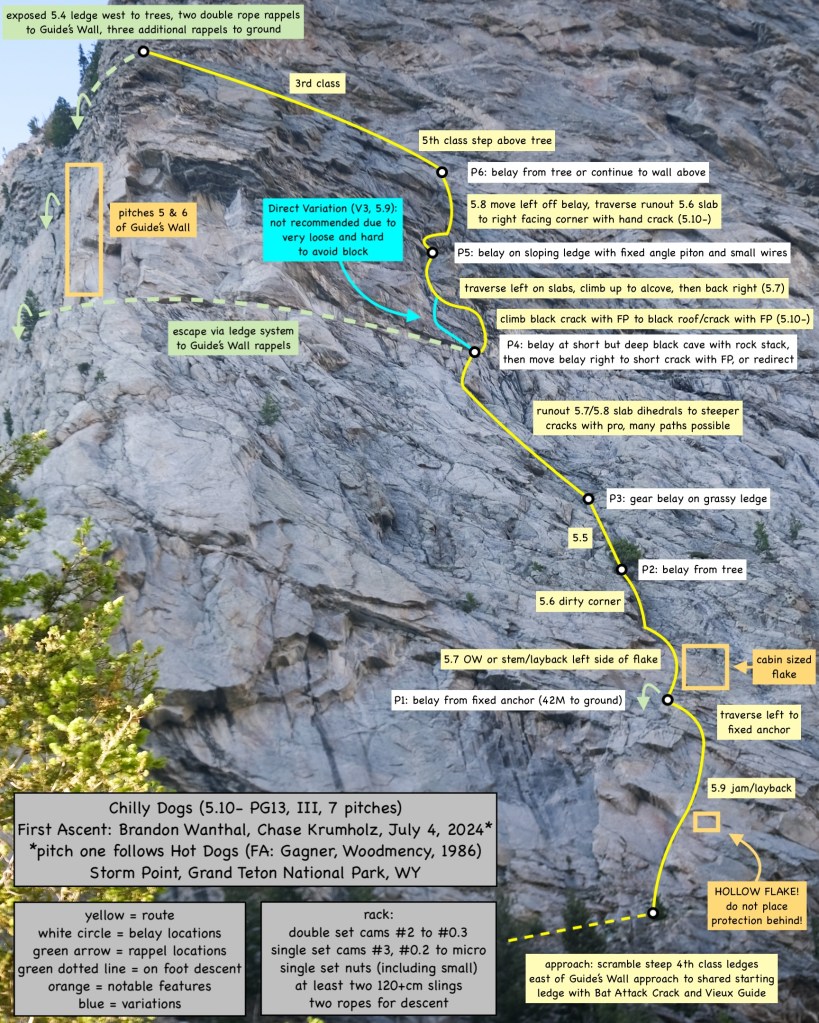
Approach (90-120 minutes): When the Guide’s Wall approach trail nears the base of the steep south face of Storm Point, depart the trail and scramble 100-150 feet of steep fourth class ledges (some loose rock) to the base of the route. The gigantic and arcing roof of Bat Attack Crack (5.11) is a prominent landmark. Hot Dogs, the first pitch of Chilly Dogs, follows the crack exiting right before the Bat Attack roof. This ledge is also home to the start of Vieux Guide (5.10, II). Packs can either be hung from a tree on this ledge, or from trees at the base of Guide’s Wall.
Pitch One – Hot Dogs (5.9): 40 meters of awesome. Climb easy rock into a shallow left facing corner beneath the prominent roof of Bat Attack Crack. At the roof, bust out right following a right leaning crack and flake system with sustained 5.9 laybacking and jamming capped by a small roof. The lower part of this crack has a large (~25 square foot) wafer-thin flake that is attached at the base, does not flex, but should NOT be used for protection. Hopefully this is very obvious. A shallow crack above the flake accepts good small protection. Above the roof, a few body lengths of unprotected 5.7 slab lead to a small ledge, which is traversed left to a fixed two nut anchor.
Pitch Two – THE Flake Pitch (5.7): Avoid the obvious loose blocks directly above the belay. A miraculous cabin-sized flake forms a left facing corner with a gaping crack. Squeeze behind the flake or layback the outside, both are 5.7. Atop the flake, aim for the obvious large tree above, passing a short vegetated corner. Belay from tree.
Pitch Three (5.5): Clamber up nondescript mountain terrain to a large grassy ledge. Many paths are available here. Belay from gear on the large grassy ledge before the steepening clean slabs of the Sea of Dihedrals.
Pitch Four – Sea Of Dihedrals (5.7/5.8 R): Many fractured, low angle, open book dihedrals defend the steeper upper black headwall of pitches five and six. Following the path of least resistance up and slightly left yielded clean 5.7 slab climbing with little protection, to steeper cracks with better protection. There’s clearly multiple ways through this terrain, hence the variable grade. Aiming for the obvious broken black rock section of the large roof overhanging the entire face, the only section where passage through the roof looks viable, is useful for orientation. Belay at a short but deep cave with a rock stack using a horizontal crack at head height.
Move Belay – If climbing the S-Pitch (recommended), consider moving the belay to a semi-hanging stance beneath the starting crack, 3 meters east of the cave.
Pitch Five – S-Pitch (5.10-, PG13): Two pitons were added on lead during the second ascent to make this pitch more civilized. Boulder a short black crack with a fixed lost arrow piton just right of the belay (5.9) and mantle onto a big ledge. Clip an angle piton below an intimidating overhang which can be reinforced with marginal thin gear. Move through the overhang on sloping holds into a shallow dihedral containing a crack for protection (5.10-). Above the roof, traverse left on black slabs, climb a short wall of unprotectable jugs to an alcove, then trend back right on a low angle slab split by an attractive finger crack to a sizable belay ledge with a fixed angle piton. Your rope will form an “S” shape (hence the name), but proper use of long runners should prevent relevant rope drag. Small nuts and cams are needed for the belay.
Pitch Five Variation: The Direct (V3, 5.9): Surmount the cave directly with overhanging wizardry, utilizing the left trending crack providing hand jams and ring locks. Folks that can do twenty pull-ups might think this is 5.9. Folks that can only do two pull-ups might say 5.11+. Once above the cave, traverse left on slabs to an amazing layback flake with a very loose block at its head. Climb directly up and join the S-Pitch at the alcove. While this pitch has been free climbed without touching the block, the potential catastrophe for both leader and follower warrants extreme caution.
Pitch Six – Jungle Crack (5.10-): Boulder a tricky 5.8 move left off the belay to a slabby ledge system that traverses back right with uninspiring protection (5.6R). Follow this ledge system until the wall overhead breaks into a right facing corner with an attractive steep hand crack. The start of this corner is visible from the belay. Crank up the physical and reasonably dirty, yet surprisingly solid and fun crack system with good protection to a small belay tree. Make sure to admire the exposure from the final moves. The route openers would welcome the fixing of a thin piton before the 5.6R slab traverse.
Pitch Seven (5th Class): A short step of easy fifth class is followed by a rope length of third class to the route conclusion on a small step of Storm Point’s Southwest Ridge. The short fifth class step can also be easily combined with pitch six facilitating an unroped scramble for pitch seven.
Descent: Traverse a very exposed 5.4 ledge directly west to a large tree with slings. Two double rope rappels, the first from the tree and the second from a fixed piton/nut anchor, lead to the second rappel of Guide’s Wall. Three more rappels from trees and fixed anchors to the ground. Scramble east to regain approach.
Protection: Double set cams #0.3 to #2. Single set cams #3 and #0.2 to smallest micro size. One set nuts. At least two 120cm slings. One Knifeblade or thin Lost Arrow piton could be added to pitch six. Two ropes for descent.
Want to support? Consider a donation, subscribe, or simply support our sponsors listed below.
Ten Thousand Too Far is generously supported by Icelantic Skis from Golden Colorado, Range Meal Bars, The High Route, Black Diamond Equipment and Barrels & Bins Natural Market.



DISCLAIMER
Ski mountaineering, rock climbing, ice climbing and all other forms of mountain recreation are inherently dangerous. Should you decide to attempt anything you read about in this article, you are doing so at your own risk! This article is written to the best possible level of accuracy and detail, but I am only human – information could be presented wrong. Furthermore, conditions in the mountains are subject to change at any time. Ten Thousand Too Far and Brandon Wanthal are not liable for any actions or repercussions acted upon or suffered from the result of this article’s reading.
 Ten Thousand Too Far
Leave a comment