
I’ve been battling a partial rotator cuff tear this summer, so I’ve been dipping my toes into the dark arts of rope-less climbing as a way to score significant mileage on easy terrain. The Chouinard Ridge provides a 1,600′ vertical adventure on clean-as-a-whistle Middle Teton granite.
As mentioned in the header, my rotator cuff took a nose dive early into summer. At the time of this article’s documented adventure I was only a week or two removed from not being able to lift a tea kettle. Luckily, I saw a climbing specialized physical therapist and have since made significant progress with strategic and diligent exercises. My goal is to evade the blade – non-surgical treatment – especially because the tear is chronic rather than acute and I still have decent range of motion. Part of my rehabilitation strategy has been lots of low difficulty mileage on rock, where I can reduce the strain on my upper body, drive blood flow out the ceiling to promote healing and establish proper climbing posture habits. While I could certainly climb easy routes with a rope, it almost feels a little selfish to coerce one of my buddies, who’d rather be climbing something more difficult, to tie in for routes this moderate. Furthermore, adventuring in the hills alone gives me a guilt free buffer for bailing if my body doesn’t feel up to the challenge. I love solo ski mountaineering by winter, so progressing to rope-less exploits on the high alpine Teton granite I revere so deeply seems only logical. That said, as I continue to write about solos I would like to present the caveat that forgoing the cord is the devil’s work, and my publishing of such accounts should not be misconstrued as promotion of soloing to anyone. I believe it is personal decision that should be considered carefully. My decision was based on being a confident 5.10 traditional climber with a time tested sturdy mindset for long runouts which often aren’t far removed from soloing, and an extensive resume in the Teton alpine. With that asterisk established we proceed.
Love Ten Thousand Too Far? Support independent mountain journalism with $5.10 per month through Patreon (and receive extra bonus content), or with a one-time donation. Any and all support is greatly appreciated.
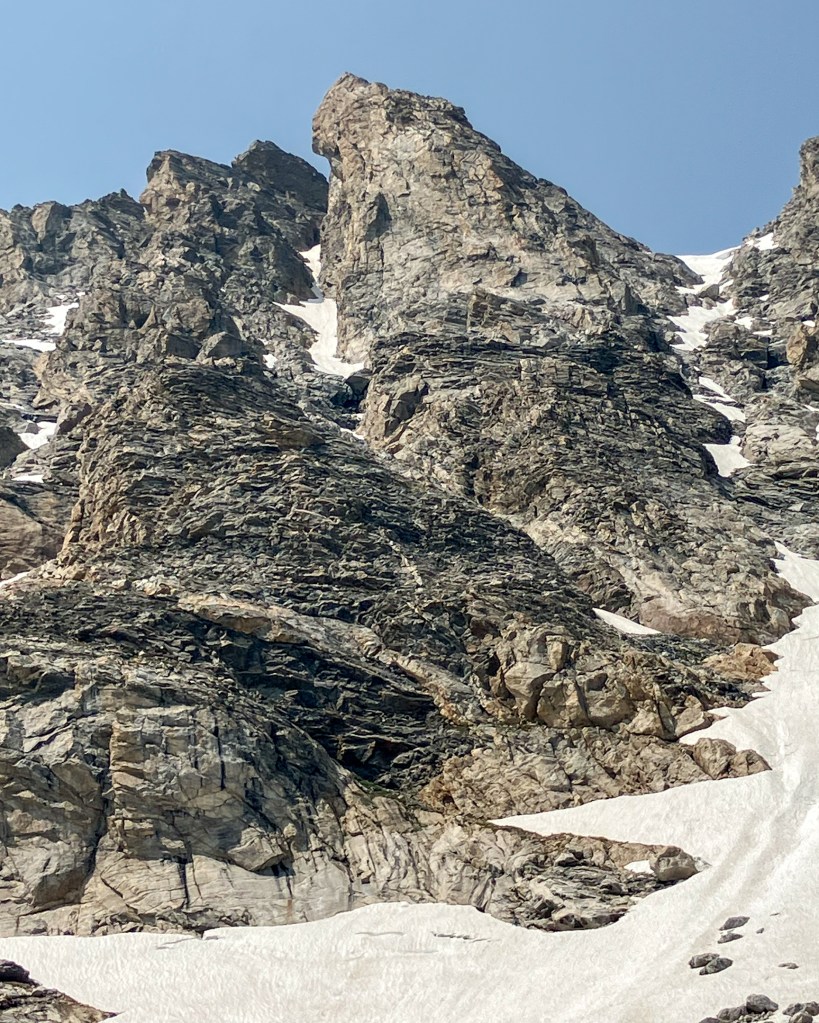
Climbing this route? A topo for the Chouinard Ridge can be found at: https://www.patreon.com/tenthousandtoofar/shop/chouinard-ridge-5-5-ii-topo-mini-guide-443152?source=storefront
The Chouinard Ridge is revered in Renny Jackson and Leigh Ortenburger’s A climber’s Guide to the Teton Range as a moderate and long adventure on trustworthy golden stone. The stated 5.4 grade seemed like the perfect level for my first solo longer then 1,000 vertical feet. The ridge measures approximately 1,600 feet from it’s conception. With Yvon Chouinard on the first ascent team I didn’t rule out the possibility of difficulties registering closer to the 5.5 or 5.6 range – his routes are notorious for sandbaggery – so I carried rock shoes and chalk. I opted against carrying a rope, harness and gear for retreat as I have done on other solos because I already needed an ice axe and crampons, and much of my attraction to soloing centers on minimalism, pack weight included. Instead, my insurance policy would be to follow the time-tested golden rule of soloing: “don’t climb up what you can’t climb down”.
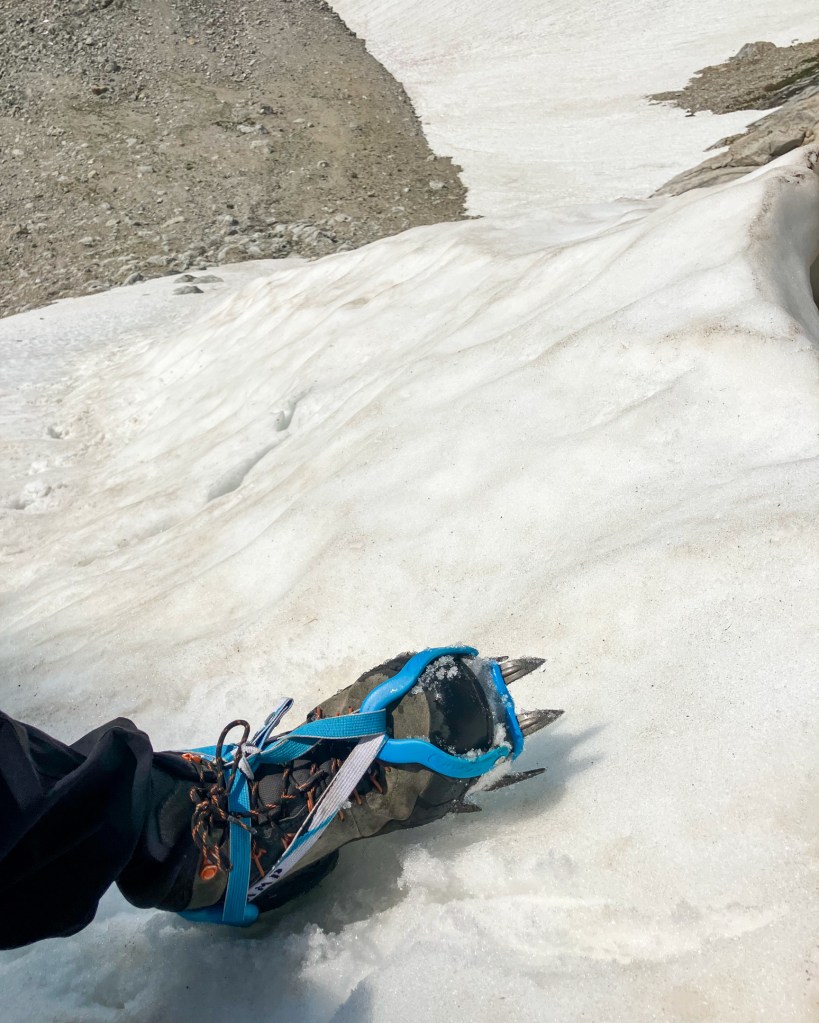
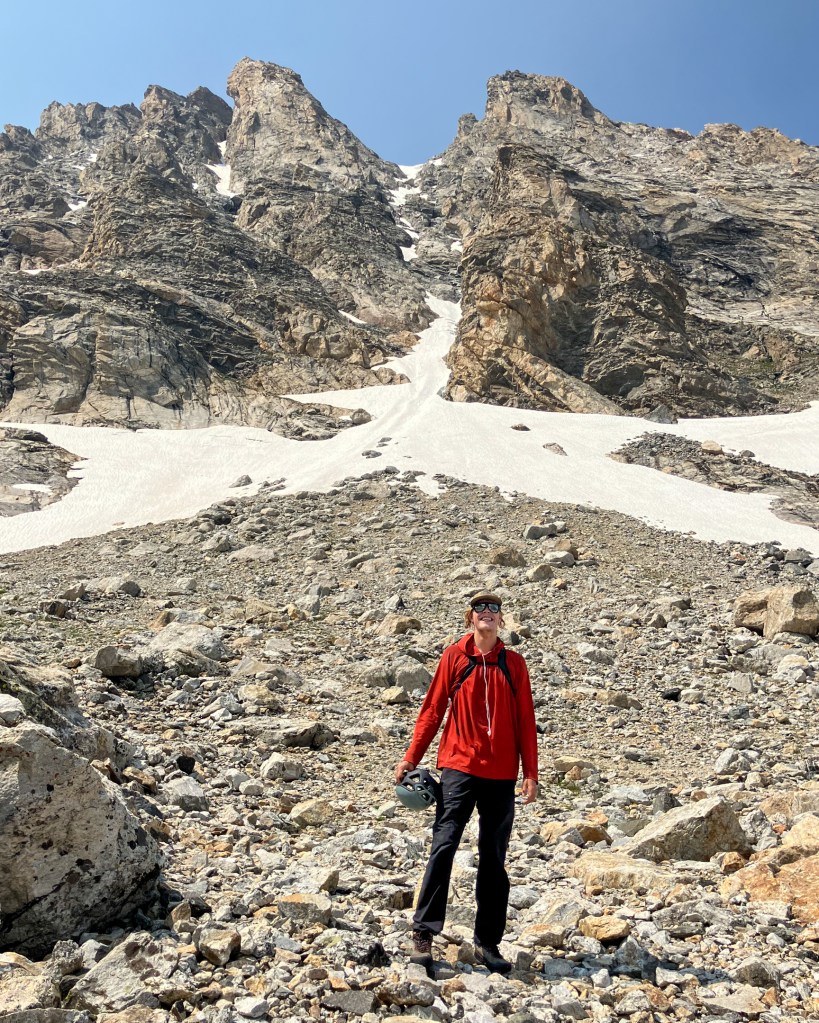
I approached Garnet Canyon with lifted spirits and made quick work to the confluence of the Ellingwood and Chouinard Couloirs. The Chouinard Ridge forms the western boundary of the latter, a low angle ridge gradually crescendoing in steepness, severity and visual presence. I found a convenient trickle of water beneath the couloir duet to replenish my sole liter before continuation up a south facing ridge sure to be baking by mid-afternoon. The toe of the ridge is guarded by a few hundred feet of steep 40-45 degree snow, and because I got an early start crampons played a vital role in keeping matters civilized. Kicking steps with strap on crampons and a flimsy aluminum ski mountaineering axe can be dicey, but I managed. The aforementioned guidebook’s description suggests skipping the geological beginning of the ridge to avoid poor rock, but I was eager to escape the snow, wrangle choss regularly and didn’t find the initial climbing’s appearance overly disenchanting. The sun was shining and the vibes high as I savored a light snack and transitioned to rock mode. A dizzying swath of featured alpine ridge layed shimmering just above, and while I struggled to repress an elevated heart rate of subconscious nervousness, I let the comforting warmth of Teton July flatten the energy. One thing was for certain – this was a beautiful place to be.

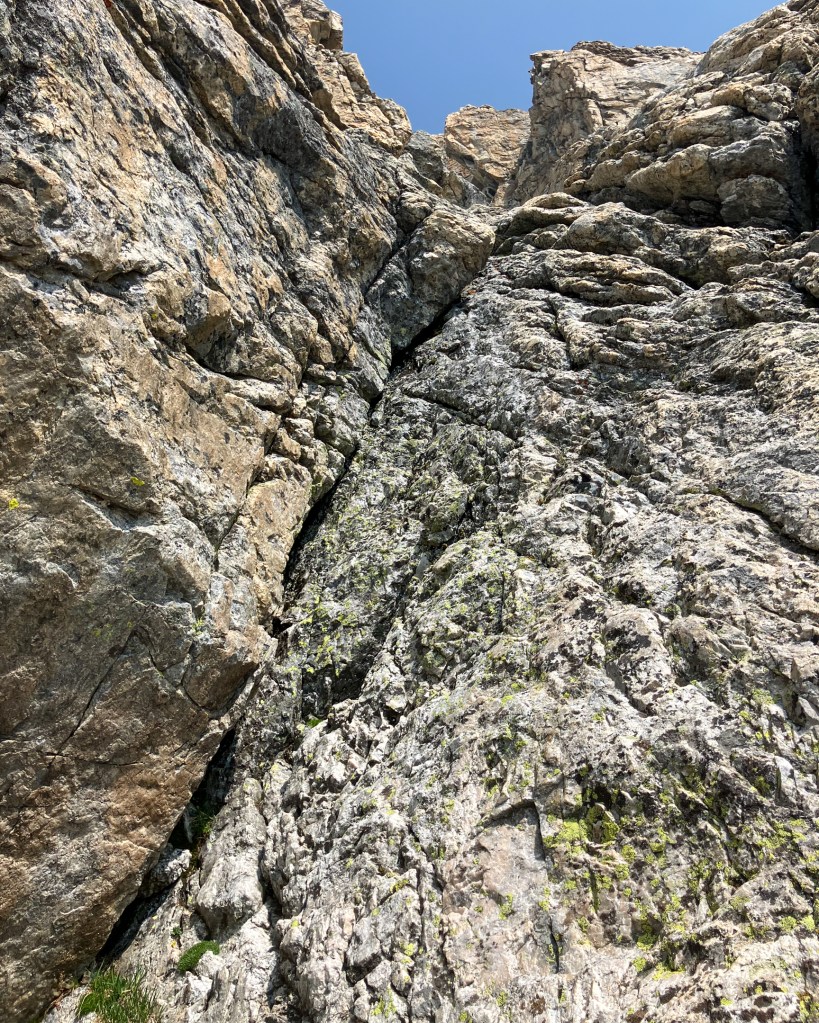
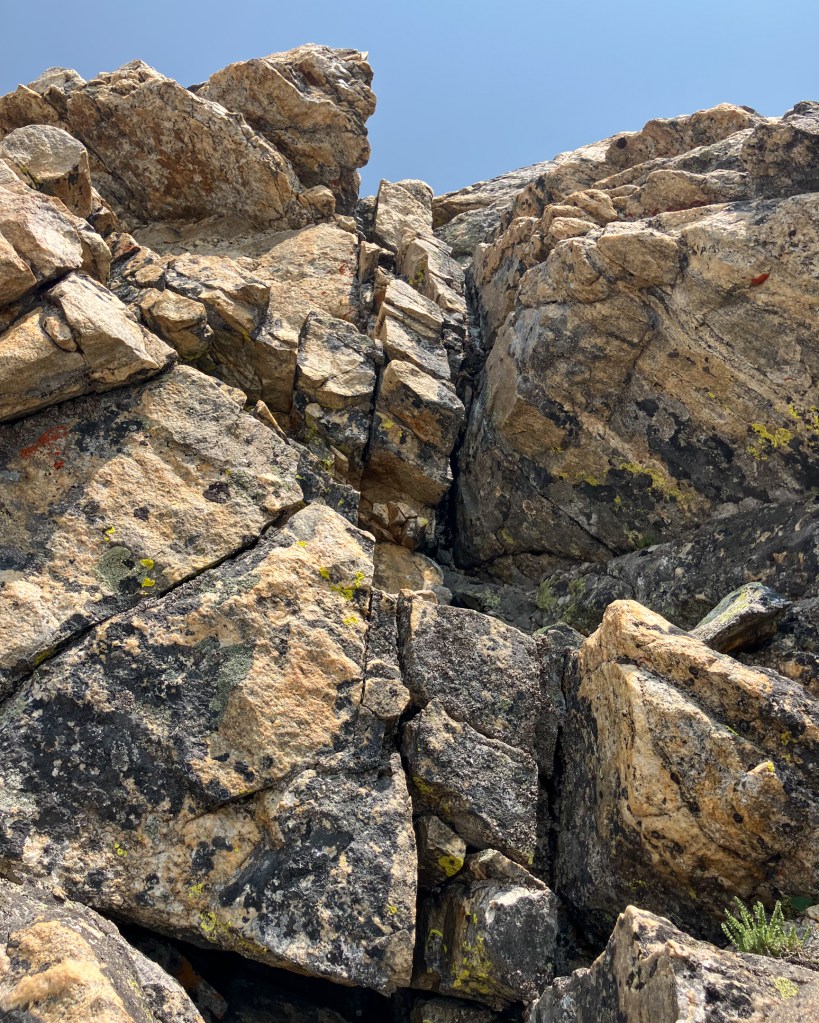
The ridge began with several hundred feet of fourth class clambering up progressively higher quality stone, easily dispatched in approach shoes with little thought. Two significant obstacles, an inside corner of layered crystalline gniess and a slightly grainy ledge traverse around the east side of a small gendarme brought the first relevant difficulties of about 5.4, which transitioned back to fourth class before reaching an obvious notch with lingering snow. Above the notch, some 1,000 feet into the main event, the route character diverges from a broad and low angled slab-centric affair to a more channeled and dramatic alpine ridge rife with steeper obstacles. Straight from said notch was the crux, a blocky yet deceptively vertical chimney with significant fracturing that beckoned cautious climbing. I started up the chimney in approach shoes but quickly down-climbed and switched to my ninja slippers. Armed with precise toes and sticky rubber I tackled the opposition with awareness, yet made sure to lean back off a large jug at the lip to admire the stretching exposure below, and the pleasant southwesterly winds riffling my hair. Two more memorable difficulties included a near vertical wall of positive face climbing with a thoughtful stem move, and an awesome crystalloid slab wall with a locker hand crack through a few bulges near the ridge conclusion. I aired my toes and picnicked on a pleasant bivy ledge with stretching views to the west, and popped my shirt off for a prolonged sunbathe session on the 12,809 foot Middle Teton summit alongside a few Southwest Couloir third classin’ compadres. Few things compare to bluebird summits in the Teton alpine.

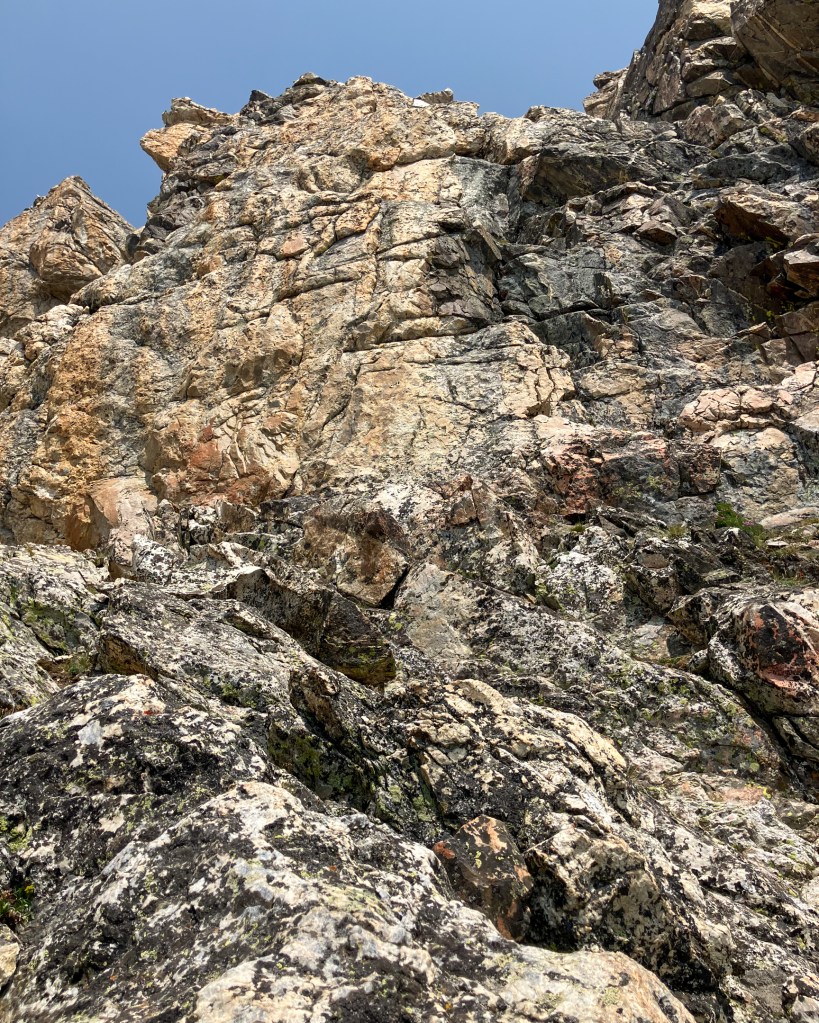
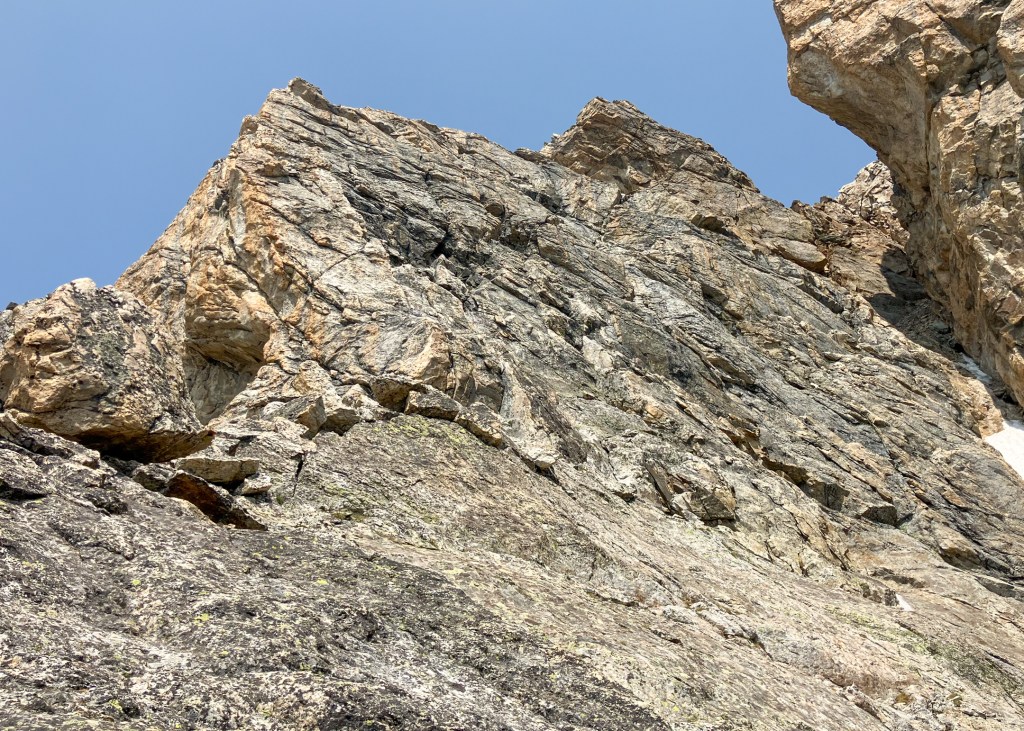
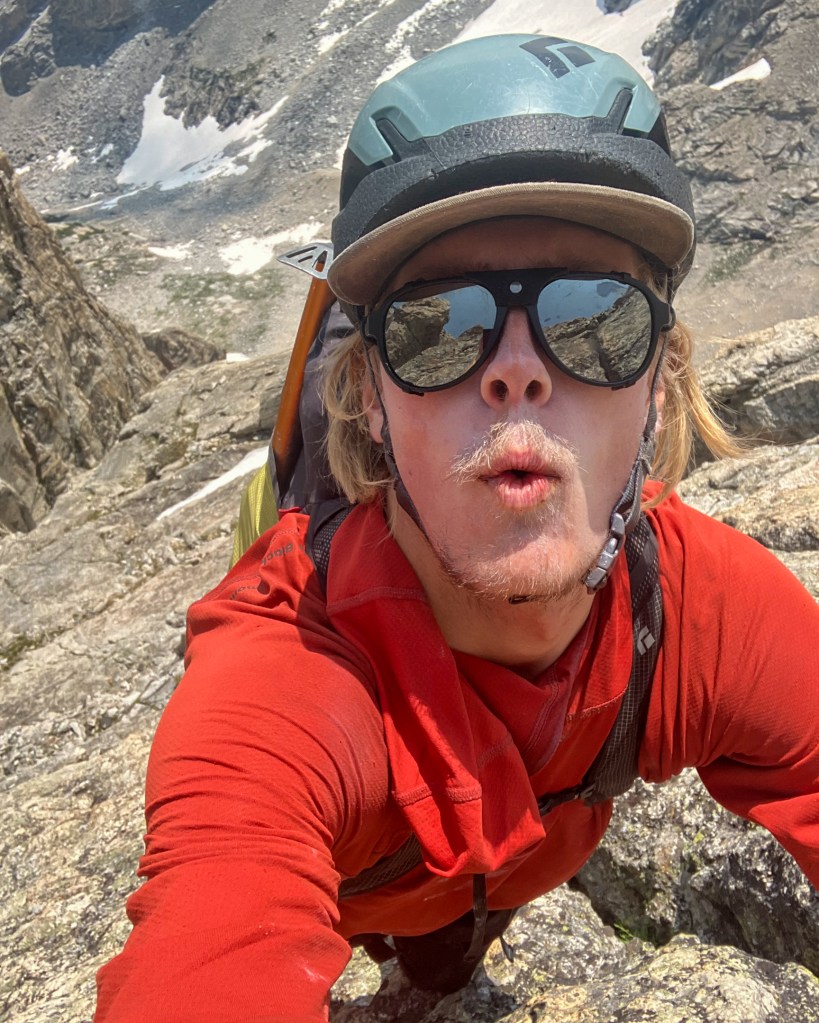
I jungled down the Southwest Couloir, pushed my glissading limits on a sloshy snowfield that resulted in a slow careening into a talus field at the hands of weak snow that resisted self arrest tactics, and jogged the remaining knee-crushing miles to the blaring sounds of Linkin Park in my headphones. The whole fiasco wrapped up around the ten hour mark and fell smoother than freshly ground peanut butter. In the proceeding days I reflected on the energizing feeling of onsight free soloing, the empowering feelings of self control when all was buttoned tight and the diametrically unnerving sensations of tapping on hollow blocks while pinned in a vertical chimney at 12,000 feet with multi-thousand foot free fall potential. I was left neither enthralled nor disappointed. As suspected, the ridge presented difficulties greater than other 5.4 routes across the range, though with rock shoes and chalk I felt overly qualified. I thought 5.5 fair, in line with a local guide’s opinion on Mountain Project. None of the rockcraft felt any bit tenuous and in any sections where nerves escalated I made a habit of down-climbing and re-climbing that stretch to reinforce a solid essence of control. However, while I never felt any modicum of insecurity I was also left with an incessant echoing thought asking “why” – why take on such needless consequence? However, when I unpacked those intrusive thoughts over several quiet mornings of coffee I realized the sobering reality that often times I am no safer, and sometimes even at greater danger, when alpine climbing on a rope. When the protection runs dry or confidence skies high the rope serves little more than lip service and false confidence. That said, what the rope does provide is a viable tool for retreat if fortune or ambitions turn sour. I committed to the Chouinard Ridge with no form of katabasis beyond down-climbing, and at points ascended terrain that while I surely could’ve descended if absolutely necessary, wouldn’t have wanted to. Perhaps my occasional feelings of discomfort were born from true commitment. As a child who experienced significant trauma and was fundamentally insecure, I’ve always refrained from one hundred percent commitment. I’ve always felt most comfortable with some method of escape in my back pocket. On the Chouinard Ridge I was naked, stripped down to my raw materials and dancing with dark vulnerabilities reflected on a pane of warm golden granite. I worked through my inhibitions with every handhold and foot placement. I was forced to rely on my thoroughly crafted skills. Any struggles were mere mental fabrications, as I was well matched to the task at hand. By the time I reached the car I was stronger, more curious and open than when I left. As I write this article I vow expand this experience, reflection and distillation into my everyday pursuits. Confidence is the key.

Resources:
The only descriptive resource for the Chouinard Ridge is A Climber’s Guide to the Teton Range by Renny Jackson and Leigh Ortenburger. Mountain Project offers some brief words. A detailed topo with specific pitches can be purchased at this link.
Want to support? Consider a donation, subscribe, or simply support our sponsors listed below.
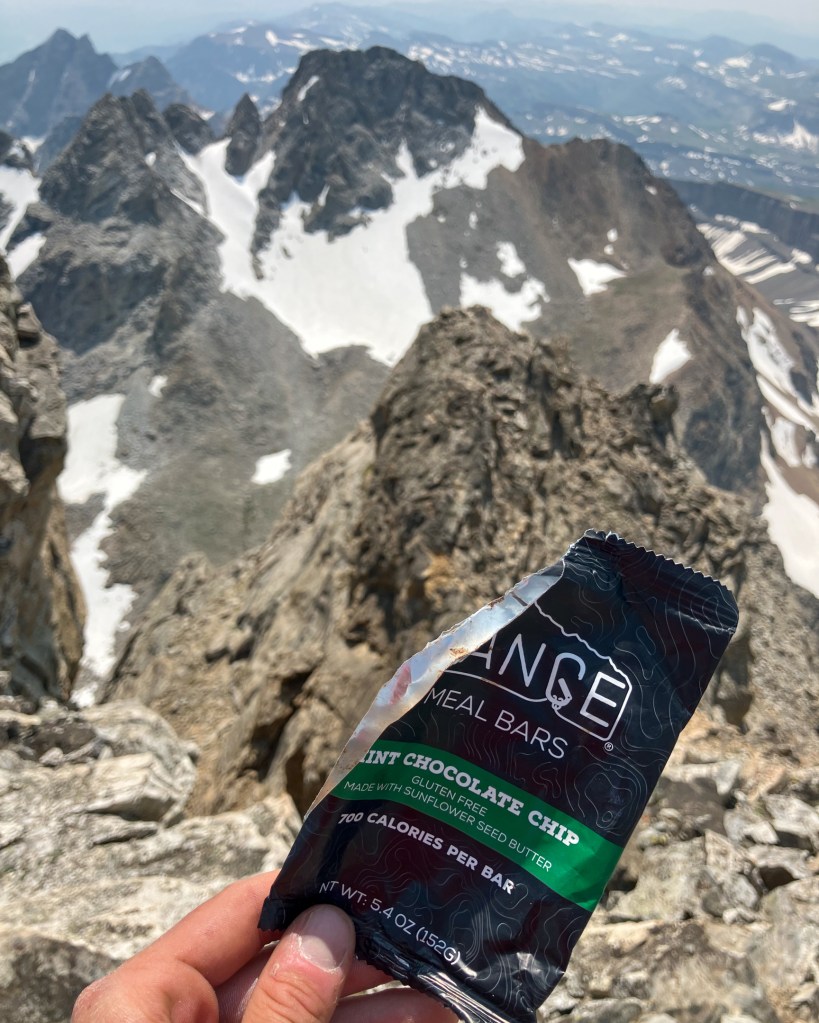
Ten Thousand Too Far is generously supported by Icelantic Skis from Golden Colorado, Range Meal Bars, The High Route, Black Diamond Equipment and Barrels & Bins Natural Market.




enter your email to subscribe to new article updates
DISCLAIMER
Ski mountaineering, rock climbing, ice climbing and all other forms of mountain recreation are inherently dangerous. Should you decide to attempt anything you read about in this article, you are doing so at your own risk! This article is written to the best possible level of accuracy and detail, but I am only human – information could be presented wrong. Furthermore, conditions in the mountains are subject to change at any time. Ten Thousand Too Far and Brandon Wanthal are not liable for any actions or repercussions acted upon or suffered from the result of this article’s reading.
 Ten Thousand Too Far