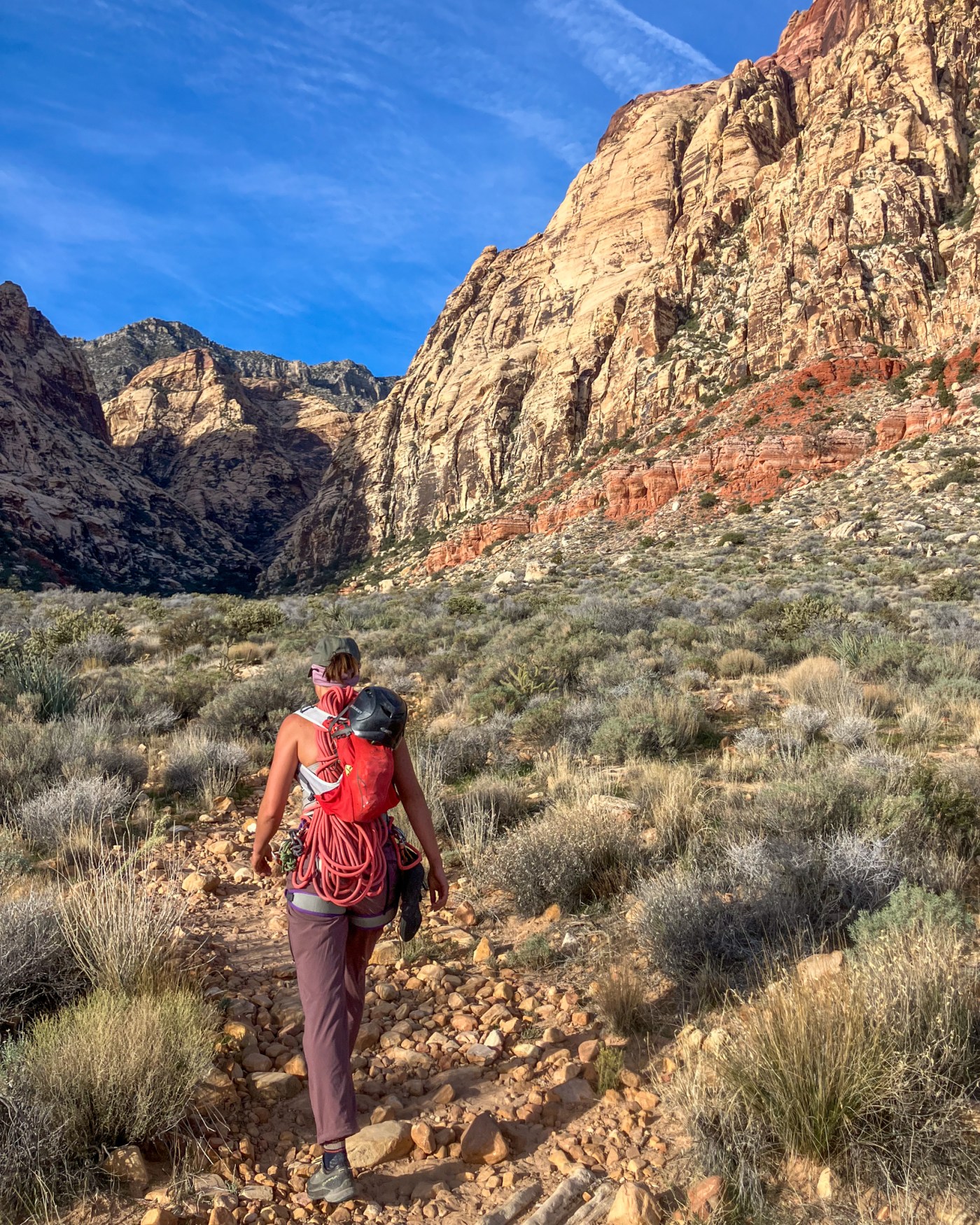
On December 18, 2025, Bobbi Clemmer and I channeled our inner Teton spirit, raging up the 2,000 foot mega-classic Solar Slab as our final climb of 2025. We climbed the full route and scenic “walk-off” to Oak Creek in a civilized nine hours car to car. We also climbed a few harder variations to the standard route.
Until 2025 Bobbi and I have spent every climbing summer in the Tetons, a mythical land of lengthy approaches, soaring alpine ridges and headlamp descents. Due to equal burdens of altitude, volatile weather and complex logistics, the bulk of our climbing was historically sub-maximal, long routes 5.9 and below. This summer was different. Our new home crags Red Rocks and Idyllwild also offer ample adventure climbing, but the approaches, descents, weather threat and altitude tax are exponentially less. We were able to climb harder multi-pitch routes than ever before without sleep deprivation or fears of getting benighted. Cranking hard high off the deck was addicting. Our previous seasonal pyramid of 5.7 to 5.9 alpine routes was replaced with almost constant 5.10 to 5.11- crack climbing. Naturally, our ability levels and inspiration sky rocketed. But as our fingers grew stiff as our shoulders squeaky, we realized something was missing. For our final climbing day of the 2025 season we would trim our rack, set alarms and shoot high, Teton style.
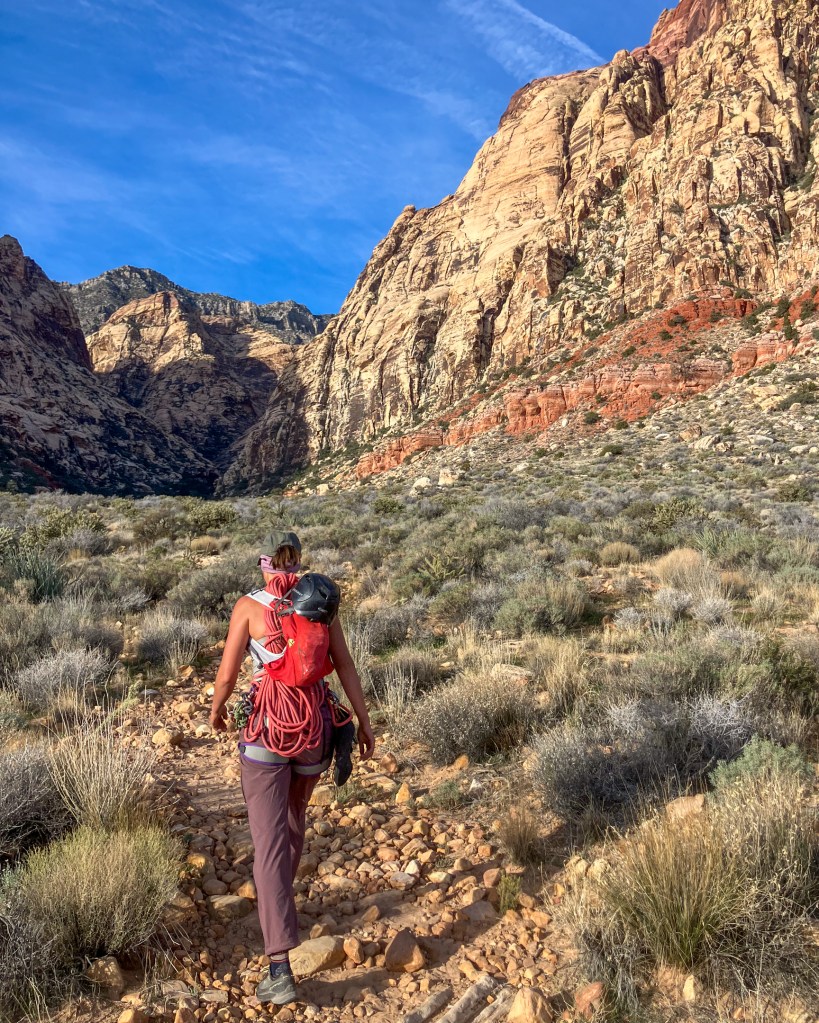
Solar Slab is one of the most popular routes in Red Rocks. From bottom to true summit the business is approximately 2,000 vertical feet and 14 pitches, taking a striking line up a captivating south facing slab at the mouth of Oak Creek Canyon. Sure, its only 5.6 and is a popular free-solo for the hardened, but any route 2000 feet tall deserves respect. Most parties rappel the route, but the thought of a dozen rappels over low angle varnished sandstone clogged with other parties made me nauseous. Furthermore, Solar Slab rappel descents skip the final two pitches, exciting summit scramble, and scenic walk off through one of the prettiest areas in Red Rocks, the Painted Bowl. Fixed belays are virtually non-existent in the Tetons, so until 2025 we’d never rappelled a long trad route anyways. We would pack light, carry all our gear over the top, and walk off in style. With the short daylight hours of late December we got the earliest timed entry slot for the scenic loop, arrived at the gate with bags packed at 7:55AM, and cast off from the Oak Creek Trailhead at 8:30AM.
Love Ten Thousand Too Far? Find the information useful? Support independent mountain journalism with $5.10 per month through Patreon (and receive extra bonus content), or with a one-time donation. Any and all support is greatly appreciated.
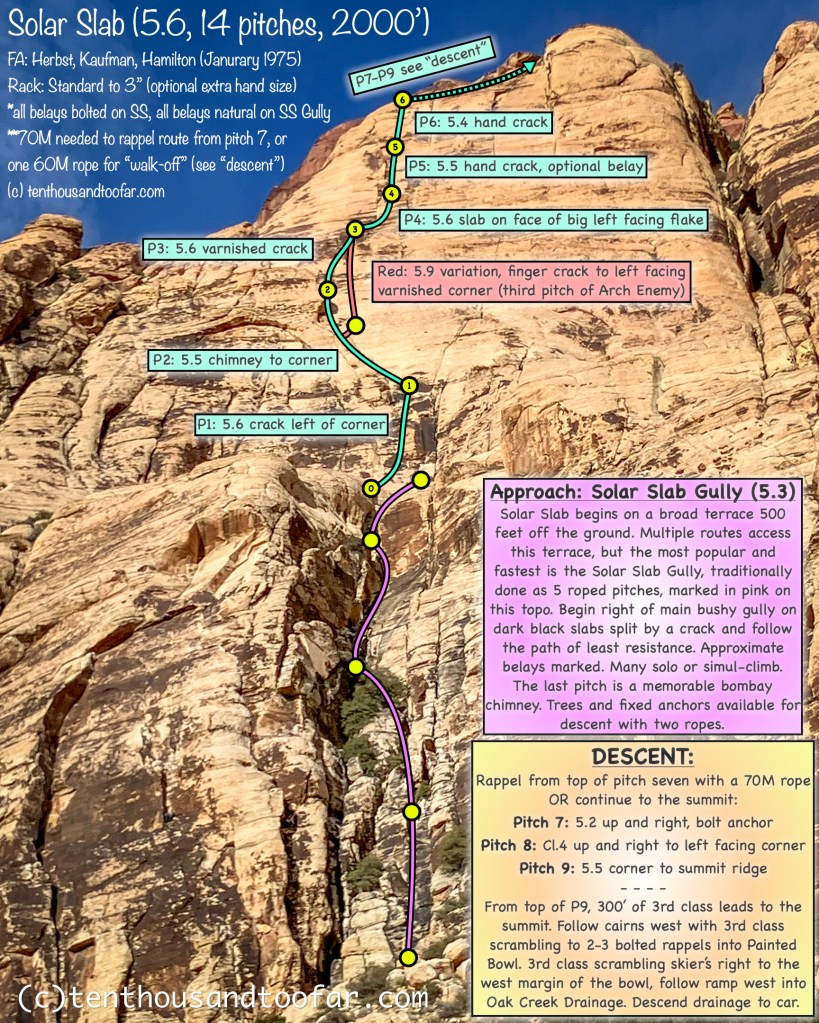
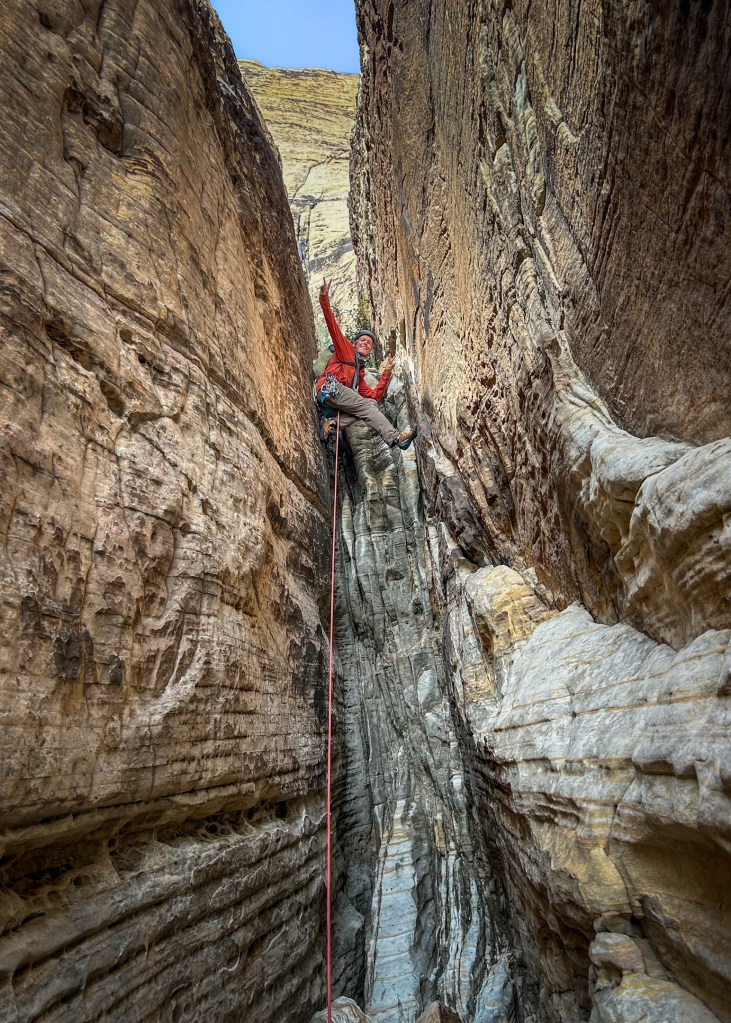
Reaching the base of Solar Slab was relatively straightforward, as the entire route is visible from the car. Guidebook descriptions get confusing, because while Solar Slab itself is usually listed as nine pitches and 1,500 feet, pitch one begins from a hanging terrace 500 feet off the ground. Several routes gain this terrace of various difficulty, but the most common and easiest is the Solar Slab Gully (5.3, 5 pitches, 500′). Our plan was to tandem free-solo the Gully, but this was a steeper varietal of 5.3 with no defined path and some crumbly rock. Bobbi made it about 100 feet before a steeper move prompted a belay. I free soloed the rest of the gully trailing a rope for Bobbi, using two trees and one terrain belay to reach the terrace in three efficient pitches. The final difficulty of the gully was a really sweet bombay chimney that left both of us grinning ear to ear. We launched into the first proper pitch of Solar Slab at 10:30AM.

With at least two parties hugging our coattails I voiced intention to climb as fast as possible, placing the bare minimum gear required to keep things civilized. Aside from fixed natural protection and one accidental 5.9 variation which needed more gear on pitch three (see topo), I placed 9 pieces of protection in 1500 feet, free-soloing about half the pitches while jamming out to punk music in the soft December sunlight. Rather than simul-climbing, which I generally despise on low angle terrain and especially high friction sandstone, we made use of a short 45 meter skinny rope, nice ledges, bolted belays and hasty changeovers to save time. Bobbi followed like a ninja squirrel. Our only serious time penalty was getting off route on pitch two, where I nonchalantly climbed directly up from pitch one into the second pitch 5.9 finger crack of Heliotrope. Had I thoroughly consulted the topo even once I would’ve known to move left. Instead, I had to rappel off a fixed anchor back to Solar Slab, and down solo 20 feet of exposed jugs when the rope fell short. Furthermore, my light rack lacking in small sized cams and wires meant I only scored three pieces in 100 feet of baking hot 5.9 fingers. What doesn’t kill you makes you stronger… they say.
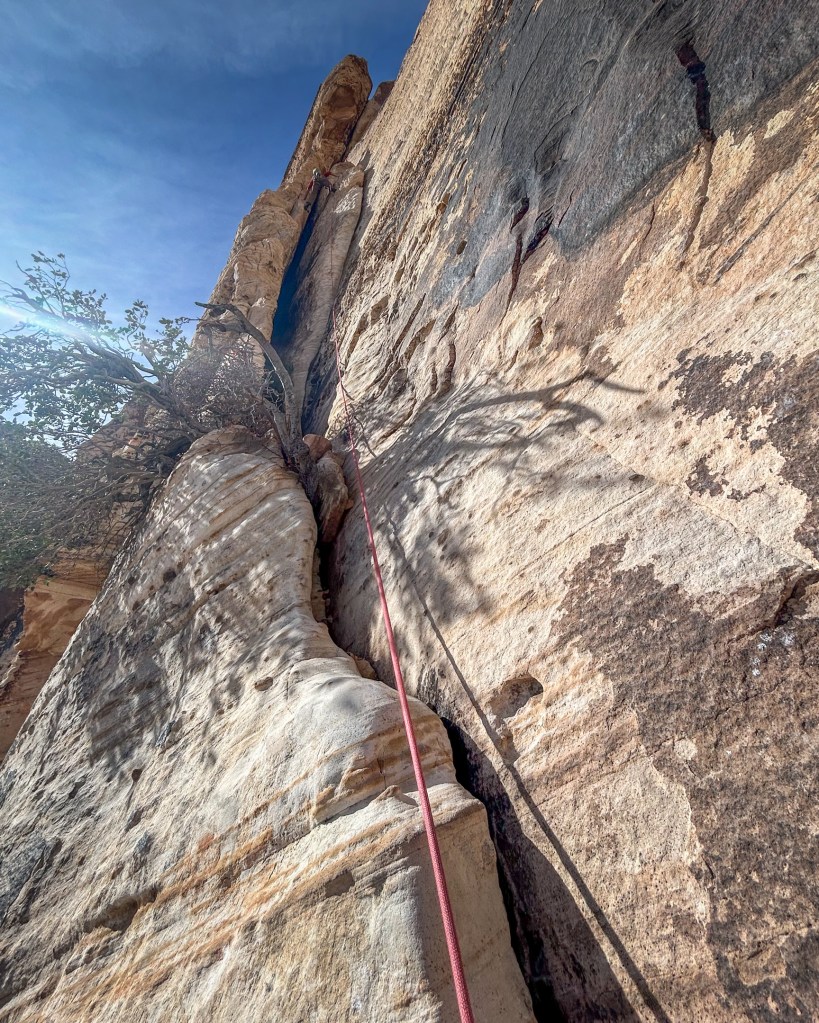
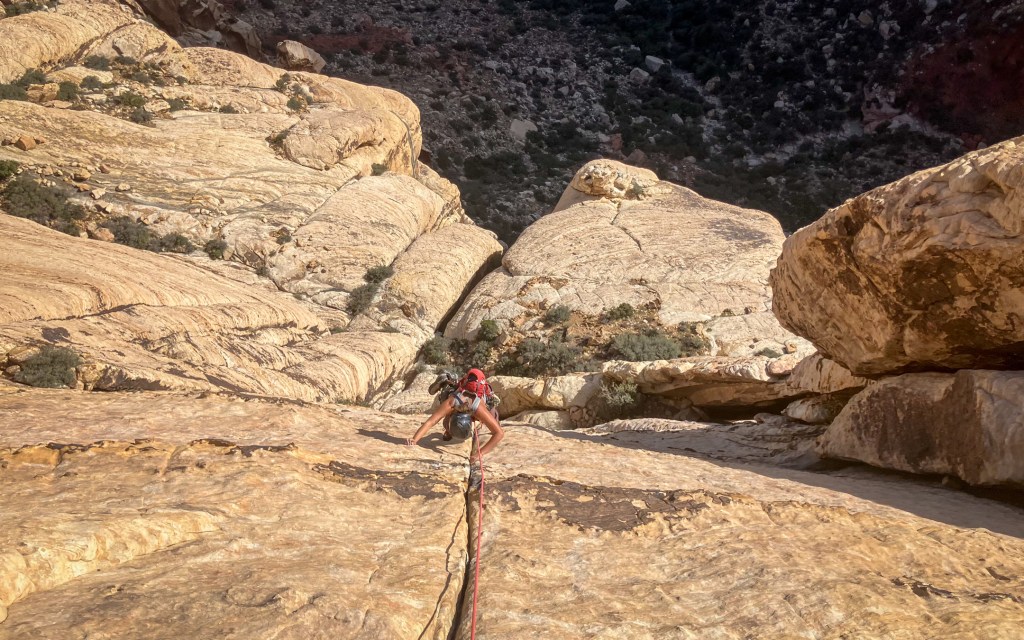
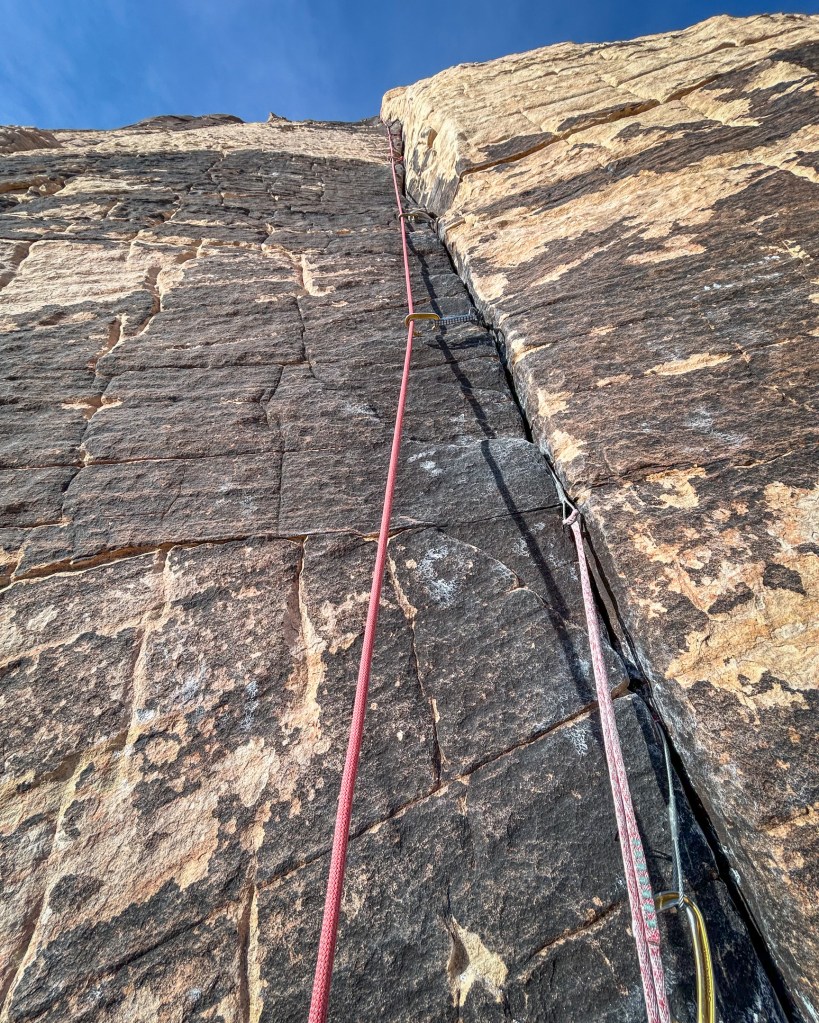
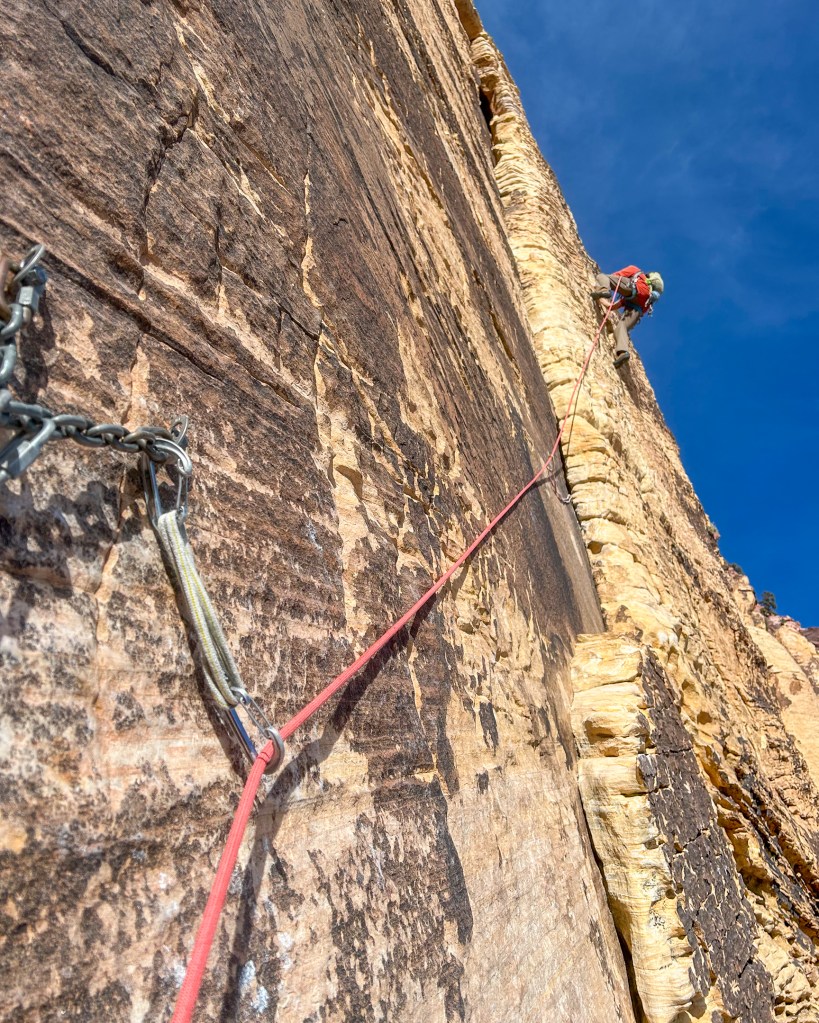
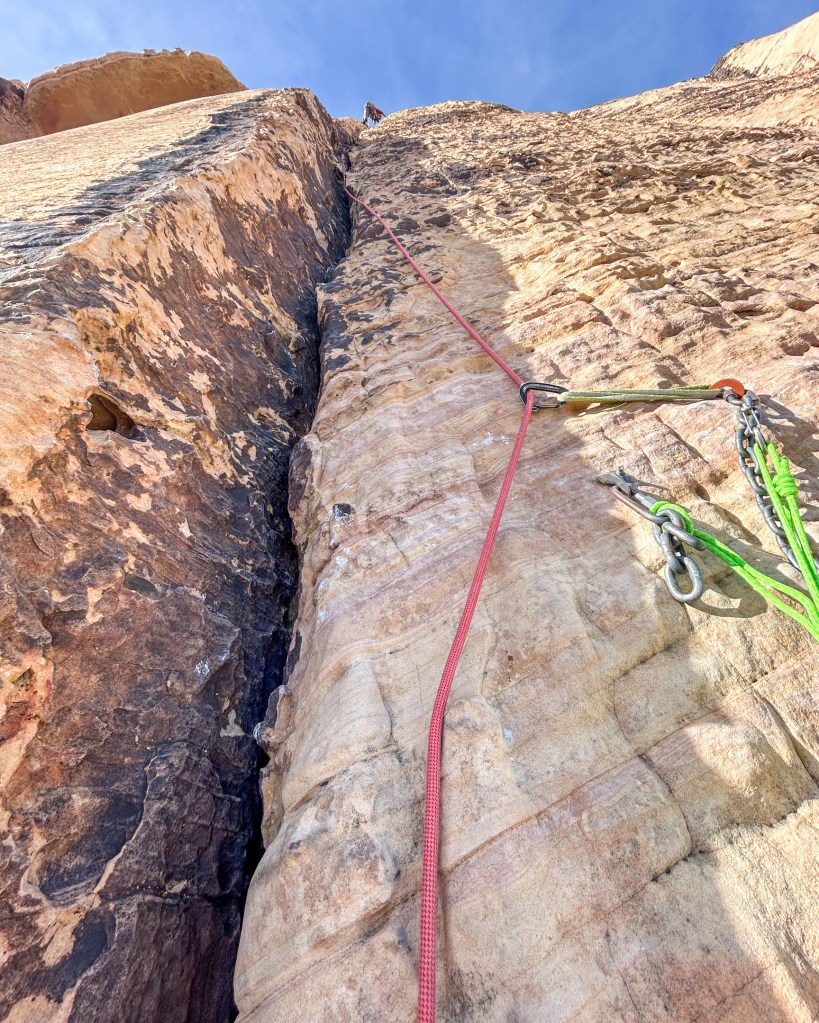
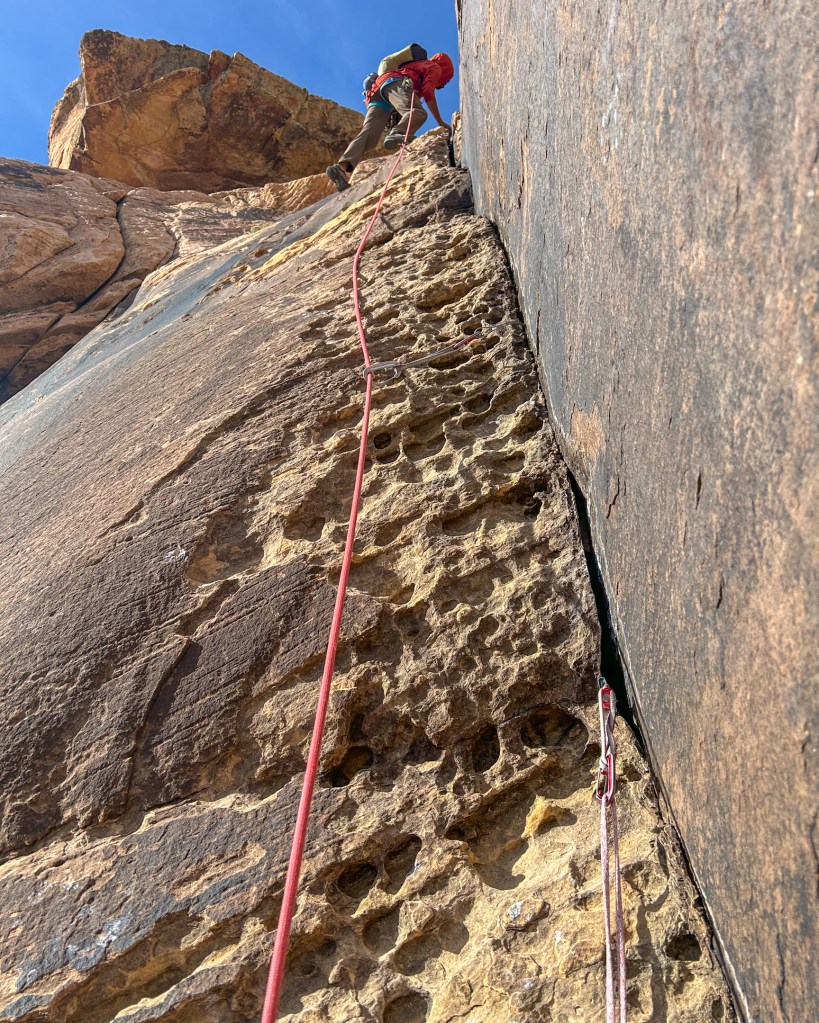
We coiled ropes on the summit ridge at 1:30, five hours after leaving the car. 300 feet of exposed scrambling led to the true summit, where we followed cairns west down ramps and chimneys to a series of bolted anchors. Apparently there are different anchors for rope lengths as short as 70 meters, but we used a light 6mm tagline and reached the Painted Bowl in two rappels. The Painted Bowl is named for an incredible array of colored sandstone from jet black varnish to pastel pink, clay orange, pearly white, speckled brown and even Easter Egg blue. Above the Painted Bowl lies the south face of Rainbow Mountain and the staggering Eagle Wall, home to the world famous Levitation 29 (5.11c, 700′, IV) which I dream of climbing someday, and lesser classics like Eagle Dance (5.10c A0+, IV) and Rainbow Buttress (5.8+, IV). Substantial water runoff from Rainbow gives bloom to an incredible spread of desert flora that dazzles from afar, but threatens sanity while bushwhacking. A mandatory slick rock slip n’ slide drops into Oak Creek. From there, a mindless grind of playful boulder hopping leads straight to the car. We reached Oak Creek at 3:30 and took our sweet time stumbling to the car for a round trip time of nine hours. The Tacoma door slammed shut at 5:30, and by 6:00 we were slamming hand tossed pizza at Mark Rich’s New York Pizza in Summerlin (which we can’t recommend enough). Had we not climbed the 5.9 second pitch of Heliotrope, the 5.9 Arch Enemy pitch three variation, and feasted on the geologic delicacy of the Painted Bowl, I reckon we could’ve easily saved two or three hours without extra effort.
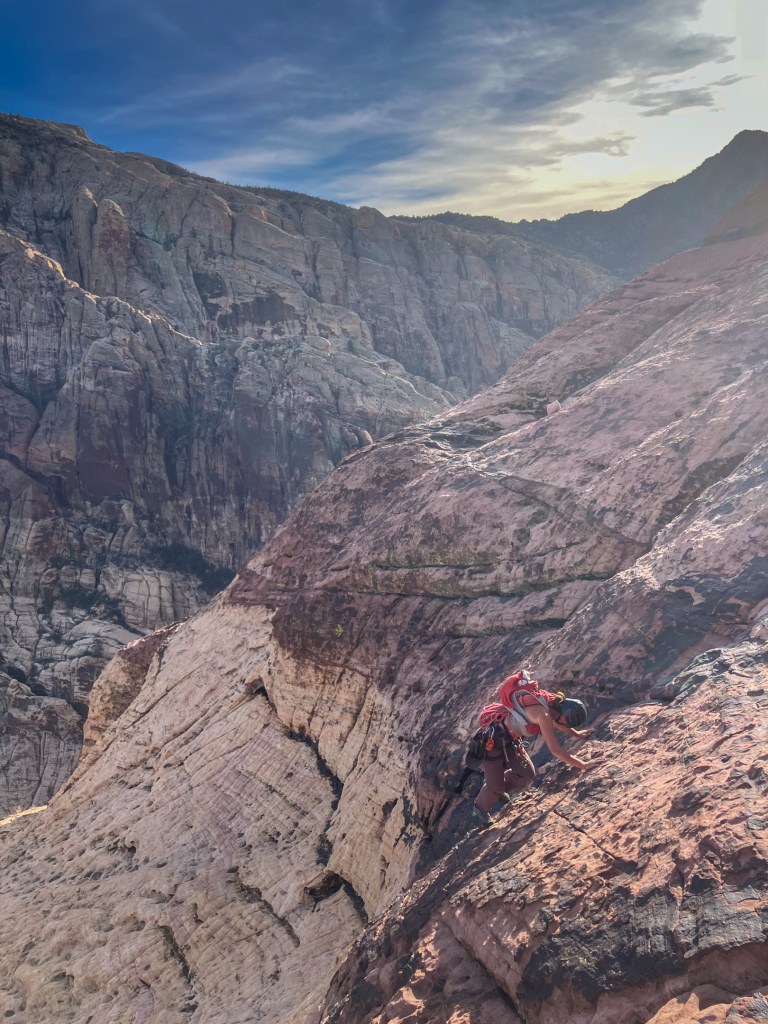
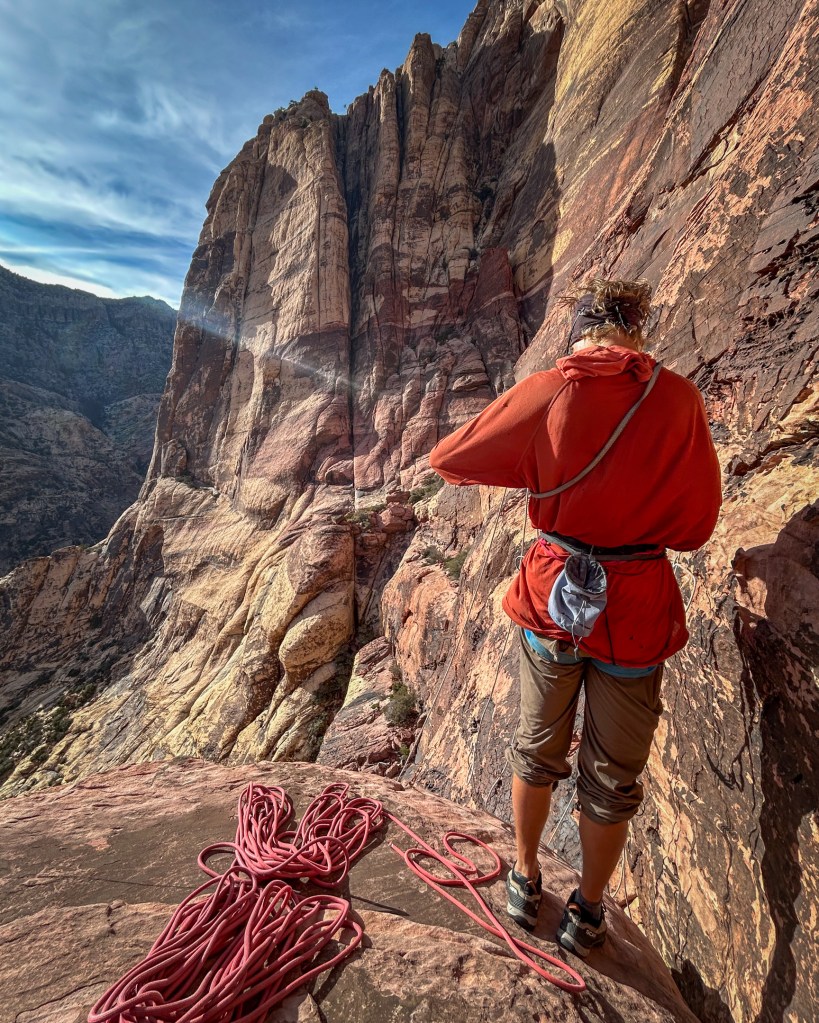
Solar Slab was the perfect bookend to our long season of desert climbing. The Solar Slab Gully was awesome and expedient alpine style scrambling, and every pitch of Solar Slab offered excellent rock quality, regal exposure and a fun diversity of movement. No lead bolts highlights the natural appeal of the line. We carried a single set of cams from #0.3 to #2 Camalot, doubles in #1 and #2, and a half dozen wires. If I were to climb Solar Slab with a partner again I would drop the extra #1 and #2 at least. Long runners were useful for clipping anchors when linking pitches. While simul-climbing is a popular strategy with competent parties, the first three and last two pitches both wander and are low angle enough to create rope drag even if the leader is soloing. In my opinion, this route lends perfectly to short and efficient pitches, with a possible simul block combining pitches three thru seven. Typical for Red Rocks, the 5.6 grade is generous and short lived, with the bulk of the work clocking 5.5 or under. In Joshua Tree, Solar Slab would be rated 5.4. The walk-off is often shunned as long and circuitous, but we thought it was neither. A party of two topped out and began rappelling just behind us, and were still a few hundred feet off the ground when we scurried by a few hours later. Rappelling low angle sandstone is a time consuming risk of both rope and sanity, and if you bail from pitch seven you miss the last two pitches, true summit, and uncompromising beauty of the Painted Bowl. In the Tetons, the Solar Slab walk-off would be certified light duty.
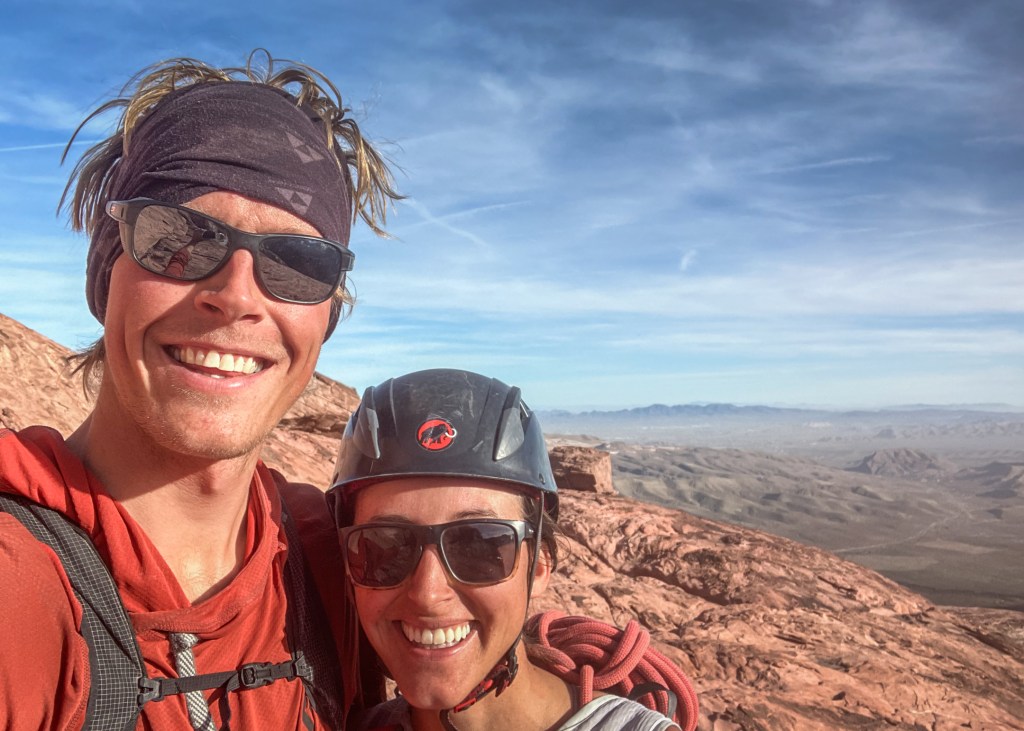

Three days and eleven hours of driving later, we touched down in home sweet home Idaho, unfortunately greeted to not a single inch of snow. I thought I would be happily skiing, but instead I’m donning a cup of hot coffee and dreaming of days like these. Until next time, Vegas.
Want to support? Consider a donation, subscribe, or simply support our sponsors listed below.
Ten Thousand Too Far is generously supported by Icelantic Skis from Golden Colorado, Range Meal Bars, The High Route, Black Diamond Equipment and Barrels & Bins Natural Market.




subscribe for new article updates – no junk ever
DISCLAIMER
Ski mountaineering, rock climbing, ice climbing and all other forms of mountain recreation are inherently dangerous. Should you decide to attempt anything you read about in this article, you are doing so at your own risk! This article is written to the best possible level of accuracy and detail, but I am only human – information could be presented wrong. Furthermore, conditions in the mountains are subject to change at any time. Ten Thousand Too Far and Brandon Wanthal are not liable for any actions or repercussions acted upon or suffered from the result of this article’s reading.
 Ten Thousand Too Far
Leave a comment