
Seams Heady is a renowned 5.11b “PG” trad seam in the glacial polished granite wonderland of Teton Canyon. In 2024 I completed a ground-up redpoint with no previous inspection or beta. I learned three enlightening lessons through the process.
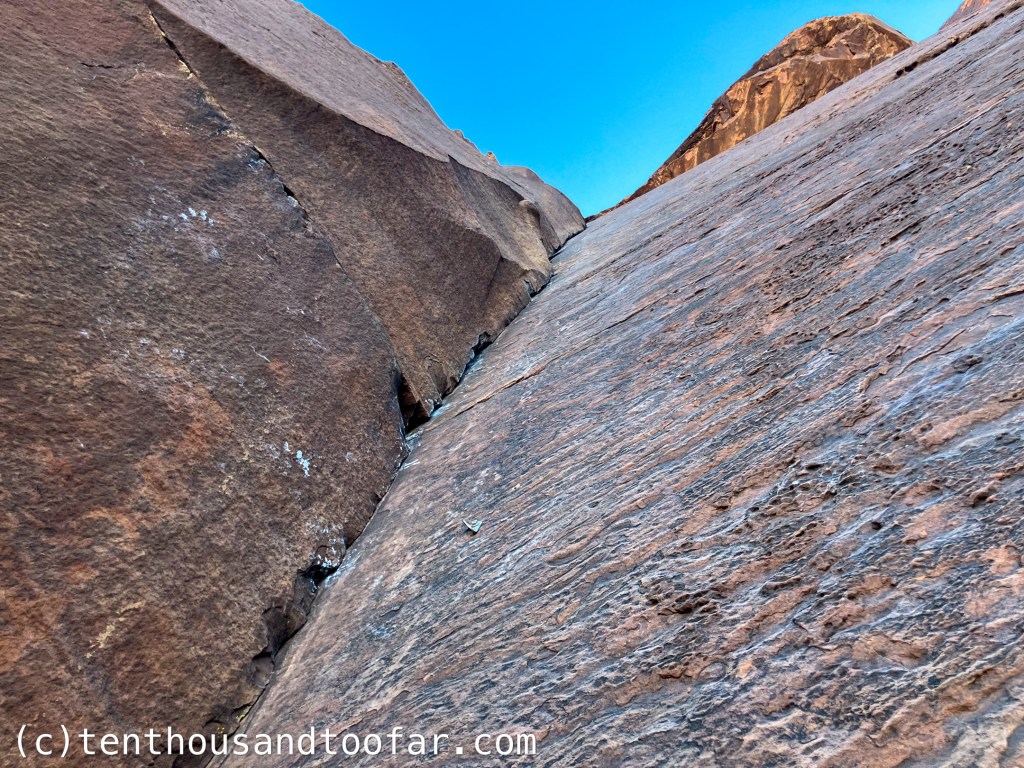
Last summer I climbed my hardest trad route, a thoughtful 5.11b head-point in Teton Canyon known as Seams Heady. The route tackles a striking 50 foot fingernail seam, with a small offset stopper guarding an ankle breaking fall from the crux. Higher, a nest of #00 cams protects funky exit climbing. Should that gear rip, the ground would be terribly close. I called the route a head-point because to date its only been climbed after top-rope rehearsal from the super classic and generally well protected Hoods in the Woods (5.11a/5.10d). For better or worse, I’m a bit of a renaissance man. I have a gravitational pull towards traditional ethics, and aspire to the gold standard of ground-up onsight climbing whenever possible. Sure, I’ve top-roped routes that feel excessively dangerous before taking the sharp end – I don’t want to die. But Seams Heady looked just manageable enough to attempt from the ground.

After warming up on Kiddie Corner (5.8), I lowered to the ground, pulled the rope, and set sail. I arranged a nest of trustworthy small gear and gingerly slabbed up to the crux. Sure enough, a chalked mono-pocket from regular top-ropers took a small but bomber offset wire. I welded the wired, clipped it with a long draw to reduce likelihood of an upward pull, and scrutinized the terrain ahead. A crimp ladder with grim feet left of the seam was obvious. Move by move I worked higher above the gear, constantly analyzing fall potential should the wire pull. As the harsh 5.11 crimping approached the no fall zone, I didn’t have the gusto. I down-climbed a few moves and jumped. The nut held. I returned to the ground.
While resting ballooned forearms I reviewed my new intel. A sloping ledge only one move above the crux promised salvation, and so long as the stopper held a second time, a fall would be safe. The seam widened just enough above the crux to where I hoped to wedge a few RP’s or tiny cams. Intoxicated by inspiration, I set off for a second burn.
After clipping the now ultra-welded nut a second time, I committed fully to the black granite crimps and mantled onto the ledge. Sadly, it wasn’t the ledge I expected. Sloped footholds and a bulging wall above precluded a full rest, and the crack above didn’t take any protection. I was officially stranded in the no fall zone with shaky legs. There was no way I could reverse the mantle. However, while calming my burning toes I noticed a small slot at knee height. I managed a single #00 cam and two shit stoppers, clipped the lot, and breathed deep. Confident the gear would hold my weight, but perhaps not a lead fall, I panned upward. The puzzle ahead was definitely easier, but far from the jug haul I hoped , and the only good protection was a hand sized crack a few too many moves away. If I ripped the nest I could suffer grave injury, and 5.11b was at my physical limit. Spying a convenient line of edges leading to Hoods, the nervous pull towards salvation became overwhelming. One long span later and I was sinking locker jams with bomber protection to the anchor. I had failed, but lived to tell the tale.


The next few days I obsessed over this silly little seam, particularly the #00 slot. I knew it was just big enough to except a second, and with a pair of deep #00’s I could flirt with the second crux. Two days later I was back at the base with “5.13 Chase” Krumholz, a local 5.13 crusher eager to support my dreams. Armed with a double rack of micro gear I cast into the sea of crimps one last time. The slot accepted the second #00, and with augmented protection I had just the confidence to push upward. Fortunately, a few secure 5.9 moves brought me to a dubious tooth which took another shoddy wire, and a few moves higher I received an integral #1 Camalot to protect the final slippery mantle. Seams Heady was in the bag, along with a coveted ground-up ascent. Armed with my gear beta Chase proudly flashed the route. The following weekend I returned with Mike Parri, a partner of similar strength to myself. He repeated it shortly after on his second attempt. The send train was unleashed.
Seams Heady represented a pivotal and enlightening step in my trad climbing. Aside from reassurance in the exhilarating discipline of ground-up trad climbing, I learned three key lessons which formed a successful framework for future limit trad projects.

#1 – Always Have an Escape Plan… or Three
Limit trad climbing, especially on runout routes with tricky protection and ground-up tactics, is dangerous. If embarking on such devilish work, having an escape plan is crucial. On Seams, I had many stages of possible escape for both cruxes. My first was being able to down-climb before entering the main crux. This allowed me to assess protection before full commitment. From the resting ledge above marking the no fall zone and second crux, I had a reasonable chance of protection in the tiny slot, and Hoods was nearby enough for a likely bail. Lastly, I could’ve got down on my knees, taken in all slack, and slithered over the mantle ledge to a scary, but not necessarily dangerous, fall onto the proven bomber wire below. Having all these escapes in the toolbox provided confidence to continue upward with a safety margin aligning with my personal risk tolerance.
#2 – Placing Less Gear to Climb Harder
The main factor that allowed me to climb Seams, my hardest climb on bolts or gear, was the absence of protection through the crux. This is counterintuitive, but many 5.10 plateaued trad climbers will relate. If the seam took protection the entire way, I surely would’ve wasted valuable energy zipping it up, and it would probably remain a project. I only had enough strength to surmount the crux because there wasn’t gear to place. I was solely focused on climbing, which preserved energy and channeled my attention. On subsequent limit climbs the following summer, I deployed this same tactic with great results, even though both routes took protection the entire way. Rather than consistently trying to keep myself on a permanent top-rope through the hard climbing, placing gear overhead from poor stances which zap energy and often block critical jams, I would analyze fall potential, take a deep breath, and punch it – vowing only to place protection from the next resting stance. Sure enough, I unlocked previously unattainable pitches. I redpointed the sustained fourth pitch 5.10+ layback corner of The Nightcrawler, my third redpoint of the grade. Shortly after I completed my first 5.10d onsight on the slippery second pitch tips crack of the Challenger, often regarded as 5.11a/b. That same summer I onsighted the wickedly runout 5.10b R/X first pitch, and 5.10c R third pitch, of the notorious Red Rock’s test-piece Risky Business. These were my two hardest “R” rated leads.
#3 – Confidence and Commitment is Key
When climbing at my limit, confidence and full commitment is key. Escape plan? Check. Gear and fall analysis? Check. And if I still decide to continue upward from that point, any mental noise over the last two points need be silenced. It’s impossible to climb optimally when scared, or with a distracted mind. When cranking on the smallest crimps, fighting for the next jam, or runout on intricate smears, full confidence and commitment is crucial. At this point, not falling is the best course of action – and that requires climbing to the absolute best of your ability.
Of course, this whole yap comes with a major caveat: if you don’t know, don’t go. I’ve previewed many a dangerous route on top-rope, and fully abandoned others until building requisite strength. No singular route is worth breaking bones or dying over. The more important point is this: faffing around with too much gear, and climbing scared, are the enemies of limit trad climbing.

Want to support? Consider a donation, subscribe, or simply support our sponsors listed below.
Ten Thousand Too Far is generously supported by Icelantic Skis from Golden Colorado, Range Meal Bars, The High Route, Black Diamond Equipment and Barrels & Bins Natural Market.





subscribe for new article updates – no junk ever
DISCLAIMER
Ski mountaineering, rock climbing, ice climbing and all other forms of mountain recreation are inherently dangerous. Should you decide to attempt anything you read about in this article, you are doing so at your own risk! This article is written to the best possible level of accuracy and detail, but I am only human – information could be presented wrong. Furthermore, conditions in the mountains are subject to change at any time. Ten Thousand Too Far and Brandon Wanthal are not liable for any actions or repercussions acted upon or suffered from the result of this article’s reading.
 Ten Thousand Too Far
Leave a comment