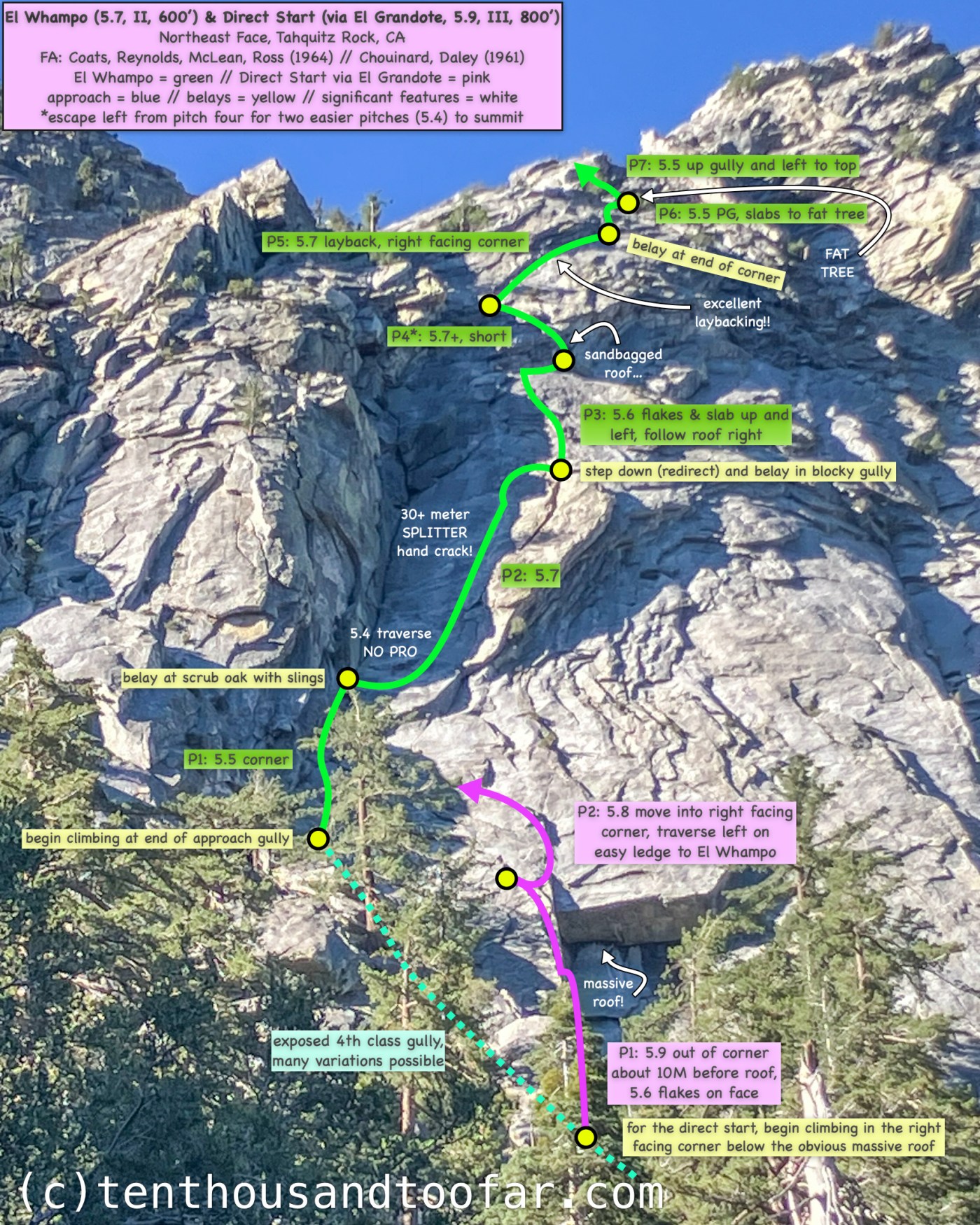
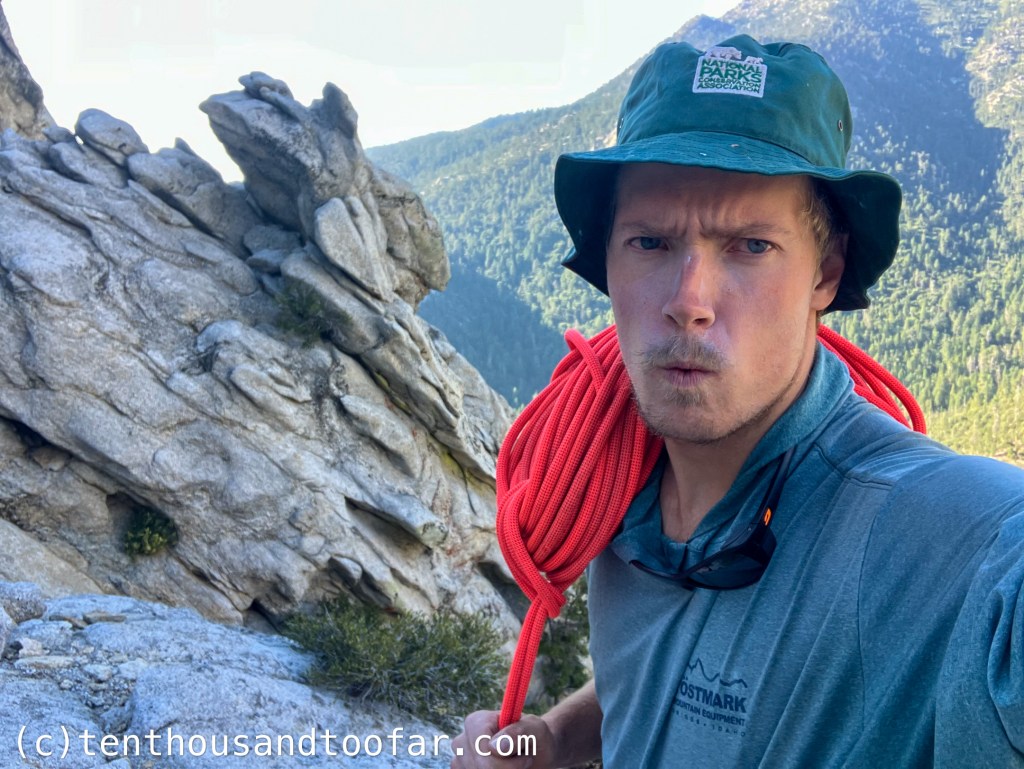
On Saturday September 6th, 2025, I lead rope soloed my first multi-pitch route! El Whampo (5.7, II), and it’s direct start via El Grandote (5.9, III), are respective classics on the legendary Tahquitz Rock.
An Intro to Lead Rope Soloing
I taught myself to rope solo a few months ago on a rest day in Red Rocks. Being new to the area, I lacked partners. And although I fancy myself some moderate free soloing from time to time, I wanted to step from my comfort zone. I also knew the rope soloing skillset would be valuable for big wall and aid climbing, two disciplines I aspire to. For those unfamiliar, rope soloing is self belayed lead climbing. There is no “approved” method or devices for rope soloing. Generally, it’s an inadvisable activity with high potential for disaster, reserved for the rare few with enough passion, rope systems knowledge, and stubbornness to walk up to a vertical wall alone and say: “I can’t wait for a partner, I must climb now.” Rope soloing is infinitely more complicated than standard climbing. You are both the climber and the belayer. There’s nobody to check your knot or belay device, nobody to inspect your anchors, nobody to lead the crux pitch when you’re scared, and nobody to call for help when you mess yourself up. When multi-pitch climbing the soloist must rappel, clean and re-climb every pitch. If the last five sentences sound like a headache, it’s because they are. That said, for the right personality, the prospect of mastering a bizarre craft to access to more difficult terrain than possible when free soloing, without relying on another human being, is irresistible. That personality is me.
I spent a few parking lot hours watching YouTube videos and experimenting with different systems. I used the tow hitch of my truck as a ground anchor, and slings attached to my roof rack for lead protection. Having a robust understanding of rope systems, and a mathematically inclined mind, I quickly developed a methodology which felt safe. However, I didn’t immediately hop on a 5.10 crack. Instead, I picked a short wall with a few easy single pitch cracks and bolted anchors. I ran a few laps each on a 5.6 and 5.7, experiencing surprisingly few tribulations. By evening I was ready try harder.
Coincidentally, after that day I received an influx of partners. The Alpine Peanut moved permanently to the desert, and I gained a few local friends. I didn’t touch the rope solo kit again until finding myself partnerless last weekend, craving more excitement than top rope soloing or bouldering could provide. On Saturday morning I shouldered a bulging pack with a full double rack, 70 meter rope, all the extra rope soloing gizmos, food, and three liters of water, and trudged up to the Southern California alpine wonderland of Tahquitz Rock.
El Whampo Direct
My objective was El Grandote, an 800 foot 5.9 on the North Face. I chose this route for three reasons. First, Bobbi and I had recently climbed the route next door, El Whampo (5.7, II), and dropped some gear onto a belay ledge shared with El Grandote. Second, despite earning two stars in the guidebook, El Grandote sees little traffic. I knew I would experience some hiccups, and didn’t want to clog a classic. Third, 5.9 seemed like the perfect first multi-pitch rope solo grade – I would be challenged, but felt confident I wouldn’t fall.

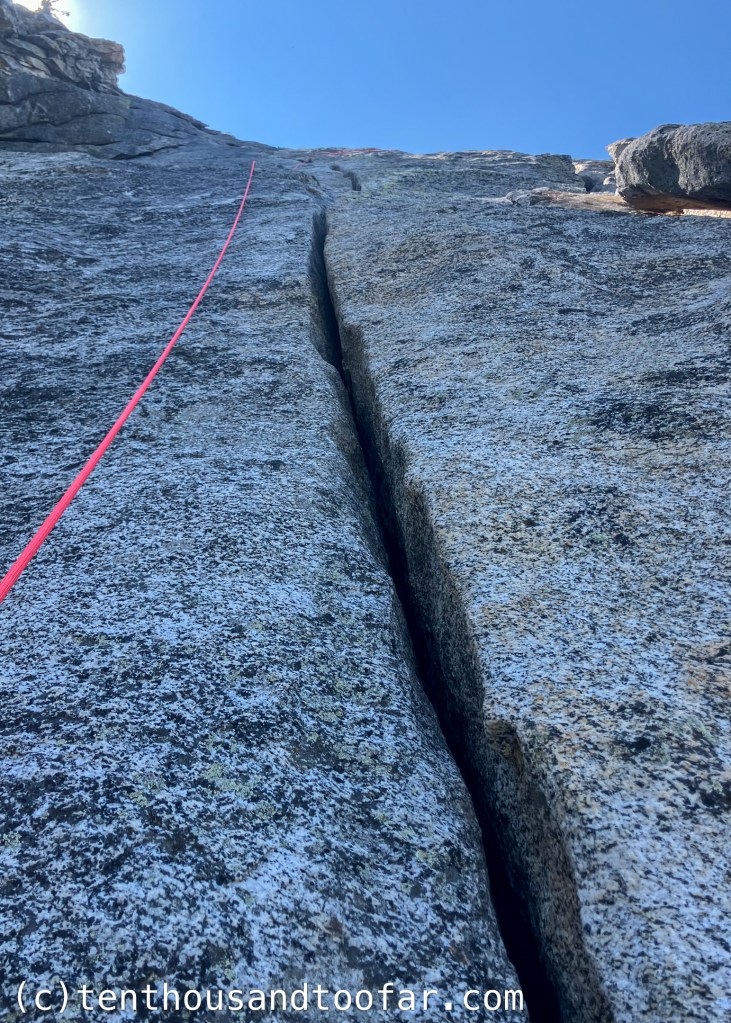
Overall, the day went swimmingly. The 5.9 crux is just off the ground – wild parallel cracks exiting a deep dihedral to a thin slab – but fortunately it both protected and climbed well. I struggled to find the proper route on pitch two. Facing a dealer’s choice of lichen covered runout slabs with no guarantee of protection above, I reluctantly bailed towards El Whampo via an easy ledge system. Those who know me know I don’t surrender easy, but one of the biggest struggles with rope soloing is providing a tight belay. An extra five feet of slack can be the sole difference preventing a nasty ledge fall. If there was any time to back off a runout pitch, this was it. I finished to the top of El Whampo in a peaceful 6.5 hours. Pitch three holds the best 5.7 hand crack I have ever climbed. It’s rare to find a pure 30 meter two-inch splitter, void of any face holds, at such an accessible grade – a true delight. Pitch six was another standout, a brilliant and lengthy 5.7 layback on excellent rock. To make it even better, because I don’t have a belayer, I got to climb every pitch twice! Double the fun, double the pump, and double the classic… what’s not to love. El Whampo is a standout Tahquitz 5.7, and when combined with the first two pitches of El Grandote becomes a must-do classic. I would certainly climb it again.
Love Ten Thousand Too Far? Support independent mountain journalism with $5.10 per month through Patreon (and receive extra bonus content), or with a one-time donation. Any and all support is greatly appreciated.
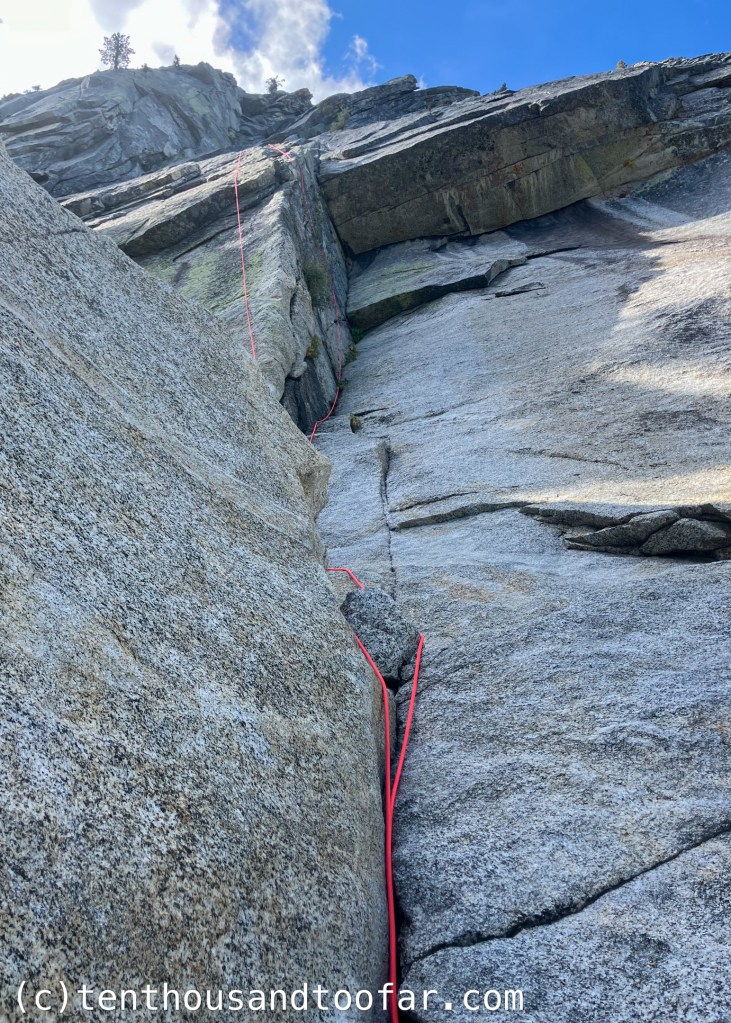

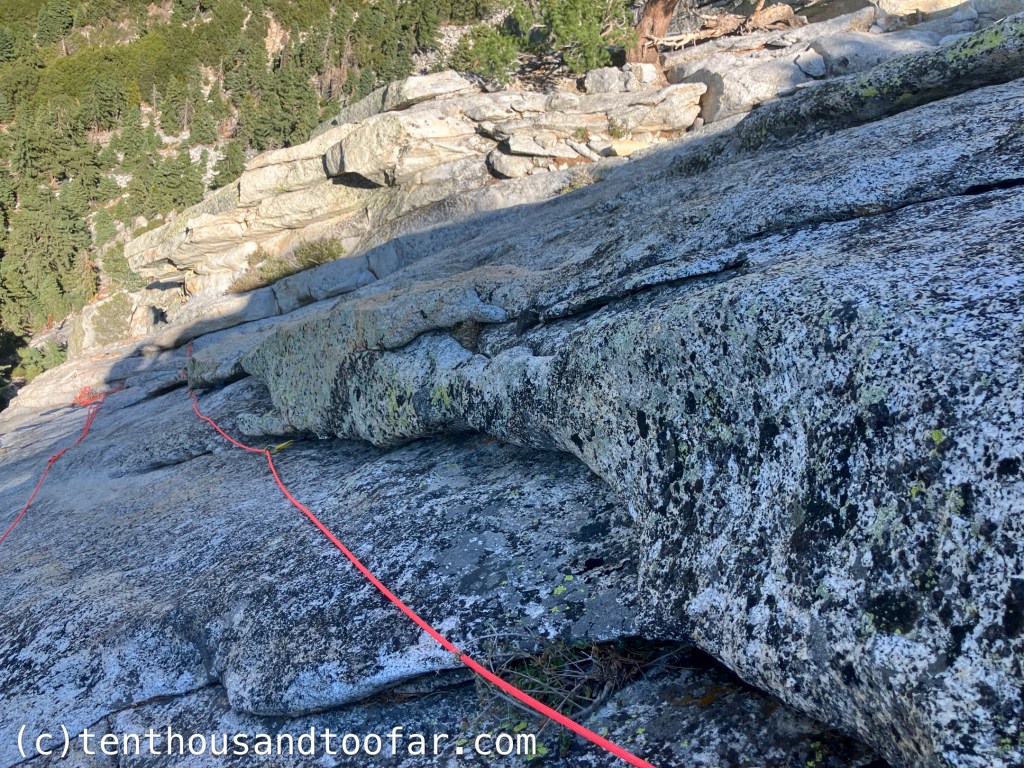
The biggest difficulties I experienced with rope soloing were managing the aforementioned slack accumulation, getting my belay/cache rope stuck (causing an abrupt end to my leading abilities, happened twice), and redirecting the rope for returning to the previous belay on traversing pitches. I’ve already identified strategies to mitigate all those problems, and after testing these tactics further I will report back.

A Quick Note on Systems
For the climbing nerds wondering, I do not own a Silent Partner. My belay device is a regular Gri-Gri (oriented upward with an Avant Climbing neck bungee), and my cache loop device is a Micro-traxion. I do not use any other specialized gizmos like anti-cross-loading clips, or carabiner attachments/prusiks to prevent back feeding. Instead, I use a super beefy auto locking carabiner strong enough to hold a dynamic fall in the unlikely event of cross-loading, and intermittent clove hitches to prevent back-feeding. Lastly, I do not have a “back up” for the belay device. I’ve made the personal decision to trust the venerable Gri-Gri to catch without a break hand. All these decisions were made based on personal risk tolerance. Once I refine my system on a few more routes, I will do a detailed dive on how I rope solo. Sneak peek: The ensuing day I climbed a much harder route and took some lead falls. I am still alive. Stay tuned for the next article.
Want to support? Consider a donation, subscribe, check out my Patreon page, or simply support our sponsors listed below.
Ten Thousand Too Far is generously supported by Icelantic Skis from Golden Colorado, Range Meal Bars, The High Route, Black Diamond Equipment and Barrels & Bins Natural Market.



enter your email to subscribe to new article updates
DISCLAIMER
Ski mountaineering, rock climbing, ice climbing and all other forms of mountain recreation are inherently dangerous. Should you decide to attempt anything you read about in this article, you are doing so at your own risk! This article is written to the best possible level of accuracy and detail, but I am only human – information could be presented wrong. Furthermore, conditions in the mountains are subject to change at any time. Ten Thousand Too Far and Brandon Wanthal are not liable for any actions or repercussions acted upon or suffered from the result of this article’s reading.
 Ten Thousand Too Far