
The “Complete Exum” – “Full Exum” – “Direct Exum” – “Durrance Direct to Upper Exum” – whatever you want to call it, this 1,700 foot skyline route is one of the 50 Classic Climbs of North America for a reason. You can see it from just about anywhere within 100 miles, and pitch for pitch holds some of the best alpine rock climbing in the Tetons, on the tallest and most impressive peak in the Tetons.
While a concrete name for this fusion adventure remains elusive, its classic status does not. I say fusion because rather than a route to its own, the “Direct Exum Ridge” combines the Upper Exum Ridge (5.5, II) and Durrance Direct (5.7, III) for 1,700 feet of climbing on the stunning skyline South Ridge of the 13,775 foot Grand Teton. The “Upper Exum” was first ascended by Glenn Exum, solo, in 1931, what is now the second most popular summer summit route on the Grand. Glenn’s route gained the ridge from the west approximately 1,000 feet below the summit, via the impressive “Wall Street” ramp, leaving some 720 feet of steep unexplored rock below. Enter stage left Jack Durrance and Kenneth Henderson, who, only five years later, made a free ascent of the steeper and much more technical lower ridge connecting to Glenn’s point – the “Durrance Direct” – continuing to the summit. On September 1st, 1936, one of the most captivating rock climbs of North America was opened, known to most as the Direct, Complete or Full Exum Ridge (5.7, IV). A true classic in just about every way, the “Direct” involves six pitches of remarkably steep, clean and exposed 5.7 climbing on bulletproof polished granite, followed by 1,000 feet of complex technical alpine scrambling up to 5.5, in a purely spectacular setting – one of Steve Roper and Alan Steck’s “50 Classic Climbs of North America”. Bobbi and I had been eyeing the Direct since last year, and were eager to set rubber to history on our three year anniversary weekend.
Love Ten Thousand Too Far? Support independent mountain journalism with $5.10 per month through Patreon (and receive extra bonus content), or with a one-time donation. Any and all support is greatly appreciated.

With a stable weekend weather window we planned a two day ascent via camp in the Garnet Canyon North Fork Moraines. We left the Lupine Meadows trailhead around 4:00PM and made leisurely clouded progress through The Meadows, past the Petzoldt Caves and to our sleeping zone at 10,600 feet by dusk. The air was crisp, and the full glory of Exum Ridge loomed directly above our evening meal. The lower ridge looked delectably steep and challenging, the upper familiar, jumbled and never ending. Two years earlier I soloed the Upper Exum, Glenn Exum’s original line, but had never recreated on the massive swath of stone below. Both of Bobbi’s Grand summits had been on the west face, so the whole enchilada was new to her. We were in for an adventure.
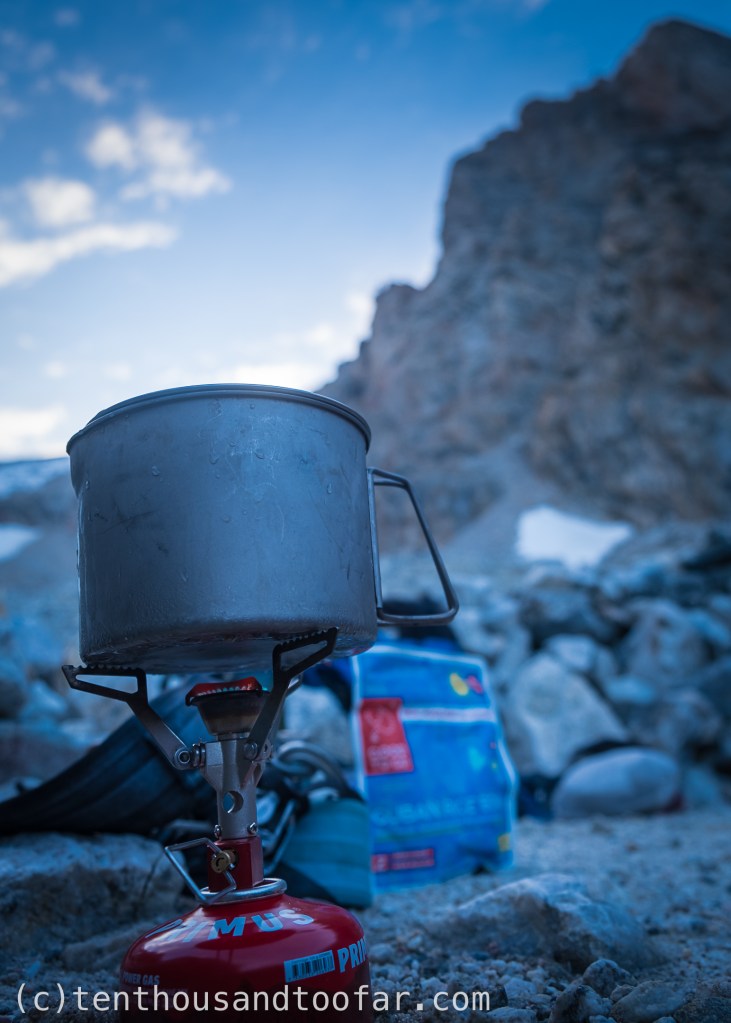
Bird chirps lured me from the bivy sack just before a 5:30AM alarm. Per usual, I slept horribly and Bobbi conked out solid. I never sleep well in the mountains, perhaps why I almost always prefer alpine-style day trips. Regardless, I’ve done enough climbs of substantially harder difficulty with substantially less rest, so I wasn’t the least bit concerned as I yawned my way through a remarkably perky cup of black instant coffee and smeared a thick layer of peanut butter onto our half-stale Pearl Street Bagels for breakfast. We gained the ridge via the Lower Saddle and Black Dyke Traverse, beneath the Wall Street Couloir and across a brief seasonable snow patch towards the ever familiar Glencoe Col and Stettner Couloir, comforting familiarities from the Grand’s standard winter route which I had climbed five times. Following instructions from the Gams guide we began our day with a few hundred feet of gentle fourth class soloing on broken black rock that was unfortunately slicked with melt water, to the base of a prominent west-southwest facing chimney on the west side of the lower ridge pointing towards the crest proper. Guidebooks say this chimney is difficult to locate but we found it quite obvious. We broke out the rack and ropes and here, and began climbing around 9:00AM.

Durrance Direct (Lower Exum Ridge) (5.7, III)
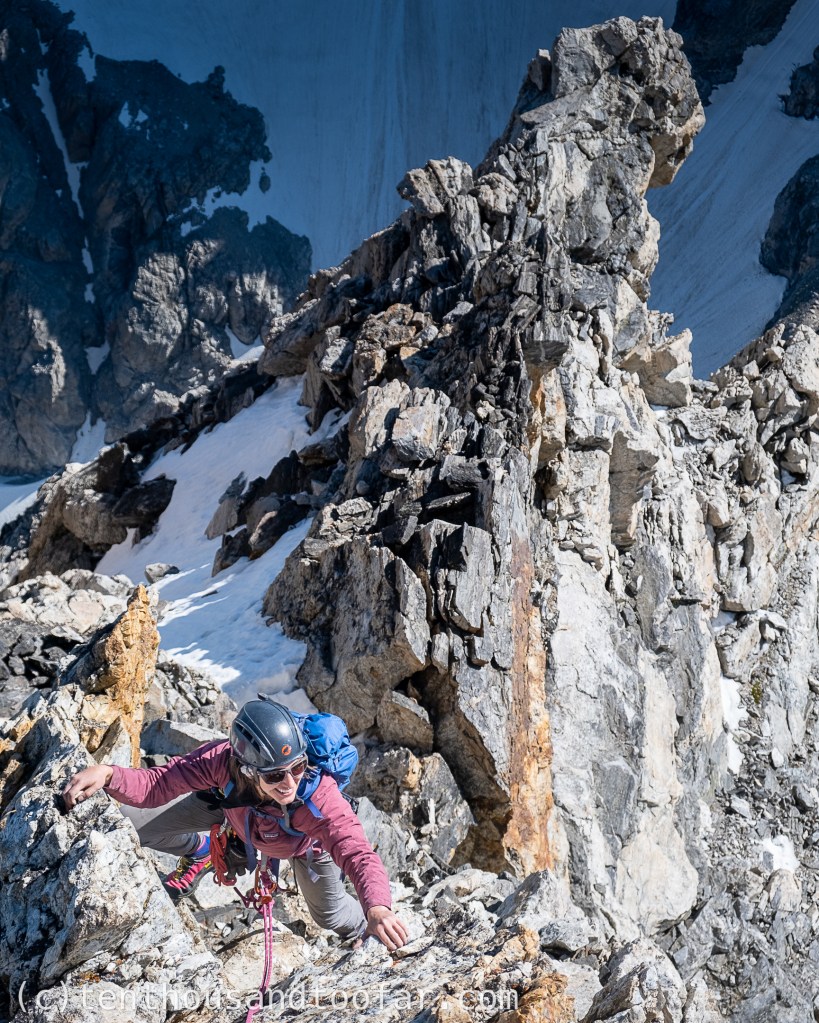
The first two pitches follow the path of least resistance towards the ridge-crest proper. Guidebooks split hairs in this area, but the consensus is generally 5.7ish whether directly in the chimney or on the intriguing fractured face to the right. I opted for the backpack friendly face and was bamboozled by steeper than expected climbing with meager protection and numb extremities that felt closer to 5.8. Pitch two hammered up soloist terrain for another half rope length before gentle 5.6 climbing on immaculate golden flakes warranted more care. The rock on both these pitches was four-star bulletproof, emblematic of the rest ahead. Above pitch two we shifted the belay down and across a broken face to the base of an intimidating left-leaning crack with black rock above. By now we were in the sun, charged by a duotone of warm toes and an inspiring wall of granite overhead.
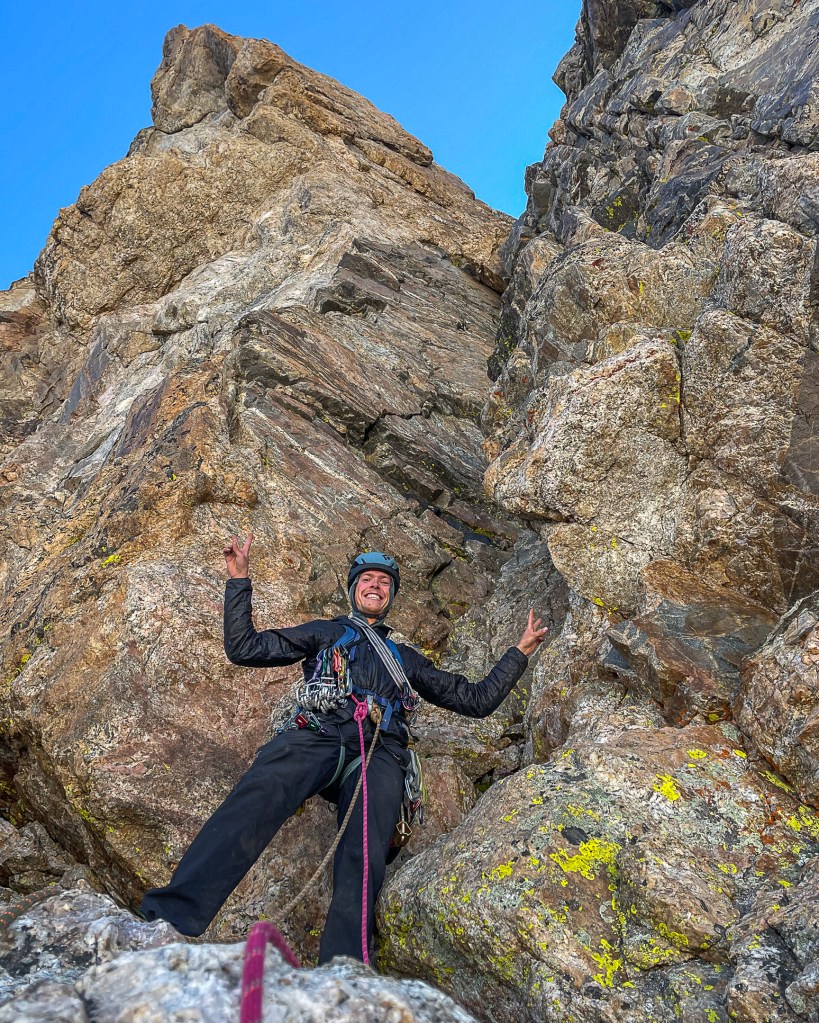
Pitch three was perhaps my favorite, beginning with an awkward balancy 5.7 layback to a strange body-sized flake I called the pommel-horse. I splayed the horse and jammed over the top until I could gain large face-holds and continue straight up on fractured but solid black rock. Climbing with a light rack and interested in maximum efficiency, I placed very little protection and ran the rope nearly dry to a monstrous, low-angle stem chimney that marked the beginning of pitch four. Bobbi continued her steady eddy trend of expedient following, and at the halfway point of the Durrance we were stoked and pace confident.
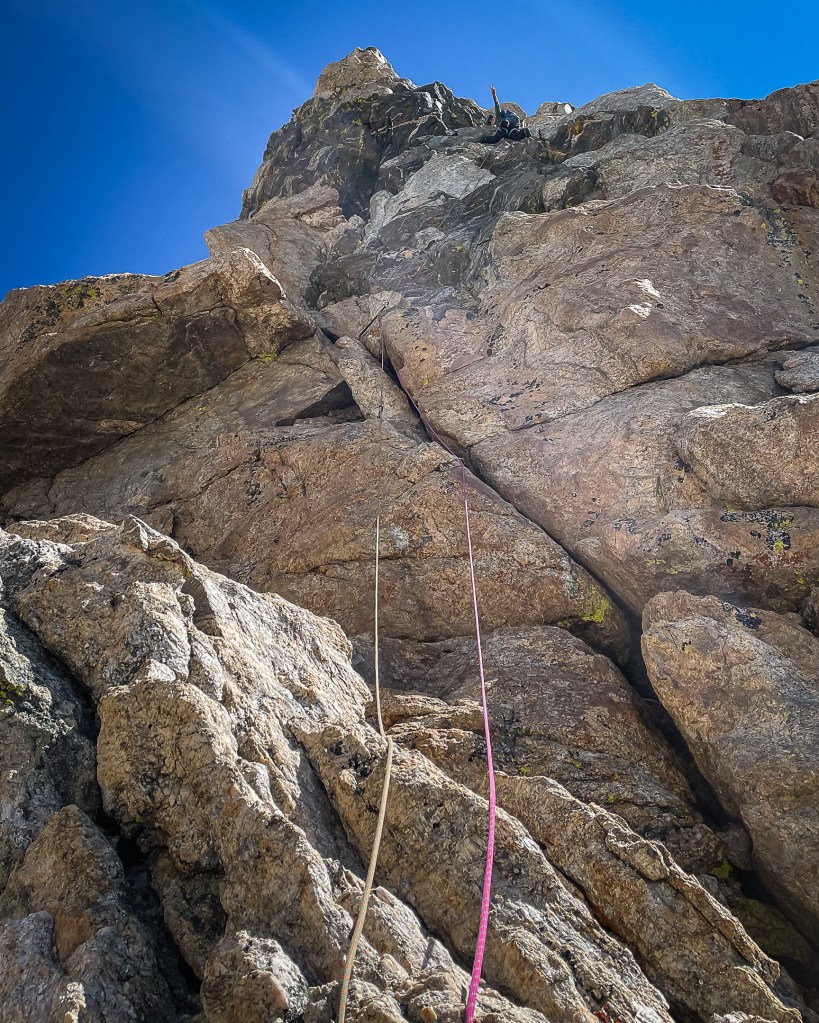

Pitch four was just as uniquely stellar as the previous, a surprisingly cryptic 5.7 stemming gully with an off-width crack that offered virtually no protection beyond a low chockstone and a single suspect stuck wire. I climbed with incredible focus to the precipice of this chimney, which ended in another technical stemming sequence up an even wider chimney with even worse protection. I had an old fixed bail anchor clipped at this point, but had I botched the upper moves, still 5.7, I would have certainly broken at least a few bones. I savored this pitch as one of the best on the climb – legs and palms fully splayed on friction nubs nearly 13,000 feet in the sky, does it get much better? A second party overlapped us on this pitch, venturing right to the notoriously difficult 5.10- Gold Face variation. Zach and Kelsey were a pair of guides from the East, and provided welcomed belay station banter as we danced alongside each other for the next short while.

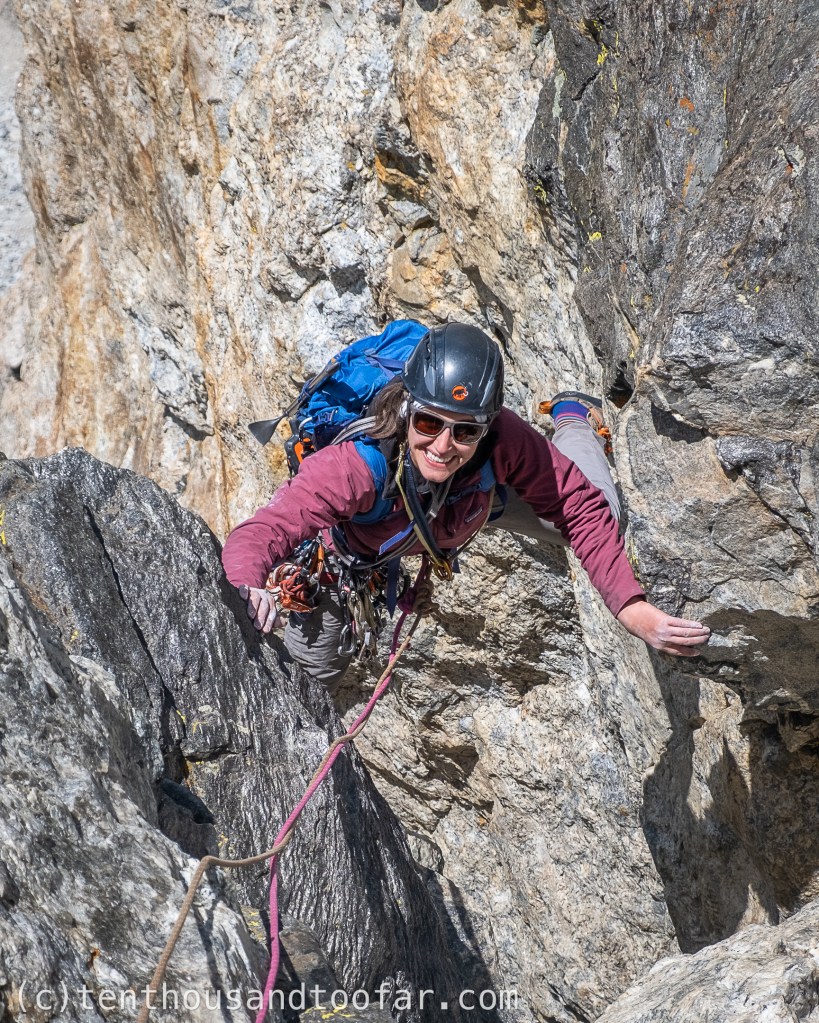
Pitch five – the infamous Black Face – a near-vertical wandering face climb with astute positioning on the ridge-crest. Though only 5.7, high elevation, steep angle with a heavy pack and occasionally sparse pro made this lead feel pretty real. Several first ascent pitons litter this pitch, some more inspiring than others, but all a wonderful reminder of the history that occurred on this same rock 87 years ago. I linked the Black Face into the final pitch six above, a once again four star 5.7 ramble up coarse quartz studded cracks and slabs near the arete, ending at Wall Street after a valiant 10 meters of high stakes simul-climing through the Black Face crux from Bobbi. With only seven cams, two large hexes and a set of wires, this 200 foot mega-lead was truly something to remember, especially ironic because neither of us got a single photo – I guess we were too absorbed in climbing most captivating 5.7 pitch of our lives. We re-grouped beneath clear skies, aside Wall Street and the Golden Staircase for our second assignment, the Upper Exum Ridge (UXM).
Upper Exum Ridge (5.5, II)
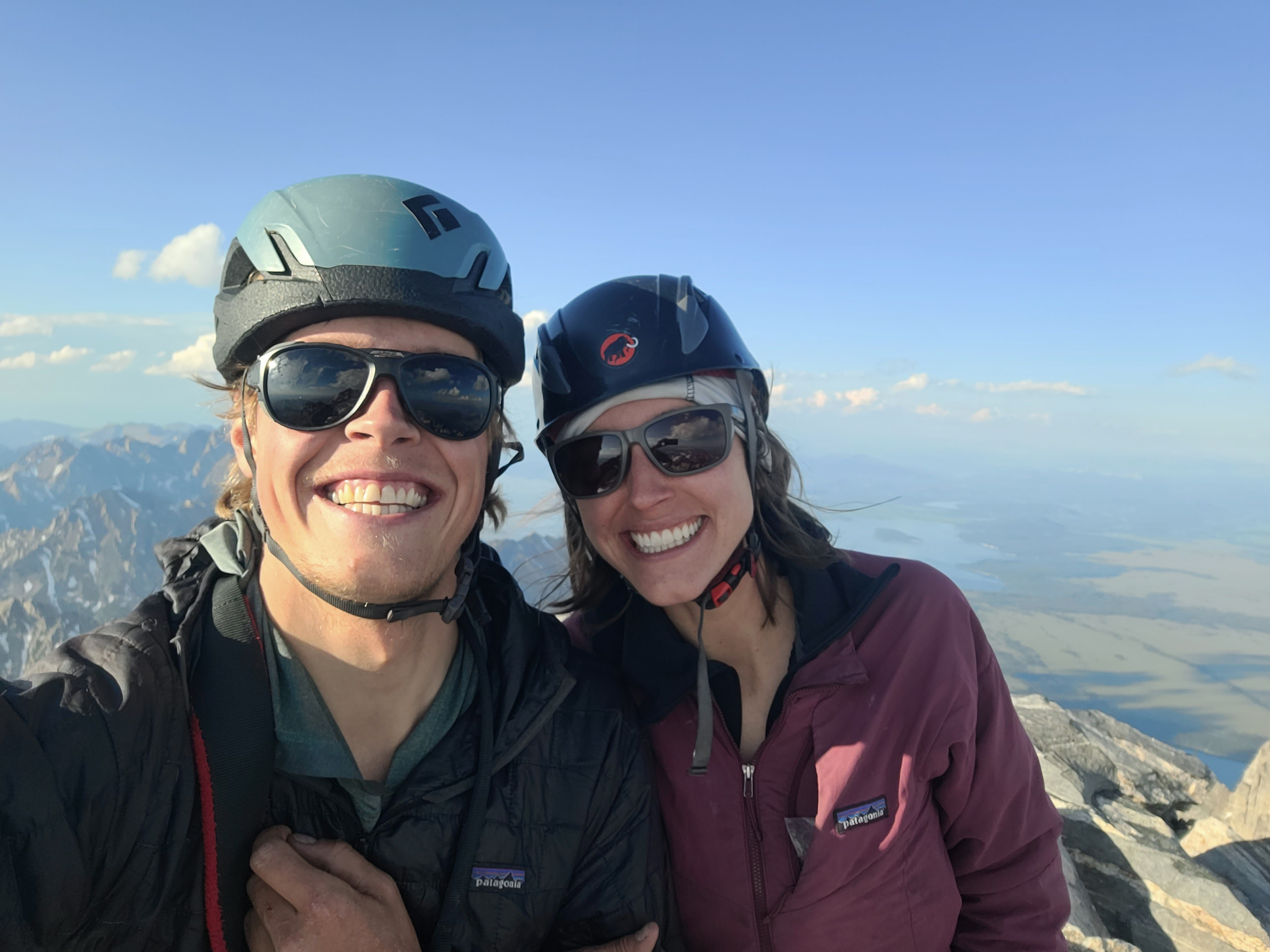
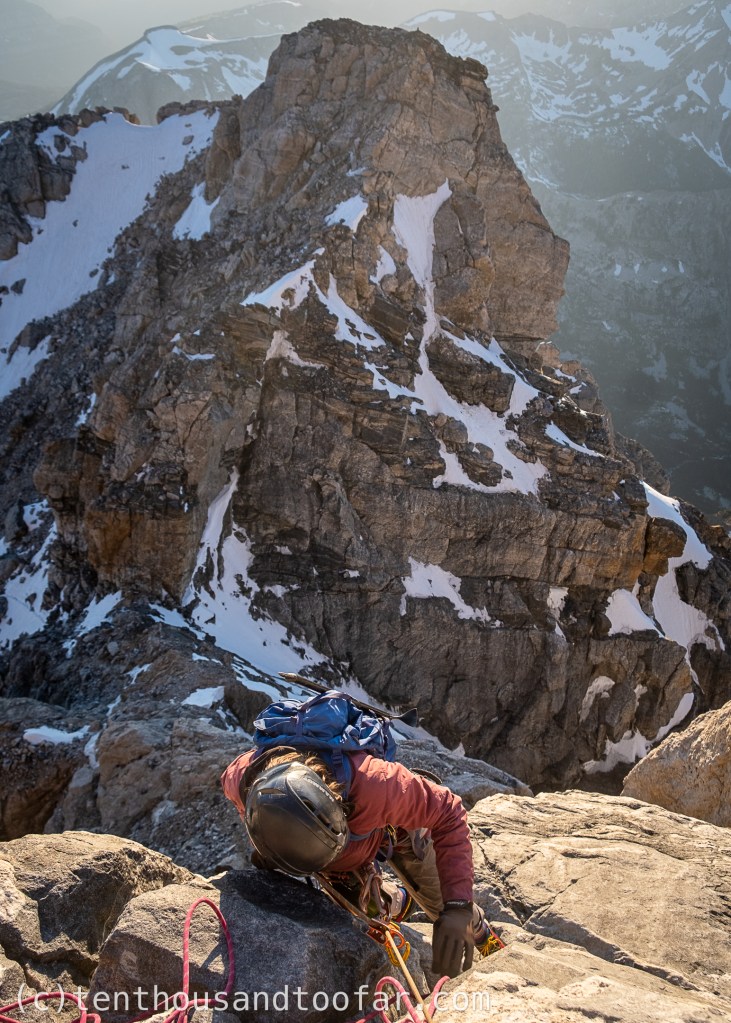
Having climbed UXM before, I had a rough plan for the most efficient way to move through the jumbled alpine terrain. We stowed one of our half ropes and folded the other, kiwi-coiling 10 meters until about 15 was left between us. Beginning at 3:00PM we kept a running belay through the Golden Staircase and Wind Tunnel to the base of the Jern Dihedral. As Bobbi stopped for a bathroom break dark clouds built, and we elected to hang low instead of committing to the infinitely more exposed pitches above. The Wind Tunnel was the best-of-the-worst places to be in a freak lighting hailstorm, a natural alley that provided some sheltering from the elements. Despite a 0% chance of forecasted precipitation (thanks NOAA) we spent about an hour getting reamed by ice pellets while crouched on our climbing ropes for extra electric insulation, stripped of all metal and contemplating our demise. Fortunately sunny skies and a light breeze trailed behind, drying the rock near instantaneously. With fleeting daylight we raced up the remainder of the route, through the classic Jern, Friction and V-Pitches which all offered excellent scrambling in the golden evening light. Atop the V-Pitch we hit significant snow that ground progress to a halt, with old exposed boot-packs running both left and right of the ridge. Fearing a crampon changeover could cost too much time, I climbed a short verglas glazed chimney requiring one move of aid, climbed a steep hand-crack on the crest and circumnavigated a matrix of mini-towers, eventually traversing the top of the Ford Couloir and finishing on the traditional winter scramble route. Between the lightning storm, route finding difficulties and unexpected snow/ice, time dissolved at an unfathomable rate, but nevertheless we hit the 13,775 foot summit of the Grand Teton just before 6:00PM, about 9.5 hours from tie in. This was above and beyond the most beautiful of my eleven Grand Teton summits, a truly mind bending display of crimson alpenglow in every direction – something a camera could never do justice – the perfect anniversary gift.


Descent
The descent down the Owen-Spalding was painstakingly slow, a mushy mess of isothermal snow on exposed fifth-class slabs that ushered a rope and extra caution, especially for Bobbi who had spent almost no time in exposed, snow covered, alpine terrain. We returned to the Upper Saddle via the traditional two rappels and coiled ropes by sunset. Down-climbing from the Upper Saddle involved endless wet chossy meandering, a few more snow crossings and endless down-climbing on damp slabby rock. In terrain like this, with the burden of all day fatigue and the onset of nightfall, methodical movement was paramount. We picked, chatted and snacked our way back to the Exum Camp and enjoyed a brief chat with two SAR friends headed to assist a party, or two, that presumably got derailed by the impromptu weather and were still on the upper mountain. We reached our bivy safe and sound near 2:00AM.
We awoke on Monday morning to clear skies and warm temperatures, and enjoyed a pleasant egress after a meager breakfast of half a protein bar each, generous peanut butter and a few leftover crackers. We never intended on spending a second night on the mountain, so we were dining on emergency rations. The night before’s dinner was two ounces of imported sheep’s cheese, a half dozen crackers and a protein bar each, which actually hit the spot. The only real issue with our food packing was a lack of bean juice. I solemnly swear to never walk into the mountains with a single day’s supply of coffee ever again, but fortunately we had caffeinated electrolyte tablets to ease withdrawals. We stopped by Zach and Kelsey’s camp on the way out, pleasantly informed they were not one of the two parties benighted on the upper mountain. The electrical storm derailed their summit, but they managed to free the Gold Face, a truly impressive feat I hope to emulate someday. By mid-afternoon we were eating burritos and drinking fresh watermelon juice at Pica’s, celebrating a seminal climb – and three years of love, smiles, adventures and memories. I couldn’t be more proud of how far this chica, Bobbi, has come.

Route Thoughts
Pitch for pitch the Direct Exum Ridge is about as classic as it gets. On the Durrance Direct every pitch is four stars, stellar climbing on bulletproof alpine granite with the best of scenery and history. If all six pitches were lined at the base of a single pitch crag I would climb every single one again. Protection is regularly lacking, entirely absent at points (pitch four), and when combined with high altitude, suprising-for-the-grade steepness and remoteness beckons more respect than your average Teton 5.7. All of our belay stances were large ledges and route finding is straightforward with Aaron Gams’ description from Teton Rock Climbs. The only pitch that felt sandbagged was pitch one, definitely more 5.7/5.8 than 5.6. Upper Exum Ridge provides classic airy alpine scrambling interspersed with low-fifth class climbing. Most parties will be comfortable soloing or simul-climbing, and route-finding will present the biggest challenge. I have now climbed the UXM twice, and have taken slightly different variations both times. It seems this broad ridge could probably be climbed a dozen different ways. All together, this route was one of the most memorable experiences from my mountain career.
Rack
For rack, we packed a single set of cams from fingers to three inches, two large DMM Torque Nut hexes and a single set of wires, and climbed on 50M half ropes. I found this allotment sufficient, but I was regularly running the rope 20 feet between pieces. Bring extra long slings if planning to link pitches five and six. The main rappel from the Owen-Spalding to the Upper Saddle requires a precise toss with a 60M rope (more information in Teton Rock Climbs). I’ve only ever used two ropes, or down-climbed the OS.
Resources
- Teton Rock Climbs, Aaron Gams (book, topo and description)
- A Climber’s Guide to the Teton Range, Ortenburgaer & Jackson (book, topo and description)
- Wyoming Whiskey (blog, Upper Exum Ridge beta, pictures)
Ten Thousand Too Far is generously supported by Icelantic Skis from Golden Colorado, Barrels & Bins Natural Market in Driggs Idaho, Range Meal Bars from Bozeman Montana and Black Diamond Equipment. Give these guys some business – who doesn’t need great skis, gear and wholesome food?



If you would like to support Ten Thousand Too Far, consider subscribing below and/or leaving a donation here. The hours spent writing these blogs is fueled solely and happily by passion, but if you use this site to plan or inspire your own epic adventure, consider kicking in. A couple bucks goes a long way in the cold world of adventure blogging. I also love to hear your thoughts, so don’t leave without dropping a comment! Thanks for the love.
Follow my photography at @brandon.wanthal.photography
enter your email to subscribe for new articles
DISCLAIMER
Ski mountaineering, rock climbing, ice climbing and all other forms of mountain recreation are inherently dangerous. Should you decide to attempt anything you read about in this article, you are doing so at your own risk! This article is written to the best possible level of accuracy and detail, but I am only human – information could be presented wrong. Furthermore, conditions in the mountains are subject to change at any time. Ten Thousand Too Far and Brandon Wanthal are not liable for any actions or repercussions acted upon or suffered from the result of this article’s reading.
 Ten Thousand Too Far