
The Bee’s Knees is a newly developed four pitch route on the shady north wall of Prospectors Mountain, a worthy addition to an area flooded with classics.
In July 2020 Aaron Diamond and Zack Little established the Bees Knees, a moderate four pitch ramble up the easternmost buttress of the impressive Lower North Face of Prospector’s Mountain. The Lower North Face in full encompasses an impressive swath of rock, over a linear mile of terraced granite up to 2000 feet tall, from the near shores of Phelps Lake to the Apocalypse Couloir and beyond. The specific buttress that houses the Bees Knees is a small 400-500 foot nugget, the easternmost piece of desirable north facing granite stone from the Phelps Lake Overlook, approximately 700 feet above the canyon bottom. Guarded by thick brush characteristic of low elevation Teton north faces, the approach is not for the faint of heart, and sadly detracts from the otherwise “easy access” appeal of this climb. However, the rock quality and logical nature of the climbing makes for a scenic, shady and pleasant moderate adventure in an otherwise abandoned nook of Death Canyon. Would I climb it again? Probably not. Was it worth the tick? Absolutely.
Love Ten Thousand Too Far? Support independent mountain journalism with $5.10 per month through Patreon (and receive extra bonus content), or with a one-time donation. Any and all support is greatly appreciated.

(Photo Credit: https://www.mountainproject.com/photo/120808296)
I had slept a literal two hours and ten minutes after a prolonged epic on Trinity Buttress the day before, and had it not been for a highly motivated partner I didn’t want to let down there’s no way in hell I would’ve moved a muscle until at least noon. However, the perks to stuffing your face at 4:00AM and waking up at 6:15AM to climb means the day doesn’t require any breakfast to get rolling. I was pleasantly surprised by how springy my legs felt as we knocked off the easy approach to Death Canyon, forking left to the lakeshore instead of up canyon towards the typical south facing classics. The GPX track provided by the FA party was not loading on our devices, but we were able to on-sight the approach by sticking to the geological crest of Prospectors’ NE Ridge. Eventually the bushwhack opens into a boulder field where cairns abound, and just above that a forested shelf that allows a straightforward contour west. The climb is located near the end of this shelf after passing a brief fourth class ramp topped by a tree, and subsequent down-climb. The pictures from the FA party on Mountain Project were especially useful, as the “vague weakness” of pitch one is on the vaguer side of vague. (CalTopo GPX track for Bee’s Knees approach: https://caltopo.com/m/CDBV)

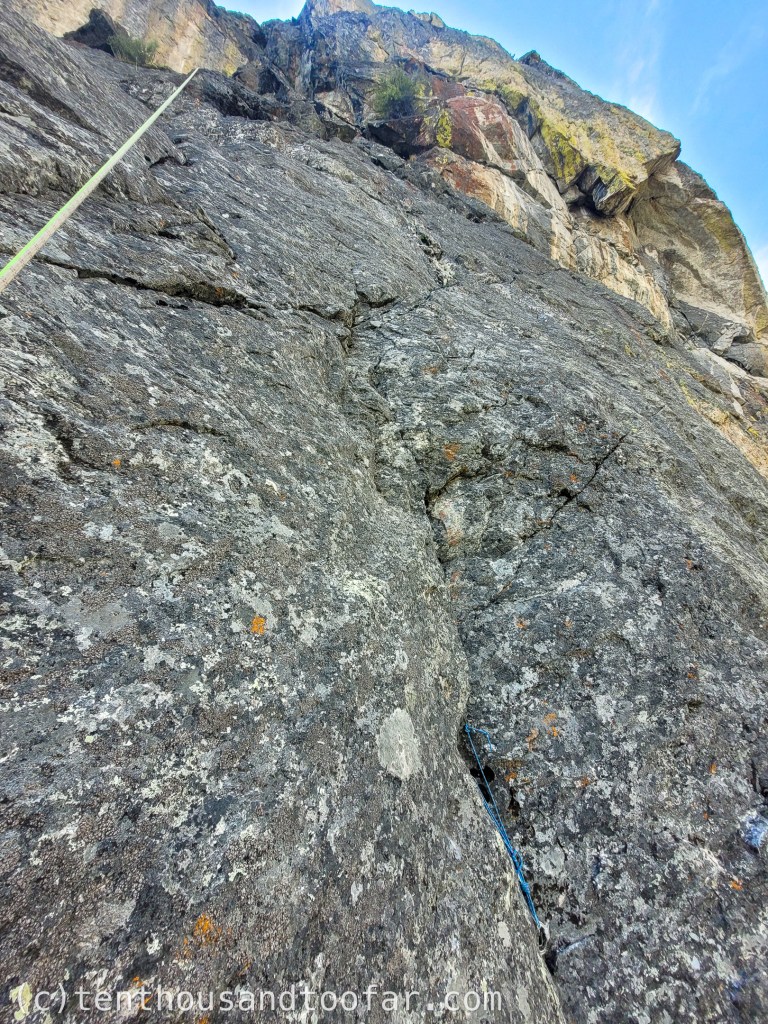
The climbing itself was surprisingly pleasant, with pitches two and four as the highlights – though every pitch had its moments. Pitch one follows a slightly runout leftward slab traverse (5.8) beneath a large roof with a few fixed pins to supplement gear placements. The anchor for this shorter pitch is directly below the obvious right facing corner of pitch two, a dangerous nest of vertically driven half-hilt pitons that should be supplemented by a bomber #0.75 placement in a crack to the left. Pitch two provided the only sustained anchor-to-anchor technical climbing, with a steep and varied right-leaning corner (5.8+) leading to a minor roof pull and a final, stellar, low angle 5.7 finger crack. Gear conservation was pertinent on this four star pitch, which ends at a small stance with a fixed nut anchor. Pitch three was perhaps the least desirable, following an interesting but short lived 5.8 flake feature to a vegetated blocky gully of low-fifth class groveling, ending in yet another fixed nut anchor directly below the 5.9 crux of pitch four. And, last but not least, you have the 5.9 crux pitch, which is really nothing more than a stemming boulder problem followed by 5.7/5.8 wandering face climbing with occasionally deceptive gear placements. The final belay ledge of this climb adds serious value to the overall experience, a grassy outcrop fit for a picnic with epic panoramic views over Phelps Lake and beyond. We swung leads, with Brian on pitches one and three, and myself on two and four, and topped the climb out in a casual two and a half hours.
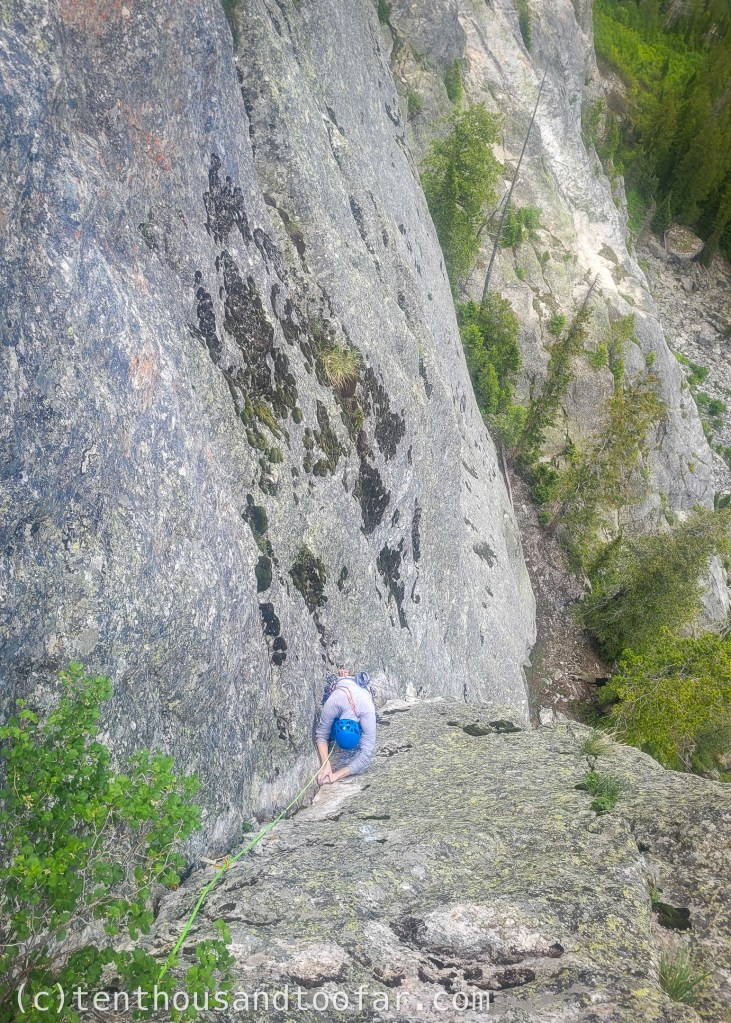

Overall, the Bees Knees earns stars for remarkably solid rock, varied climbing with at least some difficulty on every pitch and a truly special, shaded, private location above the bustling Death Canyon. Having been established only three years ago the rock is exceedingly clean, but could still benefit from some wire brushing, gardening and general traffic in places, especially away from the crux sections. In my personal opinion the greatest detriment to this route is the anchors, which are either placed inconveniently (pitch three) or downright dangerous (pitch one). On pitch three, the fixed anchor is a mere 10 feet below the 5.9 crux of pitch four, and if the leader fell they would most certainly donkey kick their belayer, and/or possibly compromise the anchor. Two bolts on the climber’s left wall, outside the corner, would solve this problem. On pitch one, the trio of vertically driven pins should be treated suspect at best, and need to be replaced with bolts or simply removed. This nest is listed as the final rappel station, but I personally wouldn’t trust my life to those pins. We were able to descend in two rappels, with two 70M ropes, bypassing the first and third fixed anchors. Until the first fixed anchor is replaced, I think this should be the recommended modus of descent. Ultimately, I’m not sure the bushwhack and lack of continuous climbing on pitches one, three and four will warrant repeats by many. However, this wall is relatively unexplored and offers tremendous new route potential, and should an established trail get developed and some permanent hardware installed I could see the Bees Knees becoming a three star climb. Would I go back? Probably not. Was it worth the tick? Probably yes.
Personally, for two hours and fifteen minutes of rest I was stoked to fire the crux pitch, and round the day out feeling reasonably strong. I was roasted to zombie mode for the next three days, but I’ll sacrifice work performance over climbing almost anytime.
Recommended Rack
A double set of cams from fingers to two inches, with one three inch piece, and a set of nuts should be sufficient for the sustained climbing on pitch two. Many runners will help with wandering terrain.
Resources
Ten Thousand Too Far is generously supported by Icelantic Skis from Golden Colorado, Barrels & Bins Natural Market in Driggs Idaho, Range Meal Bars from Bozeman Montana and Black Diamond Equipment. Give these guys some business – who doesn’t need great skis, gear and wholesome food?




If you would like to support Ten Thousand Too Far, consider subscribing below and/or leaving a donation here. The hours spent writing these blogs is fueled solely and happily by passion, but if you use this site to plan or inspire your own epic adventure, consider kicking in. A couple bucks goes a long way in the cold world of adventure blogging. I also love to hear your thoughts, so don’t leave without dropping a comment! Thanks for the love.
Follow my photography at @brandon.wanthal.photography
enter your email to subscribe for new articles
DISCLAIMER
Ski mountaineering, rock climbing, ice climbing and all other forms of mountain recreation are inherently dangerous. Should you decide to attempt anything you read about in this article, you are doing so at your own risk! This article is written to the best possible level of accuracy and detail, but I am only human – information could be presented wrong. Furthermore, conditions in the mountains are subject to change at any time. Ten Thousand Too Far and Brandon Wanthal are not liable for any actions or repercussions acted upon or suffered from the result of this article’s reading.
 Ten Thousand Too Far
Leave a comment