
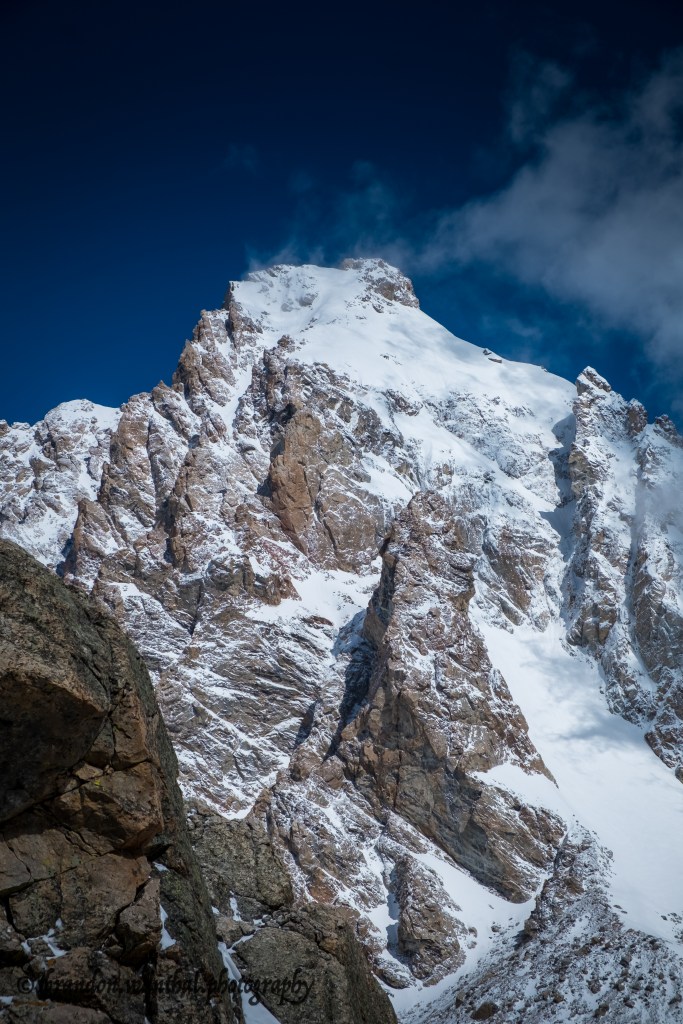
Turning around is one of the hardest decisions to make when climbing a mountain. To start in pitch blackness, queasy and sleep deprived, commit so many hours to endless climbing with aspirations for a wondrous summit only to return empty handed. However, this decision is the one that most frequently save lives, or at a bare minimum prevents perilous rescues. Opting to forgo your goal in favor of safety is something that requires self-discipline, honesty and humility. For this reason, I call knowing when to cut your losses an art form.
Love Ten Thousand Too Far? Used it to fuel an amazing adventure? Support independent mountain journalism with $5.10 per month through Patreon (and receive extra bonus content), or with a one-time donation. Any and all support is greatly appreciated.
In my opinion, the majority of mountain accidents occur when people push beyond their intuition – when that tiny voice in the back of their heads whispering “things aren’t right here” is ignored. However, if a mountaineer listens to that voice every time it speaks, they probably wouldn’t get anywhere, ever. I’m a math-minded guy, so I play the odds. If I am not at least 99.5% certain, realistically higher, that I will return home safely, that’s my sign to pull the plug. Today, during a valiant summit attempt on the Grand Teton, we made the heart-wrenching decision to abort mission at 12,000 feet, a mere hour or two from the top.
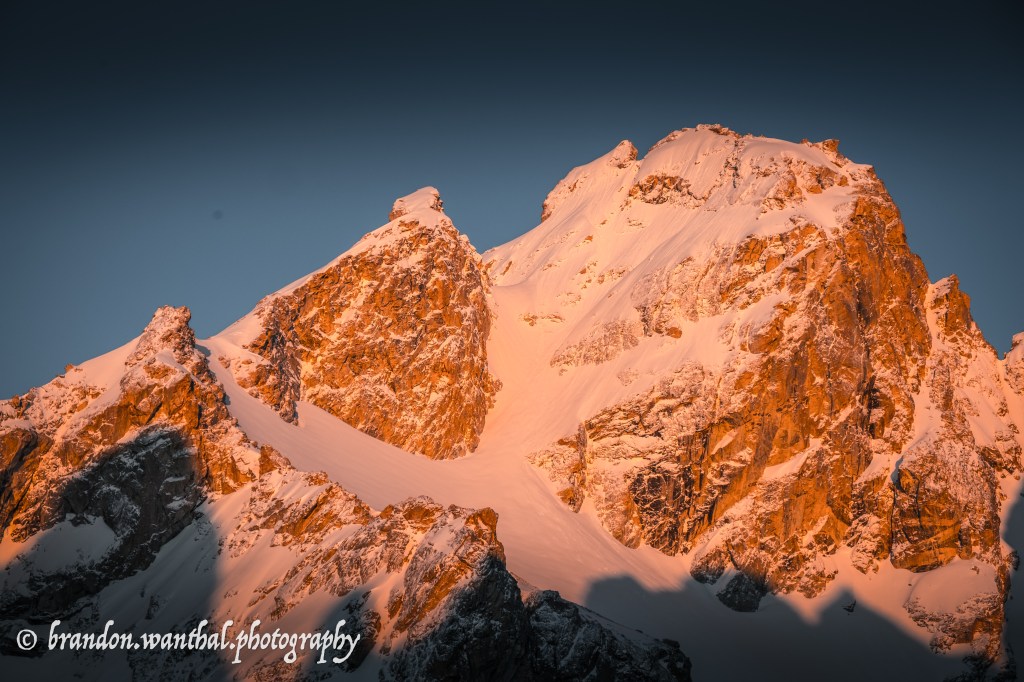
The Push – The Grand Teton
We were loaded with a light rock climbing rack, two half ropes, harnesses, ice screws, ice tools and all the other odds and ends needed for a technical descent. Our lofty goal was to climb the Grand, Middle and South Tetons in a single day, a gargantuan full-day outing – a true test of alpine endurance. New snow had fallen overnight, but seemingly not much as I pulled into Grand Teton National Park at 9:00PM Sunday evening. I had run a ten mile trail race in Pocatello earlier that morning, three and a half hours away, so my legs felt a little damp. When our alarms sounded only two and a half hours later I was in a splitting fog. Nevertheless, by 12:30AM we set off for the top of the universe.
The day went according to plan. Basically we punched our way through ankle deep snow, skated on frozen ice and occasionally walked some dry trail for a solid five miles, in summer shoes, until we reached Lupine Meadows, the gateway to the high-country of Garnet Canyon and the Grand Teton. Here we hit a reliable snow-pack, so we changed into our ski boots we lugged for the last two hours, along with our skis. I successfully skied the Grand Teton last year around this time, so I knew the trail well and guided our two-man team efficiently to the base of Teepe Glacier. The snow depth deepened linearly with our progress. Two inches turned to four, then boot depth and finally, at the top of Teepe, to a staggering knee’s depth. For May this is beyond uncharacteristic. Though exceptionally light and fluffy, abundant snowfall on a hard spring crust is a dangerous recipe for avalanches, especially when combined with solar warming popular on southerly aspects. Our route up the south face of the Grand Teton is not a friendly place for an errant slip. By this point we discarded our dream of the traverse, simply because we were losing valuable time booting through such deep snow. However, we still figured we had plenty of time to knock out the main attraction.

As we finished our final push to the top of the steep glacial cirque, the sun rose. The warmth felt amazing on our frozen extremities, but apparently the Grand Teton liked it too. This time of year, rapid warming from the sun can be the bearer of rockfall. Just like pavement, as granite warms chunks can dislodge from cliffs posing a significant threat to climbers. Obviously melting ice would behave the same, as well as snow perched on steep slopes. To some degree, wet slab avalanches are born from the same process. Right on cue, as the sun beamed off the prominent east facing cliffs above Teepe, snow began to slough. Plumes rained upon the glacier, gaining momentum as they cascaded like waterfalls. With light snow density these slides seemed harmless, but they are certainly far from ideal when climbing technical ice and rock. Cautiously we continued upward as the second, third and fourth sloughs released. Nearing the top of the saddle we heard our first ice fall. The game was over. We had seen enough.
After a short snack we clipped into our skis and began descent back to Lupine Meadows. To our surprise, even though the slope had only been sunlit for less than an hour our first turns on Teepe Glacier produced some small wet-slab activity. We traversed carefully north, mitigating all danger and regressing cautiously into the canyon below. The snow on the upper glacier fell on a bed surface of old avalanche debris, making the turns chunky and underwhelming, a skier’s version of rodeo bull riding. But, as we transitioned to mellower slopes we were rewarded with the fruits of our labor – BLOWER MAY POWDER! Two thousand feet of truly epic (for May) turns accompanied us back to Lupine Meadows, empty handed, but full of gratitude.
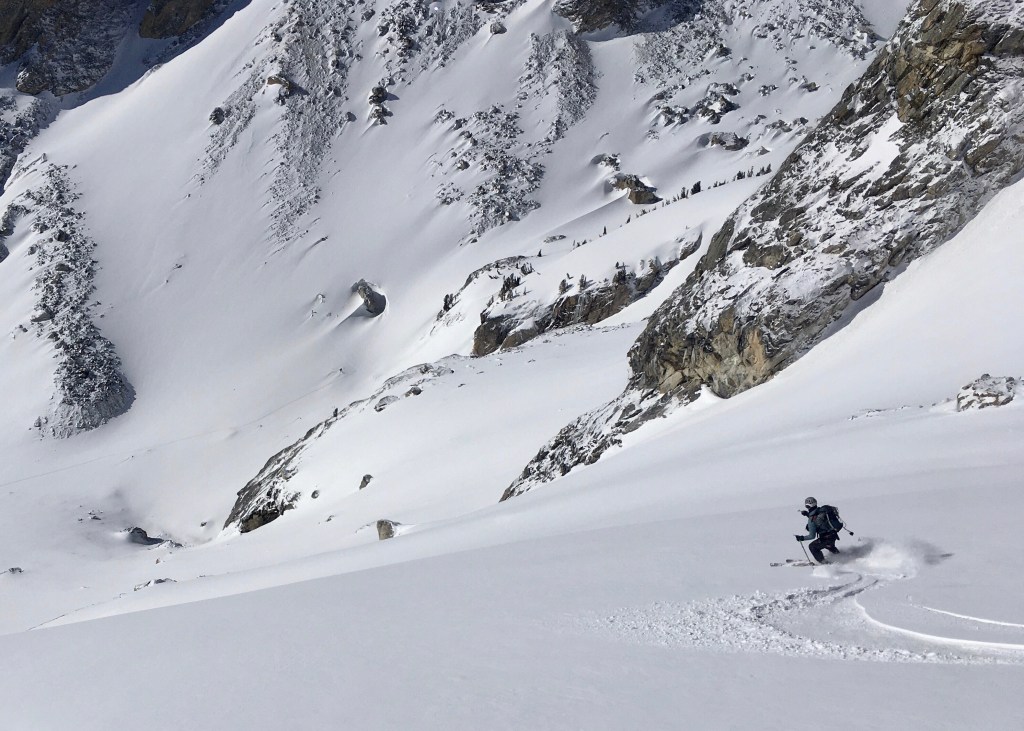

A Consolation Prize – The West Hourglass Couloir
After second lunch we decided to salvage the remainder of the day and target a tamer objective on the opposite side of the canyon. Nez Perce’s West Hourglass Couloir is somewhat classic by Teton standards, probably the last major line left unchecked on my Garnet Canyon resume. The short but steep chute lies beneath a north facing cliff-side which wouldn’t see sun until the very end of the day. We stashed our rock and ice gear, heading up for our consolation prize with lightened loads. We made quick work of the lower couloir but were stopped dead in our tracks at the sight of the upper bottleneck. The steep ramp pictured below was gloriously filled with fluffy powder, but the upper stretches were stripped to ice by apparently voracious winds. We pushed through the fractured concrete for a short while before I asked Carl “why are we doing this?” In the spirit of the day we played our trusty bail card, but were again rewarded with epic May turns in a place with natural beauty that rivals any landscape in the world. The steep lower head-wall is the meat of the run anyways, and the fifty degree rollover certainly caught my attention, but with stable and supportable powder we picked our way down with ease and smiles, sweeping into the apron below and relishing the last scraps of powder skiing for the ski season.
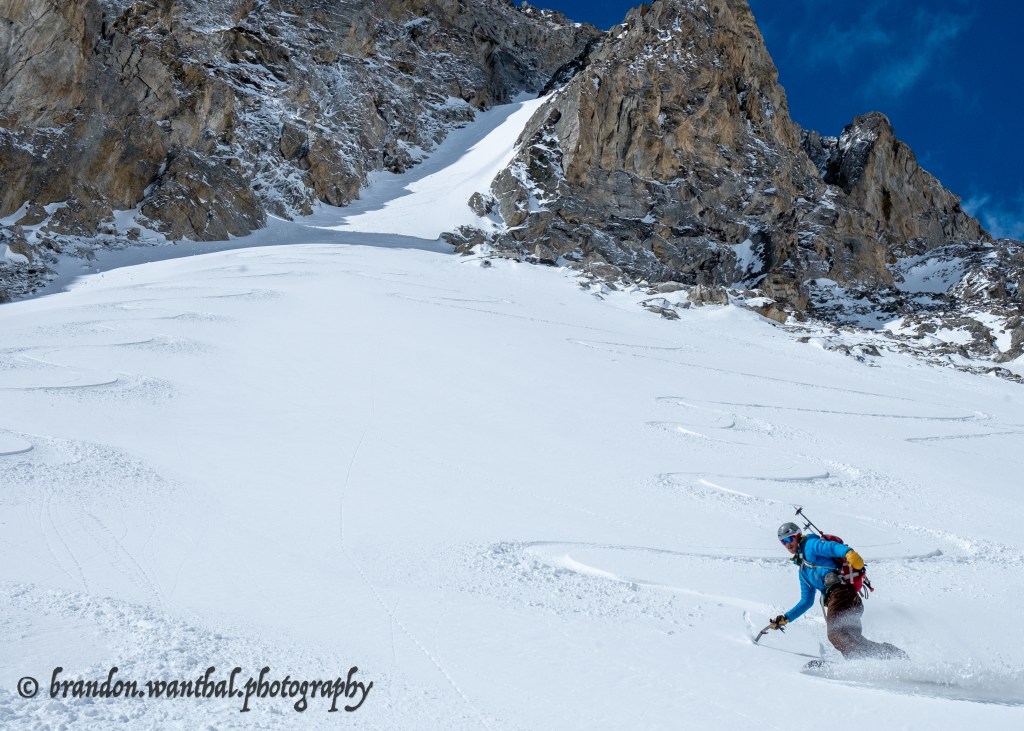
We put third lunch in the tank before heading back to the car. In typical late spring fashion the retreat wasn’t glamorous, but we got er’ done. Rounding out the day at fourteen hours, we swore off another Lupine Meadows mission until summer. Alpine climbing season is only weeks away, and because of our respect for “the art of the turn around,” we’ll get to enjoy the mountains for years to come
Avalanche Evaluation: ALPTRUTH
For the non-skier, this section might be a little redundant and wordy. But for the back-country skier or mountaineer, using the ALPTRUTH acronym is a great way to make decisions in avalanche terrain. Let’s take a look at our experience through the lens of ALPTRUTH:
- A: Avalanche – Recent signs of avalanches? YES. Fresh snow sloughs, rock/ice fall (definitely counts) and the wet slides we kicked off.
- L: Loading – Recent signs of fresh snowfall? YES.
- P: Path – Traveling in an avalanche path? YES.
- T: Trap – Traveling in a terrain trap? (cliffs beneath, rock walls, etc.) YES.
- R: Rating – Avalanche rating above moderate? YES. No forecasts in May. But rating would have likely straddled considerable and moderate.
- U: Unstable Snow – Signs of instability? YES. Falling ice and snow.
- TH: Thaw – Warming? YES.
The American Avalanche Institute coined the acronym and reports that of 1,000 incidents analyzed, three or more ALPTRUTH factors were involved in 90% of accidents. Clearly, with a score of 6/6, the Grand Teton, on May 9th 2021, flunked the test. The West Hourglass, on the other hand, scored a 2/6 (loading and path violations) which gave us a solid green light for adventure. As you can see, the right choices were made today, and as such, a wonderful and safe day in the mountains was enjoyed.
Thank you as always to Icelantic Skis for supplying me with amazing wooden planks for epic adventures.
Check out the Natural 101 for an exceptional blend of lightweight and durability, my go to choice for all things ski mountaineering.
Much love to my readers. Skiers, stay safe out there!

DISCLAIMER
Ski mountaineering, rock climbing, ice climbing and all other forms of mountain recreation are inherently dangerous. Should you decide to attempt anything you read about in this article, you are doing so at your own risk! This article is written to the best possible level of accuracy and detail, but I am only human – information could be presented wrong. Furthermore, conditions in the mountains are subject to change at any time. Ten Thousand Too Far and Brandon Wanthal are not liable for any actions or repercussions acted upon or suffered from the result of this article’s reading.
 Ten Thousand Too Far