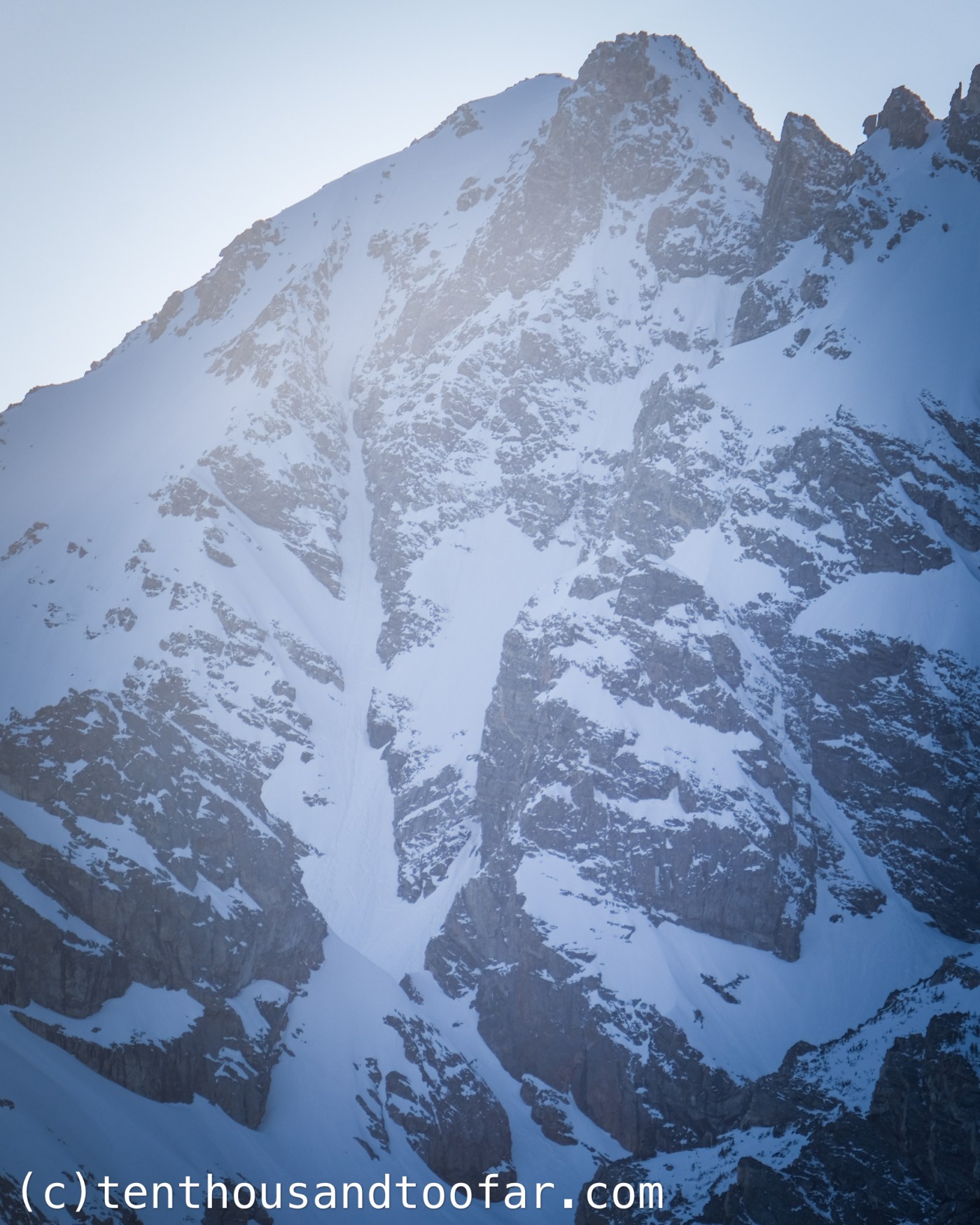
The South Teton’s Southeast Couloir is one of the steeper Teton ski descents. Considering it’s remarkable roadside visibility, it sees very few suitors. Now I know why.
If you’ve wondered why the blog has been dormant lately, it’s because I’ve been in the remote Nevada desert since May 9th doing tortoise conservation work. That’s right, for 20 days straight, 12 hours per day, I’ve been combing through Yucca, Creosote and Boxthorn, among all other things spiky and poisonous, looking for the elusive and endangered Mojave Desert Tortoise. How I came about this unique work is a different day’s conversation. I’ll be down here until at least June second, meaning that for all intensive purposes my 2025 ski season is just about over. Luckily, this day with Mike Parri was the ultimate sundae cherry. Besides the mighty Southeast Couloir of the South Teton, one of the steeper ski lines of my life, I had the opportunity to complete my first Teton “first descent” on the North Face of Wanda Pinnacle. Because both the Southeast Couloir and Wanda Pinnacle descent were so memorable, I decided to separate them into individual articles despite them occurring on the same day. To any and all partners out there: I’m still thirsty. When I get home in June, let’s go skiing.
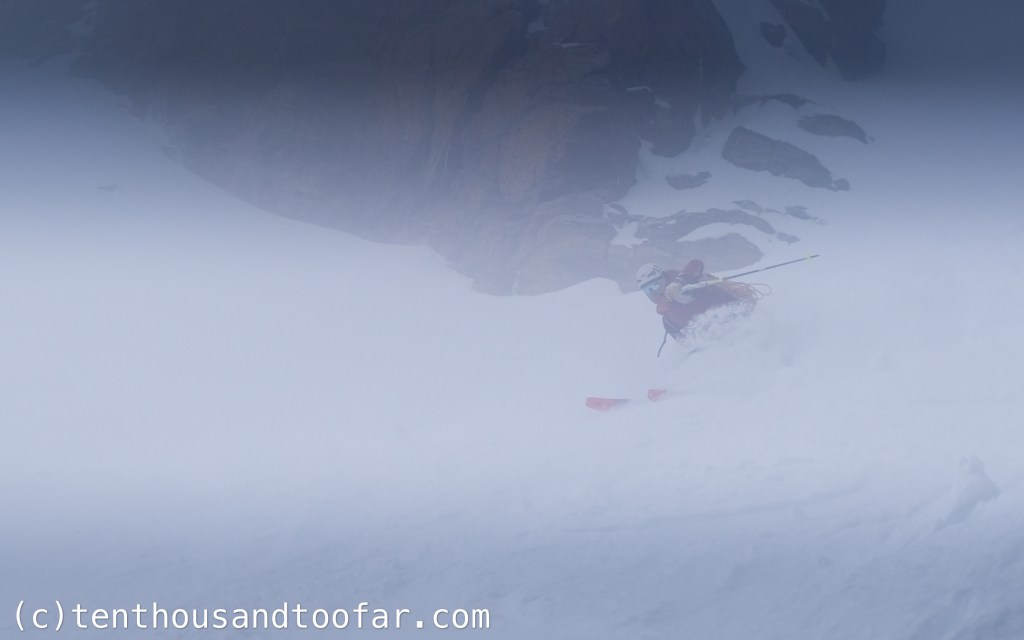
After skiing the South Face of the Dike Pinnacle 48 hours earlier, I hauled heavy legs into Garnet Canyon on Thursday May first. Fortunately, Mike was feeling chipper and an excellent overnight freeze let us move with leisure. 6,000 vertical feet later we reached the summit of the 12,519 foot South Teton with exactly a stone’s throw of visibility. I’ve skied a lot of high consequence descents in the “ping pong ball” this year, and today would be no exception. Part of me wanted to bail down the exceptionally simpler Amor A Vida Couloir or Southeast Face, but a bigger part shouted loud and clear: so long as the objective could be safely descended, we would do exactly that. Mike was on board. At the slightest cloud break, we would pounce.
Love Ten Thousand Too Far? Support independent mountain journalism with $5.10 per month through Patreon (and receive extra bonus content), or with a one-time donation. Any and all support is greatly appreciated.


Our first turns off the summit were ominous, taking us ever closer to a foreboding rollover marking the entrance of the couloir. For such a prominent, accessible, and road-visible line, the Southeast Couloir sees very few descents. As we crested the rollover and peered into the couloir, I immediately realized why. The upper pitch is remarkably steep, holding a sustained angle in excess of 50 degrees. 500 feet below the summit lays the crux: a rocky ski-width choke often accompanied by a body height ice bulge, entirely obscured by thick clouds today. Difficult breakable crust conditions gradually transitioned to scratchy powder as we jumped deeper into the darkest annals of the South Teton, quickly approaching the ice bulge we couldn’t yet discern. With every turn the vibe became more ominous and unsettling, exactly the opposite of my desire when steep skiing. A pleasant relent in steepness approaching the constriction provided a welcomed reprieve before the slope rolled over again. Right on cue, a fixed anchor came into view. In hindsight, the fact I couldn’t tell whether we’d be able to ski through the crux from six turns above should’ve warranted the deployment of a rope. Instead, soft snow and exciting turns seduced me into those six additional turns. It wasn’t until the fifth I realized the crux was indeed vertical water ice, and the couloir below was too steep and narrow to consider jumping.

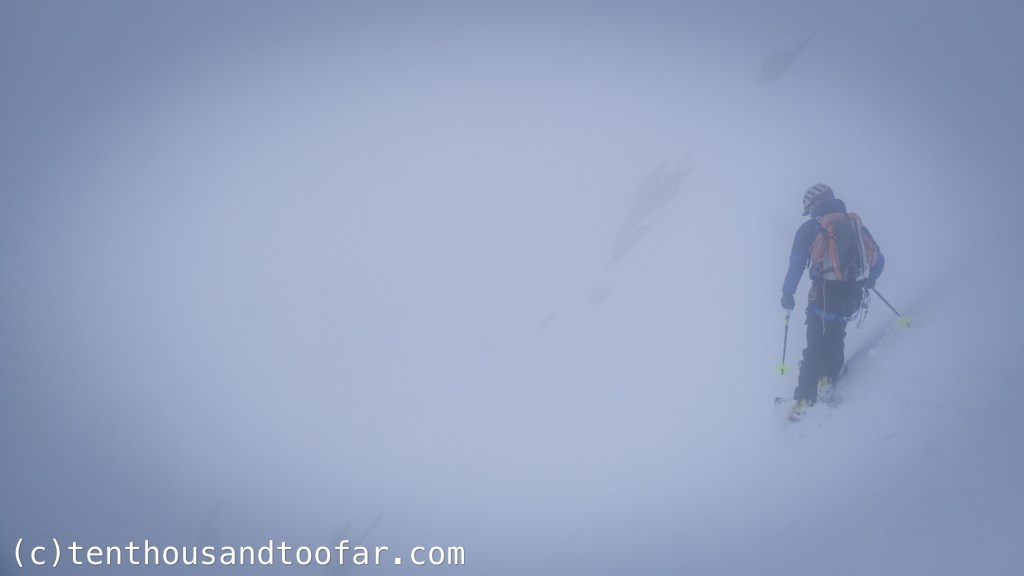

Wishing to have my right ski downhill to better communicate with Mike as he shuffled to the anchor with the rope, I made one last turn within 10 feet of the bulge. This time, rather than blissful soft powder my edges broke through to blue ice. Realistically I probably only slipped a few inches, but in 50 degree terrain above life threatening exposure, perfection is the only option. In those infinitesimal milliseconds while my edges skittered on ice, rattling for any and all purchase, time slowed to molasses. I was able to fully experience the dreadful feeling of finally falling in steep terrain – that is, until my edges caught. I never actually fell, and a quick hand check kept me upright. Mike claims he never thought I was falling, just that the turn “looked sketchy”. While waiting for Mike to thread and toss the life saving rope, I equalized my ice axe and a plunged ski pole as an emotional support anchor, digging my edges in tight.

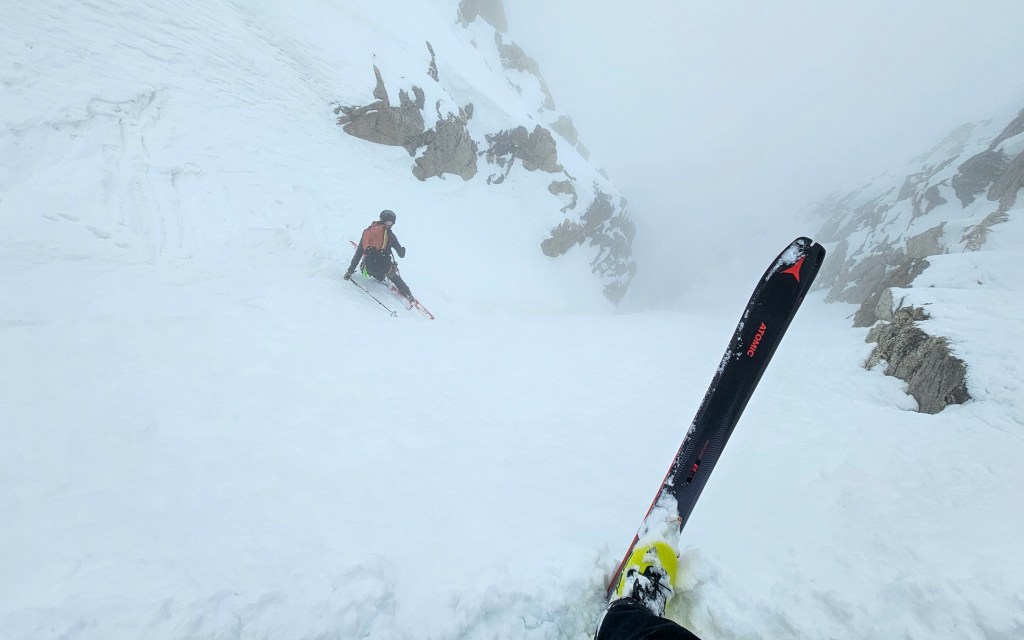

We rappelled the bulge with skis on, and were happy to find a lesser slope angle and deeper powder in the lower couloir. The remaining 3,000 feet of skiing to Taminah Lake is best described as bliss. We exited east via Matternaught Col once the couloir opened, and enjoyed a magical transition from ripper powder to perfect corn at 10,000 feet. Oh, and the visibility lifted too. The Tetons provide.
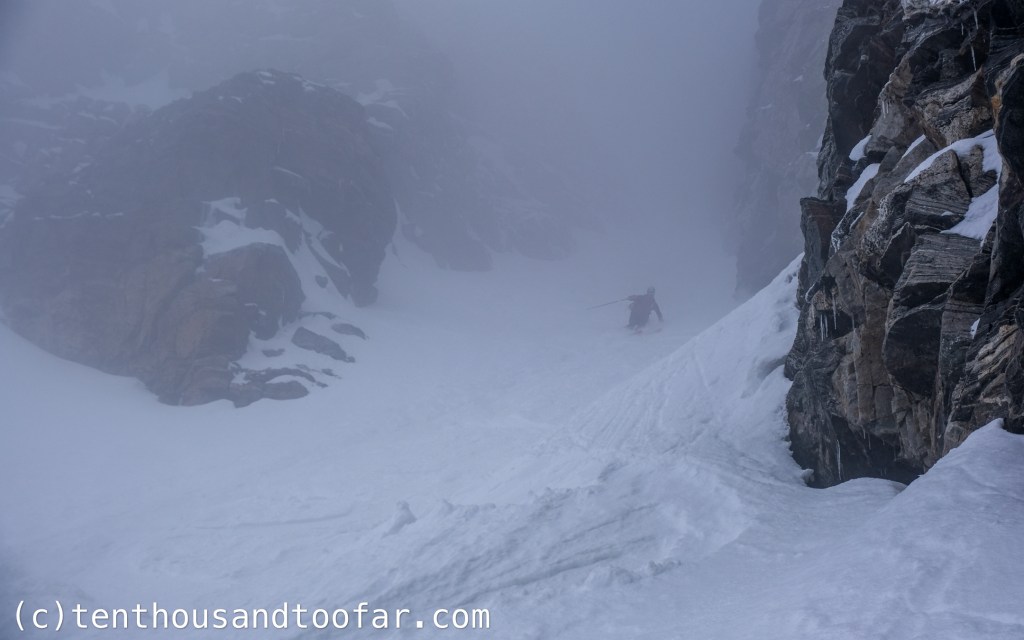

Falling and being unable to self arrest in steep terrain is my worst nightmare. The feeling of my edges slipping, thinking I was falling, and suddenly catching myself was nauseating. With better visibility I would have spotted the ice from above, and never skied so close to the bulge. I spent a healthy 24 hours chastising myself for misjudging the terrain. However, after having multiple conversations with other serious ski mountaineers I hold in high regard, it seems such instances are commonplace in extreme terrain. From a practical angle, I never actually fell – I just came closer than I ever have, and it scared the living shit out of me. Instead of dismissing the slip or letting the memory manifest as fear, I’ve chosen the middle line. I’ve been skiing a lot of very steep terrain the past couple seasons, occasionally in dodgy conditions, and became complacent. In this instance, when faced with a known potential cliff and insufficient visibility to assess the hazard before passing a fixed anchor, I should have deployed the rope. Next time I will. Semantics aside, this was among the finest days of my 2024/25 ski mountaineering season, and a true pleasure to enjoy with a good friend. The Southeast Couloir is a gem of steep Teton ski mountaineering hiding in plain sight. I look forward to returning for seconds.

Want to support? Consider a donation, subscribe, or simply support our sponsors listed below.
Ten Thousand Too Far is generously supported by Icelantic Skis from Golden Colorado, Barrels & Bins Natural Market in Driggs Idaho, Range Meal Bars from Bozeman Montana and Black Diamond Equipment.




enter your email to subscribe to new article updates
DISCLAIMER
Ski mountaineering, rock climbing, ice climbing and all other forms of mountain recreation are inherently dangerous. Should you decide to attempt anything you read about in this article, you are doing so at your own risk! This article is written to the best possible level of accuracy and detail, but I am only human – information could be presented wrong. Furthermore, conditions in the mountains are subject to change at any time. Ten Thousand Too Far and Brandon Wanthal are not liable for any actions or repercussions acted upon or suffered from the result of this article’s reading.
 Ten Thousand Too Far
Leave a comment