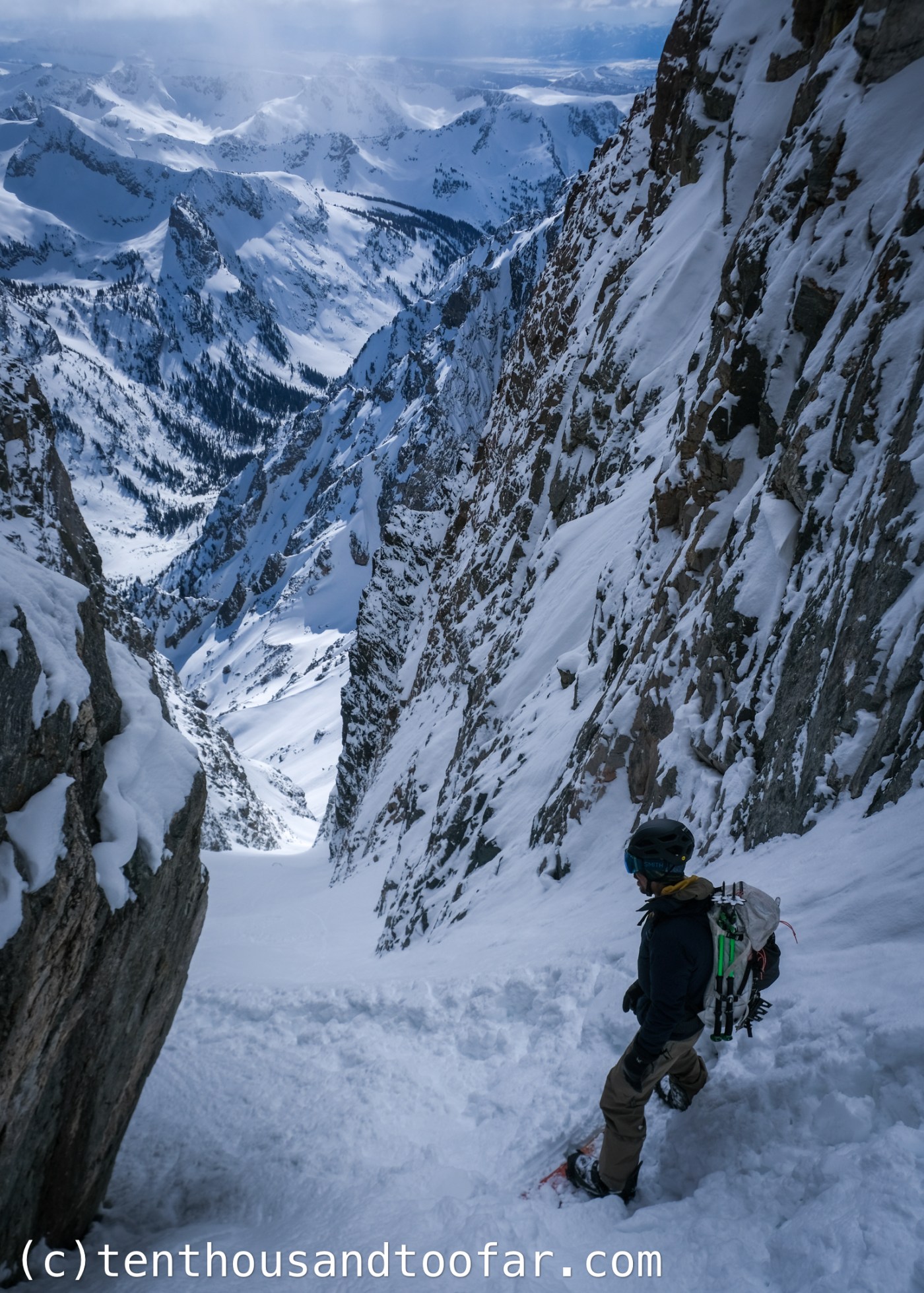
On April 3rd we skied the Southwest Couloir on Mount Moran in deep powder conditions. With 4,500 feet of consistently pitched fall-line skiing, nearly 6,000 feet in full, this colossal couloir is Teton royalty.
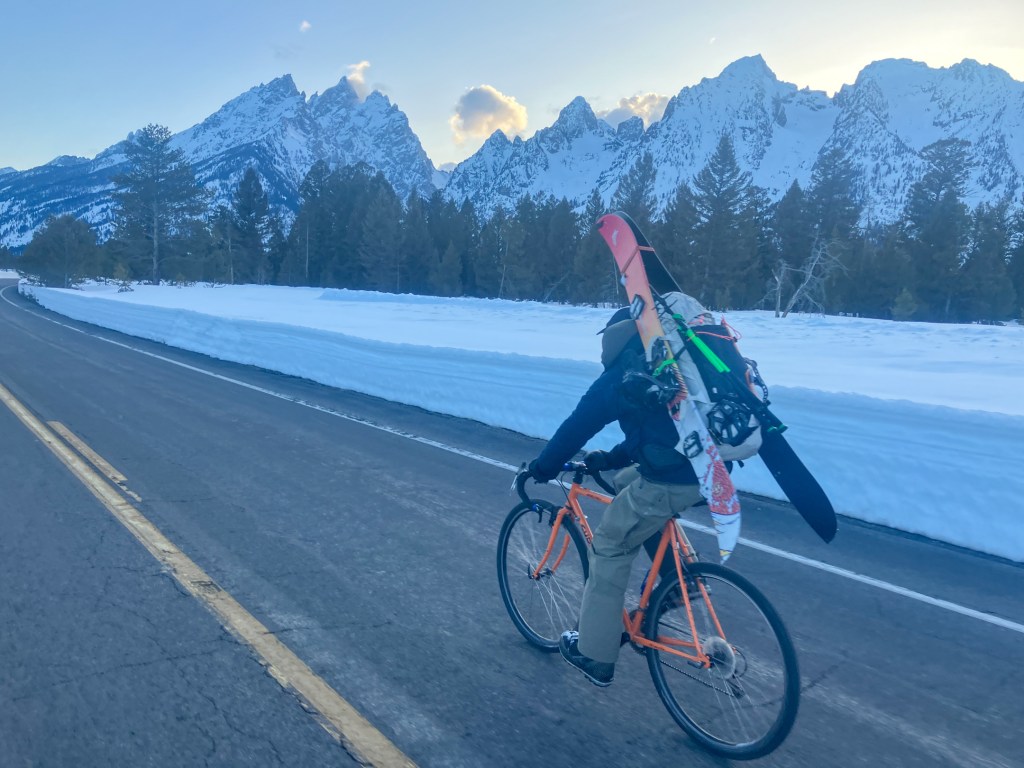
April is the penultimate month for ski mountaineering in the Tetons. Around April 1st every year the Grand Teton National Park road opens for bicycle access, providing streamlined access to the north-central range from Cascade Canyon to Mount Moran. This area includes a massive swath of terrain that, save for a frigid overnight camp, is unjustifiably distant by winter. On May 1st the road opens to cars, but by then the snow-pack has thinned substantially. Bike-ski-bike season is the ultimate intersection between snow-pack depth and ease of access. Plus, it provides a novel multi-sport experience. During April, lines like the mighty Southwest Couloir become realistic single day objectives.
Love Ten Thousand Too Far? Find the information useful? Support independent mountain journalism with $5.10 per month through Patreon (and receive extra bonus content), or with a one-time donation. Any and all support is greatly appreciated.
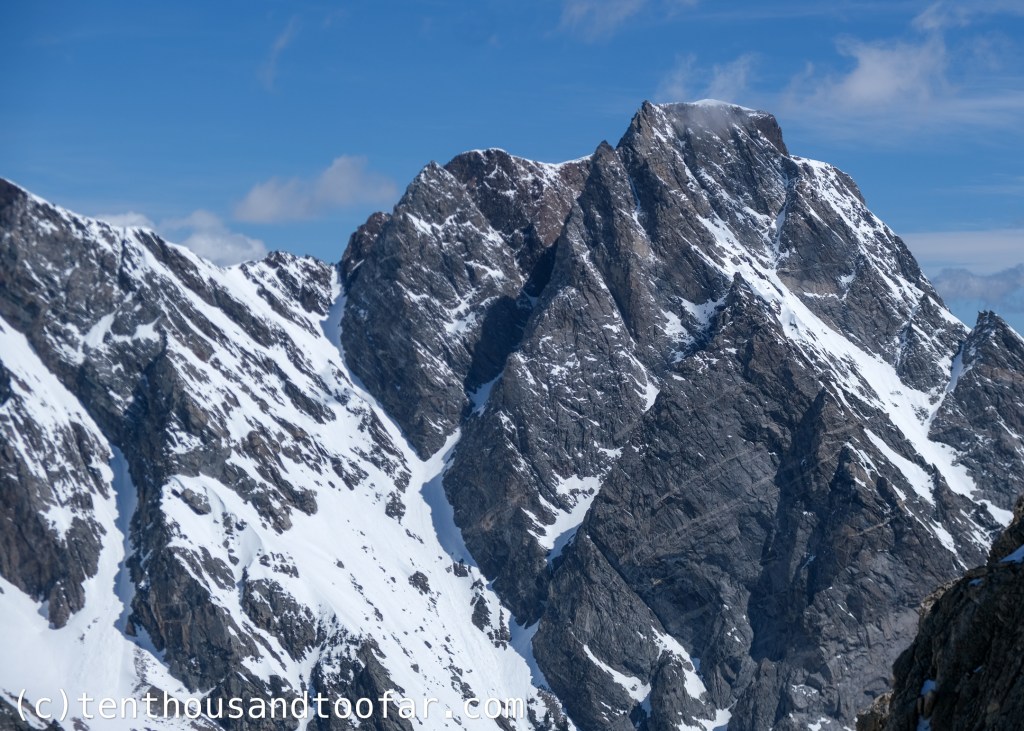
I’ve wanted to ski Moran’s Southwest Couloir for years. The 4,500 foot Baffin Island-esque boomerang couloir is the most striking ski mountaineering descent visible from Teton Valley. Without exaggeration: it’s a monolith. On paper the route seems simple – a 6,000 foot plug and chug. But, as typical for the Tetons, there’s more nuance. Two exit chokes with varying degrees of water ice located just above the canyon bottom taint many a ski-through attempt, where skiers have downclimbed, rappelled, or taken flight. Other times, parties will move east to an adjacent couloir halfway through the descent, crossing a rocky rib, into the main southeast drainage of Mount Thor. A skis-on descent of the full Southwest Couloir is a rare commodity. On May 9th, 2023, I attempted the Southwest with Mike Parri, but the lower 1,000 feet had glide avalanched, exposing two waterfalls and a bed surface of orange granite. Optimal timing is fickle. The bottom 3,200 feet faces due south and is spiked with an inordinate amount of rock. When the sun breaks, conductive heat acts quickly. Avalanche debris often desecrates the runout, and the aforementioned ice cruxes are extremely ephemeral. Lastly… well… it’s a 6,000 foot descent 13 miles from the car. It’s easy to be late.

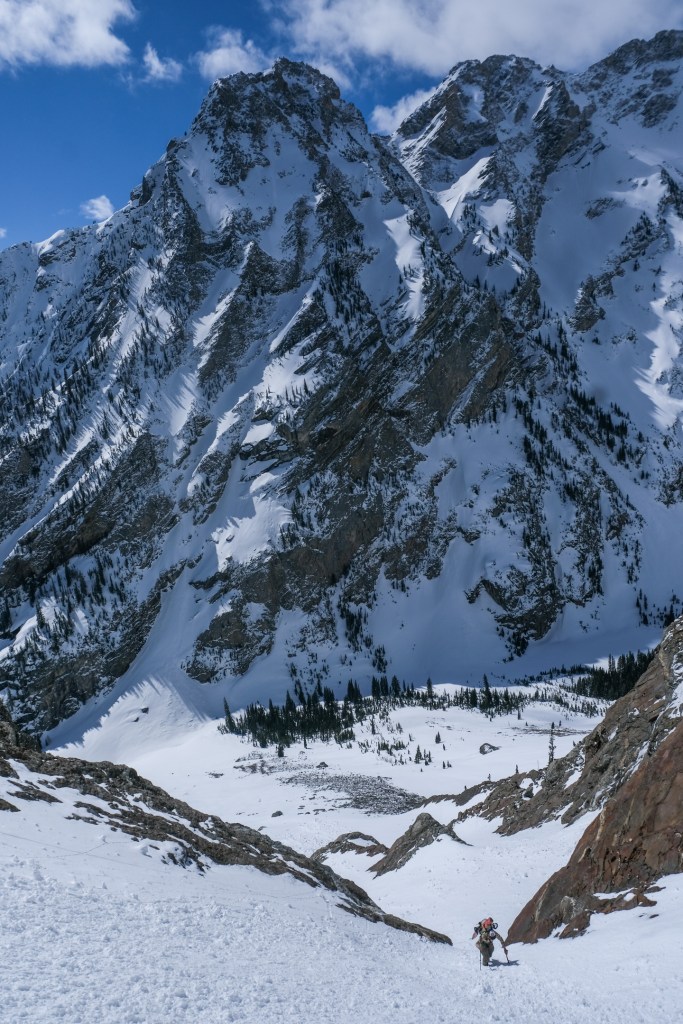
Following a three day pacific storm bridging two swings of high pressure, on a day with intermittent cloud cover and lingering cold temps, a dear friend and I broke from the Bradley-Taggart trailhead by bicycle at 7:00AM. Nine chilly pavement miles later and we were on the southern banks of String Lake. Four miles of frozen lake travel, and 1.5 miles of climbing up Leigh Canyon, brought us to the base of the Southwest Couloir. To our delight, both ice cruxes were filled in, with only the smallest step of exposed blue ice over a tiny bergshrund. Our skis stayed on our backs above 8,700 feet, as a stout crust beneath varying amounts of new snow provided efficient bootpacking. Through late morning our forecast for cloud cover was still struggling to materialize. A crushing spring sun saturated the beautiful fresh powder quickly, threatening wet loose avalanches and sticking to our crampons. However, around noon thick cloud cover encroached, preserving the style and safety our descent. The namesake 40 degree upper couloir, stretching for 1,400 feet to a staggering 12,200 feet, has a predominate western tilt and remained shaded all day. Above 10,900 feet, the snow was cold, smooth, and remarkably deep. As we neared the summit. we wallowed through consistent thigh deep powder reminiscent of February. Eight gently paced hours after leaving the truck, we reached the snowline.


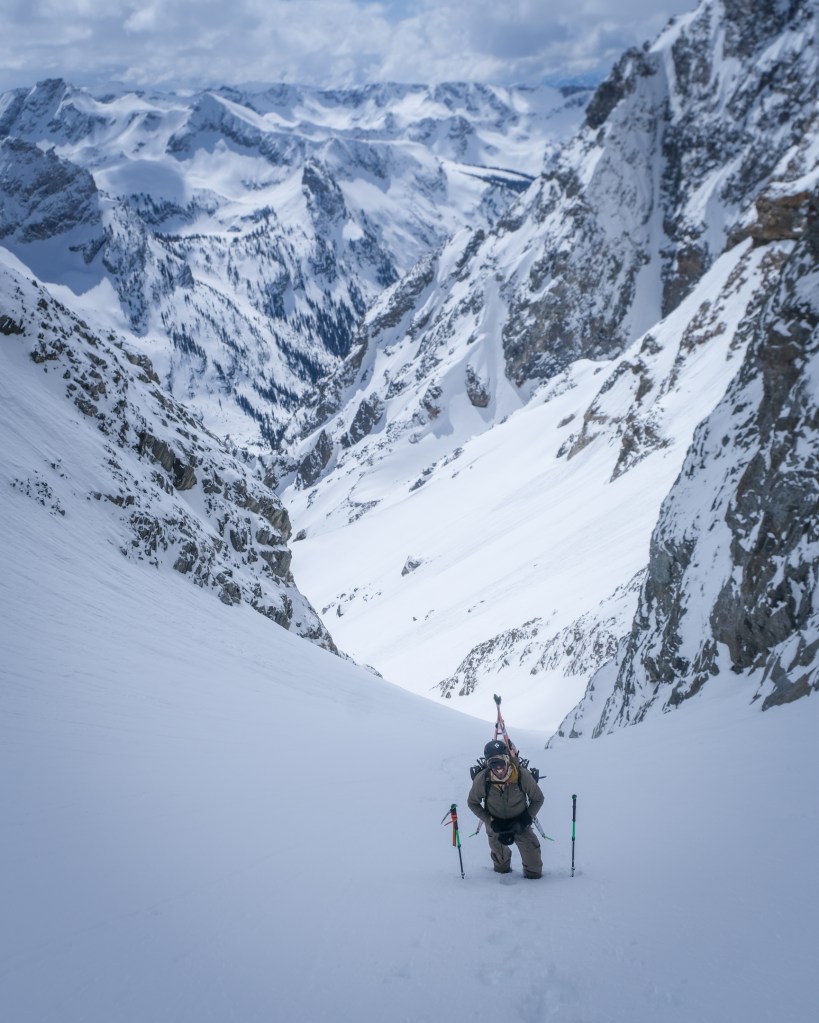
The ensuing 1,400 feet of skiing was among the finest of my life, consistent flowing powder turns at 12,000 feet in a striking couloir with incredible ambiance. I can count on one hand the number of times I’ve skied snow of this depth and quality in such a dramatic position. The granite walls of the Southwest stretch upwards for hundreds of feet on either side, providing an echo with every hoot, holler, and high speed turn. The line maintains a consistent pitch of 40 degrees, the perfect gradient to promote both terrain awareness and confident skiing. My partner skied the couloir in a single valiant pitch, collecting face shot after face shot on his splitboard. Donning 1,000 gram carbon boots, I sunk into a slower flow facilitated by the energetic sounds of Trampled By Turtles. Between companionship, conditions and setting, this was about as close to a perfect ski mountaineering descent I’ve experienced above 12,000 feet in the Teton Range.

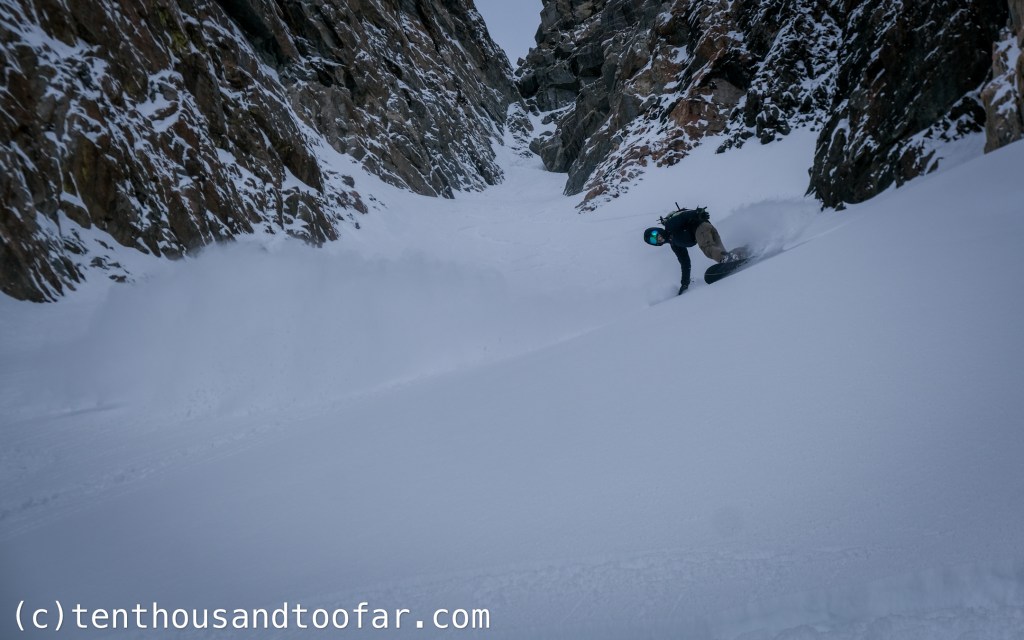
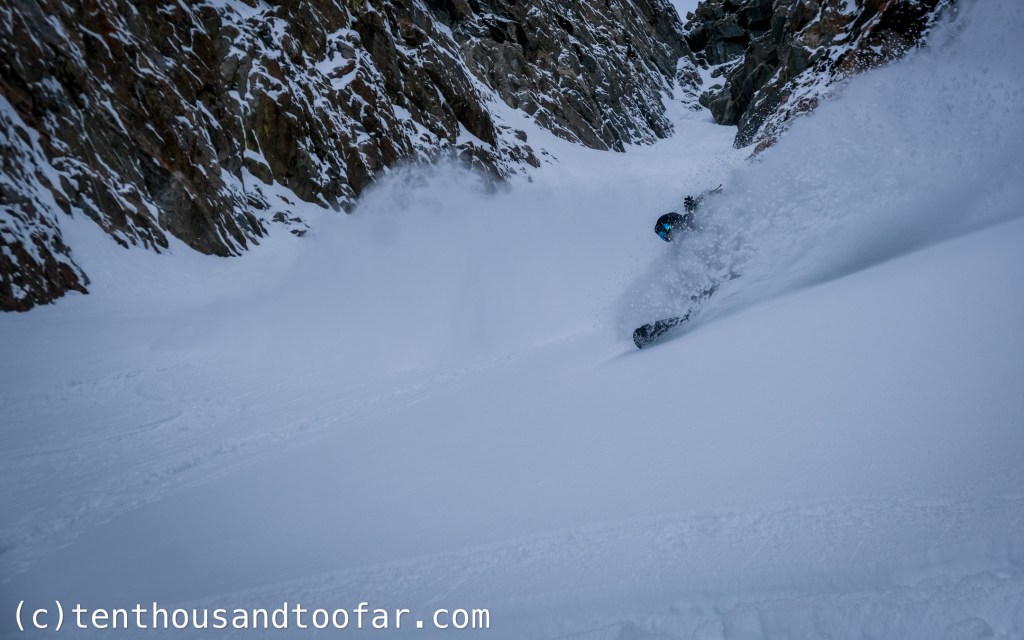
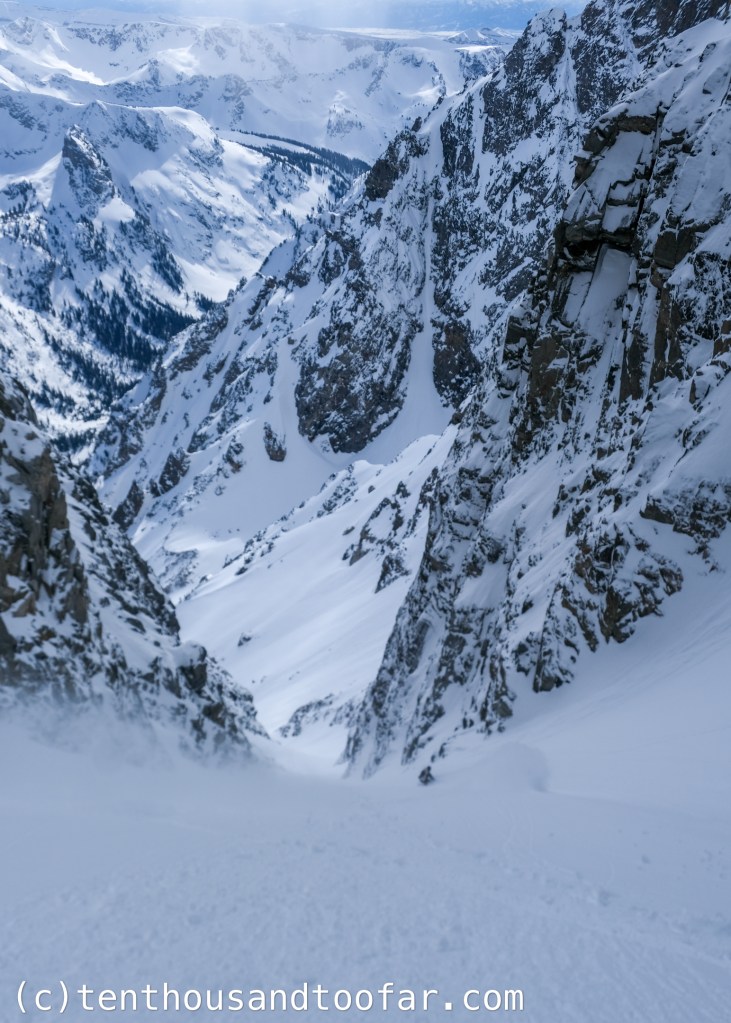
Below 10,500 feet, powder transformed to a light refrozen zipper crust. Some sloppy corn was available for harvest on the eastern margin of the now broad couloir, but the skiing was no longer heroic. Two sections of stimulating jump turns in the ice cruxes kept the mind focused, and a couple hundred feet of ripper corn was dessert for reaching the apron safely. Compared to the steeper canyons of the core range, egressing from Leigh Canyon is a breeze. 13 hours later we were seated on the tailgate, toasting to a special day we’ll remember forever.

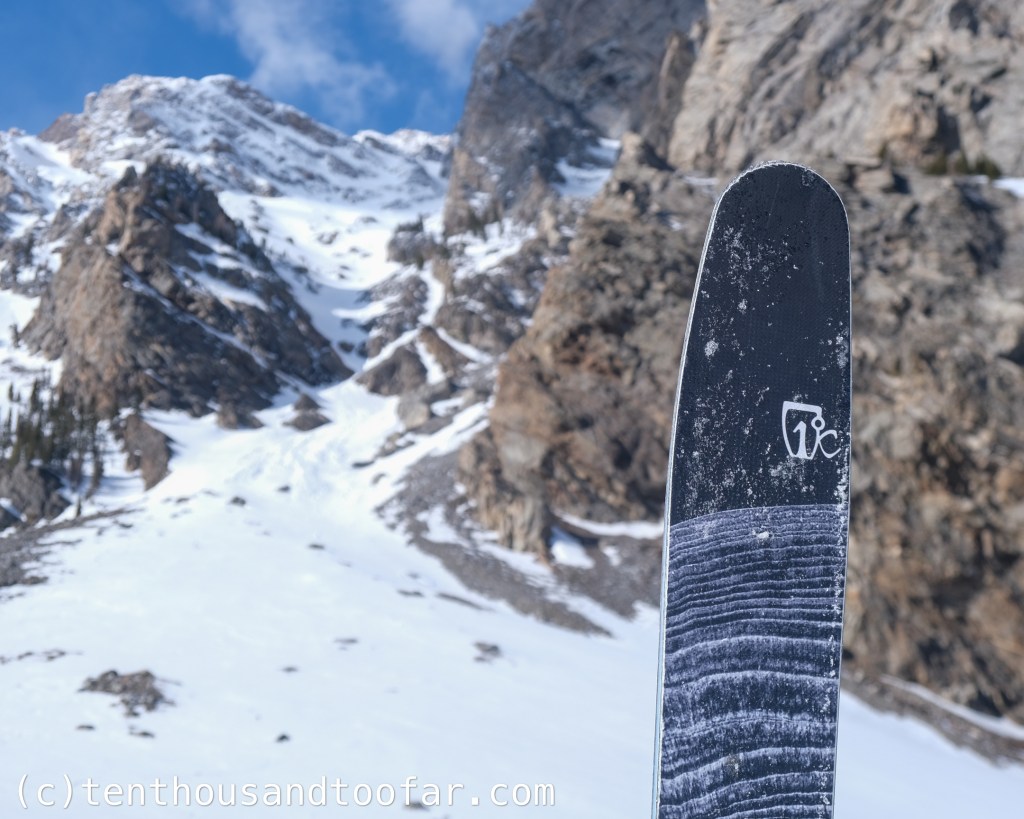
All in all, our day totaled 18 miles of biking, 8 miles of frozen lake travel, and about 6,000 feet of vertical gain maxing out at 12,200 feet. To ski the Southwest Couloir in a day is a truly classic multi-sport endurance adventure. There’s no particularly challenging part of the outing. The skiing is never steeper than 45 degrees, any ice climbing encountered will be trivial, route-finding is straightforward, and the flatland travel is… well… tedious, but just flatland travel. Instead, what makes the Southwest Couloir a coveted Teton ski mountaineering descent is piecing the entire fiasco together in a reasonable time frame. The Southwest is almost certainly the longest fall-line couloir descent in the range. Need I say more? Having stared at this beauty for years, I was extremely grateful to get er’ done in such unique conditions.
Want to support? Consider a donation, subscribe, or simply support our sponsors listed below.
Ten Thousand Too Far is generously supported by Icelantic Skis from Golden Colorado, Range Meal Bars, The High Route, Black Diamond Equipment and Barrels & Bins Natural Market.




subscribe for new article updates – no junk ever
DISCLAIMER
Ski mountaineering, rock climbing, ice climbing and all other forms of mountain recreation are inherently dangerous. Should you decide to attempt anything you read about in this article, you are doing so at your own risk! This article is written to the best possible level of accuracy and detail, but I am only human – information could be presented wrong. Furthermore, conditions in the mountains are subject to change at any time. Ten Thousand Too Far and Brandon Wanthal are not liable for any actions or repercussions acted upon or suffered from the result of this article’s reading.
 Ten Thousand Too Far