
On our third attempt over two seasons Reed Finlay and I finally made a successful ski descent of Mount Wister’s Northwest Couloir. The line may be be small and obscure, but packs a mighty punch.

Wister’s Northwest Couloir became somewhat of an odyssey for Reed and I. Our first attempt was last year around this time, where we came in top-down but failed to bring the requisite amount of rope or rack needed to make a safe descent. We didn’t even reach the skiable snow line before our piddly supply of pins and wires got wittled to near nothing, and with a large chockstone at the bottom that may or may not have required a rappel it felt a little irresponsible to quest 600 feet down the beast with less bail pieces than I have fingers on one hand. We ended up reversing the rappels, cleaning as many anchors as possible and skiing the west face, vowing to return as soon as possible – but ski season faded fast. We circled back around on April 19th of 2024 with renewed intentions to climb the couloir bottom-up, as the box truck sized gatekeeper chockstone looked passable entirely on snow climber’s right – in fact, it looked so passable we even considered leaving the rope at home. However, when we reached the chockstone we found burly near vertical wind stiffened snow that was tenuous to clean, and the snow that circumvented the chockstone was little more than poorly adhered dust on polished granite. We busted out the cord and Reed put me on lead, but my aluminum crampons and single light-duty ice tool weren’t up to the verglas glazed, entirely protection-less, 60 degree friction slab. After scratching around for too long and returning to our belay alcove with tucked heads, we heard a sickening crack and echo overhead. Seconds later a tire-sized saw blade of granite came whizzing through the notch I was just attempting to climb for the past 10 minutes. I reckon the widowmaker would’ve cleaved me in half. We sat in quiet contemplation for a few minutes, processing the whole scene – Reed with a family and young child, myself with a girlfriend I’m excited to build the remainder of my life around – trying to climb that slab through the direct fall line of this claustrophobic couloir was officially off the table, even if we returned with the proper technical gear. Reed pointed out a steeper and nearly triple the length, but far more featured line of angling flakes left of the chockstone, which would avoid the direct fall line and appeared to offer a continuous crack for protection. Another robust vertical snow wall barred access to rock and required tedious excavation to surmount, and by the time I finished the leading the pitch, only finding four marginal wires in the back of a generally hand sized crack, our time had expired. Reed’s son was due to be picked up from school at 5:45 and the clock had just struck 3:00. It was painful to retreat with the only puzzle barring success having been solved, but I deeply respected Reed’s dedication to being more than just another self absorbed ski mountaineer. I rappelled the chock from an old fixed anchor, cleaned our gear, and after skiing the apron in delicious April powder we vowed to return as soon as possible the following week. In other words, this couloir kicked our ass twice over – we needed to bring more juice to the table.
Love Ten Thousand Too Far? Support independent mountain journalism with $5.10 per month through Patreon (and receive extra bonus content), or with a one-time donation. Any and all support is greatly appreciated.
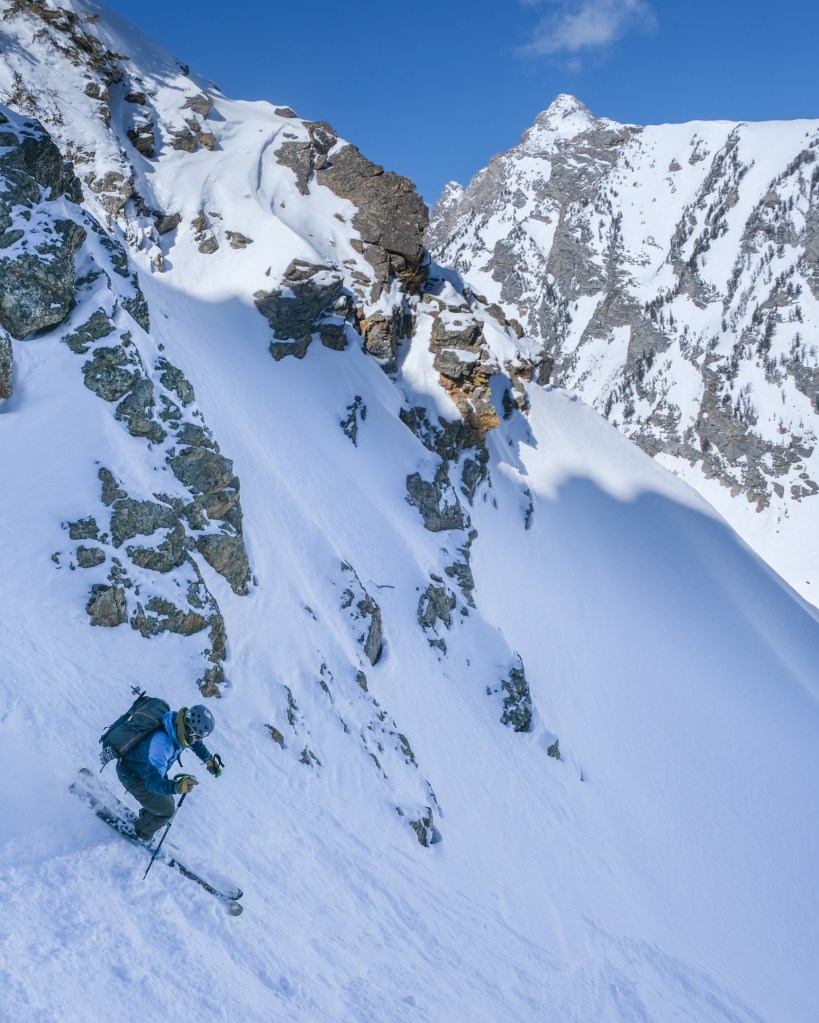

After rallying for a single day push on Mount Moran’s Falling Ice Glacier the following day with Bobbi Clemmer, I called Reed from the car and announced my spontaneous Sunday availability hoping he would bite. We found ourselves at the base of the same impregnable couloir less than 24 hours later, this time with a carefully chosen lead rack and the confidence needed for success. Strong southwesterly gusts ripped down the couloir with tenacity not dissimilar to that experienced during our first attempt, sending plumes of intermittent spindrift swirling over the chockstone, but weather be damned – we were here to see this through. Luckily the snow in the couloir was only beginning to get wind buffeted, still retaining plenty of softness for quality skiing. I re-led the pitch, which was later determined to be 5.7 per the 1968 summer alpine ice route “Northwest Couloir” (II, 5.7, A1, Chadwick/Hunter*) placing four cams and two wires. The aid portion of the summer route must’ve been buried below the snow line, because the pitch was easily freed in ski boots, requiring little technical difficulty save for one body-length of awkward crack climbing. Reed followed in commendable style, hand jamming past the vertical snow wall and slabbing his way through the final crux after blowing a crampon. We had reached the annals of the Northwest Couloir and all that set above us was snow. The excitement was higher than the shady walls that locked us to the mountain. We fixed the rope, tied off the rack and set off with intention.


The Northwest Couloir is about 1,200 feet in full, with a 250 foot main couloir hanging above the crux chockstone, and another 250 feet below leading to the 600 foot apron. Above the main couloir is a series of “rooms” separated by pinches, and the height of the ski line on any given year is dependent upon these pinches being filled in. We were able to climb through the first constriction which was little more than ski-width crust on talus, but pulled the plug at the next pinch, another dust covered slab, about 100 feet higher. Above this dry crux the size of the skiable snow patches nears desperate, the next being all of 40 feet, calling into question what is really worth clicking into skis for when a down-climb will be needed four turns later. Above this blob lies two more sinewy strands of wind drifted snow that would hardly be classified skiable save for a record a year. When the Tetons crack 1000 inches I’ll be first in line for the full Northwest Couloir ski descent, but my guess is that the few ski descents this obscure beast has seen begin from the top of the main couloir or our highpoint above the first room at 10,350 feet. We changed over amidst gale force winds slicing the couloir, careful not to lose a ski in the process, all while a divine beam of late afternoon sun popped over the west ridge and shined directly down our fall-line – a magical, yet intense, environment to say the least.

Without much snow available for transport, the downstream winds weren’t loading the slope, but rather disfiguring snow surfaces and playing with visibility, especially near the top of the line. The snow in the first room was some of the worst and most wind sculpted I’d ever seen, a hardened windslab of epic proportions – about 80 feet long and 15 feet at its thickest, with a width spanning the entire couloir – my imaginative girlfriend would compare it to a prehistoric turtle. I wasn’t worried about avalanches in the slightest, as we climbed it like bulletproof neve on the ascent. On skis I treated this monster as simply part of the slope, enjoying six edge-able, firm and predictable jump turns until the precipice, where the slab rolled over in excess of fifty degrees. Anticipating another firm turn I threw my skis with intention, but when my edges connected with the snow I plunged to knee-depth through a stiff breakable crust, sending me tumbling with a loud “f%$k” that echoed off the couloir walls. I fell somewhere between 10-15 feet, bouncing once on my back and landing in a pocket of deep powder below the drift, skis downhill and entirely uninjured – a fall that would be considered routine just about anywhere besides a remote hanging couloir with tight walls. I was never going to go the distance, for the main couloir was only 45 degrees and padded with knee deep supportable powder, but the split-second feeling of plummeting down a mountain head first, in quintessential no-fall terrain, was enough to flood my brain with equal pulses of mortality and adrenaline. Even if I wasn’t facing death outright, I could’ve twisted a knee or smacked off the couloir wall to a broken hip or shoulder. I could’ve landed on a sparsely covered talus spike. I’m a ski mountaineer, and ski mountaineers don’t fall. In seven years of chasing the steeps I’d never even come close violating the unwritten code, and now my armor was pierced. Furthermore, Reed was my mentor and I feared I’d let him down. As the buzz wore off I was left with embarrassment, yet still had 98% of the descent left to ski. “My head’s on straight” I said to Reed as I dusted my skis off and prepared for the next turn. “We’re all good.”
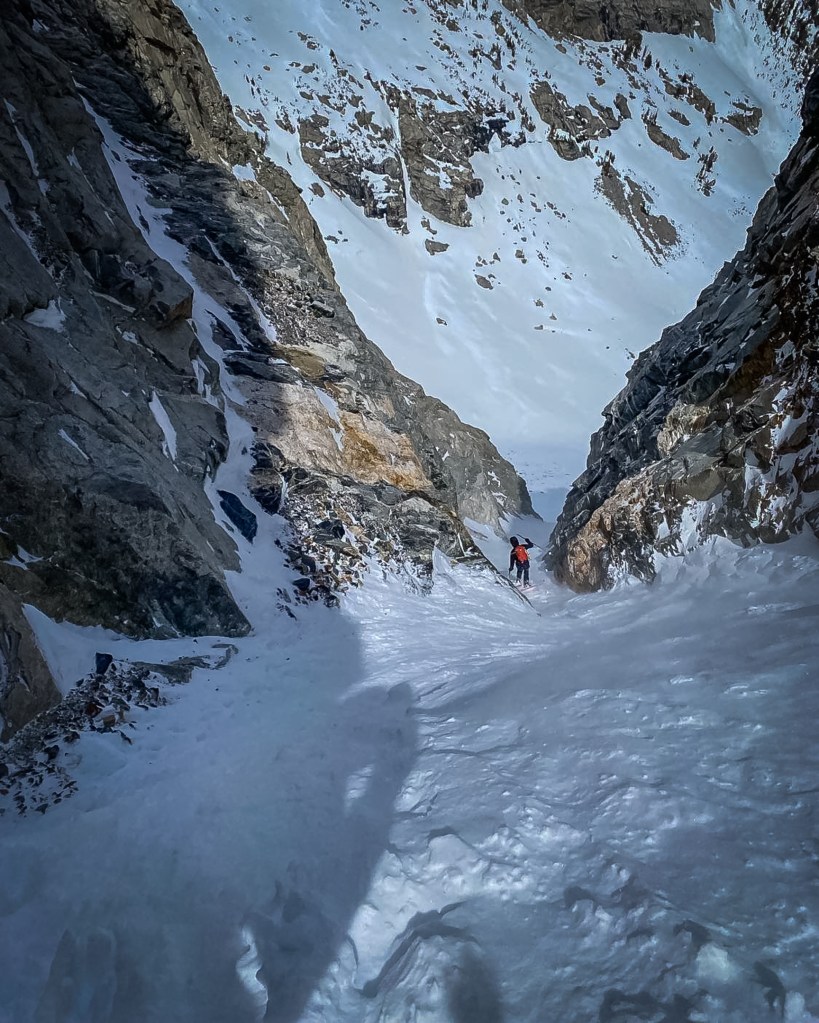


My first handful of turns after the fall were cautious, finding the pockets of good snow and weaving through the pinch below the first room at tactical speed. Reed followed and we regrouped below the main couloir. As we skied lower the snow quality steadily improved, leapfrogging stable pitches of pillowy wind drifted powder in one of the most scenic couloirs I’d ever skied. As I approached the chockstone and entered the real no-fall-zone I had to repeatedly remind myself I wasn’t just going to spontaneously blow a turn, that the snow conditions preceding my tumble were especially unique, and one fall doesn’t negate the thousands of high consequence turns I’ve made in my lifetime. Jump turn by jump turn I made my way towards the anchor, milking every last inch of snow instead of relenting to the side slip my irrational mind yearned for. I clipped into the anchor and settled in to watch Reed ski the couloir he’s hunted for decades. He’d made two attempts before connecting with me, bringing his total Northwest Couloir strikeout number to four, and now he was harvesting the fruits of persistance. His turns looked cool, calm and collected as he approached the anchor amidst a dazzling display of apocalyptic spindrift that intermittently wiped him from my camera frame. There’s really no way to accurately describe it.
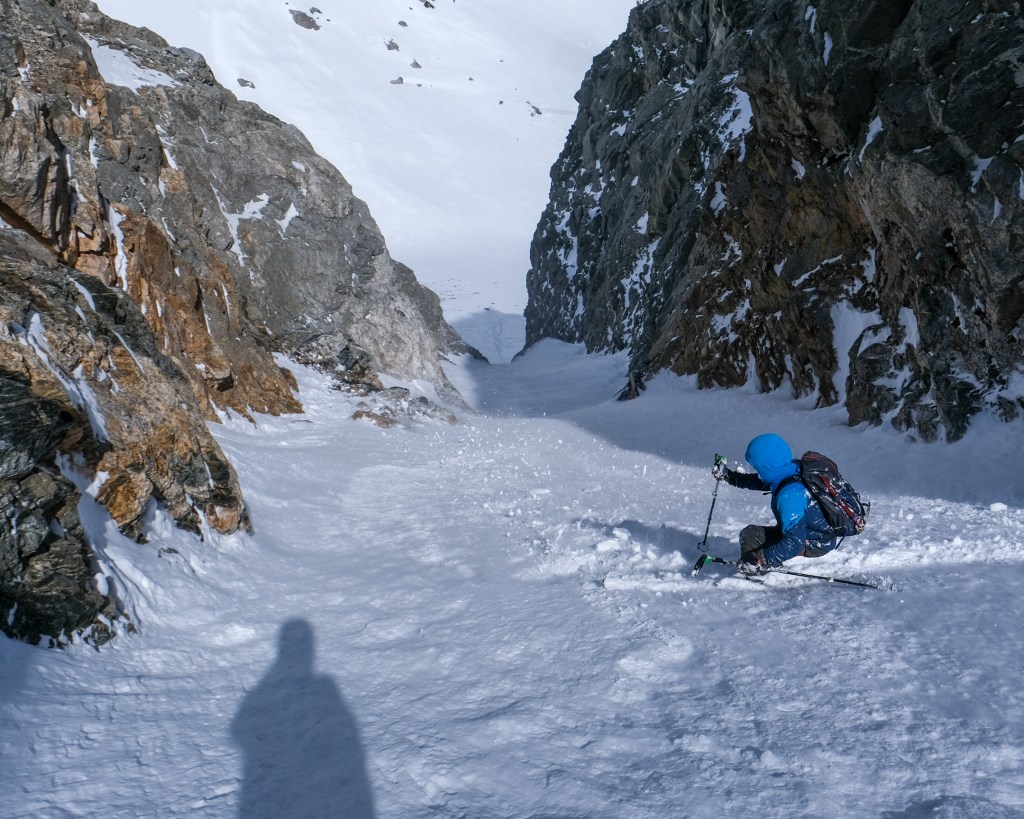
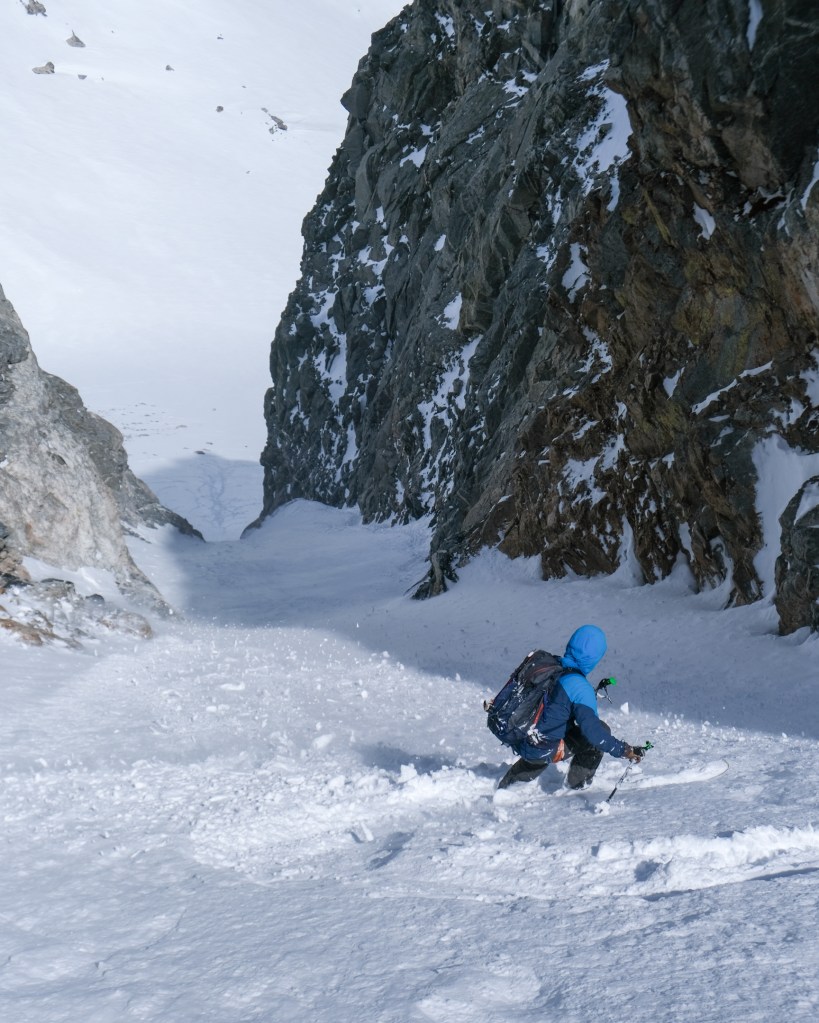


A 15 meter rappel saw us to the familiar lower couloir we’d skied no more than 48 hours earlier, and another equal dose of excellent powder that transitioned brilliantly to refrozen corn nearing the canyon bottom. Views up the couloir of ski tracks old and new told tales of hard work, perseverance and brotherhood. One final billow of spindrift over the chockstone was the couloir’s way of reminding us, in Reed’s words, not to let the door hit us on the way out. As we enjoyed pleasant refreeze conditions down the many headwalls of Avalanche Canyon I struggled to remove my mind from the stain of imperfection, while a more practical voice gently whispered that we’re all human, and no human has ever been perfect. While unpacking my tumble in the days following I concluded that complacency was the culprit. I’d been spending an unprecedented amount of time in no-fall terrain this season, so much so that the Northwest Couloir actually felt trivial, encouraging me to be a bit loose with difficult snow conditions I may have treated more seriously in other years. Wind drifted snow is predictably unpredictable, and Reed told me he bookmarked that drift on the way up as place he would side slip on the descent. I viewed it as some sort of freeride obstacle, a clear sign of a disparity in experience and perspective. He explained his philosophy on ski mountaineering as “descending with skis on”, and as he spoke those words something clicked. Perhaps style in ski mountaineering isn’t predicated on how many turns a skier does or does not make, but rather the grace and wide margin with which they are able to navigate the difficulties presented to them. In the grander spectrum this was one of the finer days I’ve had in the mountains, equally owed to sharing the experience of failure, learning and triumph with a great friend, the full-spectrum challenge of the adventure itself, and the lessons I learned to further my ski mountaineering going forward. Ever onward, ever upward.

* More information on the 1968 Northwest Couloir climbing route can be found in A Climber’s Guide to the Teton Range (Ortenburger/Jackson), page 116 (third edition)
Want to support? Consider a donation, subscribe, or simply support our sponsors listed below.
Ten Thousand Too Far is generously supported by Icelantic Skis from Golden Colorado, Barrels & Bins Natural Market in Driggs Idaho, Range Meal Bars from Bozeman Montana and Black Diamond Equipment.




enter your email to subscribe to new article updates
DISCLAIMER
Ski mountaineering, rock climbing, ice climbing and all other forms of mountain recreation are inherently dangerous. Should you decide to attempt anything you read about in this article, you are doing so at your own risk! This article is written to the best possible level of accuracy and detail, but I am only human – information could be presented wrong. Furthermore, conditions in the mountains are subject to change at any time. Ten Thousand Too Far and Brandon Wanthal are not liable for any actions or repercussions acted upon or suffered from the result of this article’s reading.
 Ten Thousand Too Far