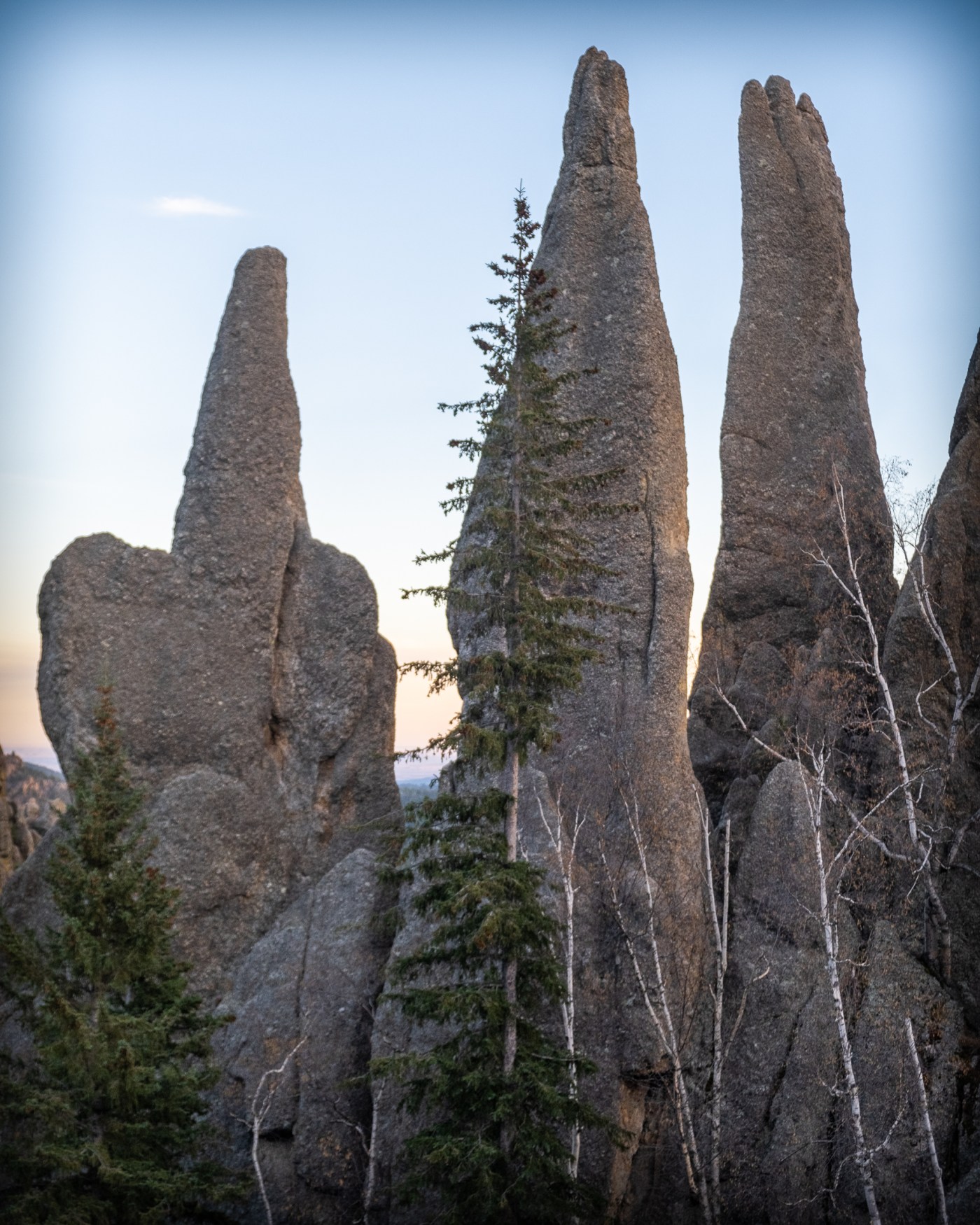
The Needles host some of the boldest old-school trad lines in the country, with rich history on amazing granite pillars. Bobbi Clemmer, Carl Osterburg, Bailey Haus and I sampled some of the moderate four-star classics over two days, including Threading the Needle (5.8+ R/X), Tricouni Nail (5.8 R) and Tent Peg (5.7 R).
After a day of well protected bolt clipping at Mount Rushmore – what a novelty – we shifted focus towards our main inspiration for driving ten hours to South Dakota other than hanging out with Minnesotan friends Carl Osterburg and Bailey Haus – the South Dakota Needles. The eroded course-grained granite pillars are a popular tourist attraction for many driving the west. Located in Custer State Park and the famous Black Hills, an impressive road winds through tunnels and car-width notches to show all eyes the most interesting of granite formations in the country. This unparalleled access makes approaches virtually non-existent, and every route we climbed was accompanied by astonished tourists snapping pictures, recording home movies and celebrating our summits. Had we been clipping bolts or climbing straightforward cracks `the overbearing attention may have felt more benign, however, there’s few things like tourists asking “what happens if he falls?” while you’re 30 feet runout in a 5.8 stem chimney above a micro-nut in a shallow flare. The Needles have a strong old-school ethic focused on minimal fixed gear, with bolts placed on lead and grave defying run-outs embraced. I had a tick list up to mid-5.10, my typical Teton trad on-sight grade, but quickly checked myself after a wild adventure on Threading the Needle (5.8+ R/X) left me satiated. This was a different varietal of 5.8 than I climb back home. For the pure climbing audience out there, each route will be followed with a recommended rack based on what I’d carry for a second lap.
Love Ten Thousand Too Far? Support independent mountain journalism with $5.10 per month through Patreon (and receive extra bonus content), or with a one-time donation. Any and all support is greatly appreciated.
Day One – Hitching Post (5.3) and Threading The Needle (5.8+)
The Hitching Post and Threading The Needle are situated on either end of the Needle’s tunnel parking lot, and both are belayed from the pavement. Naturally we began on the Hitching Post, to sample the famed crystalline granite and tick an easy pillar. The 70-ish foot summit offered no inspiring protection for the first 60 feet, though the climbing to the first reliable cam was 5.1 at worst, and quite positive. The final “crux” move onto a small tower was well protected and in whole, the Hitching Post offered a scenic warmup and perfect way to get our crew of four to a care-free Needles highpoint. From the summit we rappelled directly into the parking lot, drawing quite the buzz, and shifted the belay an apple’s toss to perhaps the most classic climb in the Needles.
Hitching Post Rack – Black Metolius Cam (5), #13 BD Stopper, 2-3 120cm slings, optional small nuts
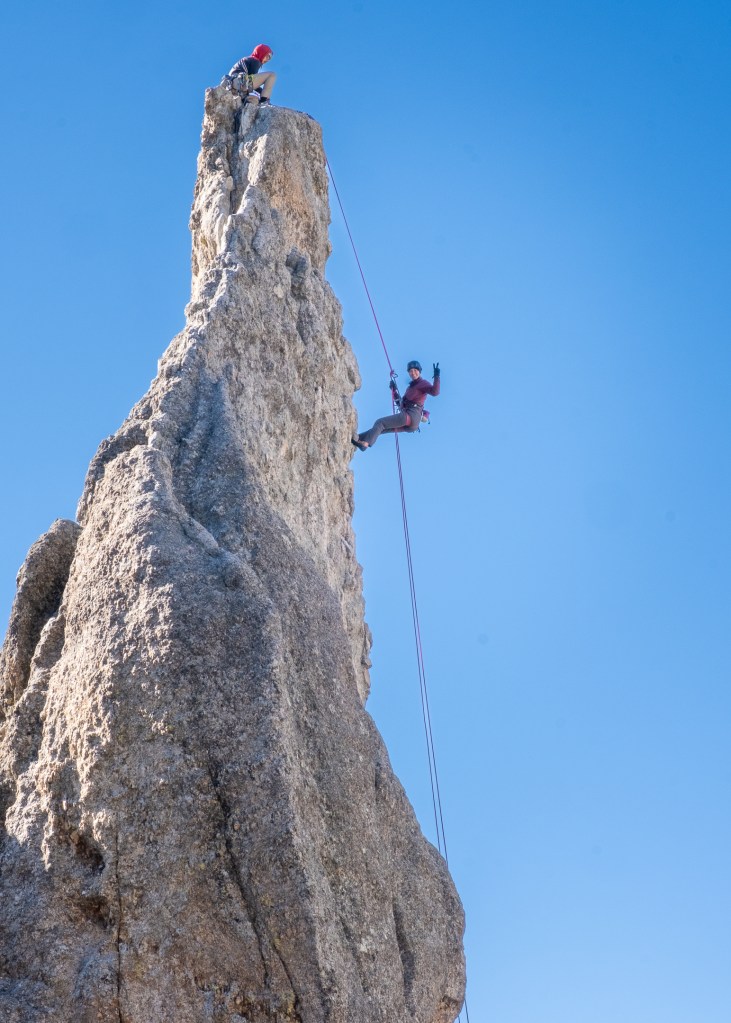

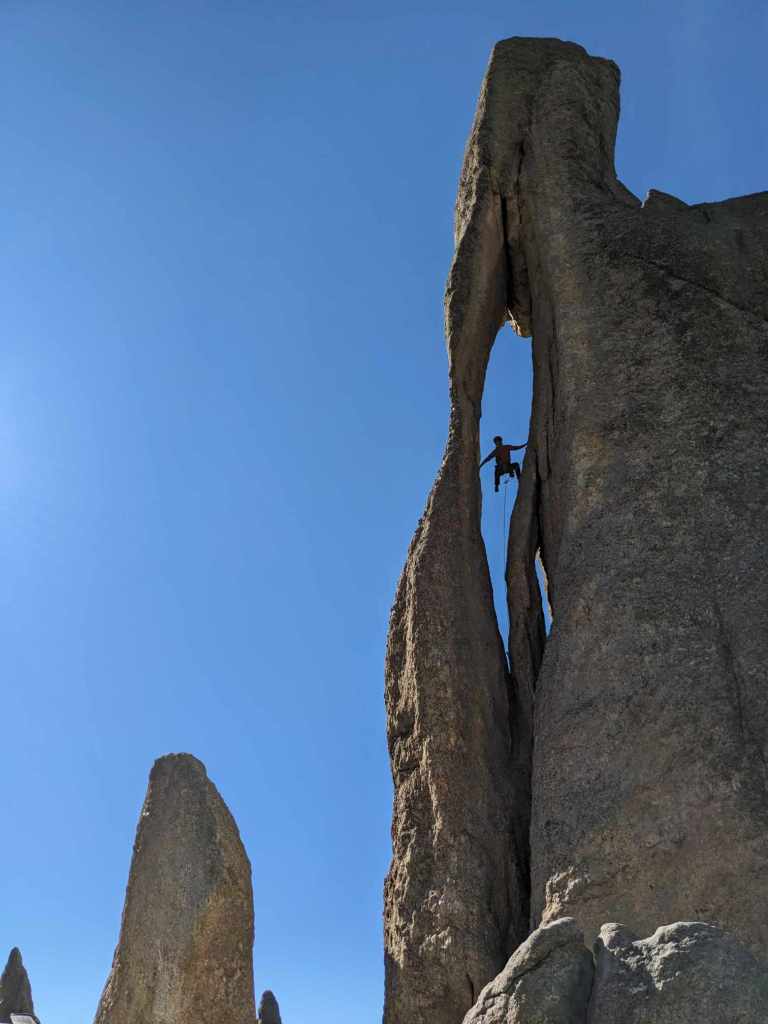
There’s no route more photogenic, perhaps anywhere, than Threading The Needle – but the lack of protection bars many. At least 100 tourists (literally) photographed our crew over the course of our climb. I began on lead, chimneying on slick feet for 20 feet until getting a reasonable nest of surprise gear – a Light Blue Metolius Cam (7) in a hollow flake and a small HB brass offset micro-nut in a thin seam. From here it was another 20 feet of 5.7 chimney to a reliable crack that ate gear of all sizes, and I sure zipped it up. The highest piece was a beautiful #4 Camalot as I moved out of the chimney and into the iconic stem box that is the namesake of this route. Brilliant protection-less wall to wall stemming for 30 feet provided the R/X spice for this climb, where an errant plunge into the chimney would be ill advised, boasting movement just secure enough for smiles, and just insecure enough for intense focus. Another surprise flake took a nice finger sized cam and small nut before the first bolt some 70 feet off the deck, and one more bolt protected an airy 5.8 friction traverse around the formation to a nice shaded pedestal with a fixed anchor. The whole crew climbed this caterpillar style, trailing a rope and re-clipping directionals for the next, and we set a fixed rappel line that facilitated a neat roundabout cycle that kept the tourists intrigued. Threading The Needle was by far the highlight of my trip, and consulting with Bobbi, Carl and Bailey over s’mores that evening, I think it was their’s too. In fact, it might be the best single pitch climb I’ve ever done, and refreshingly gentle at the grade.
Threading The Needle Rack – Cams from fingers four inches, regular stoppers, HB brass-offset stoppers, 120cm slings, two quickdraws



Day Two – Tent Peg (5.7) and Tricouni Nail (5.8)
Our second day started slow, with a morning fire, muesli and ashy yoga. After climbing the day before we ran up Black Elk Peak at sunset, the tallest point east of the Continental Divide, and it’s been a while since I’ve trail run 10 miles (though we did hike the second half). My legs were sore – and my fingers, after clawing at tiny crystals for two whole days, were sensitive at best. We rolled into the Needles by high noon and jumped on Tent Peg to warm-up. What we found was a slightly more engaging climb than your average 5.7, with a cold and shady wide-crack to start, and a final seam that protected well with small stoppers but felt damn tricky for 5.7. And of course, the seam withered some 20 feet from the summit, requiring another heady runout on 5.6 friction with once again, quite dire consequences. The summit is no bigger than two microwaves, but both Bobbi and I took turns saddling our legs over another memorable Needles pillar. Carl also scored a commendable lead with help from a sling extended anchor taming the final runout. For prospective climbers, we followed the route described in the most recent guide beginning on the north side of the formation, but many other routes surround the Peg and are described differently from other sources. I’d give the Tent Peg three stars, and would totally climb it again.
Tent Peg Rack – Cams from fingers four inches, small stoppers for the upper seam and a few long slings
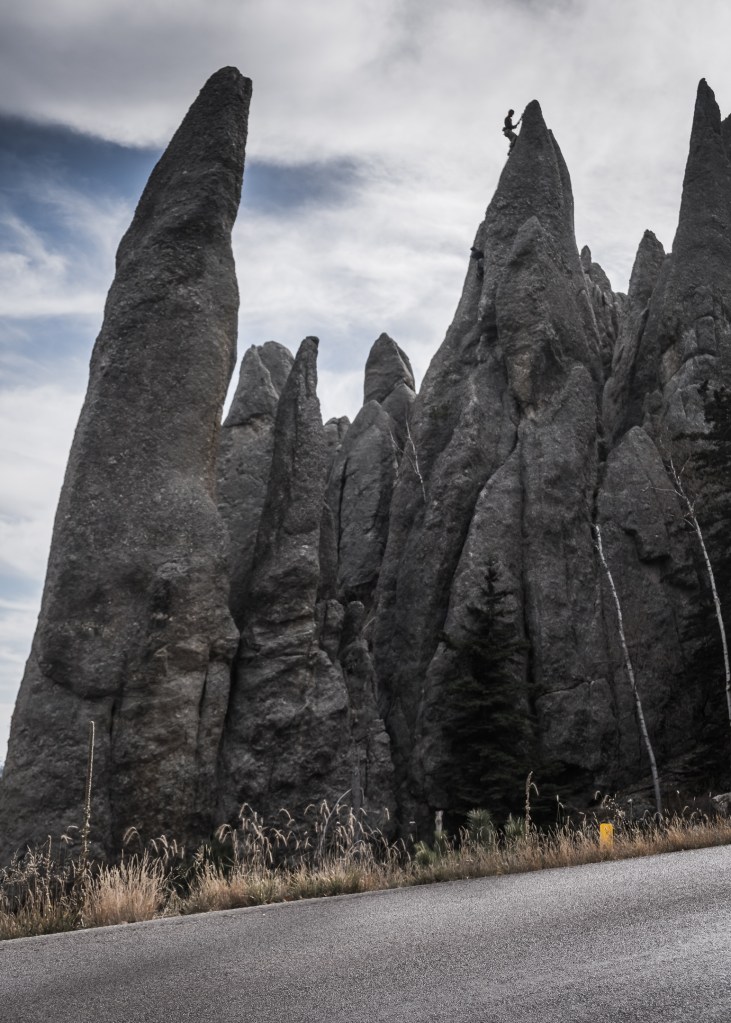
After the Peg Carl and Bailey opted for a hike to Cathedral Spires, leaving Bobbi and I behind, fixed on the four-star classic Cerebrum on Tricouni Nail. In many ways, Cerebrum encapsulates all that Needles trad climbing seems to be. The summit is inspiring, a three headed dragon that attracts more stares than any other formation in the Ten Pins area. The route is funky and unlikely, following fixed pitons up an in-your-face vertical seam to a layback and perch atop a large detached flake on the southern arete that can be slung for pro. From here, more steep laybacking on shallow flakes above the smallest TCU cams leads onto the west face and a funky ring bolt. The next bolt is nowhere to be seen, tucked back on the arete proper, requiring a difficult horizontal traverse a few wingspans to the right, and up the arete on friction nubbins – a proper puzzle – capped by a heroic runout jug haul on large crystals to the tri-tipped summit with… no fixed anchor! A 120cm sling wraps the entire central summit block perfectly and provides the most picturesque hanging belay amidst the mind-bending wonder that is the Ten Pins, Cathedral Spires and Needles area. I’m not sure I’ve ever seen Bobbi climb so well, laybacking with serious grace and negotiating the heady following traverses with bulletproof composure. Several tourists yelled at us for pictures as we took turns carefully mounting the true summit, and watching the colors of autumn sunset flood the sky. But wait, how did we descend with no fixed anchor? Herein lies the the purest manifestation of Needles climbing culture: the established Tricouni Nail descent is a simul-rappel, with the rope threaded through one of the notches between the three summits! We did a counterweight rappel, where I lowered Bobbi to the ground, and she remained tied in while I rappelled off her harness on the other side of the formation, with the summit notch providing the necessary friction to balance our unequal bodyweight. Though no details are known about the first ascent by Royal Robbins, I imagine the selective “5.8” path up this feature wasn’t discovered until ample swinging around from the ring, with bolts placed on lead – a tremendous feat to imagine in 1960’s footwear.
Tricouni Nail Rack – Three smallest (00, 0, 1) Metolus TCU Cams (or small nuts?), five quick draws for fixed pins and bolts, 120cm sling for flake, two 120cm slings (four foot runners) for anchor


The Needles – A Glimpse Into What Was
I used to think climbing in the City Of Rocks, or Teton alpine, represented old-school, gritty, runout, hanging-it-all-out-there climbing – until I arrived at the Needles. There’s something both beautiful and ridiculous about the historical classics here, with bolts placed seemingly only when a fall could mean death (and even then they might be missing – check out Henry Barber’s Super Pin), and run-outs up to 30 feet considered “well protected”. Is such a disregard for safe climbing a product of macho hubris? Perhaps it could be necessity, with old hardware just too laborious to place? Or maybe the first ascentionists were too busy climbing to worry about amassing money, and the financial burden of a 10 dollar bolt was too steep to protect “routine 5.7” friction? Pass the burger, fries and beer instead. I suspect an amalgamation of all three, and while the new generation climber might rebel towards the promiscuity of these minacious routes, I embrace them as a refreshing glimpse into what was an untamed era, run by wild beats full of lofty inspirations, armed solely with pitons, threaded hardware store nuts, hand-drills, swami-belts and steely fingers. Every piton slammed into a desperate flake, or ring bolt drilled from a delicate perch amidst a deep runout is an opportunity to connect with the experience of the pioneers that came before, that made trad climbing the sport it is today.
Romantic jargon aside, I’m glad the Needles isn’t the only place I have to climb, for after a mere four routes I felt a desperate longing for perfectly protected cracks, bolted faces and an absence of cortisol, but I’m not sure I’ve ever felt such accomplishment from a route seven grades below my onsight ability as I did on Threading The Needle or Tricouni Nail. The magic of the Needles is tangible on every pitch, and as I continue to bolster my abilities I await more adventures into this rugged area that really embodies every stereotype one would expect in the four words South Dakota Trad Climbing.
Hats off to our great friends Carl and Bailey for showing us the beauty of South Dakota granite, and for the many s’mores and NA beers that made this trip the gem it was. I’ll speak for Bobbi – we can’t wait to run it back.


Want to support? Consider a donation, subscribe, or simply support our sponsors listed below.
Ten Thousand Too Far is generously supported by Icelantic Skis from Golden Colorado, Barrels & Bins Natural Market in Driggs Idaho, Range Meal Bars from Bozeman Montana and Black Diamond Equipment.



subscribe for new article updates
DISCLAIMER
Ski mountaineering, rock climbing, ice climbing and all other forms of mountain recreation are inherently dangerous. Should you decide to attempt anything you read about in this article, you are doing so at your own risk! This article is written to the best possible level of accuracy and detail, but I am only human – information could be presented wrong. Furthermore, conditions in the mountains are subject to change at any time. Ten Thousand Too Far and Brandon Wanthal are not liable for any actions or repercussions acted upon or suffered from the result of this article’s reading.
 Ten Thousand Too Far
Leave a comment