
Table Mountain gets climbed 2.5 billion times each summer via Idaho and its popular “Face Trail”, but its east aspect provides an entirely different challenge. Heartbreak Ridge is the premier moderate outing on the peak, with eight-ish pitches up to 5.7/5.8 on generally stellar granite.
Neil Gleichman was my partner for the day, someone I’ve known in passing for years, yet only discussed rock climbing with for the first time a few weeks ago. We floated around a variety of objectives, from a West Ridge traverse of Buck Mountain to the Direct Jensen Ridge on Symmetry Spire, but ended up settling on Table Mountain’s Heartbreak Ridge. Table is best known for its Face Trail, a relentless 4.1 mile natural stair stepper covering nearly 5,000 vertical feet, revered for its capacity to crush both souls and knees while providing one of the most classic views in the Teton Range. However, the Face is entirely non-technical and probably sees up to 100 ascents a day in peak season. Heartbreak Ridge on the other hand, is an often forgotten but highly reputable eight-ish pitch rock climb on the peak’s dramatically fractured east aspect. Reccomended as a moderate outing with good rock in “A Climber’s Guide to the Teton Range”, it seemed a reasonable litmus test to evaluate Neil and I’s partnership. Rather than technical difficulty, Heartbreak would present challenge in the form of a lengthy approach and subsequent loop descent, requiring us to climb traverse style with every ounce of gear on our backs. The few parties that do climb on Table’s backside often make use of an overnight camp, but we were going for a single day push. From Cascade Canyon the approach is about 8-10 miles on mostly well maintained trail – from the Roaring Fork of Teton Canyon, 7-8 miles, about 40% off trail. Though it’s often quicker to side with a longer trailed approach than a shorter off-trail approach, there were two other variables. One, there is no direct rappel descent off the long and varied ridge – the guidebook doesn’t even list a descent – so while an approach from the east could’ve been more efficient, the egress is surely a doozie. Approaching from the west allows a seamless loop descent back to the Teton Canyon parking lot by way of the aforementioned Face Trail. Secondly, I’ve been driving to Grand Teton National Park at the precipice of dawn all summer. Something about a 30 minute commute sounded luxurious.
Love Ten Thousand Too Far? Support independent mountain journalism with $5.10 per month through Patreon (and receive extra bonus content), or with a one-time donation. Any and all support is greatly appreciated.

The temperature was well below freezing when we pulled into the lot at 5:30AM Sunday morning. The bushes and trees were glazed with frost. Neil elected to hike in a base layer while I naively took the “be bold, start cold” adage a little far. We forded an icy Teton Creek barefoot, and shared a few bear whistles as we made steady progress into the Roaring Fork. Around 8,500 feet we started encountering significant snow, and many of the smaller creek crossings were glazed with fresh ice. We left the trail a mile or two from Hurricane Pass, contouring northeast to the saddle between Table Mountain and Peak 10,635 across an impressive basin of shattered limestone blocks and plateaus. By the saddle I was breaking trail through shin deep snow, and views to the east revealed a snow plastered core range, the South Teton seeming to have the highest localized accumulation. A relatively short but quite loose traverse to the base of Heartbreak Ridge lost somewhere between 500 and 800 feet of elevation in maybe half a mile, and by 11:00AM we were staring at guidebook photos and pointing fingers at the beautiful lower golden buttress baking in the morning sun.

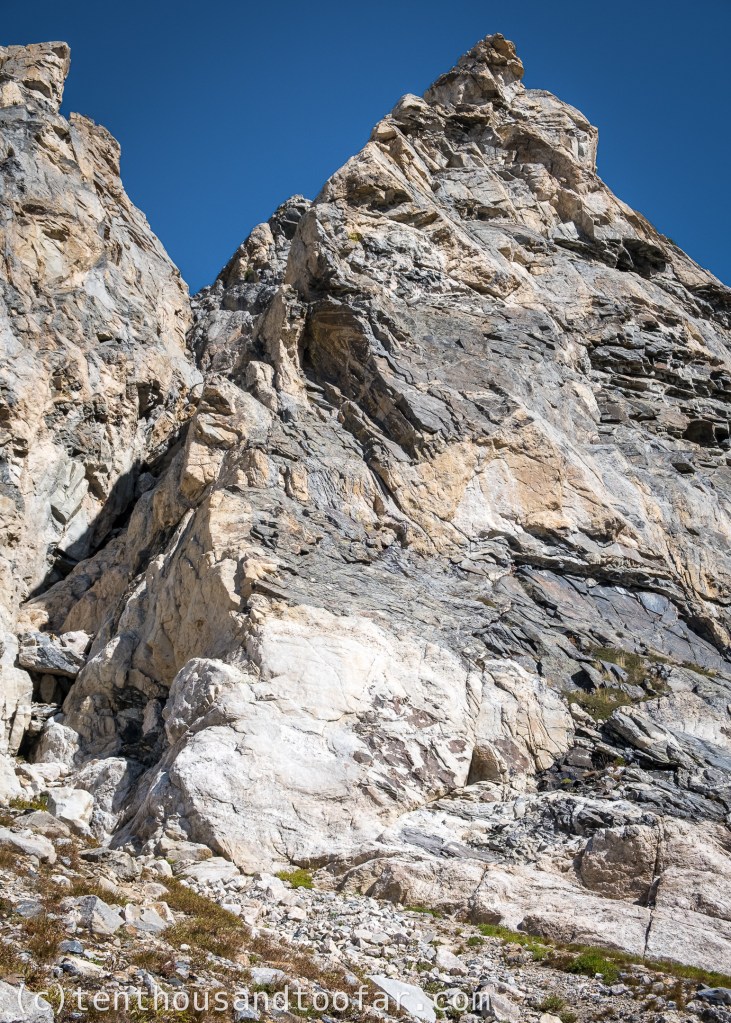
Finding the start of the first pitch proved more difficult than expected. The book indicated a 5.6 slab at the toe of the ridge, but the geological toe appeared far steeper, more difficult and nearly void of cracks. We began as close to the ridge as feasible, maybe 100 feet east, and due to a general lack of protection, and mutual comfort, kept the rope coiled. A few friction 5.6 bulges warmed the soul pleasantly for the day ahead. We changed into shoes and harnesses on a small vegetated pedestal beneath pitch two, which took towards the arete crest. Neil believes I accidentally took the “5.8 crack” variation listed for pitch two rather than the 5.7 arete, but I am still unsure. Heartbreak Ridge is similar to the typical moderate Teton ridge climb, heavily featured to the degree that discerning the “right” route is almost impossible, where upward progress is preferable to staring at a topo every 10 meters. At the end of pitch two I followed the path of least resistance onto the climber’s left side of the crest, where we found a third pitch of difficult face and slab climbing, probably 5.9, that seemed off route to me. Neil began leading this pitch, but after a valiant whipper on the crux bulge passed the reigns to me. In a full 70 meters I gained a pleasant belay ledge just left of the crest that would allow easy passage back to the ridge, where I aimed to reclaim a sense of direction. The rock on this shaded side of the ridge was far from classic, and I actually nearly pitched off a fourth class runout when a foothold spontaneously dislodged into the deep couloir below. Widespread snow stalked the larger ledges, and for 1:30PM I was beginning to grow time sensitive.
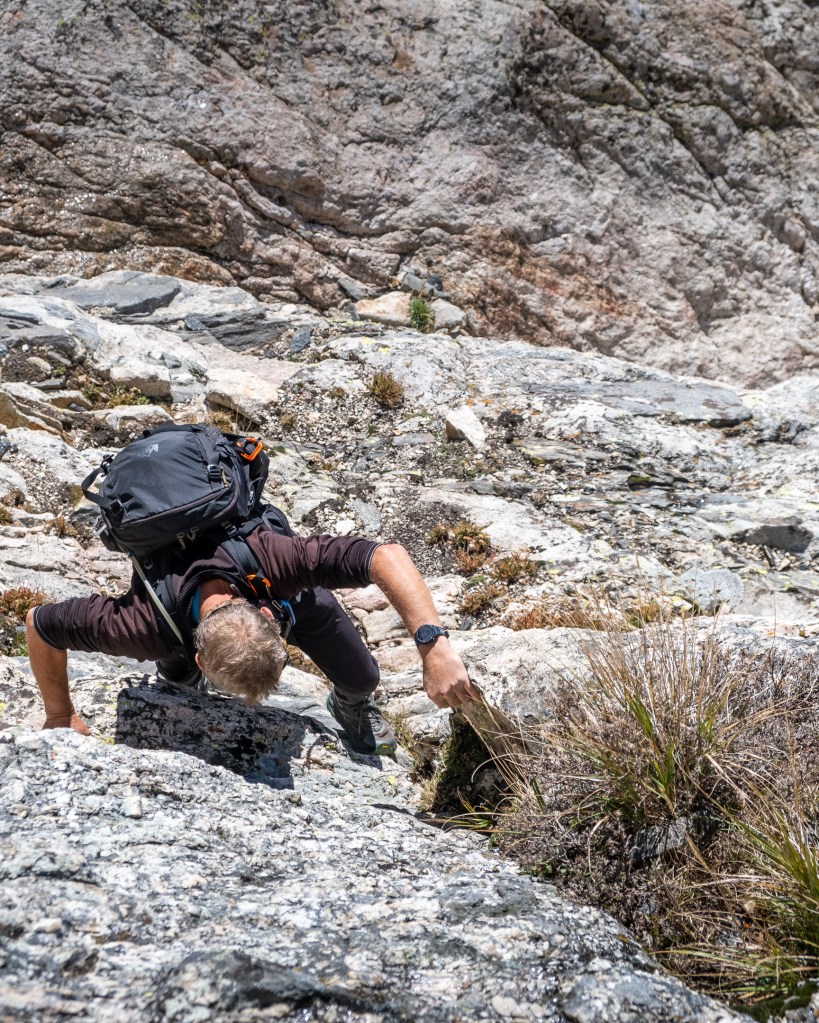

As soon as I gained the sunny crest I knew for certain we were recalibrated, and my anxiety instantaneously vanished. The rock was remarkable, golden, bullet-hard knobby granite reminiscent of a pimped out version of Exum Ridge’s Golden Staircase, with sustained difficulties from 5.5 to 5.7 and positioning rivaling that found on Irene’s Arete. After a full four-star rope-length we coiled and short-roped through extensive fourth class terrain to the base of the “Nose” – an obvious overhanging protrusion defending the upper ridge. Icicles and water seeps rendered the steep black rock beneath the Nose virtually unclimbable, and the hand-drawn topo variations, a 5.9 right of the crest and a 5.7 left of the crest, were unclear. Frankly, the whole guidebook topo from this point forward became a little cryptic. We might have found the 5.7 variation – skirting the Nose climber’s left on a dark wet slab, then working back to the ridge on blocky low-fifth terrain, but the written description of the seventh pitch didn’t match our path. Above the Nose pitch, first ascentionist mentality uncovered two more scenic and short leads on the direct crest, a short stem chimney with an overhanging chockstone (5.7+) and finally, fractured terrain to a final steep finger crack dihedral (5.8). At this point we were damn certain to be nowhere near the first ascent line, but this last rope length was one of the best of the climb and is recommended if someone stumbles across it – great rock with supreme exposure and the most challenging moves of the entire climb at 11,000 feet. Topping out Heartbreak Ridge under clear skies, evening light casting a golden veneer over a wintery Dartmouth Basin and core range, was sublime – winter felt oh so near. A light wind brought the bite, and with a complicated ridge scramble up and over Table’s snow-clad summit to come, we did not linger long. Between all the simul-climbing and initial soloing it’s difficult to pinpoint exactly how many “pitches” we climbed, but I’d wager about eight. As for proper lead and follow blocks, we preformed five.

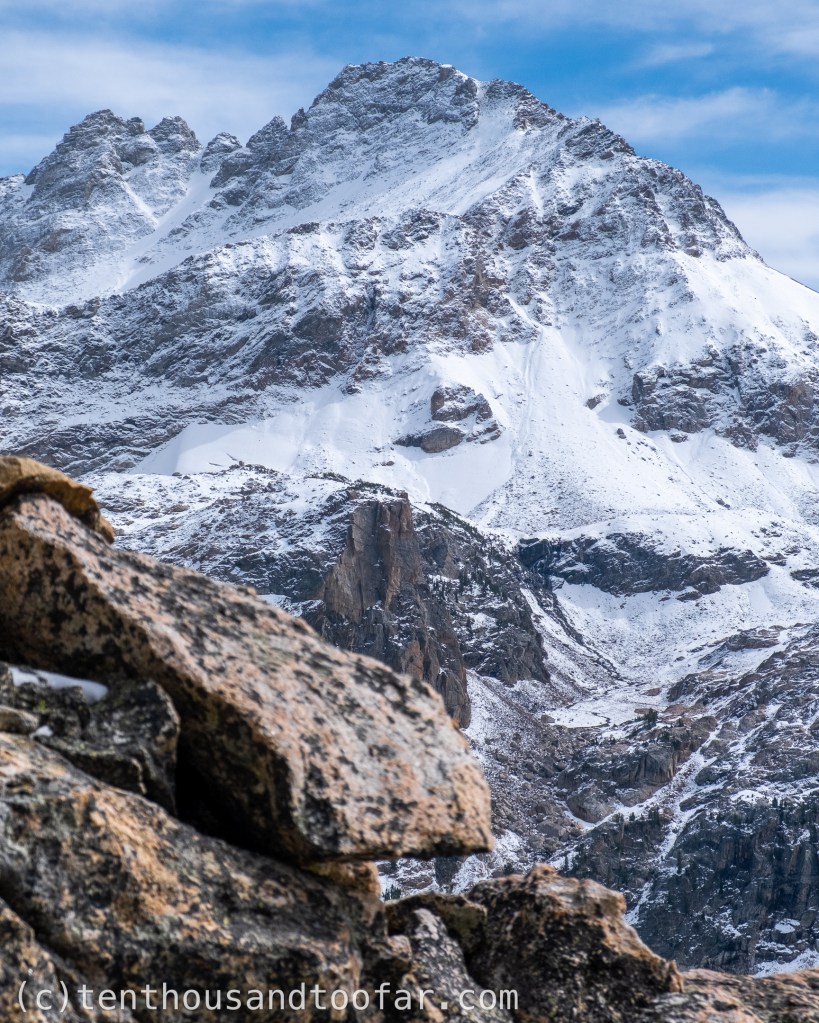

To reach the summit plateau we scrambled directly west up a matrix of low-angle power washed fourth class granite slabs to a final band of exceptionally shattered rock that required extreme restraint. The true summit was about half a mile west, accessed via a windy ridge-walk graced by shin deep post-holing. Neil kept it traditional, traversing south to the established third class summit route on the west side, while I grew impatient and found myself in a dangerously loose fourth class chimney that offered only regret, and appreciation for Neil’s wisdom. The summit of Table was as special as any of the half dozen I’ve had from the west. Part of me hoped there’d be a few curious tourists wondering why we had packs draped with ropes and climbing regalia, but the peace of having the most crowded of Teton summits to ourselves in the dwindling fall light was more rewarding. I had originally planned to jog the Face Trail on descent, but my knees had other wishes. Despite having 41 years on my 28 year old body, Neil seemed increasingly more elastic, and showed great patience in letting me methodically plod down the ankle crushing descent, which covers well over 1,000 vertical feet per mile on average. We reached the car around the 15 hour mark, narrowly avoiding the need for headlamps.


Reflection
This particular adventure brought richness in so many forms. Beyond the excellent movement, positioning and rock quality that every climber reading this article should experience for themselves, connecting with Neil stole the show. I’ve had a few backcountry partners in their 50’s, but he was only my second in their 60’s. The knowledge, stories and viewpoints shared left me with extreme inspiration, and man – the guy’s ability to bust it for a full value buzzer-to-buzzer eight pitch alpine outing was beyond impressive. I can only hope to have the same physical ability, stature and stoke that Neil emanates at that age, and am looking forward to many more adventures with him in the future. I think we are a great team.
Climber’s Notes – Rack & Resources
The only guidebook with information on Heartbreak Ridge is A Climber’s Guide to the Teton Range by Renny Jackson and Leigh Ortenburger. The hand-drawn topo provided is useful for orientation on the climb. A light rack of cams to three inches and a set of nuts should provide adequate protection for climbers confident at the grade. We stretched a 60M rope many times. A 70M would be nice if you had it. Crowds won’t be an issue on this remote route.

Want to support? Consider a donation, subscribe, or simply support our sponsors listed below.
Ten Thousand Too Far is generously supported by Icelantic Skis from Golden Colorado, Barrels & Bins Natural Market in Driggs Idaho, Range Meal Bars from Bozeman Montana and Black Diamond Equipment.



subscribe for new article updates
DISCLAIMER
Ski mountaineering, rock climbing, ice climbing and all other forms of mountain recreation are inherently dangerous. Should you decide to attempt anything you read about in this article, you are doing so at your own risk! This article is written to the best possible level of accuracy and detail, but I am only human – information could be presented wrong. Furthermore, conditions in the mountains are subject to change at any time. Ten Thousand Too Far and Brandon Wanthal are not liable for any actions or repercussions acted upon or suffered from the result of this article’s reading.
 Ten Thousand Too Far