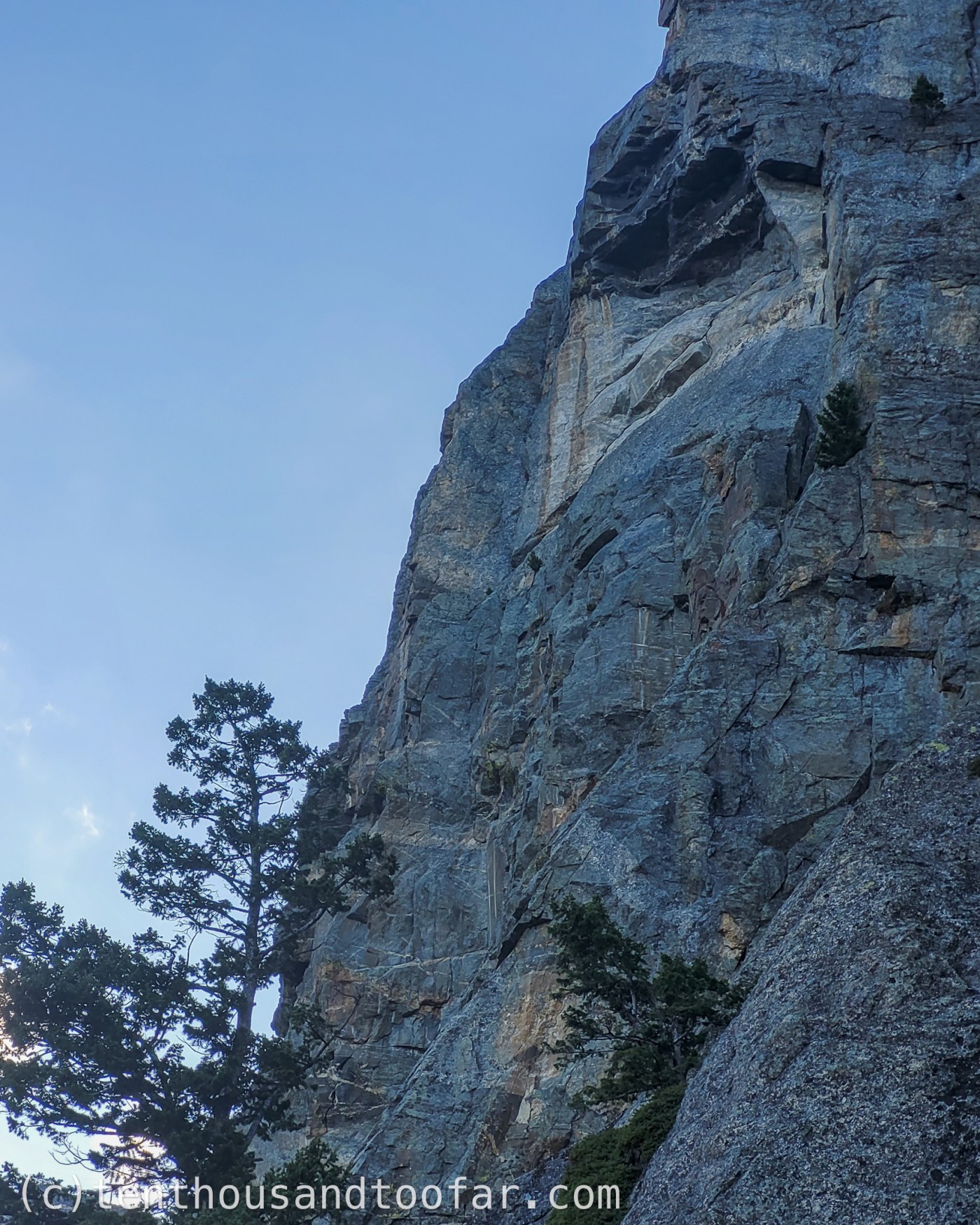
After four days of relentless precipitation Connor James and I decided to give Manfactured Crisis a roll, despite neither of us being 5.11 alpine climbers. The result? A four pitch adventure that went “free” at 5.10 C0 – and now we have a project.
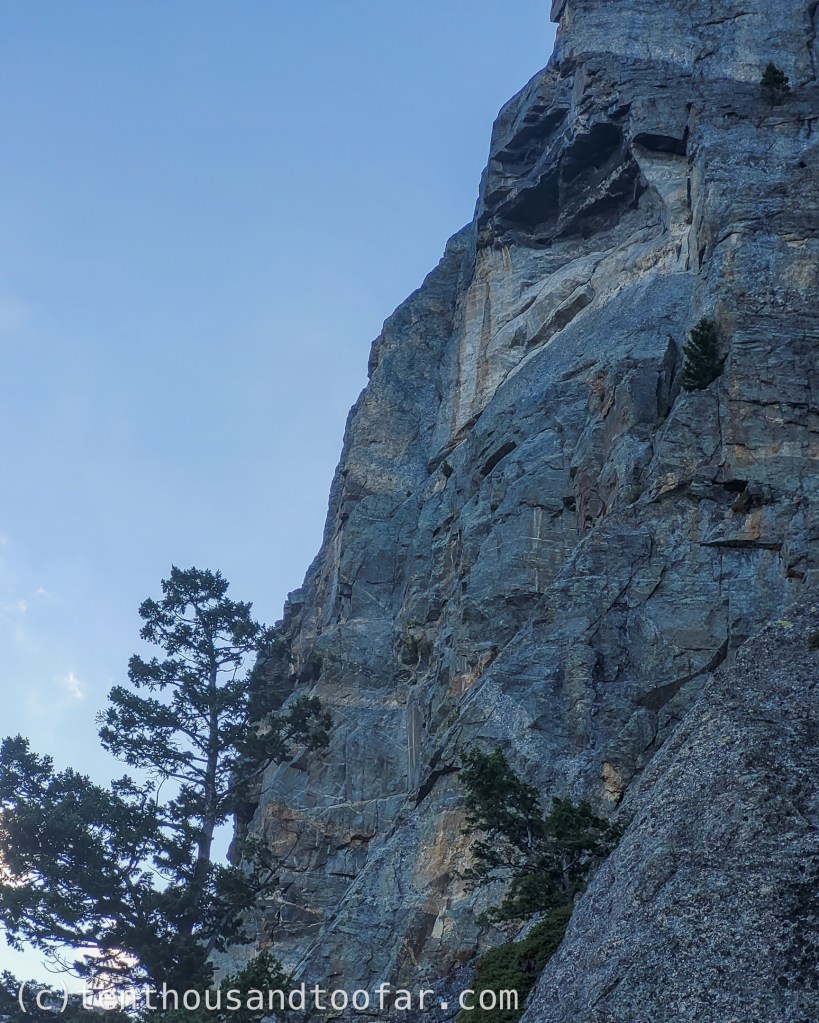
Manufactured Crisis, along with Sunshine Daydream and Omega Triangle, stand as the first frontier of 5.11 Death Canyon climbs. Why are we even talking about 5.11 when I haven’t tried Caveat Emptor? Well, Caveat is indeed next on the agenda, but after four days of cold temps and heavy rain the massive south facing columns and dihedrals that compose Cathedral Rock’s south face were surely percolating. On the other hand, Manufactured Crisis ascends a shallow east facing dihedral on a much smaller formation less likely to harbor stubborn moisture, with a two bolt crux that seemed friendly for climbers breaking into the grade, or aid-able in the likely event of failure. After a hard overnight freeze and a cloudy morning we opted to sleep in, setting sail from the Death Canyon lot with hopes of a full-sun experience at 11:00AM.
Love Ten Thousand Too Far? Support independent mountain journalism with $5.10 per month through Patreon (and receive extra bonus content), or with a one-time donation. Any and all support is greatly appreciated.
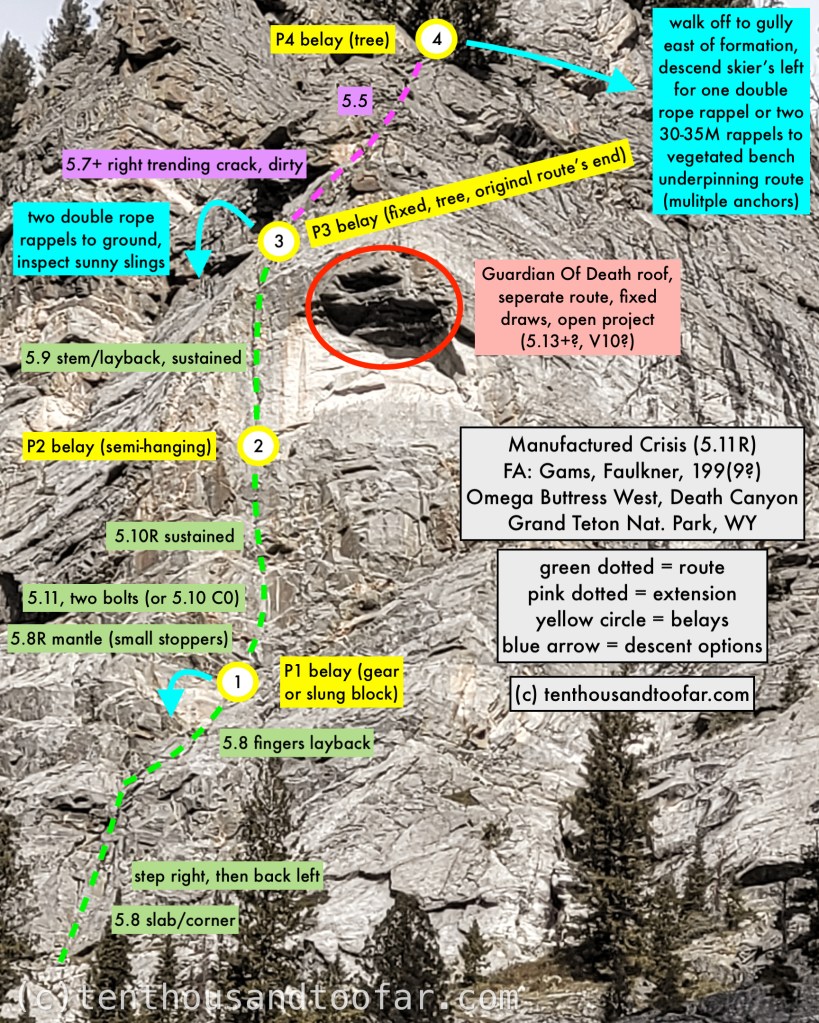
Two approaches are given for the Western Omega Buttress routes on Mountain Project. In the name of new scenery we chose to approach from the prominent couloir and slabs west of the Omega Crack (5.12). This turned out to be a time sucking detour of wet low-fifth class soloing and strange ramp traverses. At one point we got lost and scrambled up terrain we were unwillingly to down-climb, only to rappel off a tree near the base of Omega Triangle. An easier and exponentially more efficient approach, our ultimate egress, is via the traditional fourth-class Ship’s Prow approach, with continuation a mere 100 yards to the next buttress west. The Guardian Of Death roof stands as a beacon for navigation.
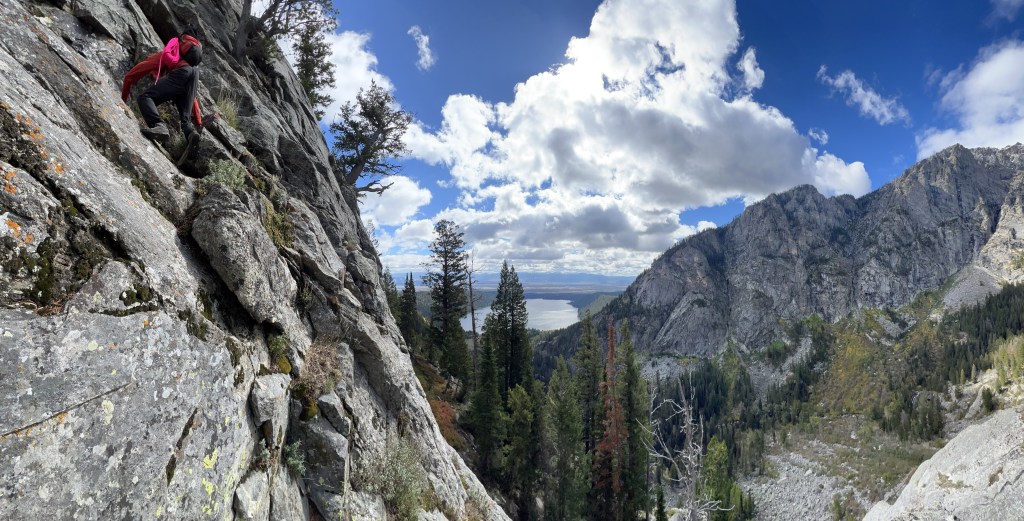
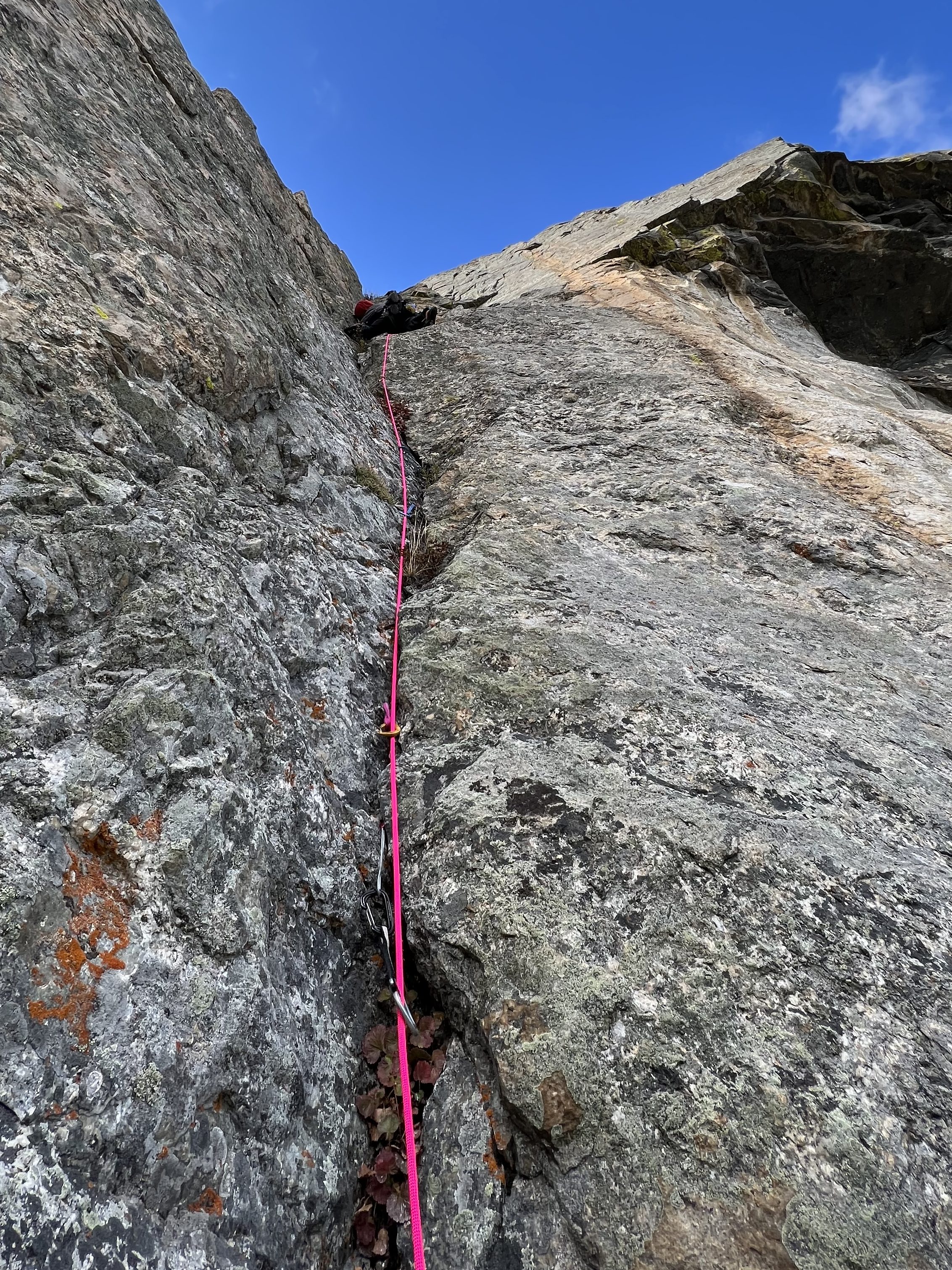
Connor graciously offered a support role, knowing I was itching to give an on-sight attempt on the crux. He took pitch one, which began in a right facing dihedral with a clean slab and followed a slightly vegetated crack system to the base of the obvious crux pitch. This lead climbed far better than it looked, an interesting half-rope of varied 5.8 features with generally good protection. The crux pitch followed, beginning with a devious 5.8 mantle and run-out directly off the belay protected by two marginal small stoppers in a muddy seam, leading to the two bolt crux tango. The bolts are chunky modern sport regalia, inspiring confidence for limit alpine thrutching. The sequence was intricate, quite thin and gently overhanging, technical stemming on marginal feet between small crimps in a remarkably clean corner. Four burns yielded four whippers and ballooned forearms, requiring sling ladder high-stepping to clip the second bolt. Above was an easier but exponentially scarier “R” rated 5.10 crack which frayed every end of my mental capacity. Though the climbing never got too difficult and the protection never too dubious, there were definitely some sustained 15 foot 5.10 runouts above micro-cams and shallow stoppers. The first ascent was done with two pitons left fixed, but both have since fallen out. Let’s just say I was super psyched to on-sight this bit, and connecting the dots on this entire pitch, a hard 5.11 boulder problem sandwiched between two serious run-outs, is an inspiring project for next season. Sadly, we didn’t get any pictures of pitch two.
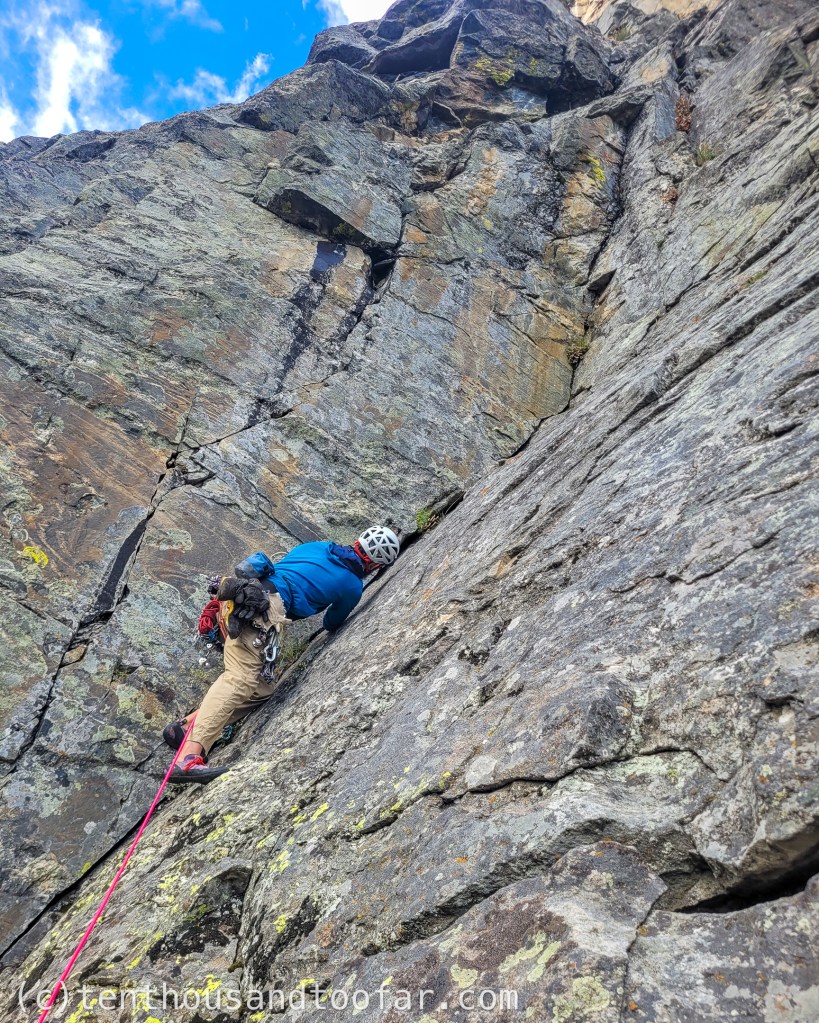

From a back clenching semi-hanging belay above pitch two I continued up pitch three while Connor rested. With many clumps of crimson mini-bushes dotting the steep and subtle dihedral my expectations were quite low, but we pleasantly dusted off a truly stellar 5.9 pitch oscillating between stemming, laybacking and cozy jamming, excellence compounded by wild positioning on a picturesque wall above Phelp’s Lake. Manufactured typically ends at a fixed tree anchor above pitch three, but we forgot the second rope required for descent. Instead, I ran our third pitch past the tree anchor and up a mangy 5.7+ right trending crack to the top of the mysterious black roof home to the Guardian Of Death project (5.13+?), and Connor led one final simul-scramble up 5.5 terrain to a large forested bench topping the buttress. Not only did this provide an excellent vista and satisfying way to end a rock climb, but also facilitated a simple walk-off descent with two single-rope rappels down the gully just west of the Ship’s Prow (see topo above for more descent information). We reached the packs some five hours after tie in, and enjoyed a lovely spread of pinkish sunset colors as we jogged out before dark.
Reflection
Alpine 5.11? YEAH RIGHT. An old Brad Gobright tribute video inspired me to try this route. Brad was known for trying harder than everybody else – never letting go – and talked in this video about the importance of attempting climbs far beyond one’s comfort zone. In Manufactured Crisis I found the sobering reality of how difficult 5.11 climbing in the alpine is, but also surprised myself with how close I was to pulling er’ off – and I think that’s what Brad was getting at. Now I have a project, a golden unfinished tick waiting in the high alpine, and once my fingers are strong enough for those two or three moves that left me stoned in a sling ladder, I’ll be back for my free ascent.
As for Manufactured Crisis in whole, this route has serious four star potential. I suspect the “R” rating on Mountain Project acts as crowd repellant, but in reality this second pitch falls somewhere between PG-13 and R, definitely not unreasonable for the 5.10 trad climber with a sturdy head. While those two FA pitons would’ve been lovely to clip, the biggest run-outs are probably no more than 15-20 feet on sound rock. I felt reasonably safe picking apart this pitch move by move, and think many parties deterred by the danger grade, rather than the difficulty grade, would share my sentiment. That said, there’s definitely a few places on 5.10 terrain where a fall could be shit scary, if not catastrophic. By alpine standards this climb is already acceptably clean, and with some repeats could buff out to a supreme short approach 5.11 outing.
Footnotes – Recommended Rack and Variations
Micro-cams and a healthy selection of small stoppers will be useful on the runout second pitch. Otherwise, I thought a standard double rack to three inches provided adequate protection. Two ropes are needed for descent from the original route ending above pitch three. These rappel slings looked quite faded and are due for replacement. If interested in a monster pitch, it seemed pitches two and three could be logically combined, skipping the uncomfortable hanging belay.
Want to support? Consider a donation, subscribe, or simply support our sponsors listed below.
Ten Thousand Too Far is generously supported by Icelantic Skis from Golden Colorado, Barrels & Bins Natural Market in Driggs Idaho, Range Meal Bars from Bozeman Montana and Black Diamond Equipment.




subscribe for new article updates
DISCLAIMER
Ski mountaineering, rock climbing, ice climbing and all other forms of mountain recreation are inherently dangerous. Should you decide to attempt anything you read about in this article, you are doing so at your own risk! This article is written to the best possible level of accuracy and detail, but I am only human – information could be presented wrong. Furthermore, conditions in the mountains are subject to change at any time. Ten Thousand Too Far and Brandon Wanthal are not liable for any actions or repercussions acted upon or suffered from the result of this article’s reading.
 Ten Thousand Too Far
Leave a comment