
On August 12th, 2023, Connor James and I made a successful ascent of the Direct North Ridge on Teewinot Mountain. Graded 5.8 in 1957, this route had some wild old-school adventure flare, with extensive route-finding amidst a maze of generally high quality, but nondescript and at times quite poorly protected rock. Combine that with 12,000+ foot elevation, a bone chillingly shaded north aspect and a never-ending, unlikely, multiple thousand feet fourth and fifth class scrambling approach, and you have a recipe for a great day.
I mostly seek classic traditional rock climbs in fair weather conditions, but there’s a certain part of me that needs deeper adventure than some hard crack climbing, heady exposure, long approach or predictable runout can provide. The Direct North Ridge on Teewinot, much like the Chouinard-Frost Chimney on Disappointment Peak and North Ridge of Mount Owen, represent my dark side, raw adventure consisting of largely virgin rock, extensive route-finding and a real glimpse into the first ascentionist experience. Rather than sheer technical difficulty, spice on such routes typically comes in the form of questionable stone or spotty protection, remoteness, cumulative fatigue and the ever-present, ever-eerie energy of being truly “out there”. Teewinot’s Direct North Ridge, established by John Breightenbach and Barry Corbet in 1957, is a visionary line consisting of eight pitches up to 1957 “5.8” in difficulty, beginning just shy of 12,000 feet and finishing on the sixth tallest peak of the Teton Range. The climb is almost entirely shaded and falls victim to the typical southwesterly Teton winds – yep, think numb extremities in August. Adding fuel to the fire, we lost the route just before the final pitch and ended up on a face pitch that felt damn near 5.10, especially given the sandbagging effect of a backpack and ice axe, 12,300 foot oxygen deprivation, socks-in-rock-shoes dexterity and thin protection. However, unlike routes of similar magnitude in year’s past, we topped this baby out with plenty in reserve, completing the entire climb car-to-car within daylight hours. Connor and I have been enjoying climbs like these for several consecutive years, and it’s gratifying to see the range of our competency grow.
Love Ten Thousand Too Far? Support independent mountain journalism with $5.10 per month through Patreon (and receive extra bonus content), or with a one-time donation. Any and all support is greatly appreciated.
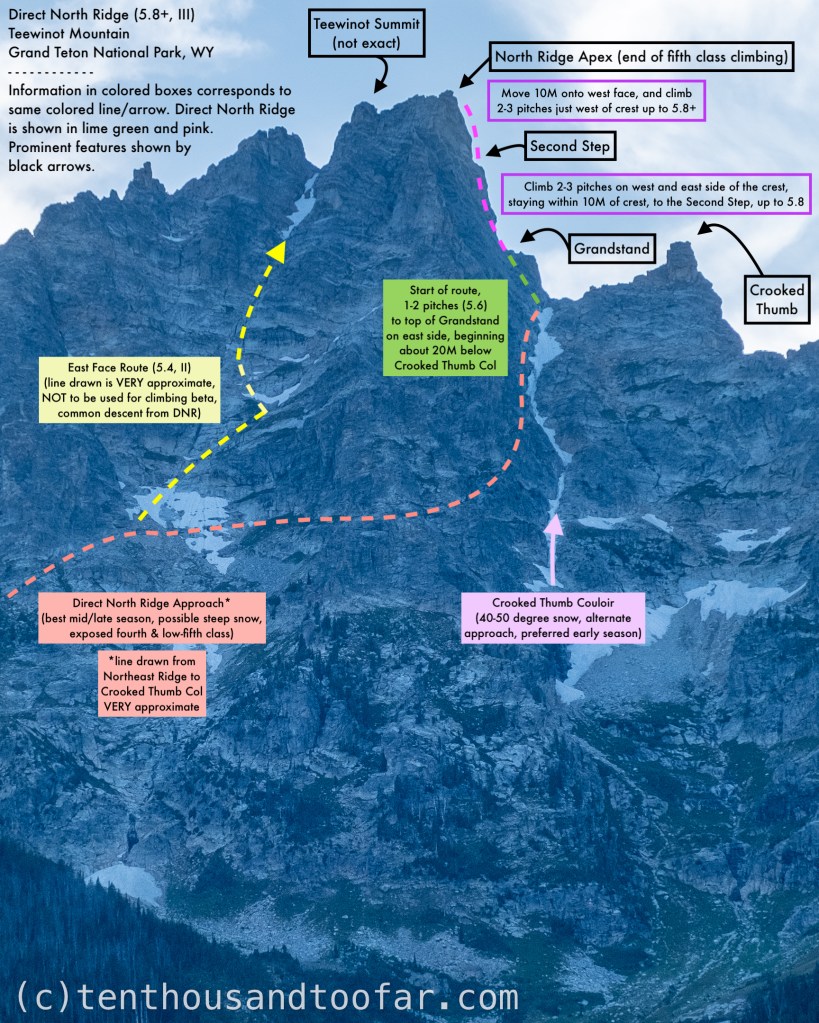
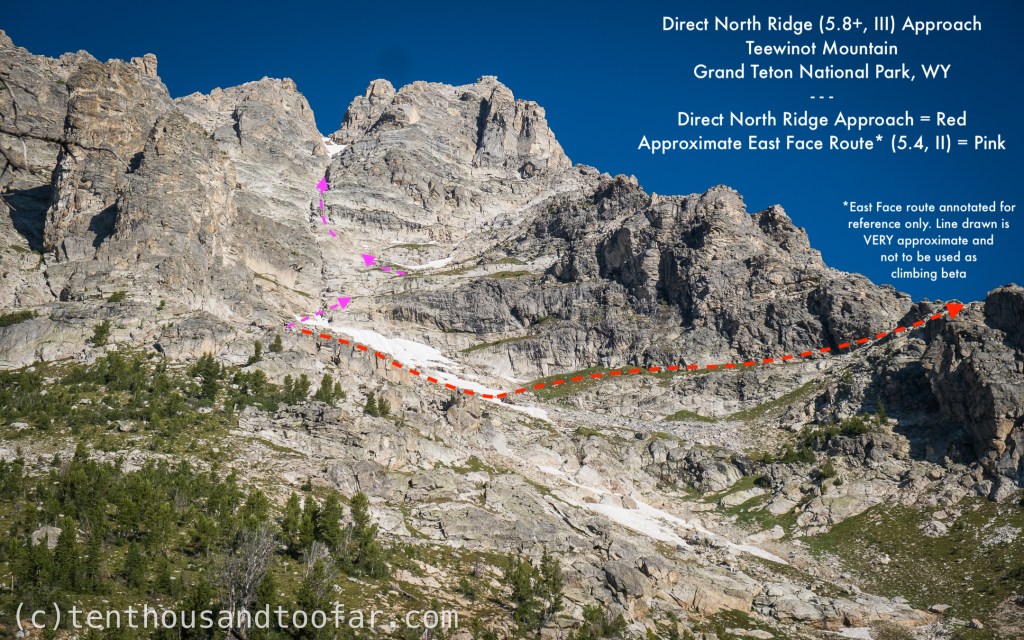
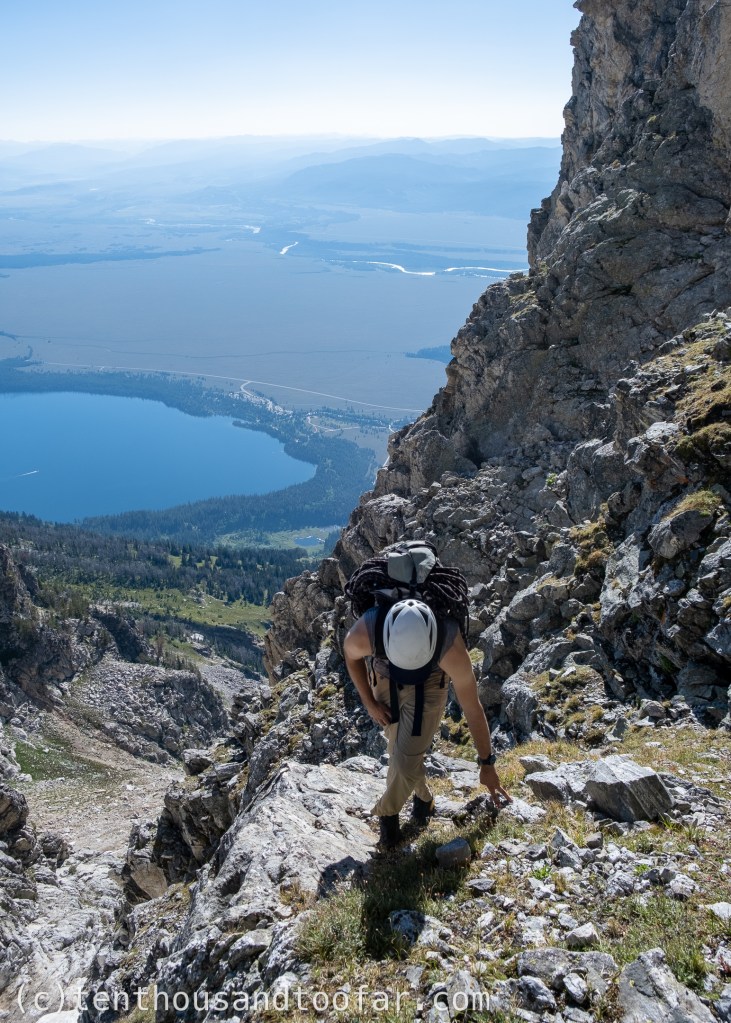
We set off from Lupine Meadows at 6:15AM and marched up the well-trodden East Face climber’s trail to just below the commencement of the technical climbing. Following vague instructions from the Ortenburger-Jackson (OJ) bible we billy-goated the only continuous grassy ramp leading to the Northeast Ridge, across steep vegetation and one seasonal snow patch, and rounded the corner onto the north facing wall above the Crooked Thumb Couloir. My familiarity with the Crooked Thumb from a winter ski descent in 2021 proved especially useful in supplying plausibility to this extremely unlikely approach, which essentially traversed about 2000 linear feet and 1,000 vertical feet, to the Crooked Thumb Col and base of the commanding North Ridge on entirely fourth and low-fifth class terrain. No signs of past human traffic were present on this traverse, and all the typical perils of virgin north facing Teton mid-elevation cliff-sides were present, including water seeps, pesky vegetation, lichen and loose rock. Fueled by blind faith we simply sniffed out the path of least resistance, continuing upward whenever horizontal terrain petered out, and visa-versa, eventually reaching the col by crawling behind the receding snow separating the melting couloir and North Face granite. Without any more than a five minute break for water we reached our changeover point at the four and a half hour mark, not bad for just over 5,000 vertical feet.
The view from the Crooked Thumb Col was spectacular in its own, and the sheer verticality of the 600 foot Direct North Ridge kept our snack break hasty. The loose description given in the OJ guide, and exponentially more worthless description on Mountain Project (since replaced), left us with little idea of where to begin climbing. However, two prominent features were indispensable in guiding our way. The “Grandstand” is the first prominent step of the North Ridge, located about 150 feet above the col. The “Second Step” is some 300 feet higher, and difficult to discern from below, but easily spotted from the parking lot. From what we could distill, the Direct North Ridge stays east of the Grandstand, and generally east of the crest, until crossing onto the west face after the Second Step. With this meager morsel of knowledge we applied the classic Teton route-finding adage of “if it feels too hard, it probably is” and set sail into the looming sea of towering granite. We began climbing about 50-100 feet below the col on gentle 5.6 slabs with attractive cracks, and gained the top of the Grandstand from the east in a single 60M rope-stretching pitch and some easy scrambling. From the Grandstand, Connor led a short 20 foot blocky chimney (5.7) with neon-green lichen, and traversed about 10 meters onto the east face, connecting a myriad of steep steps and cracks for about 50 meters, past a ratty bail anchor and separate fixed piton. The parallel 5.8 cracks of pitch four (our third pitch) were Connor’s guiding North Star on this pitch, and he set his belay about 10 meters below them. For the third lead, I stepped right and into the parallel cracks, choosing to climb the more appealing right crack. The jagged quartz weakness took less than inspiring protection but provided some of the best sustained difficulty and pure rock movement on the entire route, reminiscent of the sixth pitch of the Durrance Direct (Lower Exum Ridge). From the top of the crack I may have deviated from the FA route, climbing more or less directly up the east side of the crest to the top of the Second Step for another full 60 meter rope-stretcher. The climbing above the crack was generally high quality, containing a steep stem chimney (5.7), rolling easy-fifth slabs and an excellent golden layback flake (5.8) in that order, but several other options seemed feasible both further east and west of the crest. In hindsight we believe the FA probably climbed west of the crest – but alas there we stood, atop the Second Step which is easily identified as the only reasonably flat section of the upper ridge, directly on the crest, adorned with a scattering of loose blocks and haunted by a dauntingly steep face and chimney to the east. Stellar views of Mount Owen’s Northeast Snowfields lie just over the right shoulder. We were in Mecca.

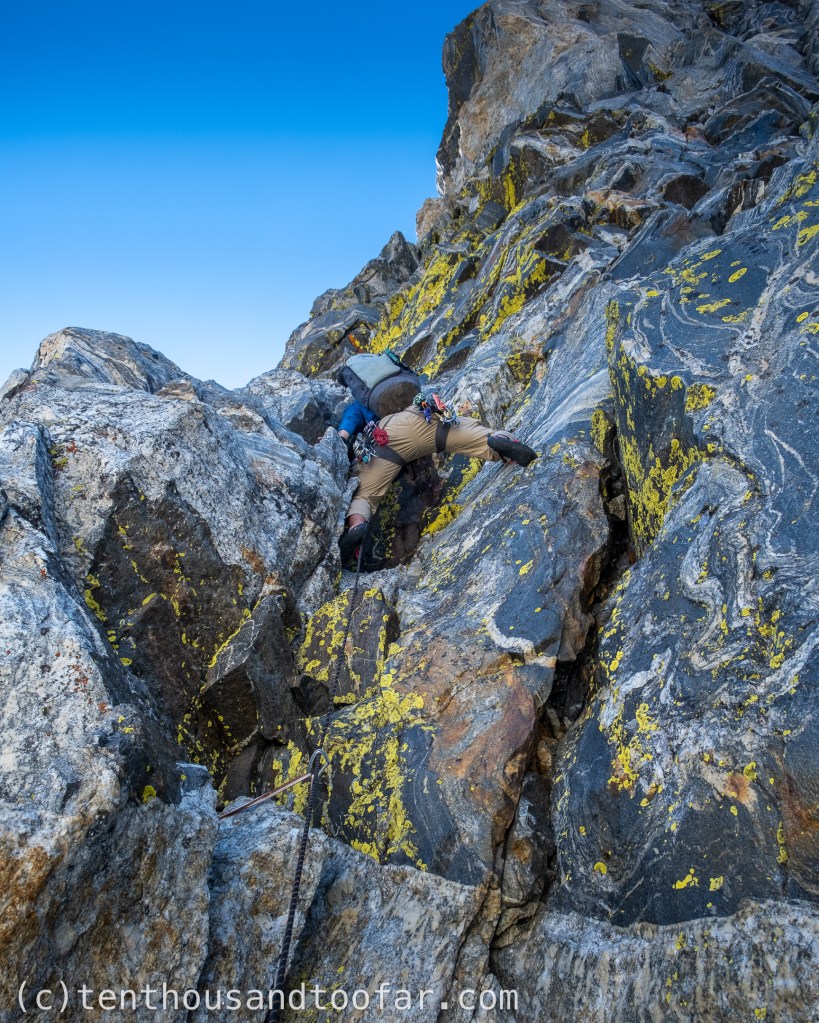
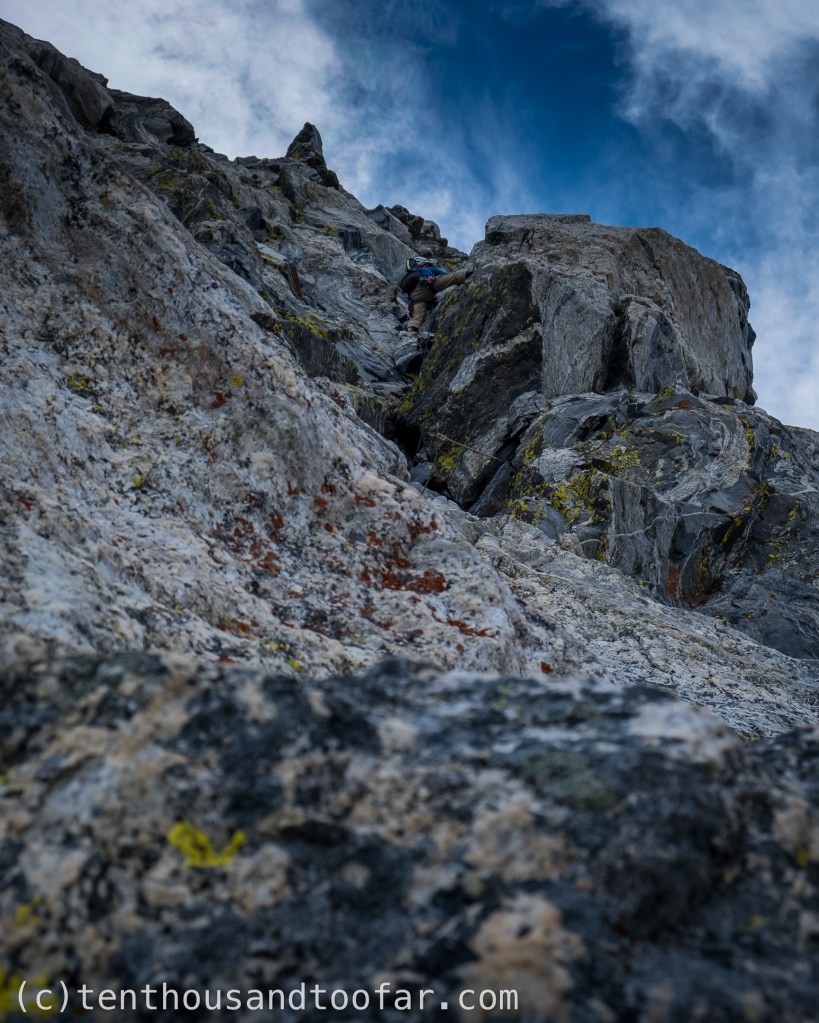
Our fifth lead, the seventh listed the OJ Guide, was particularly difficult to parse out, though we believe we hit the bullseye. We bumped the belay about 10 meters west, along a broad sloping ledge system that extends far onto the west face. We ignored two semi-appealing weaknesses just west of the crest, instead leading around the right of a short crack, up an awkward flake/pommel-horse feature and into a nondescript chimney with a challenging overhanging step at the very beginning. This was Connor’s lead, and as spectator I first thought he’d gone soft on me, taking quite some time to negotiate the seemingly rudimentary terrain. However, upon following I was blown away by the difficulty and bizarreness of the climbing. The pommel-horse flake feature was exactly that, a strange, gigantic, awkwardly overhanging low angle fissure that I hand traversed to the bitter end before sweeping my left leg over and quite literally humping up – I’ve really never climbed a piece of rock quite like it. Entering the chimney involved a strenuous 5.8+ layback, followed by a sea of questionable stacked blocks that left me with tremendous respect for my partner. A fixed pin at the belay, just above and left of this chimney, left us assured of at least one thing – someone had been here before.
Reflecting back, we believe this point is where we lost the original route for good. According to the topo we were searching for another long eastward traverse back towards the crest. Some low angle slabs looked quasi-promising but potentially un-protectable, and instead I resolved to climb an intimidating fractured black face directly above the belay piton, figuring I could at least gain some reasonable protection. Years ago I read John Long and Peter Croft’s “Trad Climber’s Bible”, and one of their key tenants for route finding on big routes is to follow the protection and logical line. This turned out to be a hairy mistake, and resulted in my first 5.10 lead above 12,000 feet. The face was composed of those strange black Teton plates that appear loose as can be, but are suspiciously reliable, and seem to be a prominent feature of high elevation north facing Teton geology. I began with no protection for a few body lengths, but luckily gained some valuable cracks for a small cam and two nuts before moving into a few overhanging face moves and a tenuous mantle void of finishing holds. The stress defused instantly after beaching onto a ledge and encountering significantly gentler terrain above the face, where I climbed a short-lived but fun crack system into broken 5.5 terrain that ultimately topped out some 10 meters west of the North Ridge summit gendarme and conclusion of fifth class climbing. While Connor followed the “Black Plate Tango” his voice sounded through the radio with a chuckle – “you’re an animal.”
The view from the final North Ridge gendarme was sublime, and despite Mountain Project talking of a vital rappel into a notch and other foolery, it was clear from my four prior Teewinot summits that we were home free, only a stone’s throw from the ever popular East Face route. With time and weather on our side we did some investigating to try and decipher the original last pitch, down-climbing to the north end of the gendarme and craning over the edge. Nothing in particular jumped out, and it seemed whatever pitch of “blocky terrain to 5.8 finishing moves” we missed wasn’t of classic variety. The greater mystery was an abandoned 30-ish meter 10.2mm sport climbing rope on the broad belay ledge above the final pitch. The strangely short rope was draped around three large boulders as if to be used for anchoring, but not tied off. Furthermore, the ends were simply left in messy, unequal piles. The whole scene felt a little Stonehenge-y to me, what could’ve happened? Surely nobody would climb the North Ridge with a short beefy gym rope, and it would be difficult to get this far off the East Face route on descent. The electric pink cord looked nearly brand new, and wasn’t even close to stuck – we easily freed it from the boulders and carried it off the mountain. Whatever happened, I just hope the party is okay, and if they read this soon there’s a slight chance that Connor hasn’t already cut the rope into dog leashes – but only slight.
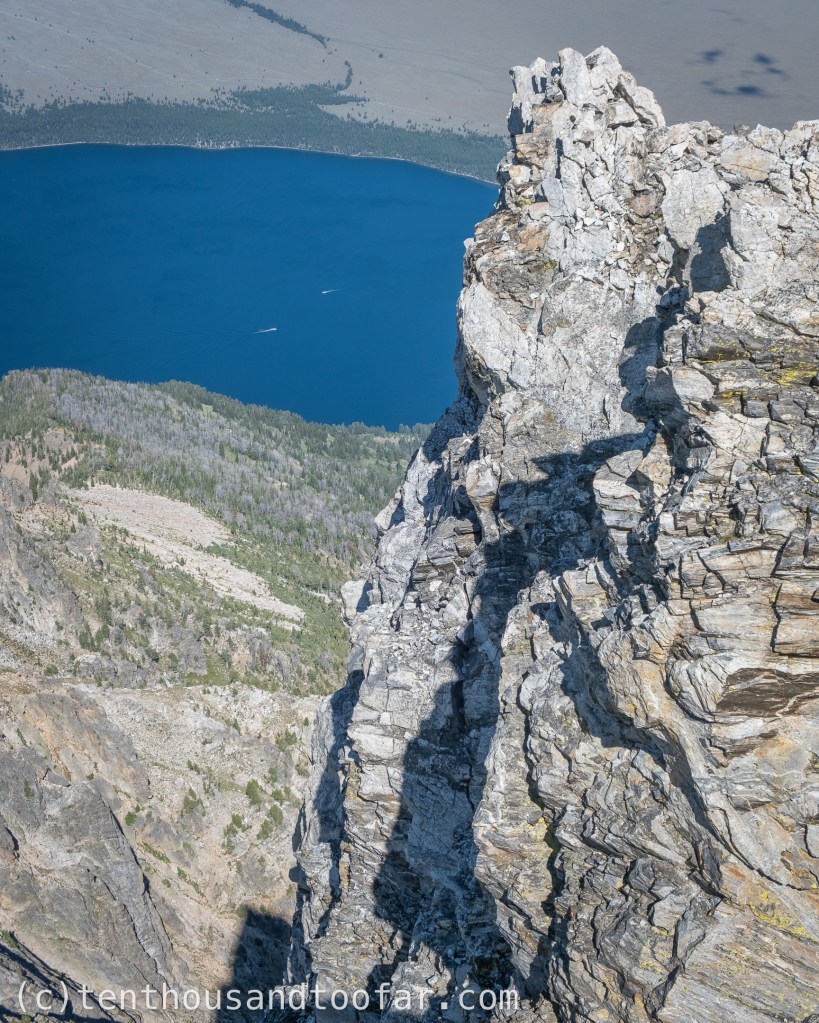
The view from the summit of Teewinot was classic as always, and fortunately the descent down the East Face was mostly snow free, and entirely snow free where it counted. I’m still baffled this route is considered fourth class, what a sandbag. Down-climbing the crux slab, especially with a heavy pack, still felt some 5.4-ish and demanded respect. I always imagine what it must feel like to a non-climber… no wonder this route has claimed so many lives. In typical sufferfest fashion we relented to personal space and Spotify as we jogged out the knee shattering conclusion to the 6,000 foot descent, reaching the car around the 13 hour mark. As we sat and enjoyed LaCroix’s to the commanding parking lot silhouette of Teewinot’s North Ridge at dusk, we marveled in just how smooth the day went, both admitting we were prepared for, if not expecting, a classic Teton epic. I guess we’re getting better at this whole endurance adventure route thing.

Reflection, and A Few Notes
In short, Teewinot’s Direct North Ridge is a full spectrum mountaineering adventure, complete with serious remoteness, year round cold and shade, high altitude, a lengthy and involved approach, and all the predictable hazards that come with high elevation mountaineering on seldom visited routes. Route finding is difficult, and some might call the climbing a little sandbagged. A superb weather window is in order, as this route would be an absolute nightmare to descend from, and the descent down the East Face features fifth-class friction climbing that would be dicy when wet. In early season, consider approaching via the Crooked Thumb Couloir, involving steep snow climbing to 50+ degrees. This was one of the most full value Teton adventures of my life, and comes recommended to those that crave true adventure climbing. However, if looking for an approachable 5.8 alpine climb, there’s probably better suiters.
For a rack, we carried a single set of cams from fingers to two inches, a full set of nuts and a few offset nuts. We found the protection plenty adequate. Long runners are especially useful, as many pitches wander. A 60M rope will facilitate a logical linking of pitches. The Ortenburger-Jackson guidebook has the best topo for this route, and the best description can be found on Mountain Project.
Want to support? Consider a donation, subscribe, or simply support our sponsors listed below.
Ten Thousand Too Far is generously supported by Icelantic Skis from Golden Colorado, Barrels & Bins Natural Market in Driggs Idaho, Range Meal Bars from Bozeman Montana and Black Diamond Equipment.




subscribe for new article updates
DISCLAIMER
Ski mountaineering, rock climbing, ice climbing and all other forms of mountain recreation are inherently dangerous. Should you decide to attempt anything you read about in this article, you are doing so at your own risk! This article is written to the best possible level of accuracy and detail, but I am only human – information could be presented wrong. Furthermore, conditions in the mountains are subject to change at any time. Ten Thousand Too Far and Brandon Wanthal are not liable for any actions or repercussions acted upon or suffered from the result of this article’s reading.
 Ten Thousand Too Far
Leave a comment