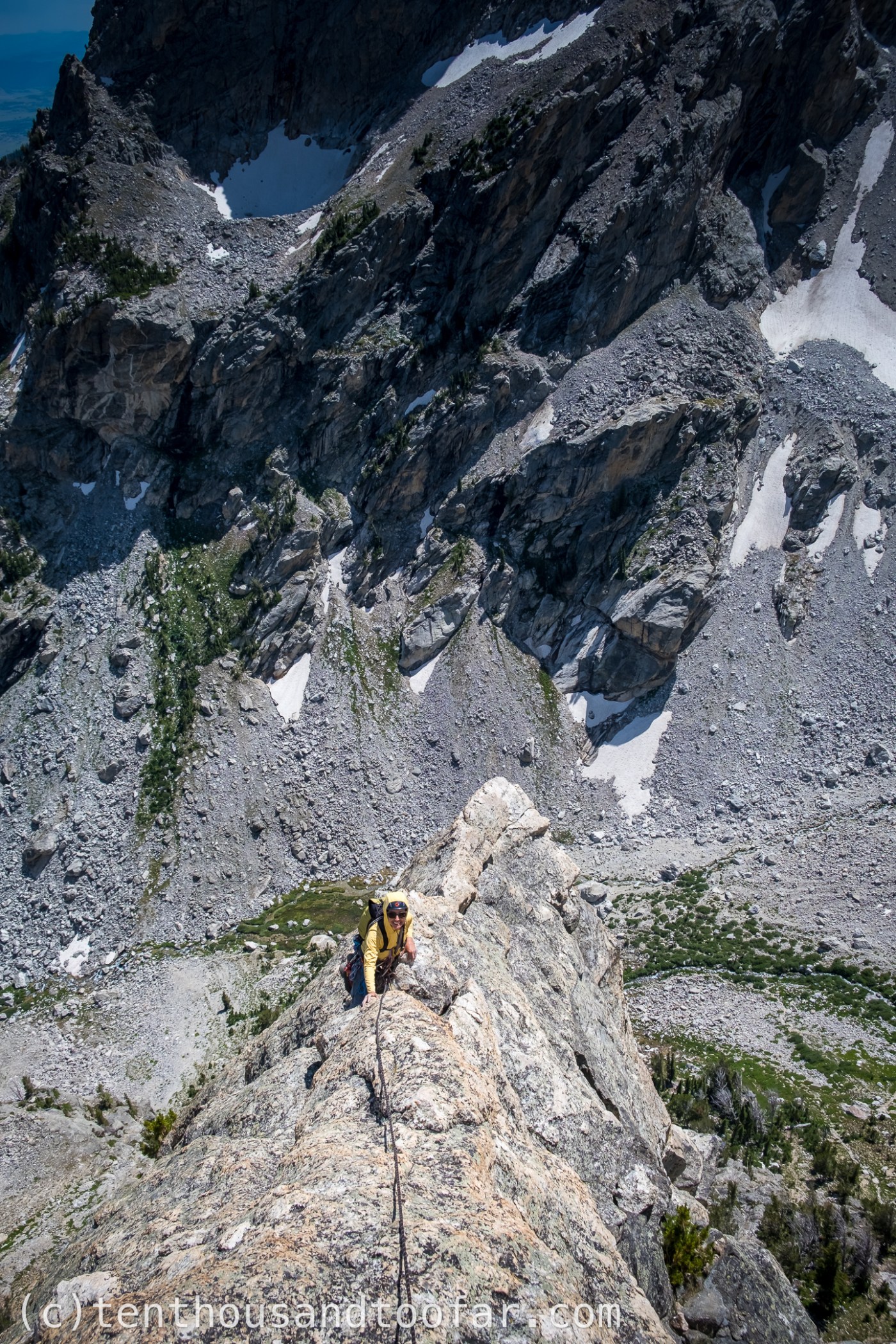
Irene’s Arete is widely stated as the finest rock climb in Grand Teton National Park. Many variations are possible, but we sought the path of least resistance and cleared the ridge at 5.8, with truly remarkable positioning on a golden, awe inspiring knife’s edge arete. Yep, she’s a classic – but, THE classic? Oh, and we hit some traffic too.
Irene’s Arete is a climb Bobbi and I probably should have sought years ago, with a wide standing reputation as the finest rock climb in Grand Teton National Park. The climb has been in our skill wheelhouse for several seasons… but the crowds! As you’ll later read, negotiating the masses on this Teton Uber-classic may very well be the crux of the day, especially if you take the original 5.8 variation. We made the mistake of climbing on a Sunday, after friends who enjoyed a private weekend climb urged us to shelve our overpopulation trepidations. We’d always dreamed of climbing Irene’s on a sleepy mid-October Thursday, but alas there we stood, as one of five parties attempting this relatively channeled six pitch outing… midday… peak season… we have no one to blame but ourselves! Nevertheless, we negotiated the bottlenecks appropriately and were able to overcome the humanoid pileup for a truly superb alpine climb fully deserving of the lore.
Love Ten Thousand Too Far? Support independent mountain journalism with $5.10 per month through Patreon (and receive extra bonus content), or with a one-time donation. Any and all support is greatly appreciated.
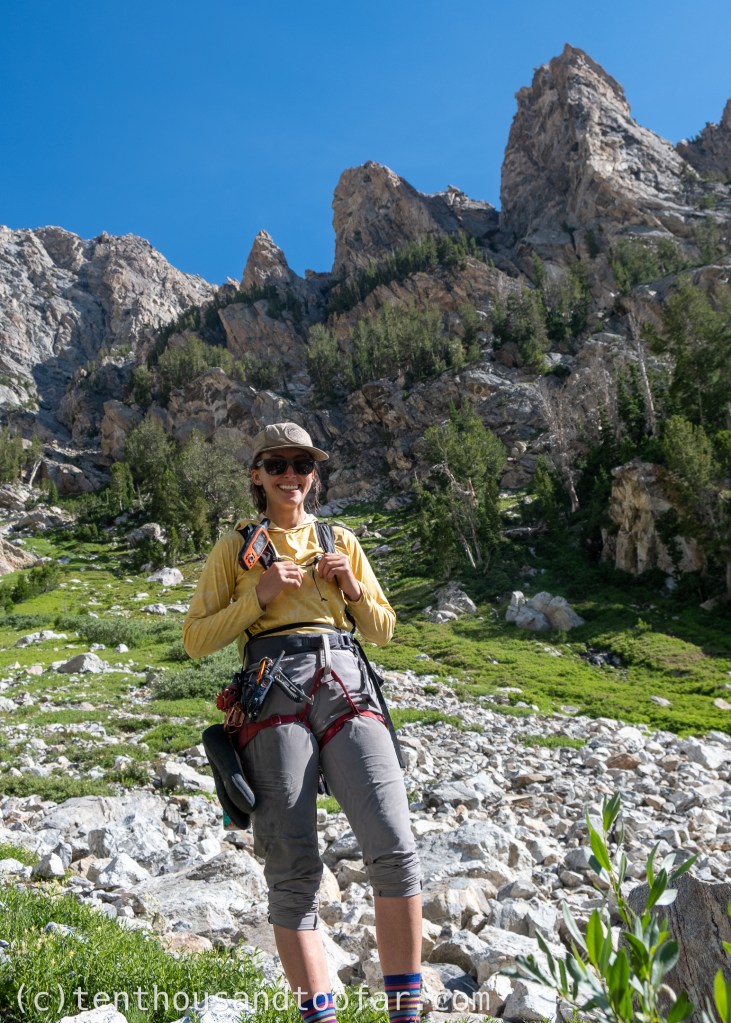
It took just under three fast-casual hours for Bobbi Clemmer and I to reach the “base” of Irene’s Arete, quotation marked because we never actually found the first pitch of the climb. The Ortenburger-Jackson and Gams guidebooks were at odds with Mountain Project, and we lost some 90 minutes scrambling around choss ramps and false climber’s trails fearing the dreaded warning from Gams: “do not follow the off-route climber’s trail toward the toe of the arete, where two pitches of lesser quality rock will be found”. We got overlapped by another disoriented first-time party near the toe of the ridge and followed them up fifth-class vegetated slabs just west of the first obvious gully some 100M east of Irene’s. These slabs felt reasonable, but definitely owned a suspicious aura. Somewhere in this slab matrix we lost the leading party, as well as a third party that decided to follow us. We simply kept climbing until the slabs petered out, trending up and west towards the ridge on a sloping ramp with cairns, and reached a notch where the wall significantly steepened and one new party of three, the third of the day, was belaying their followers from above. We had just skipped pitch one (pitches one and two on Mountain Project), but with time lost, building clouds and several parties below we considered ourselves lucky, tying in instead of retracing our steps.
It was about 12:30PM, 5 hours and 20 minutes from the lot, when I set rubber to granite. The party currently belaying pitch one was admittedly slow and willing to let us pass, and there was one party beginning pitch three. At least two, if not three parties were queued below at pitch one. We had entered the dreaded Irene’s traffic jam and I was itching to flee the scene. I started up the 5.7R start of pitch two, placing a single marginal nut before a crack of thunder echoed. I gently climbed back to the belay, where two full parties now sat, and got into a round-table weather discussion I wanted nothing to do with. After twenty-ish minutes I began climbing again beneath clear skies, moving into a 5.8 finger crack dihedral as soon as rain drops began to whiz and a rappel rope simultaneously careened into my helmet from above. The leading party was bailing and I was in the firing lane. The whole scene was a bit of a comedy skit – I had a six person audience at the base watching me lead a wet, steep, exposed crack while a party of two weather-cautious parents rappelled right over-the-top asking ever so nonchalantly “you good man?” Fortunately I’d been climbing plenty of 5.8 cracks this summer and felt comfortable dodging their rope in an effort to take the Irene’s lead. The rain was simply unlucky, originating from a lone cloud surrounded by sunny skies in every direction, and I knew if I could forge past a bit of slick rock we’d be sitting pretty for an expedient ascent. Despite the minor introductory inconveniences this pitch was absolutely stellar arete climbing, bouncing left and right of the golden crest, and got us fired up for the rest above.
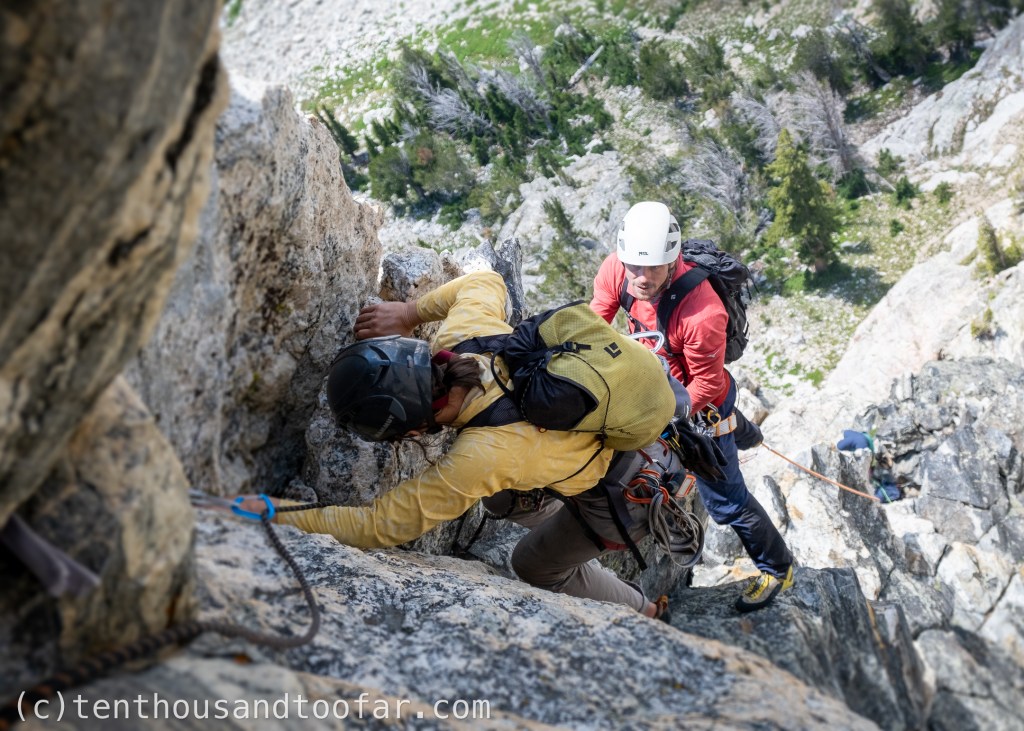
Our goal for the rest of the climb was to move as quickly as possible, seeking the path of least resistance. We had cellphone reception and were able to obtain a few forecasts that hinted at potential thunderstorms between 4:00 and 5:00PM. We began climbing pitch three around 2:00, giving us a solid two hour window to clear the four remaining pitches up to 5.8 – the race was on. We took the left variation to pitch three, beginning with a tricky 5.8 layback move that felt closer to 5.9/5.10 but was over in a hot second, quickly relenting to a long pitch of scenic 5.7 cracks reminiscent of the first. We belayed right beneath the attractive 5.9 variation of pitch four, but moved left of the crest for a brief stretch of steep 5.7 face climbing leading to an iconic, narrow ridgecrest which offered spectacular easy protection-less climbing on grippy low-angle nubbins that felt nothing short of heroic. This whole time Bobbi was in the alpine zone, climbing, cleaning and changing over efficiently, landing us at the final pitch of relevant difficulty as dark clouds were beginning to dot the horizon.
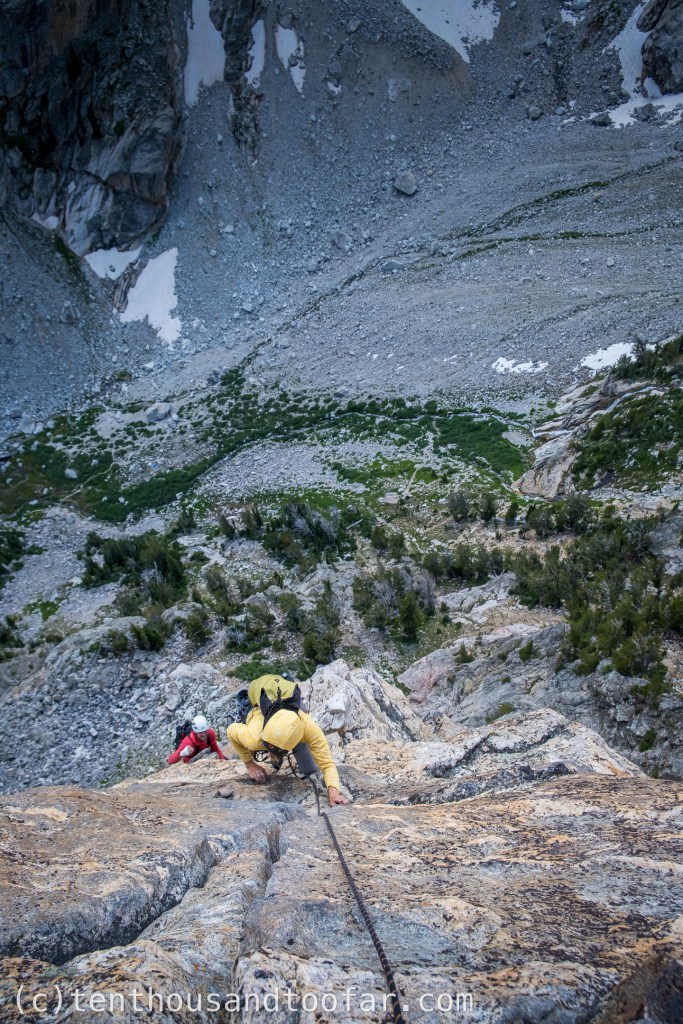
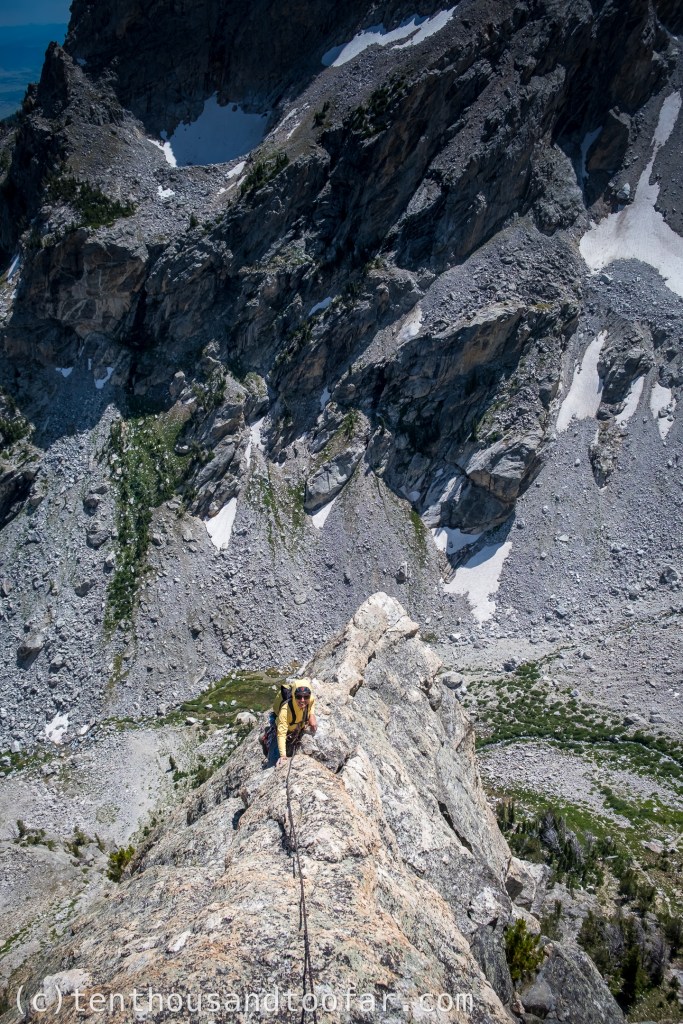
Pitch five has three variations – a beautiful looking 5.9+ layback on the arete proper, a 5.8 fist crack down and east, and a 5.7 step across even further down and east, with the latter two leading to a low angle face east of the crest. Pitch four ends at a small gendarme with a fixed block anchor, where a short rappel or down-climb east of the crest into a vegetated notch with a lone tree facilitates access the easier variants. We took the path of first ascent and least resistance, beginning about 15M below the tree, surmounting a steep step and arcing onto the east face via a short 5.7 crack and traverse. Around the corner, a brilliant slab of prehistoric alligator skin provided an excellent romp towards the crest with gentle 5.5 climbing reminiscent of the Boulder Flatirons. Bobbi raced up and met me at a lone tree on the crest, where I soloed the final pitch of easy slab to an obvious notch leading left of a final tower, pulling the rope through for a terrain belay right as driving rain began its onslaught. A cramped yet convenient cave with some nice insulating dirt provided lovely shelter as the clock struck four, and thunder began to echo amidst dark skies. We couldn’t help thinking about all the other parties on route, and where they might be, while also rejoicing in the fact we were feasibly safe and just raced up a grade-three classic in some three hours and change – truly exhilarating.
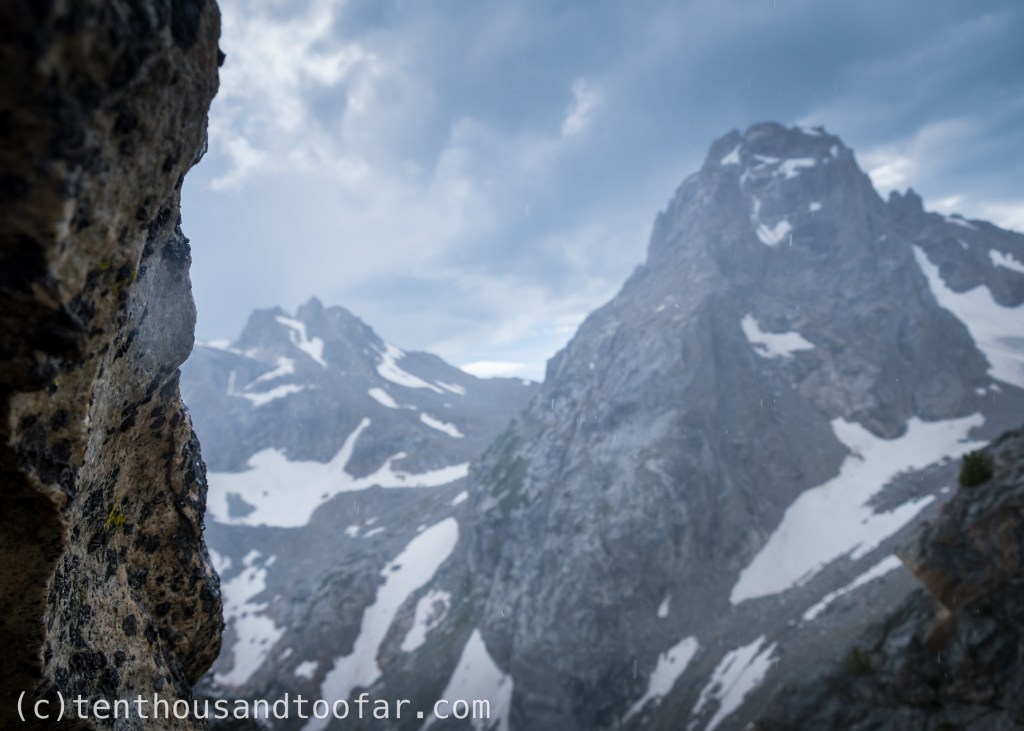
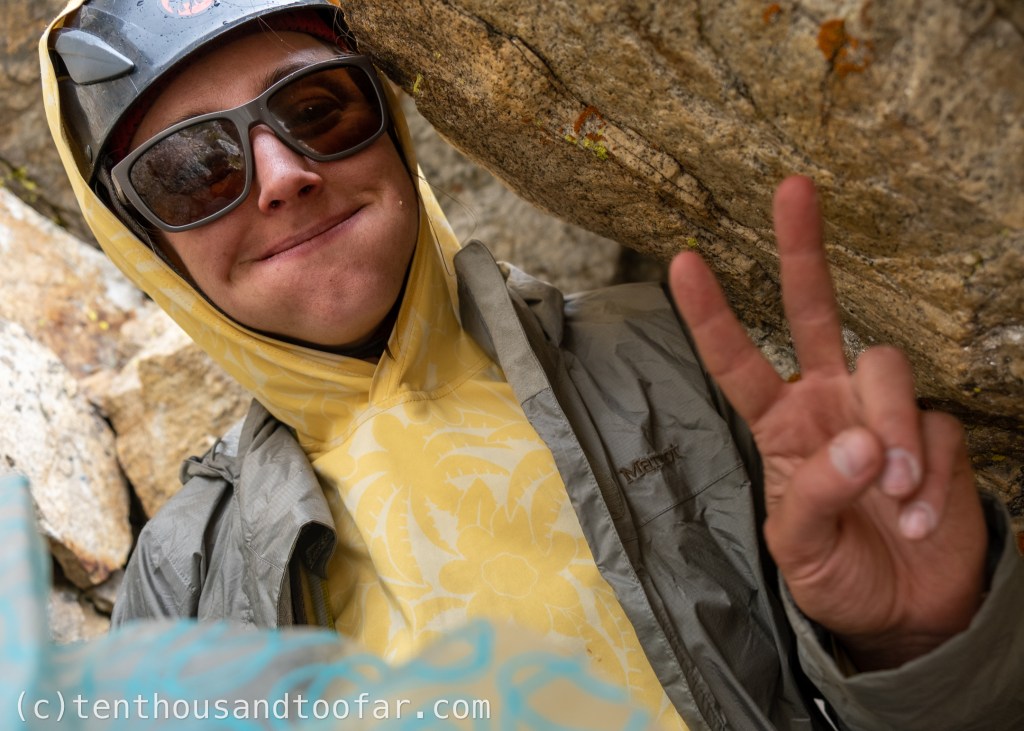
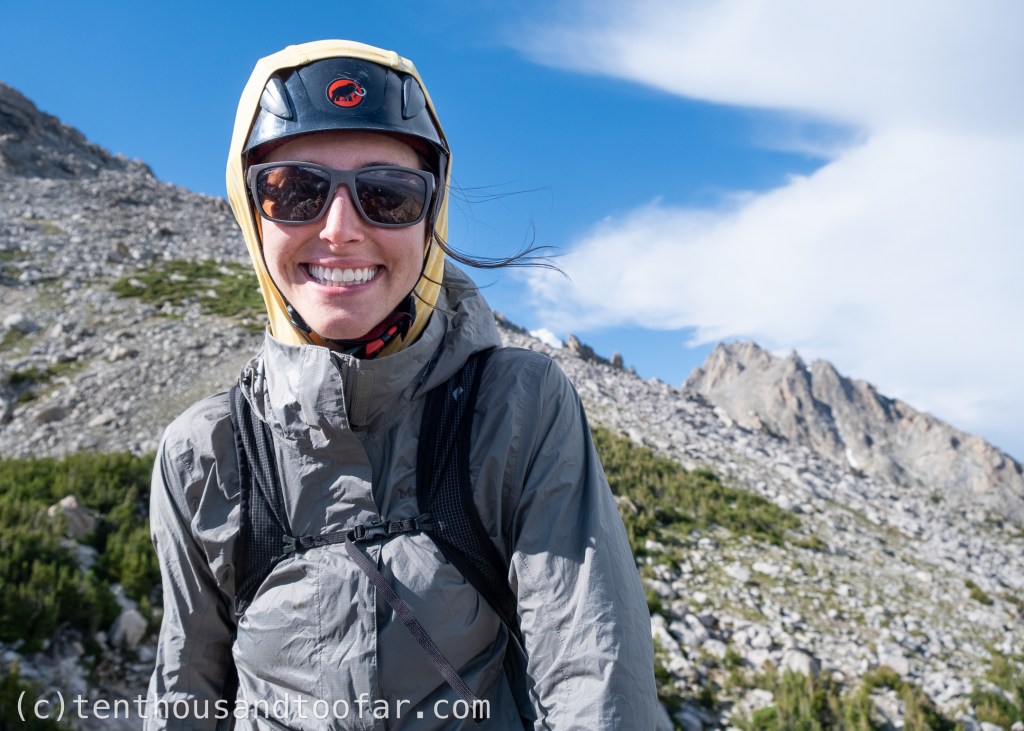
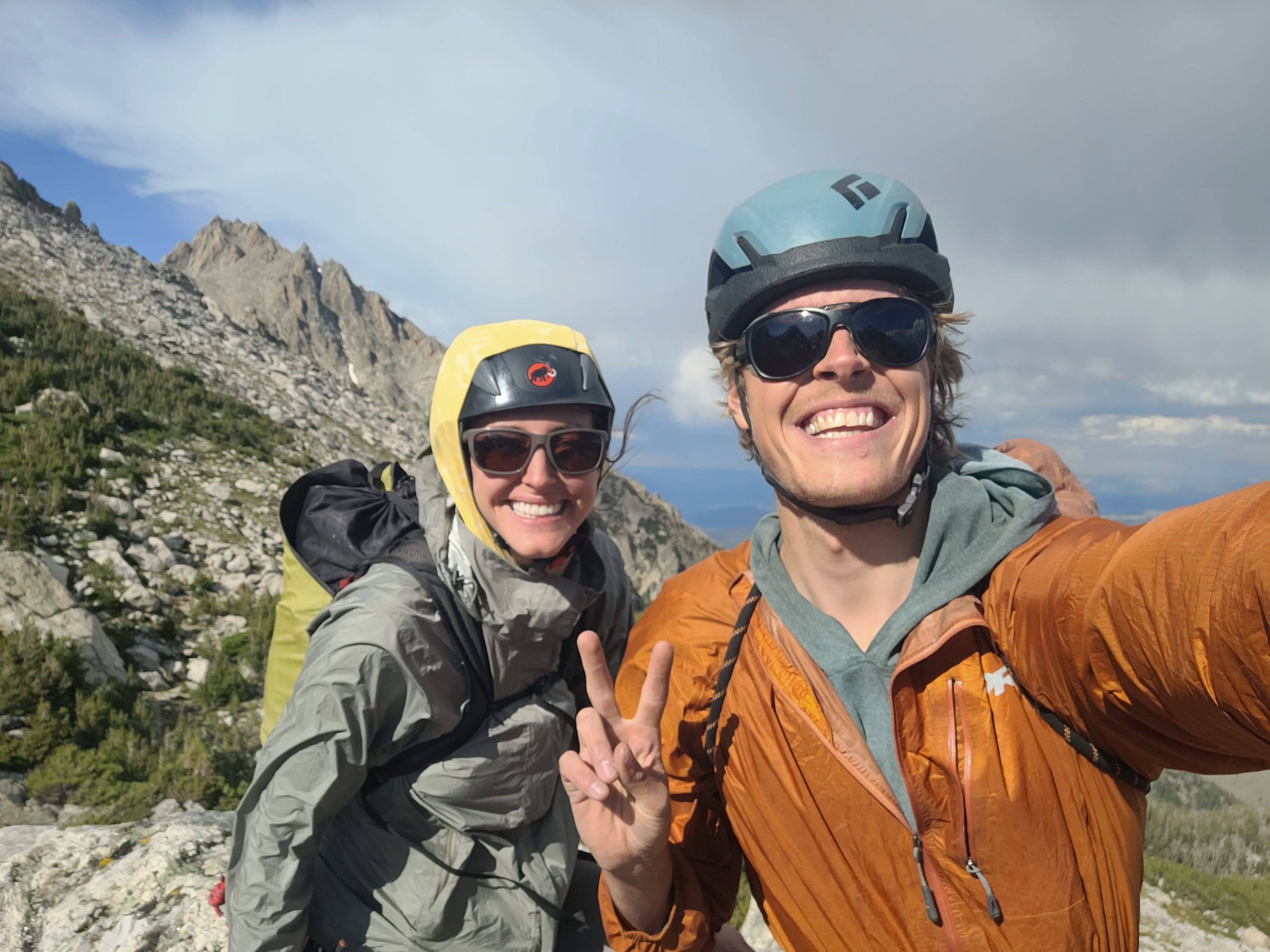
The storm only lasted about 30 minutes, and within the hour we were atop the summit tower (fourth class from the north) enjoying a lovely scene of rain-polished Teton peaks. No lightning was seen, and after talking to several Irene’s parties at various points on the descent it appears everyone made it off the ridge safe, with the only remaining variable a trio of young ambitious bucks from Pocatello that survived the storm but were still leading up the fourth pitch when the final party of the day overlapped. We descended Disappointment Peak via the fourth class Lake Ledges, and enjoyed a brief evening skinny dip in Amphitheater Lake before jogging out to the car at the 13 hour mark. You’d think by August these alpine lakes would get a little warmer, but my attempt at naked aquatic bravery was quickly thwarted by a sheepish yelp at first plunge. Bobbi was only slightly tougher. We live a special life.

Reflection – The Best?
“Best” is a relative term, open to interpretation and opinion. While descending we jabbered about the question of Irene’s being the best pure rock climb in the Tetons, and Bobbi was quick to unleash her typical spiritual argument against comparisons. I have a slightly more scientific mind, enjoy hypothetical nuanced banter, and prodded a little deeper. From the pure climbing perspective, Irene’s provided superb rock quality with little route finding difficulty on an inspiring formation. The scenery was world class, and the actual positioning of the climbing so near the arete crest was unique, juxtaposed against the typical alpine ridge climb that bounces far back and forth of the geologic apex. However, in my opinion the bane of Irene’s was the lack of continuous difficult climbing, with a few too many ledge rests and moments of hyper easy filler terrain to be crowned king. Both the Corkscrew Arete (5.8+, II) and Durrance Direct/Lower Exum Ridge (5.7+, III) provide likewise stellar rock quality, positioning and climbing style variety with a far greater sustained difficulty and a moderate grade. An argument could even be made that Irene’s neighbor to the east, Open Book (5.9, III), provides more consistently appealing rock climbing. However, these comparisons are like splitting hairs between Michael Jordan, Wilt Chamberlain and Lebron James for best basketball player of all time. Irene’s stands as a cream-of-the-crop Teton classic, and our experience only left us hungry to return for pitch one and the more difficult variations above.
Rack & Resources
We carried the guidebook recommended double rack of cams from fingers to two inches, one three inch piece and a set of stoppers. I found this protection excessive for the path of least resistance, generally reaching each belay with a full single rack. Lots of 60cm and some 120cm slings are useful for the many pitches that wander left and right of the crest. In my opinion, Teton Rock Climbs by Aaron Gams has the best topo and route description of the three prominent Teton guidebooks.
Ten Thousand Too Far is generously supported by Icelantic Skis from Golden Colorado, Barrels & Bins Natural Market in Driggs Idaho, Range Meal Bars from Bozeman Montana and Black Diamond Equipment. Give these guys some business – who doesn’t need great skis, gear and wholesome food?




If you would like to support Ten Thousand Too Far, consider subscribing below and/or leaving a donation here. The hours spent writing these blogs is fueled solely and happily by passion, but if you use this site to plan or inspire your own epic adventure, consider kicking in. A couple bucks goes a long way in the cold world of adventure blogging. I also love to hear your thoughts, so don’t leave without dropping a comment! Thanks for the love.
Follow my photography at @brandon.wanthal.photography
enter your email to subscribe for new articles
DISCLAIMER
Ski mountaineering, rock climbing, ice climbing and all other forms of mountain recreation are inherently dangerous. Should you decide to attempt anything you read about in this article, you are doing so at your own risk! This article is written to the best possible level of accuracy and detail, but I am only human – information could be presented wrong. Furthermore, conditions in the mountains are subject to change at any time. Ten Thousand Too Far and Brandon Wanthal are not liable for any actions or repercussions acted upon or suffered from the result of this article’s reading.
 Ten Thousand Too Far