On Tuesday June 6th, Connor James and I climbed another could-be-classic from the Ortenburger-Jackson book. It has a cool name, follows a very proud line and, as typical for Teton routes established in the 70’s, felt pretty stiff for 5.8.
After climbing Cardiac Aretes last October I’ve been lightly obsessed with Man O’ War. Established in 1970 by Thomas Dinwiddie and Roger Zimmerman, the route tackles the imposing Southeast Face of Ship’s Prow (SP) head on. Anyone who has walked up to climb any of the three classics on SP has stared at the steep slabs looming directly above the approach gully. From below they look nearly void of cracks, but on the sharp end sufficient protection can be gained in intermittent slots and flakes invisible from below. Man O’ War has it all – a badass name (find another route named after a deadly jellyfish), a proud line on an iconic Grand Teton National Park climbing formation and, of course, the added mystique of really not knowing how safe, difficult or desirable the stone will be. Having climbed a few historical, seldom traveled, routes from A Climber’s Guide to the Teton Range (Ortneburger, Jacksonm “OJ”), I’ve learned to expect moderate sandbagging, difficult protection, dirty rock and route finding challenges – a slightly more primitive experience. What we found was right in line with the above.
Love Ten Thousand Too Far? Support independent mountain journalism with $5.10 per month through Patreon (and receive extra bonus content), or with a one-time donation. Any and all support is greatly appreciated.


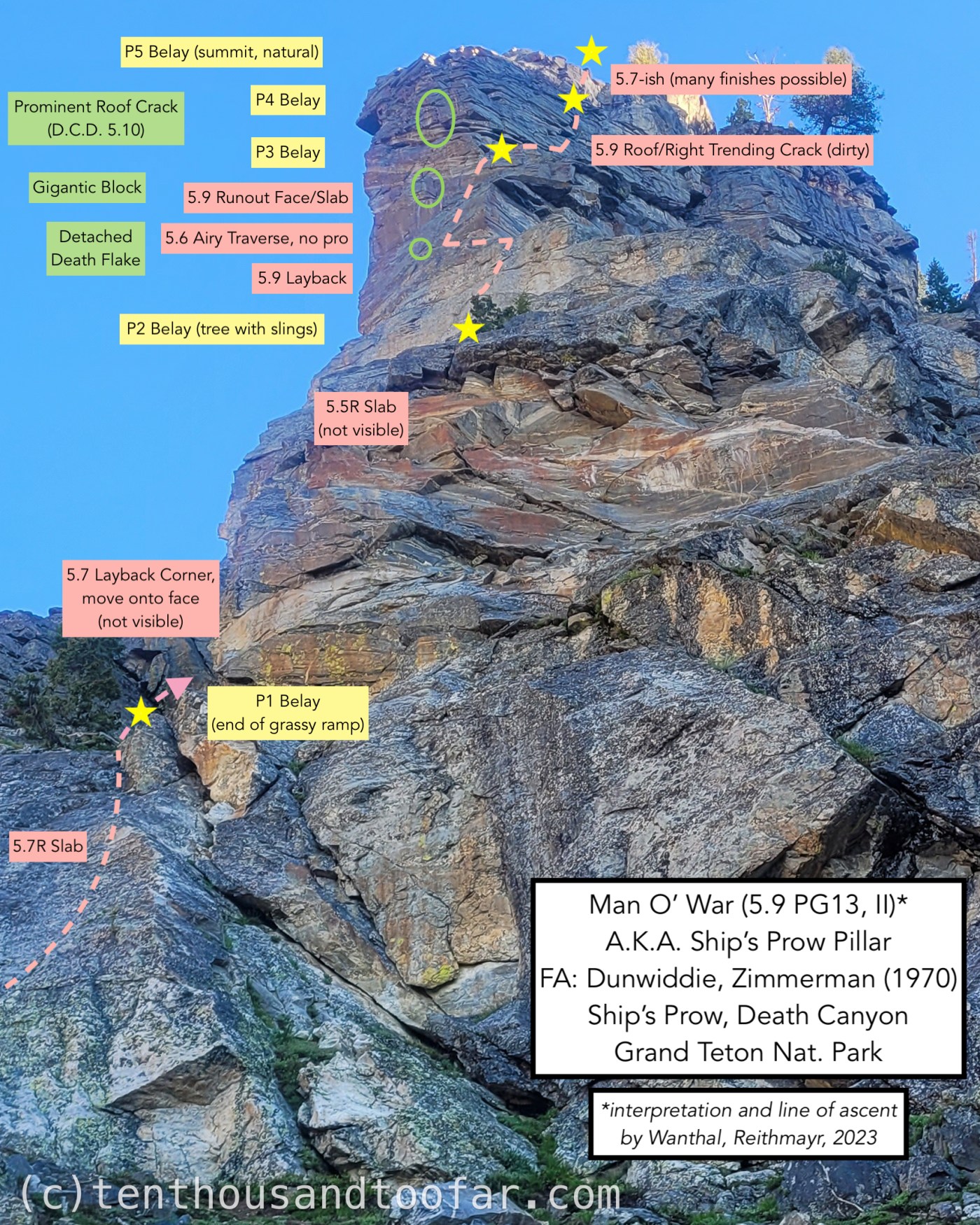
Connor and I climbed the first two pitches of Cardiac Aretes, and made our way to the lone tree with bail slings beneath the Southeast Face. From here, instead of climbing the low angle trough above the belay, with another small pine, and around the corner leading to Cardiac’s crux pitch, we continued linearly up unprotected slabs to the base of an easily identified right trending layback flake. This flake is steep and powerful but offers good protection, and gains the Southeast Arete right beneath a large overhang. As the leader I set my last protection here and traversed back onto the Southeast Face following a 5.6 handrail with positive holds but no protection to it’s terminus in about the center of the face, near a scary detached flake at foot level. The OJ lists a “stance belay” here for pitch three, but I found the thin seams and flared pockets inadequate for a safe belay – the FA may have used knifeblades. Instead I placed a small nest of uninspiring, shallow, small cams with long runners and began up the intimidating slightly overhanging black wall above. I must have climbed up to the crux and back down to the resting ledge three times, luckily finding an excellent Red Metolius cam placement, before committing to the face. A sea of positive edges, in varying sizes, overwhelmed my senses as I made my way past the only good protection into unknown territory, unsure when my next piece would arrive. I find this style of climbing the most intimidating – steep trad face climbing – requiring blind faith and a sprinkle of stupidity, and luck. I followed the path of least resistance, which felt about 5.9, a few body lengths to another decent Black Metolius placement beneath an undercling flake where I could shake out. The remainder of the pitch was a gritty slab, and with only two pieces of gear in 40 some feet I did not want to fall. I eventually reached an uncomfortable hanging belay at a horizontal crack just beneath the climber’s right corner of the final headwall and large roof above the Southeast Face.
To be honest, the whole experience on pitch three was a bit much. At one point I was pretty convinced I was taking a big plunge down the face, but at least it was steep with no ledges to hit, and the few cams I placed seemed reliable. A stronger leader would propose my experience hyperbolized – soft – but to each their own. Connor had pitch four, which also felt 5.9 despite the label of 5.8, pulling a substantial roof on crusty, lichen covered, rock, in the second of the vertical cracks reached on the east face, climber’s right of the arete. In hindsight I should have rounded the corner and set a comfortable belay here on pitch three. Following pitch four I was psyched to no be leading, as the crack arched hard to the right and required some strange movement, finger locks and underclings on a grainy, insecure slab. We belayed above this crack and followed the final pitch of Cardiac Aretes to the summit.
Final Thoughts
I wonder how a classic becomes a classic. Man O’ War is yet another forgotten route on a prominent and popular feature, on solid rock with great movement. The only real deterrent from repeat ascents is dirty, grainy rock on pitches three and four, which could easily clean up with some traffic. I’m guessing all routes in the Tetons, especially the low country, were pretty dirty before decades of travel. If someone took a wire brush to this baby, or better yet 100 pairs of rock shoes, I reckon it could be four stars. For the open-minded climber enticed by spicy 5.9 this is an interesting outing worth considering.
Variations to our line could include an intermediate belay, above the layback flake, on pitch three, especially for parties with a single rope. We climbed on half ropes and were able to mitigate the drag of the long mid-pitch traverse. Also, it would be possible to traverse to the final pitch of Cardiac Aretes from the top of pitch three (or four, with an intermediate belay on pitch three) to reach cleaner, and slightly easier, rock.
Lastly, an improvement in style would be made by taking a more direct line up the face from the belay above pitch two, but protection appeared seriously sparse. An appealing short finger crack lies on the west side of the face and reportedly goes at 5.10+, but I’m not sure how one would get there. The only documented route that ascends the final roof of the Southeast Face is D.C.D (Death Canyon Direct), taking the obvious overhanging hand crack above Man O’ War at 5.10-, but from what I can decipher on the OJ topo, requires another horizontal traverse from the Southeast Arete to the base of the roof instead of a direct line. Perhaps one day I’ll be able to connect the dots.
Rack
A single set of cams to three inches, with doubles from #0.3 to #0.75, a full set of nuts and several long slings will suit most parties. Two ropes are standard for all SP routes.

Ten Thousand Too Far is generously supported by Icelantic Skis from Golden Colorado, Barrels & Bins Natural Market in Driggs Idaho, Range Meal Bars from Bozeman Montana and Black Diamond Equipment. Give these guys some business – who doesn’t need great skis, gear and wholesome food?


If you would like to support Ten Thousand Too Far, consider subscribing below and/or leaving a donation here. The hours spent writing these blogs is fueled solely and happily by passion, but if you use this site to plan or inspire your own epic adventure, consider kicking in. A couple bucks goes a long way in the cold world of adventure blogging. I also love to hear your thoughts, so don’t leave without dropping a comment! Thanks for the love.
Follow my photography at @brandon.wanthal.photography
enter your email to subscribe for new articles
DISCLAIMER
Ski mountaineering, rock climbing, ice climbing and all other forms of mountain recreation are inherently dangerous. Should you decide to attempt anything you read about in this article, you are doing so at your own risk! This article is written to the best possible level of accuracy and detail, but I am only human – information could be presented wrong. Furthermore, conditions in the mountains are subject to change at any time. Ten Thousand Too Far and Brandon Wanthal are not liable for any actions or repercussions acted upon or suffered from the result of this article’s reading.
 Ten Thousand Too Far