
First alpine climb of the year with Mike Parri, on Lower Highway To Heaven, an adventurous “seven pitch” 5.8 outing on the SE Ridge of Storm Point. Dry rock and good times. Included is concise route description, as the one provided by the FA party is almost too descriptive and long.
The snow is gone. Well – not completely gone I guess, judging by the lone snowboarder hiking up Paintbrush Canyon on the crisp early summer morning of June 4th, but “gone” for me. After a fruitful ski mountaineering season and an especially draining effort on the Grand Teton May 27th, I had a spiritual shift – away from midnight wake-up calls and steep jump turns towards the vertical plane of dry Teton granite. Lower Highway To Heaven was the warm up, a seven pitch 5.8 on the Southeast Buttress of Tranquility Point, a lower spur of the greater Storm Point. This new route, established in 2016 by Ron Watters and Yuki Fujita, offered a gentle and adventurous ramble of mostly slab nature, with a solar aspect and a short approach, perfect for early June when seeping steep cracks are the commonplace bane of ambitious early season climbers and the sun is a welcomed warming addition rather than a sweaty, crux limiting monster.
Love Ten Thousand Too Far? Support independent mountain journalism with $5.10 per month through Patreon (and receive extra bonus content), or with a one-time donation. Any and all support is greatly appreciated.

Ultimately the four star reviews set forth by the first ascentionists on Mountain Project seemed a product of typical FA bias, though the climb did have some redeeming qualities. Aside from the standard Teton loose blocks on belay ledges, the technical climbing was on sound granite of varying composition. The second, fourth and fifth pitches were our highlights, but really, every pitch besides the third and seventh offered nuggets of brilliance. A meticulously detailed route description, including approach, descent and topo, is available on the website of Ron Watters. We climbed the route comfortably in five pitches and short scramble, descended with five 60M rappels and returned to the car at a leisurely pace around ten hours. From Tranquility Point we could survey the two additional 5.10 pitches of Upper Highway To Heaven, but rolling thunder chased away even the faintest thoughts of exploration. The confident 5.8 leader will consider this a discontinuous romp with only short bouts of challenge, but excellent views above Jenny Lake, some memorable movement and an interesting summit make this route worth the tick, especially when crowds or moisture of day’s past facilitate an audible from the typical Cascade Canyon classics. Some might call this route dirty, but compared to other long forgotten lines of Ortenburger-Jackson folklore Lower Highway To Heaven is quite clean.
Below is a short pitch by pitch description of how we climbed the route, including our variation to pitch two which I believe should be the standard. Once again, refer to Ron Watters’ website for more information. Cheers to summer alpine season!


Lower Highway To Heaven (5.8+, II)
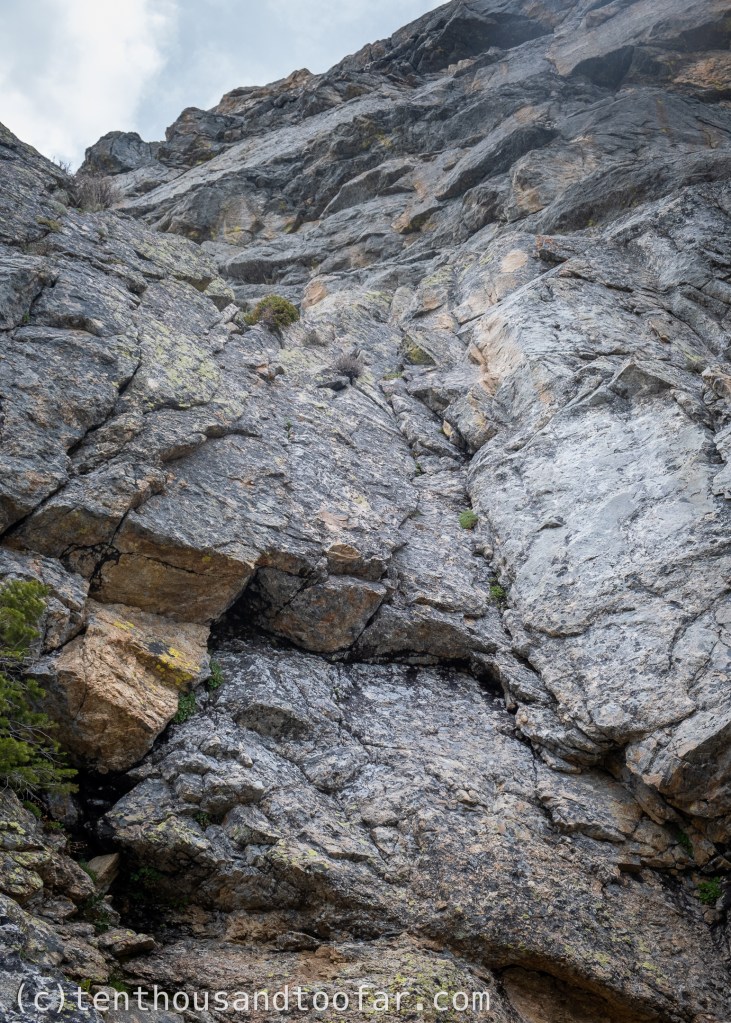
Note: All leads were between 50 and 60 meters. Refer to the pictures of the “Entrance Roof” and “Funky Flake” for guidance on pitches one and two.
Approach – Walk 0.5 to 0.9 miles past the Baxter’s Pinnacle Social Trail (if coming from String Lake), up Cascade Canyon until the flowing creek relents to a dammed, mostly still, section. Locate the SE Buttress of Tranquility Point and Storm Point. The Entrance Roof can be spotted from the trail. (see first picture). Skirt the lower cliff bands on third class terrain to the east, then hike back west to the base of the fifth class climbing, below and right of the Entrance Roof, which caps the entire first two pitches like an amphitheater. From here the Funky Flake, a boot shaped flake beneath the Entrance Roof, can also be identified. Pitch one begins on orange rock on the right side of amphitheater.
Pitch One** (5.7R) – Begin climber’s right, on an orange slab left of the prominent broken gully. Friction and edging with a few thin pieces of unreliable gear is the name of the game. Stepping right at the top bulge is slightly easier. Be solid at 5.7, as the gear is liable to rip in a big fall. Traverse left on fourth class terrain, past a fixed anchor, and set a belay beneath the Funky Flake.
Pitch Two** (5.8+) – Wander up runout but easy slabs to the base of the Funky Flake. The FA climbed the flake, but a big piece (maybe #5 Camalot?) would be needed for protection. Only packing up to three inches we traversed left, bypassing the flake, and climbed a steep slab with gritty edges and a left hand finger crack for protection. Belay above.
Pitch Three** (5.6, 5.8) – Bump the belay up a broken ledge to the base of bulging black slabs and locate another massive roof above. Climb the dirty slabs (5.6) towards the roof. When the terrain permits, traverse hard left of the roof into a steepening corner with a crack. Set a belay here, or continue up the corner with committing but short lived laybacks and jams (5.8) to another large ledge. Belay beneath the obvious open book dihedral of pitch four. Attention to long slings and/or double ropes are useful if doing in one long 60M pitch.
Pitch Four** (5.7+) – Climb a once again short lived but surprisingly fun vegetated crack pitch in the obvious dihedral. Some pockets of mud will be found, but the rock is solid. Above, traverse hard left on fourth class terrain to the terminus of a long, long, long ledge system heading towards the south face – a full 60M pitch. Set a belay at the end of the ramp beneath the steep and appealing south face.
Pitch Five** (5.7) – Above should be the “Nirvana Wall”, a short but beautiful chunk of orange granite split by cracks with excellent exposure on the south face. Climb the crack just left of a low alcove, past a fixed piton, and traverse right on edges into easier terrain (5.7). Wander up more endless dirty fourth class. An optional difficulty takes a hand crack in a chimney on the arete crest to a difficult boulder problem left of a small roof with good protection (5.10-) – I thought it was fun. Belay above, beneath the final fifth class slabs.
Pitch Six* (5.3) – We unroped here. Scramble low-angle slabs to the summit.
Descent: Fixed anchors facilitate descent skier’s left of the route, but not in the gully, with some 3rd and 4th class between rappels. The first anchor is a slung boulder on the summit. The next two are trees. The fourth, after rappelling the Entrance Roof, is a fixed anchor beneath the roof with a stuck cam. The last is directly above pitch one. Two 60M ropes are the minimum.
Rack Recommendation: A full set of cams from micro to two inches, with doubles from #0.3 to #1, and a standard rack of nuts should do the trick. A confident leader could get by with less. Long slings for wandering pitches and two 60M ropes for descent.
Ten Thousand Too Far is generously supported by Icelantic Skis from Golden Colorado, Barrels & Bins Natural Market in Driggs Idaho, Range Meal Bars from Bozeman Montana and Black Diamond Equipment. Give these guys some business – who doesn’t need great skis, gear and wholesome food?




If you would like to support Ten Thousand Too Far, consider subscribing below and/or leaving a donation here. The hours spent writing these blogs is fueled solely and happily by passion, but if you use this site to plan or inspire your own epic adventure, consider kicking in. A couple bucks goes a long way in the cold world of adventure blogging. I also love to hear your thoughts, so don’t leave without dropping a comment! Thanks for the love.
Follow my photography at @brandon.wanthal.photography
enter your email to subscribe for new articles
DISCLAIMER
Ski mountaineering, rock climbing, ice climbing and all other forms of mountain recreation are inherently dangerous. Should you decide to attempt anything you read about in this article, you are doing so at your own risk! This article is written to the best possible level of accuracy and detail, but I am only human – information could be presented wrong. Furthermore, conditions in the mountains are subject to change at any time. Ten Thousand Too Far and Brandon Wanthal are not liable for any actions or repercussions acted upon or suffered from the result of this article’s reading.
 Ten Thousand Too Far
Leave a comment