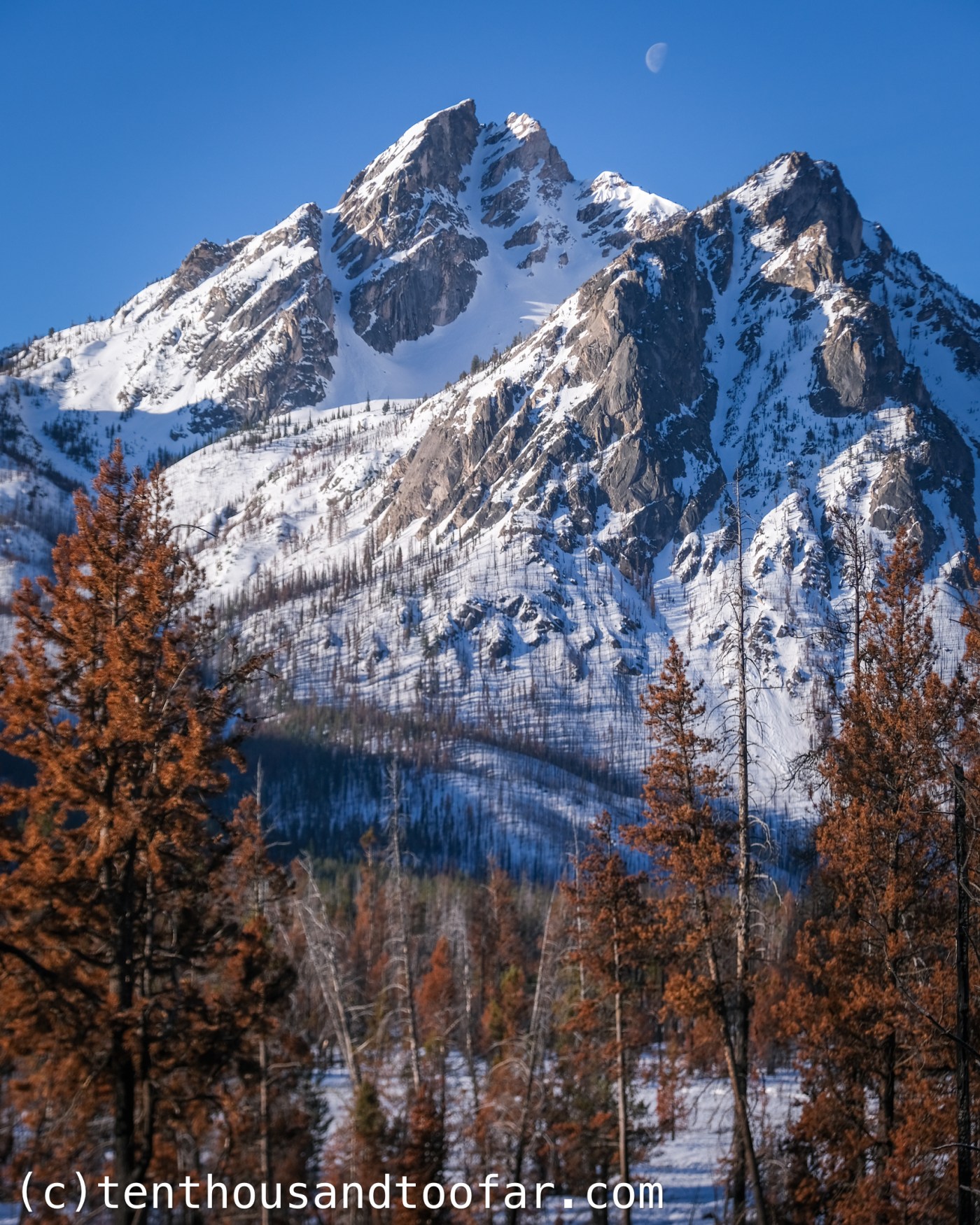
On April 20th I skied the “McGown Triple”, linking the Little McGown Couloir, “50 Classic” North Couloir, and KLB Chute for a 4,500 foot day of excellent steep spring skiing on McGown Peak. If I wasn’t a McDonald’s hater, I would call it the McTriple. Perhaps it has an official name.
The day after an 11 hour outing on Mystery Mountain with Bobbi Clemmer, I got out for a solo jaunt. The Peanut needed rest. Being alone, and having little knowledge of the Sawtooths, I sided with familiarity: repeating our same approach as for Mystery Mountain, but venturing onto the steeper north face of McGown Peak where several attractive couloirs, including one from the 50 Classic Ski Descents of North America book, are found. The classic is the North Couloir, a short, albeit insanely aesthetic couloir cleaving the north face, ending just shy of the true summit. To the looker’s left is the not-so-little Little McGown Couloir, a striking 600 foot pinner with incredible walls. And last but not least, diving due north from McGowan’s northern shouler to Stanley Lake is the KLB Chute, offering an 1,800 foot descent through a tube feature reminiscent of the Fallopian Tube in Grand Teton National Park. When viewed from Stanley Lake, these three features pop from the landscape, begging to be linked together in a single ski tour.
Love Ten Thousand Too Far? Find the information useful? Support independent mountain journalism with $5.10 per month through Patreon (and receive extra bonus content), or with a one-time donation. Any and all support is greatly appreciated.

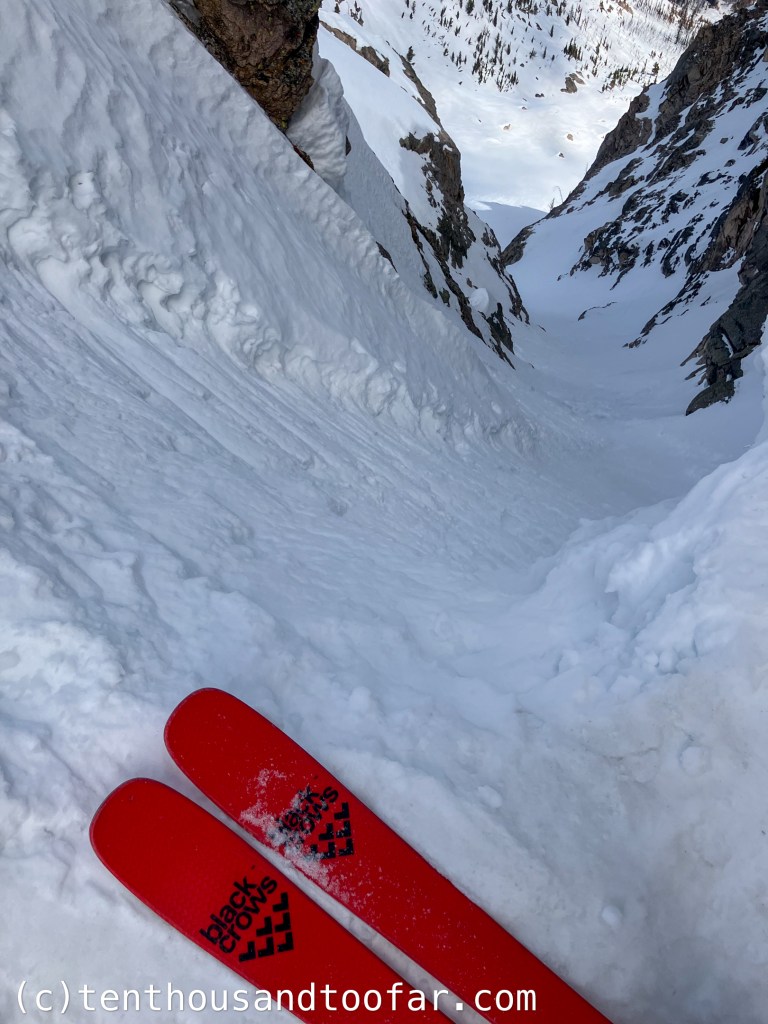
Another deep freeze, and the convenient happening that every inch of my day would be spent on shaded terrain, allowed an even later start than the day prior. I set sail from our highway pullout camp by bicycle at 7:30AM, and retraced our steps from 24 hours earlier to the north face of Mount McGown. Today was one of those magical days where I felt truly weightless, reaching the base of Little McGown within three hours. Sadly, the bulk of the couloir was packed with avalanche debris, but a clean panel on the skier’s left wall harbored a smooth interface from start to finish. My dreams for preserved powder were dashed by yet another dose of harsh breakable crust, yet the crust wasn’t too hard, and I knew I’d at least be able to link slow turns. The bulk of the couloir holds a consistent 40 degrees, with the last hundred feet creeping towards 45. I topped out beneath baby blue skies at 10:55AM.

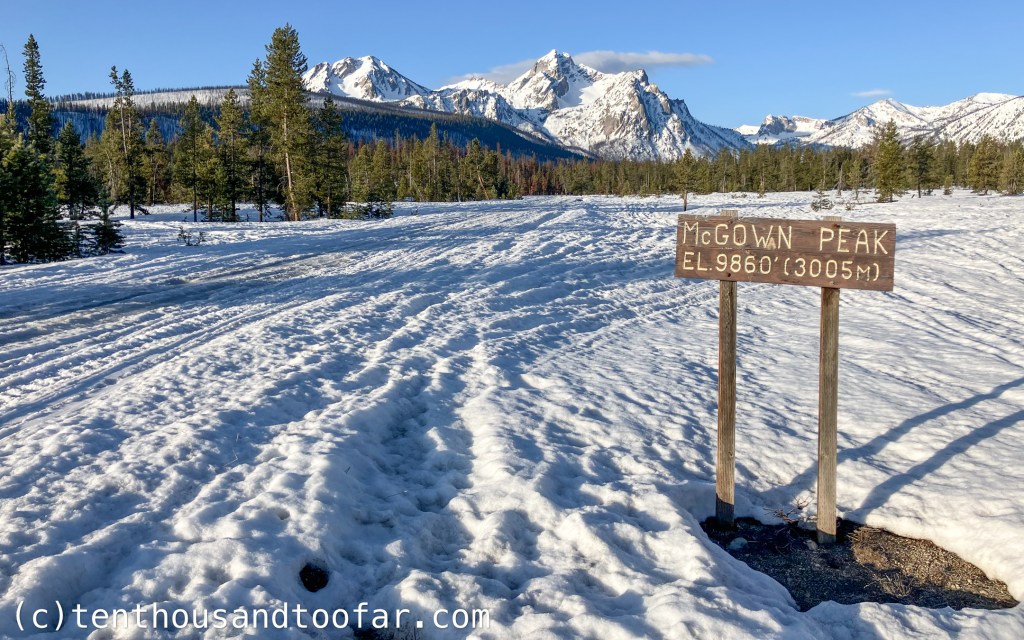

The skiing in Little McGown landed somewhere between acceptable and mediocre, but the ambiance, predictability of the crust, and tame slope angle kept the vibes high. An interesting rock island feature, forcing the skier to move either left or right halfway through the couloir, added uniqueness. From the base of the couloir I gathered some stashed gear and moseyed over to the main attraction North Couloir. Many folks, myself included, have stared at this relatively short line from Stanley Lake and wondered how it got included in the 50 Classic Ski Descents book. However, as I approached the base I quickly realized the merit. What’s lost in vertical relief is regained by sustained steepness, impressive walls, and world class positioning at the northern tip of the mighty Sawtooths. Given the prolonged high pressure leading up to our trip, at least ten pairs of ski tracks were carved into this puppy. That said, just like steep Teton classics, which often draw eyes from the overambitious, all tracks were crammed into the lowest angle section – the gut. The steeper walls were virgin, and the snow, unlike Little McGown, was soft.

The steepness of the last 100 feet of the North Couloir caught me off guard. Looking at photos and videos of years past, it seems this year the top had uncommonly good coverage, plenty wide enough for skis-on passage without clipping rocks. However, I think this coverage also made the slope angle steeper, as I measured an unexpected ~57 degrees leading up to the notorious vertical cornice denounced as “often the crux” by Sawtooth Mountain Guides. Before clicking into skis I systematically disembodied this cornice, sending large blocks of snow cartwheeling to the apron at alarming speed. Clicking into skis and slipping into the line it was apparent that despite leaving the towering Tetons for a range over 3,000 feet shorter, I was currently entering the real deal. Every prior skier had side-slipped the first 100 feet, branding an icy trench into the tight upper couloir. I can’t say I blame them, for a fall here would produce a painful fate similar to my chopped cornice, but if I’m being honest: I was slightly agitated. I was keen to make turns from inception, but because of this concave side-slip track, skiing would be impossible for any ability. I am left pondering whether it’s ethical to side-slip the top of a tight couloir when a skier knows they won’t be able to make a turn, sloughing off new snow and ruining the possibility of turns for others, instead of downclimbing to a place where turns are possible for their ability? I understand not taking skis off mid run, but when the crux is at the top of a descent, I think skiers should consider the impact of side-slipping versus downclimbing on future skiers. Semantics aside, after about 20 feet I was able to escape the track and shuffle left onto an even steeper yet untouched and well bonded patch of soft snow. Committing to the first jump turn was terrifying. I can count on one hand the number of times I’ve linked 55 degree jump turns. It feels more like controlled falling than skiing, with the consequences of a tumble viscerally understood. But when conditions are right, as were today and any other time I’ve released my edges in 55 degree terrain, the feeling is magical, weightless, like flying – each turn transporting me several body lengths down the slope. After 80 feet the angle relented to into the high 40 degree range, and with it all tension. The walls of the couloir held supportable, supple and milky snow perfect for fluent and fast jump turns, the best steeps of my season. The feeling I had at the bottom of the North Couloir cemented the route’s classic stamp.
I finished the linkup with a 500 foot climb up the south aspect of McGown’s north shoulder, and firm ski down the KLB Chute. In powder or ambient corn the KLB would be a glorious freeride style ripper, but today it was an underwhelming cocktail of zipper crust and edgeable glaze – oh well. Much like Little McGown, smooth surfaces and spectacular setting trumped snow quality. Below the chute, 800 feet of steep gladed corn skiing led to Stanley Lake, my bicycle, and eventually, the van.
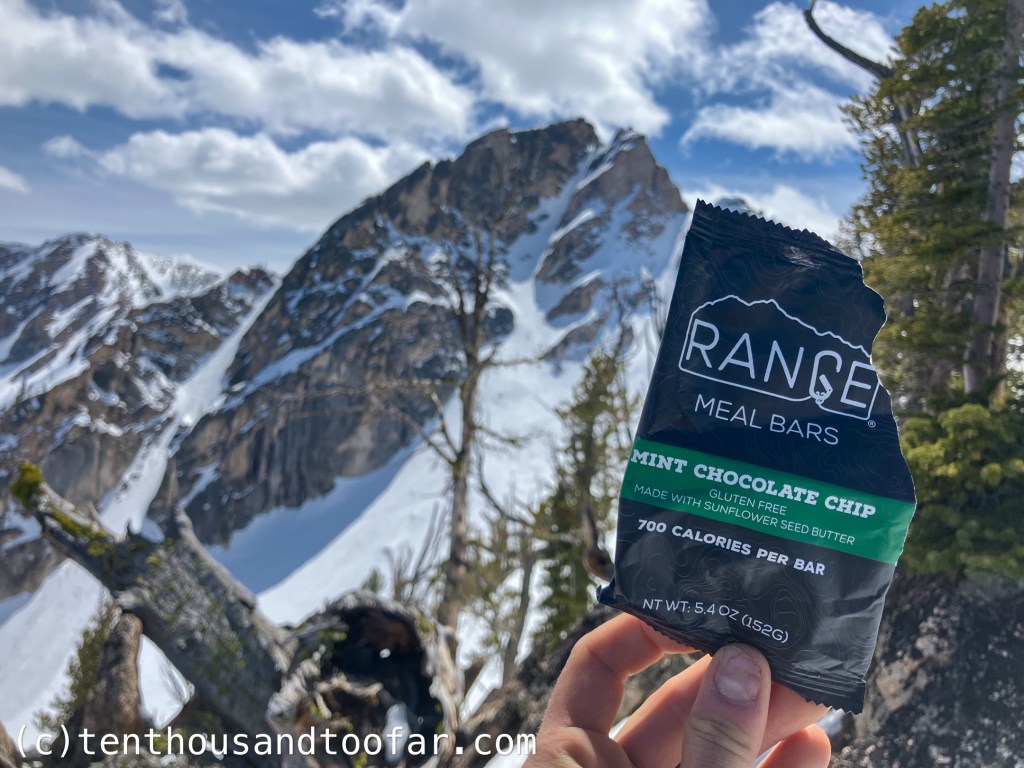

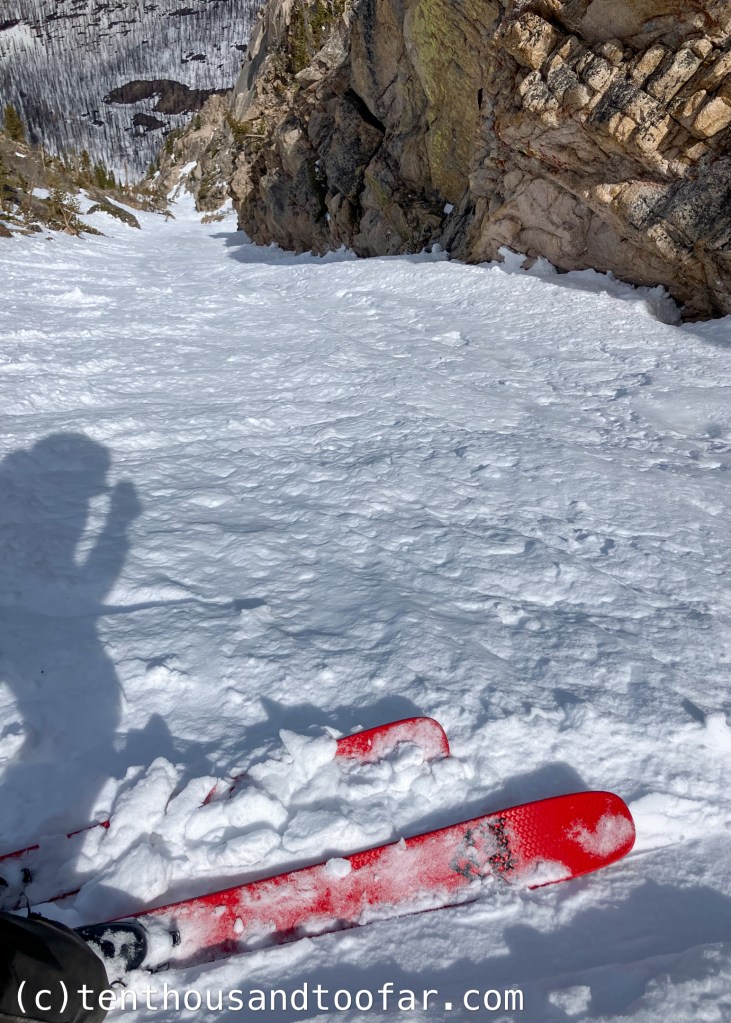

All in all, the McGown Triple was a rewarding seven hour day in the mountains. The total vertical landed somewhere around 4,000 to 4,500 feet, about the price of a single five-star line in the Tetons. Rather than total physical exertion, this day was characterized by the playful feeling of dancing around the dark side of one of Idaho’s most famous ski mountaineering peaks. The density of quality steep skiing in the Sawtooths can not be understated. The McGown Triple is a clear example of how straightforward 3,000 feet of aesthetic couloir skiing is attained in this unique mountain range.

Want to support? Consider a donation, subscribe, or simply support our sponsors listed below.
Ten Thousand Too Far is generously supported by Icelantic Skis from Golden Colorado, Range Meal Bars, The High Route, Black Diamond Equipment and Barrels & Bins Natural Market.





subscribe for new article updates – no junk ever
DISCLAIMER
Ski mountaineering, rock climbing, ice climbing and all other forms of mountain recreation are inherently dangerous. Should you decide to attempt anything you read about in this article, you are doing so at your own risk! This article is written to the best possible level of accuracy and detail, but I am only human – information could be presented wrong. Furthermore, conditions in the mountains are subject to change at any time. Ten Thousand Too Far and Brandon Wanthal are not liable for any actions or repercussions acted upon or suffered from the result of this article’s reading.
 Ten Thousand Too Far