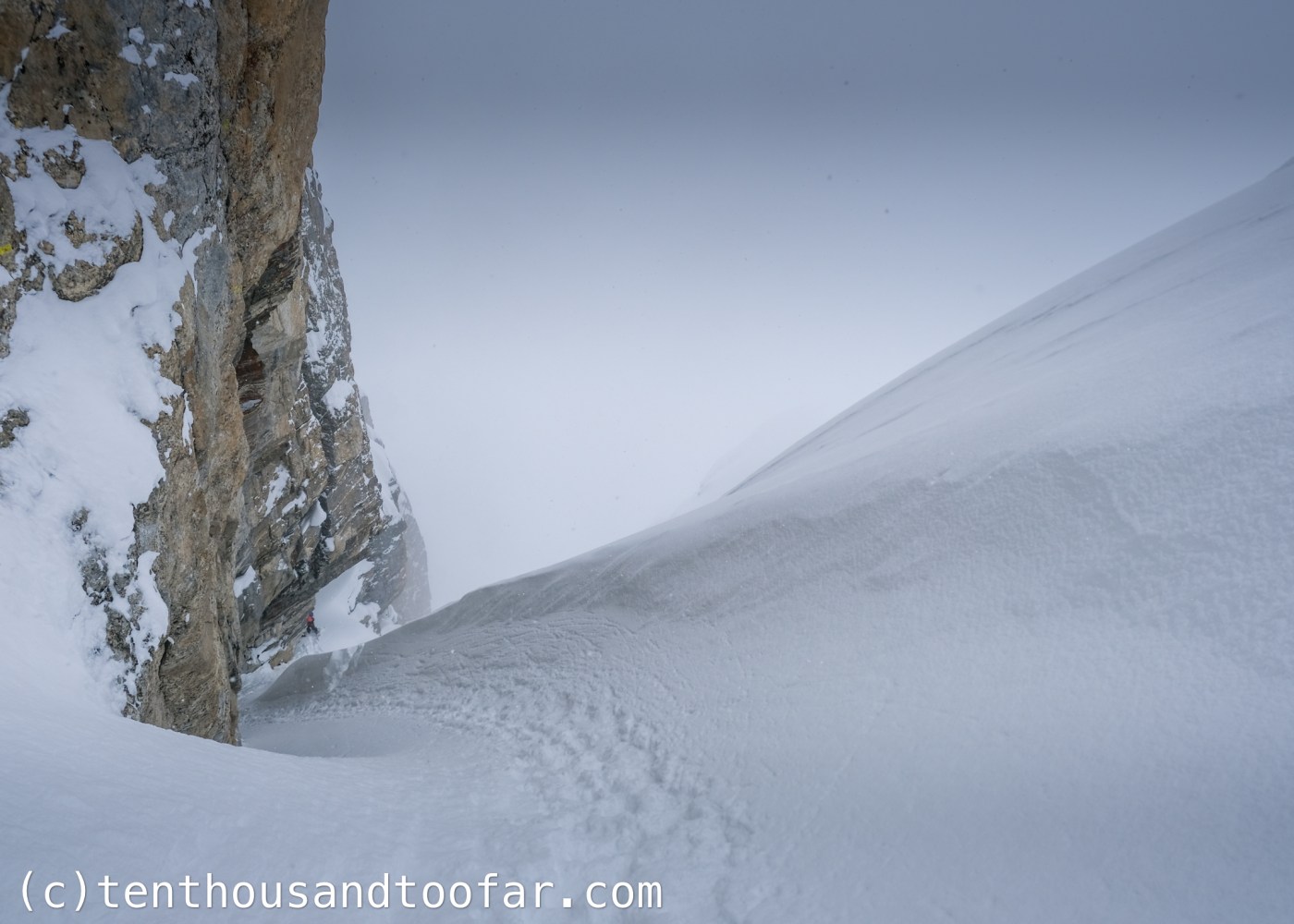
Hayden Evans and I “skied” the Koven Couloir after bailing on a different higher objective. It skied very poorly, as I always assumed it would after having climbed it many times over the past few years. Also, a few reflections on late season ski mountaineering on north facing aspects, and the volatility of spring storm systems.
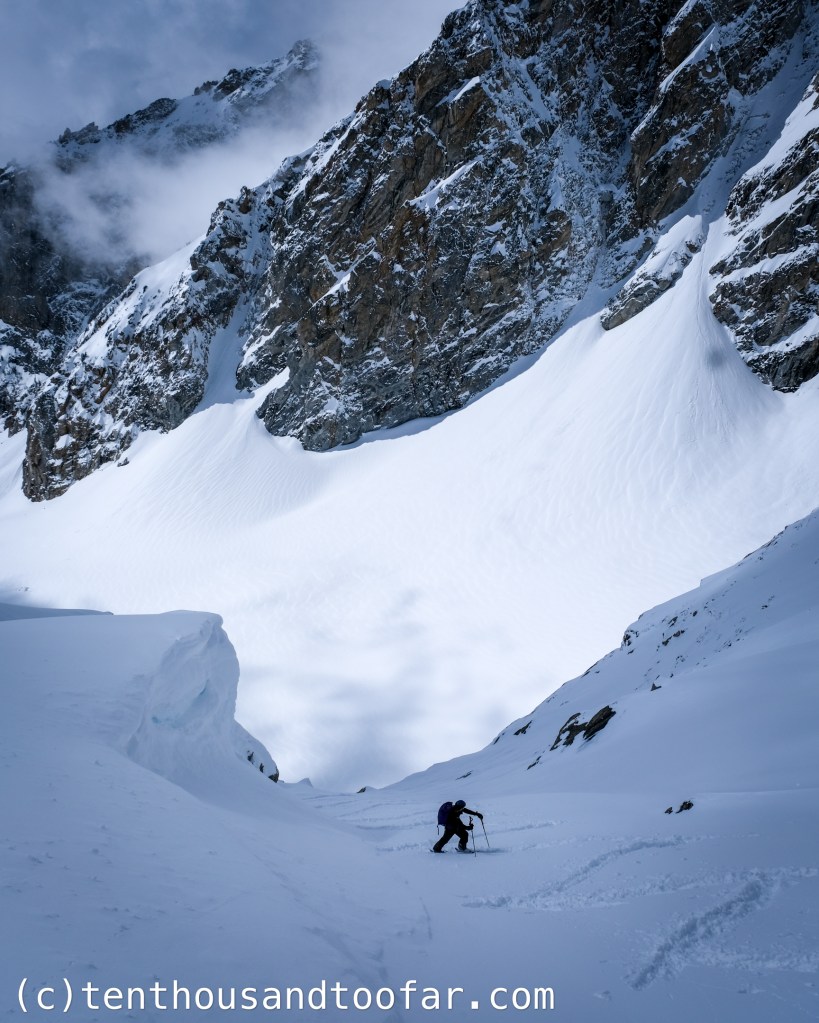
The Koven Couloir is the primary ascent couloir for all winter ski routes on Mount Owen – frequented for single day summer ascents of Owen as well. It’s 1500 feet of atypical “couloir”, more of two steep couloirs separated by a broad, long and lower-angle floating bench that faces due south, flanked by the East Prong on the east and the impressive southeast face of Mount Owen to the west. By winter the lower couloir is very steep and narrow, often no more than ski-width or less at the choke, commonly gutted by repeated wet avalanches that expose a prolonged vein of 50+ degree alpine ice or neve. The bench separating the two couloirs is about 400 vertical feet of 35-40 degree featureless snow, with an impressive girth of nearly a quarter mile. Above the bench lies a similarly steep (if not steeper) and twisting upper couloir often capped by a cornice and stiffened wind drifts that make a desirable ski line elusive, and unlikely bands of alpine ice seem to sprout here as well. By summer the Koven is graded (5.4, WI2+), and when I tried to climb it late December 2023 its rocky character was on glaring display (I ended up bailing for other reasons). Despite a few favorable tales from long tenured Teton ski mountaineers of great steep skiing in the Koven, my guess, having now climbed the beast four times and descended it on skis once, is that optimal ski conditions are pretty rare. That said, I’ve never sought the Koven as a ski objective in its own.
Love Ten Thousand Too Far? Support independent mountain journalism with $5.10 per month through Patreon (and receive extra bonus content), or with a one-time donation. Any and all support is greatly appreciated.
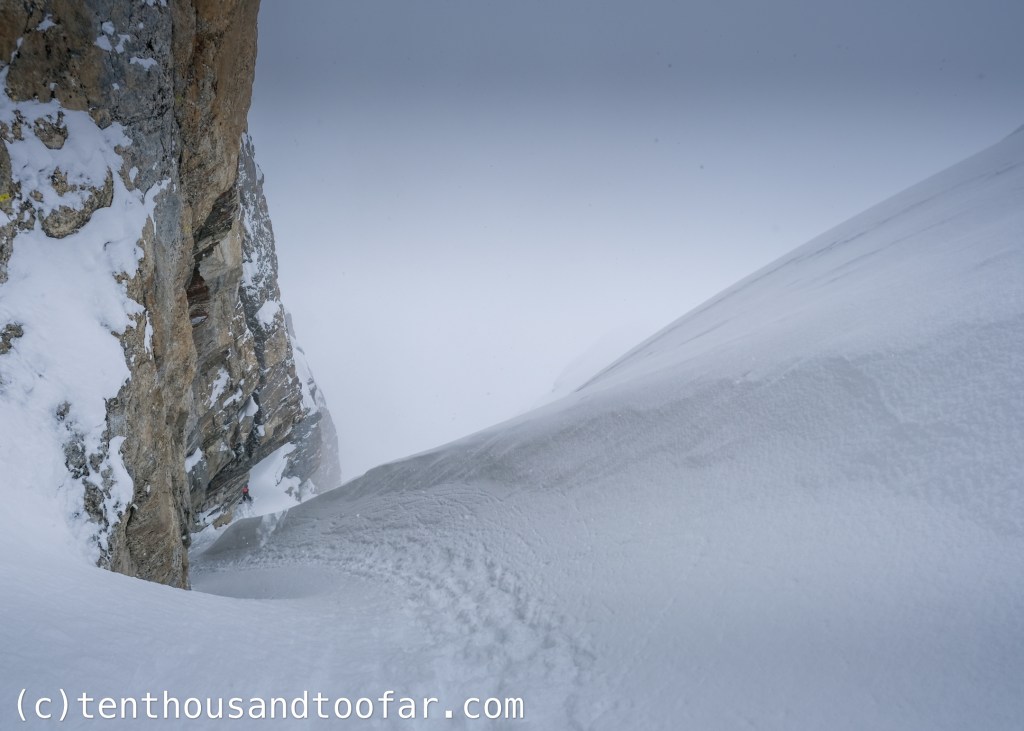
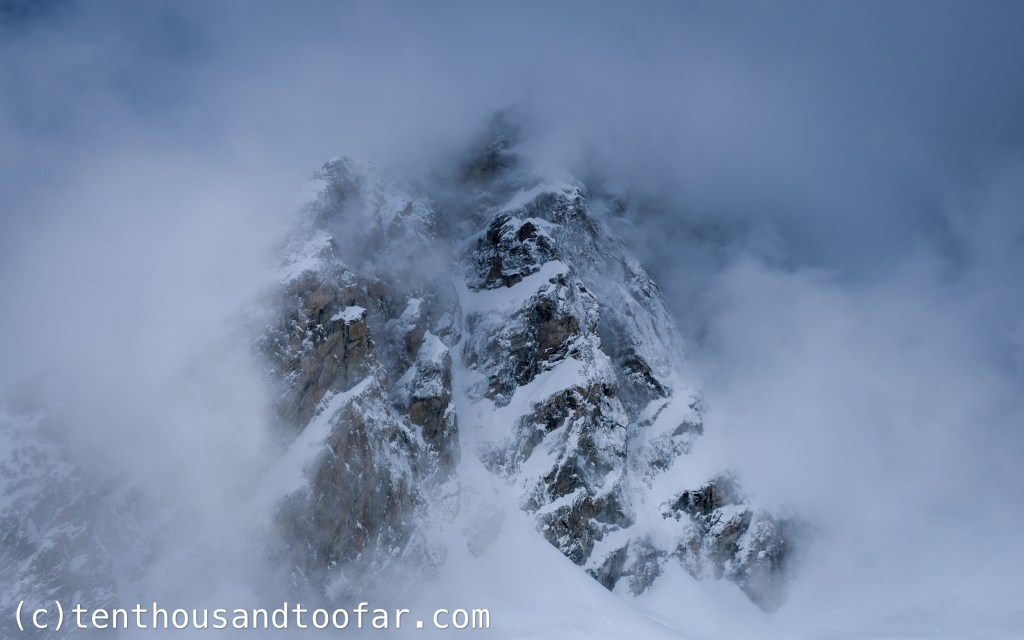
Anywho, Hayden and I ended up sorta skiing the Koven on May 3rd, 2024, after retreating from our primary objective on the north side of the Owen-Teewinot Cirque amidst a mounting storm. I say “sorta skiing” because our style was about as poor as they come for claiming a ski descent, but our skis did remain on our feet for the majority of the couloir. From the col at the East Prong we down-climbed about 100 feet of seriously steep wind drifted snow before clicking in, Hayden a little lower than I. Then, thanks to my poor judgement we got roped into some seriously dicey side slipping over 50+ degree blue alpine ice speckled with talus in the upper couloir. 800-ish feet of nasty wind-demolished heavy powder skiing led to the lower couloir where we side slipped until our edges resisted purchase, eventually relenting to crampons and down-climbing, beyond the ice and past a suspect wind slab, and skiing the apron in semi-decent style into Glacial Gulch.
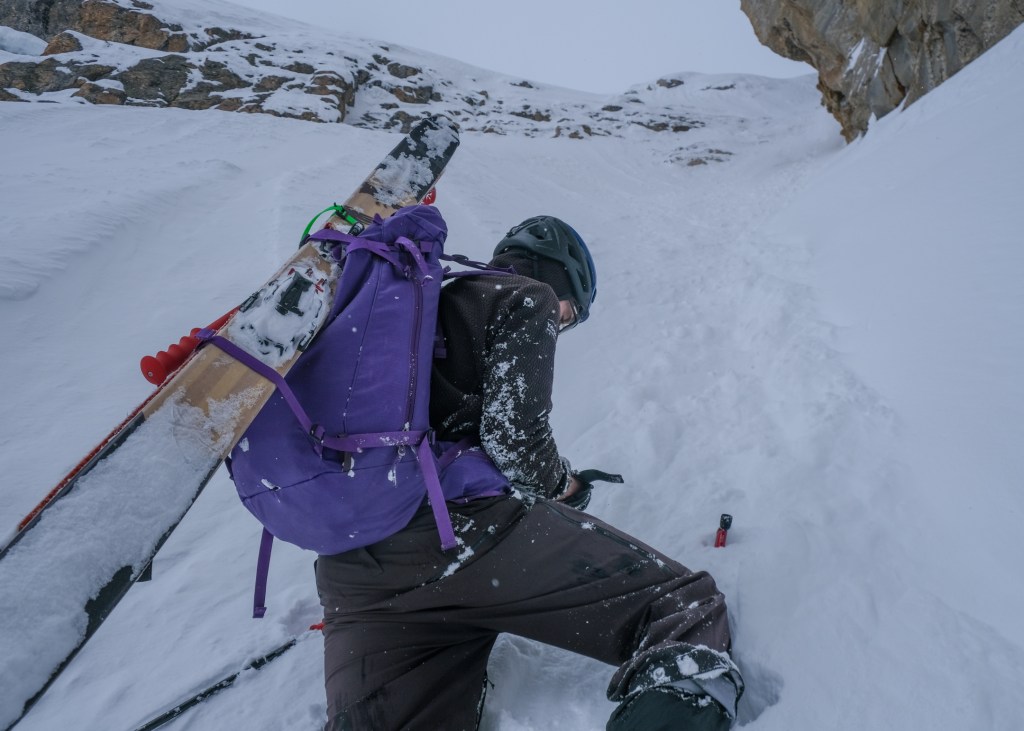
A few other interesting notes from this day follow. On the approach we watched a likely cornice failure or large loose dry avalanche rip down the north face of the Grand Teton at first light, exploding over the first and second ledges of the climbing/ski route – camera at the ready, I nailed the picture. The debris cloud was impressive, mushrooming across the entire Teton Glacier and nearly reaching our break spot at the base of the Koven. Not long after, a substantial rock and ice fall ripped through the lower Hossack-McGowen Couloir. The air temps were well below freezing the night before (forecasted about 25 degrees at 11,600 feet), but I suspect the new snow and rime from the past week’s wet spring storm insulated the snowpack and prevented a deep freeze, and was extremely sensitive to the first blast of dawn light that reams north faces this time of year. After doing battle with a few heavy spring storms this year and returning empty handed each time, I am left with a few take-home points:
- New snow and cloud cover insulates the snowpack very well and can prevent freezing beyond reason, even when temperatures are forecasted to the mid-twenties.
- Without hard freezes, north faces release debris regularly this time of year. Late spring appears to be a poor time to recreate in channelled north facing alpine areas with overhead exposure unless temperatures are unseasonably cold.
- Furthermore, the power of first sunlight on north faces come late spring cannot be understated. Rock, snow and ice fall is capable of ensuing nearly instantaneously from even the shortest window of sun, especially after recent precipitation. I’m guessing this is due to a lack of snowpack consolidation during the previous months of winter, when the sun hardly ever reaches north faces. The rock on steep Teton north faces also appears to be the poorest quality, highly sensitive to temperature fluctuations.
- Wind, snow and cloud cover forecasting appears to be very unreliable during late season storm systems. Clearing and gentle winds were forecasted both days I tried to ski this week, but both days I was met with serious winds and thick cloud cover upon reaching 12,000 feet. Further watching of the range during subsequent spring storms revealed that clouds appear to have an affinity for the 12,000 foot line in the Tetons amidst low atmospheric pressure.


Want to support? Consider a donation, subscribe, or simply support our sponsors listed below.
Ten Thousand Too Far is generously supported by Icelantic Skis from Golden Colorado, Barrels & Bins Natural Market in Driggs Idaho, Range Meal Bars from Bozeman Montana and Black Diamond Equipment.




enter your email to subscribe to new article updates
DISCLAIMER
Ski mountaineering, rock climbing, ice climbing and all other forms of mountain recreation are inherently dangerous. Should you decide to attempt anything you read about in this article, you are doing so at your own risk! This article is written to the best possible level of accuracy and detail, but I am only human – information could be presented wrong. Furthermore, conditions in the mountains are subject to change at any time. Ten Thousand Too Far and Brandon Wanthal are not liable for any actions or repercussions acted upon or suffered from the result of this article’s reading.
 Ten Thousand Too Far