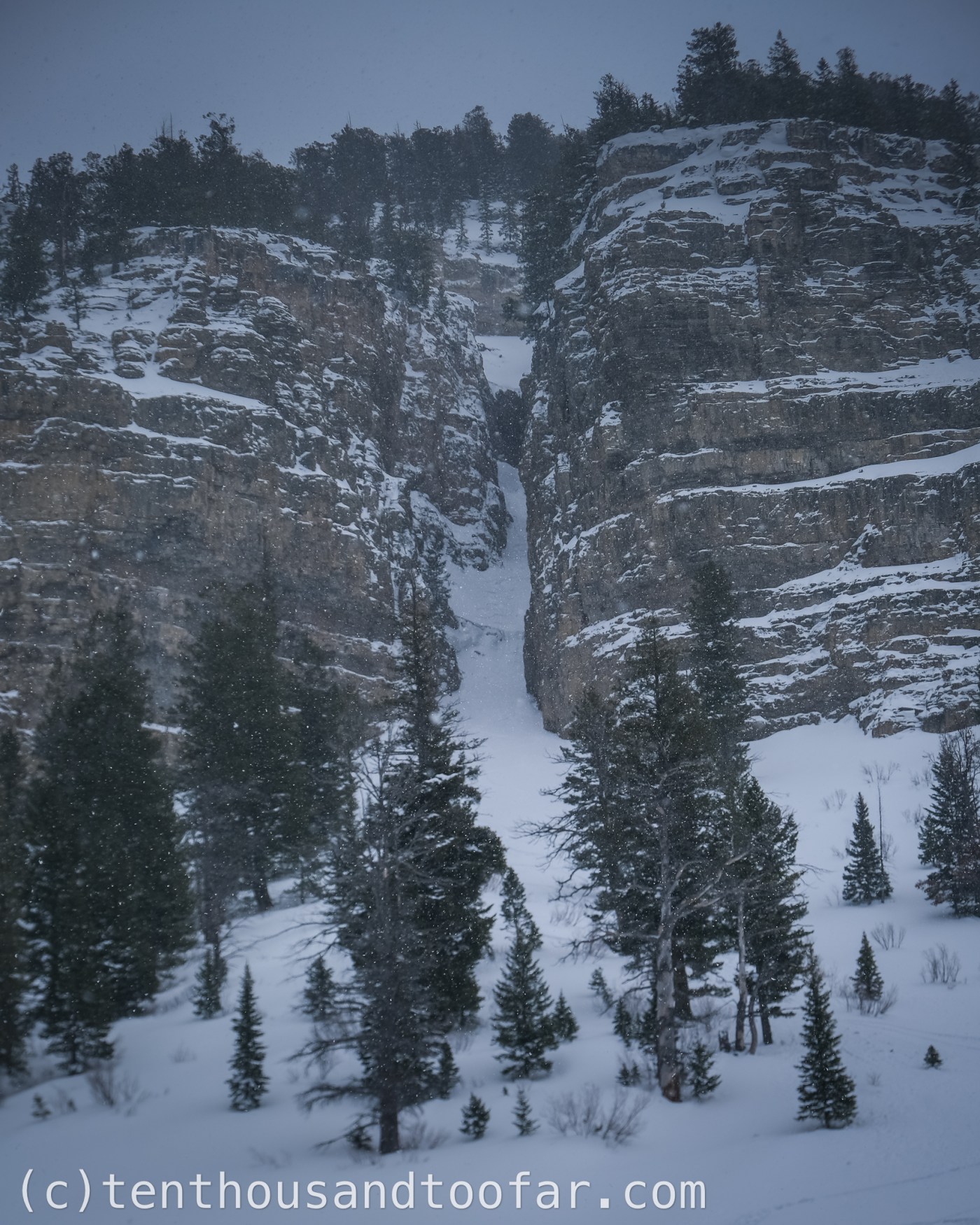
The Painted Lady is a rugged, seldom skied novelty descent on the west face of Treasure Mountain – a 2,200 foot descent that involves a gigantic 230+ foot rappel into a narrow slot, and a mandatory air over an ice fall… or epic butt slide. Something like canyoneering, on skis.
Back out with Hayden Evans, back to Treasure Mountain (see Lost Boys) – ropes in cue, cliffs in crosshairs and powder at the ready. Carl Osterburg and I made an attempt on this line years ago, ultimately bailing due to unreasonably deep snow. Any skier atop Chicken Knob on a clear day has gawked at this commanding slot capped by an epic impassable wall of limestone. I call it a “novelty line” because the couloir is relatively short, requiring extensive rope work, and any sane human in search of the best skiing would ski any of the four renowned 2,200 foot fall-line Eddington Chutes to the north. However, the Painted Lady stands as an exceptionally unique adventure in the subalpine ski mountaineer’s training ground – the Treasure Mountain massif.
Love Ten Thousand Too Far? Support independent mountain journalism with $5.10 per month through Patreon (and receive extra bonus content), or with a one-time donation. Any and all support is greatly appreciated.
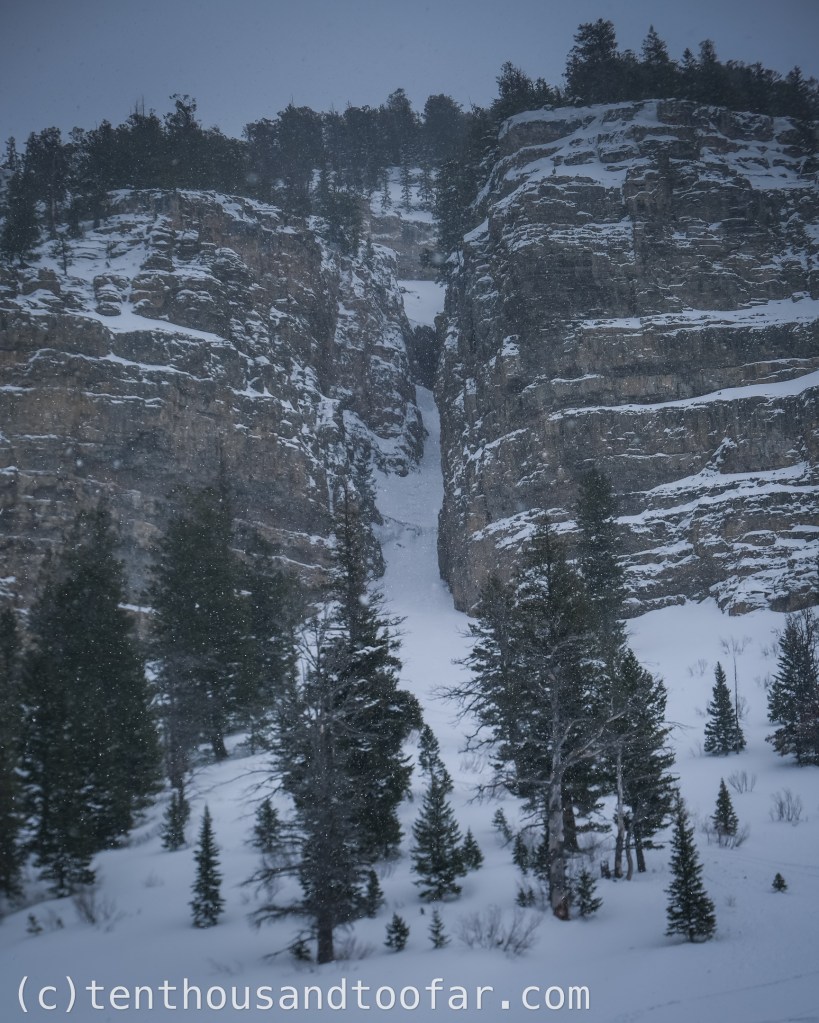
Our day began with a tedious slog into Eddington Canyon and a direct 2,200 foot skin up avalanche paths and steep trees to the summit ridge of Treasure Mountain, some 3,400 feet in full. I’ve established this method as my preferred approach for Treasure’s west side, as opposed to the more gentle and scenic, yet infinitely longer standard track over Chicken Knob and Lake Valley. If you own the Targhee Backcountry Ski Atlas, now out of print, we used the lower half of Second Shot and the trees immediately south for ascent. Any of the chutes and adjacent trees make for a grueling, yet refreshingly expedient and ultimately non-technical path to the 9,800 foot broad summit, provided avalanche conditions are in order. Breaking trail through 1-3 feet of snow determinedly, as Hayden had a 4:30 flight to Las Vegas that afternoon, had us ripping skins in under three hours.
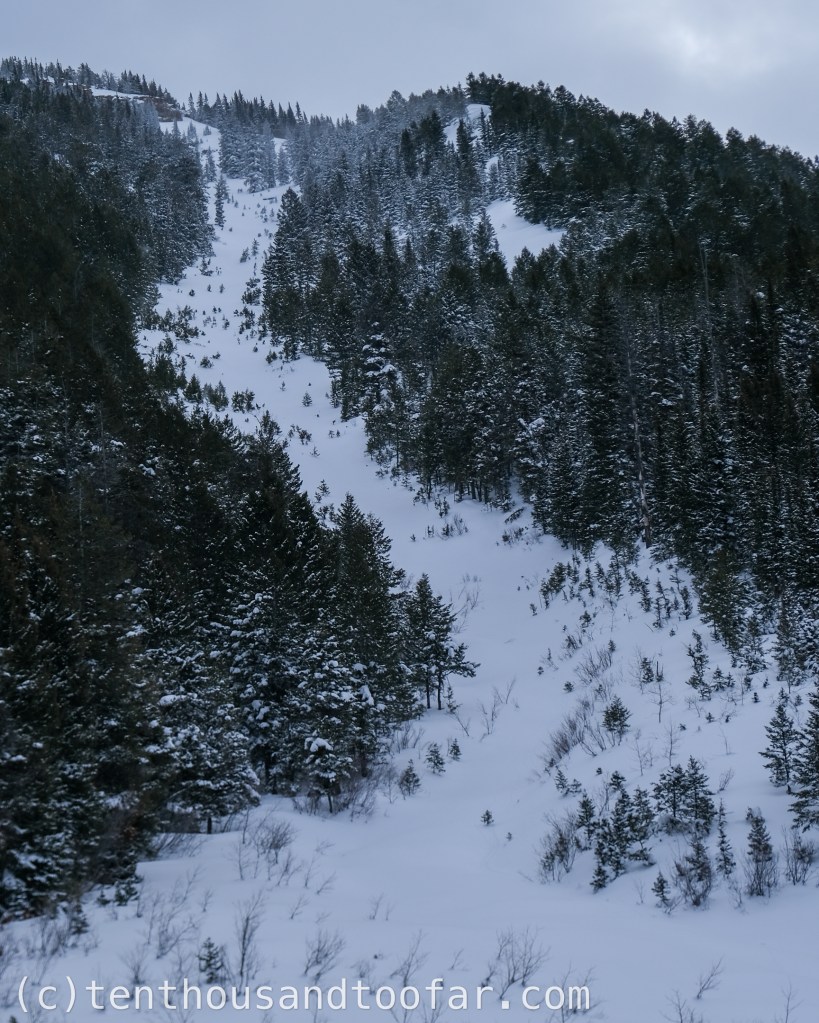
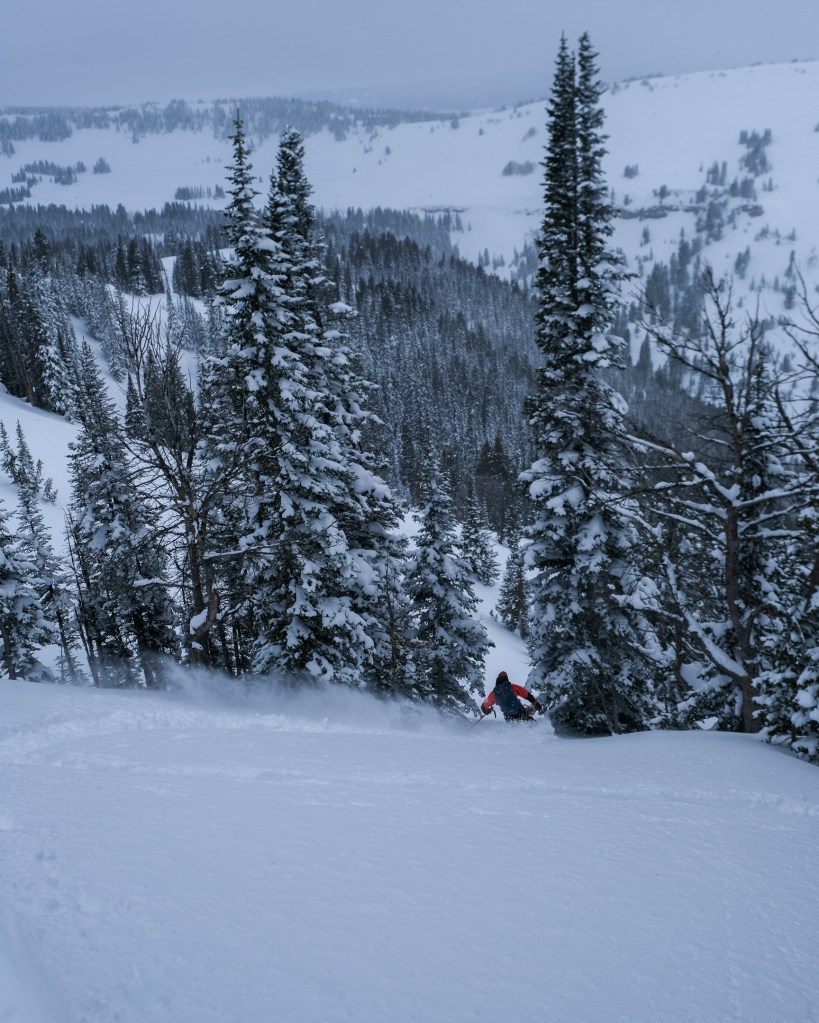
The ski conditions followed a bell curve. 800 feet of stellar fluffy powder down the dead end angling avalanche fan south of the couloir devolved into a few hundred feet of funky wind buff, which we saw through an obvious constriction before hanging a steady traverse skier’s right. Using a GPS device, guidebook or digital topographic map is recommended for navigation, as the entrance to the couloir is defended by a thick forest undesirable for skis, with several doppelgänger chutes to the west that would require vertical rappels in excess of 200 feet, over extremely chossy cliffs that may not provide any intermediate anchoring options should a rope come up short. Basically, you really want to nail this one. We began traversing north (from the avalanche path directly south of the Painted Lady) between 9,000 and 8,800 feet. This tactic worked great, and landed us directly on the humungous southern wall of the couloir. We carefully picked our way skier’s left towards the precipice of the cliff, locating a convenient fixed anchor on the largest logical tree nearing the edge. A few small wind skins moved with little resistance nearing our anchor – typical fare, as the northerly side of the vertical ribs on Treasure’s west face are almost always cross-loaded.
With a 50 meter static rope and tagline I set off on rappel, and upon reaching the main cliff was staggered with exposure – a beast, a vertical limestone choss wall of epic proportions – our rope ends weren’t even close! I prusik’ed back up from edge, rigged a hanging anchor from the nearest sturdy pine and called Hayden down. From this anchor we pulled ropes, said a prayer and descended into the void, unable to completely verify safety due to an intermediate ledge system blocking clear views of the snow below. I felt naked slipping down the rugged face on skinny ropes without any rock gear for an anchor or means to reascend, and was overjoyed when I popped over the ledge and saw a mere five feet of rope touching the snow. The whole scene was epic. Spindrift ripped overhead as a harsh wind howled up Eddington Canyon, dropping bombs of snow from the surrounding trees that exploded like piñatas on the cliff’s edge. As we rappelled our ski boots dislodged scatterings of limestone plates and vegetation with third every kick off the wall. The couloir itself was a mere twenty feet wide, adorned with an impressive cave and house-sized snow cone at its head. The Painted Lady was a special kind of place.
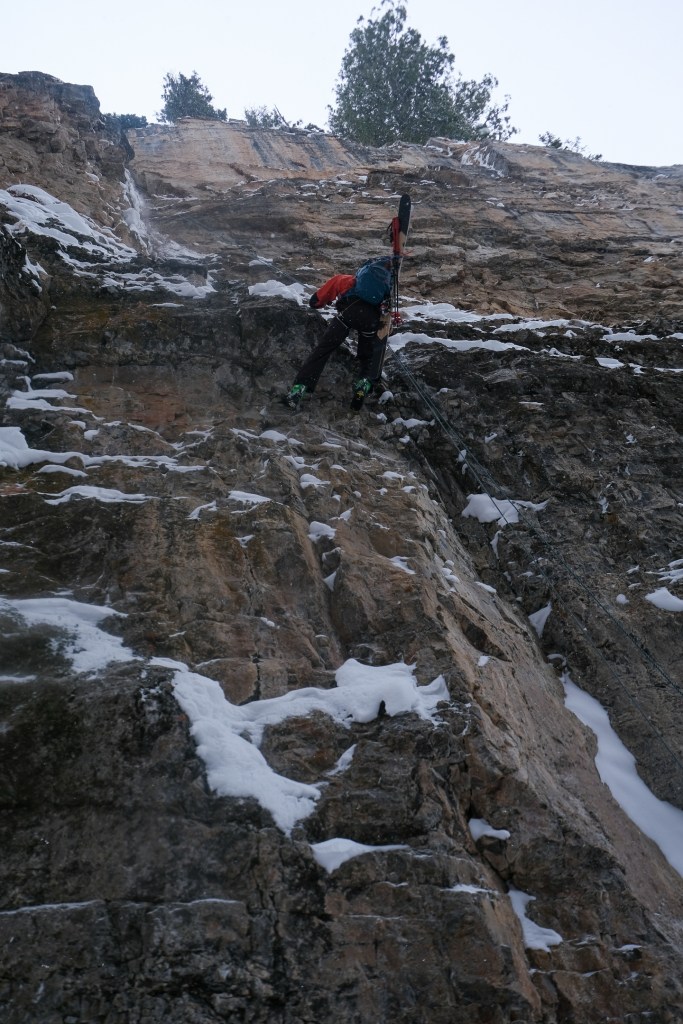
After coiling ropes we set to work on the couloir, which provided nothing but difficult turns through compacted dense powder towards an unforeseen mid-run ice bulge. Thinking the line was ski-through we didn’t have any supplemental rock gear for anchoring, and no trees were available. The ice itself was about two body lengths and near vertical, reasonably jumpable if it weren’t for the claustrophobic and steep landing zone, and generally poor snow. After deliberation Hayden made handy use of his 23 year old knees, four buckle boots and Marker Kingpins, taking flight and sticking the landing with a slight bobble, but recovering with tremendous poise and ripping turns into the powdery alluvial fan with serious velocity. I on the other hand, armed with nothing but 900 gram carbon ski mountaineering boots, lightweight mountaineering skis and slightly aged joints resistant to gravity defiance began to calculate the risk-reward equation of rekindling my outdated free-skier spirit. While the glory of high style was alluring, the likely consequence of tomahawking down an alpine couloir, to a possible knee twister or gear destruction, was a bit much to swallow. Alas I committed fringe tactics, throwing my skis, pack and poles over the ice. I scooted towards the edge on my butt, took a few deep breaths and pushed off the edge. Much to my delight I plummeted waist deep into a soft slough deposit – terrifying at first, but actually quite fun. I regathered my belongings and made my powder filled way to a smiling Hayden below – mission accomplished.

“Totally western” was a way of describing the Painted Lady. Though our tactics worked and were ultimately safe, we eeked this one out with thin margins. While rappelling the main cliff, and encountering the unforeseen terminal ice bulge, I chastised myself for not carrying the obligatory small collection of pitons and wires I almost always do for new-to-me rope intensive descents. Had I come up short on the main rappel I would have been left untethered on the sloping choss cliff while Hayden pulled and fixed both our ropes as a single strand, which we would have had to abandon after passing a knot on rappel with minimal extra gear – no small feat. Had the lower ice bulge been any larger, even double the size, jumping for either of us, skis or not, would have been unreasonable. The likely outcome would have been leaving a few ski poles as a deadman, or digging the ever terrifying and sometimes impossible snow bollard. A few pitons and wires could have provided exponentially safer and expedient anchoring options for either of these unfortunate scenarios. That said, at least we had the tools and strategies to make our way out if tides turned. In the Painted Lady we found a unique canyoneering-like experience, a descent that tested route-finding ability, terrain savviness, creativity and rope prowess above skiing ability. I’m not sure I’ll ever return, but it was a top notch adventure.
A Quick Note On Ropes
Two 70M ropes just miiiight reach from the main rappel anchor south of the couloir. We successfully, albeit barely, descended with 50M ropes and an intermediate hanging anchor at cliff’s edge. Two 60M ropes are probably the best minimum length, and would allow a slightly more comfortable intermediate non-hanging anchor above the cliff’s edge. A potentially shorter rappel entry from the north wall also seemed possible, but no fixed anchors were spotted.
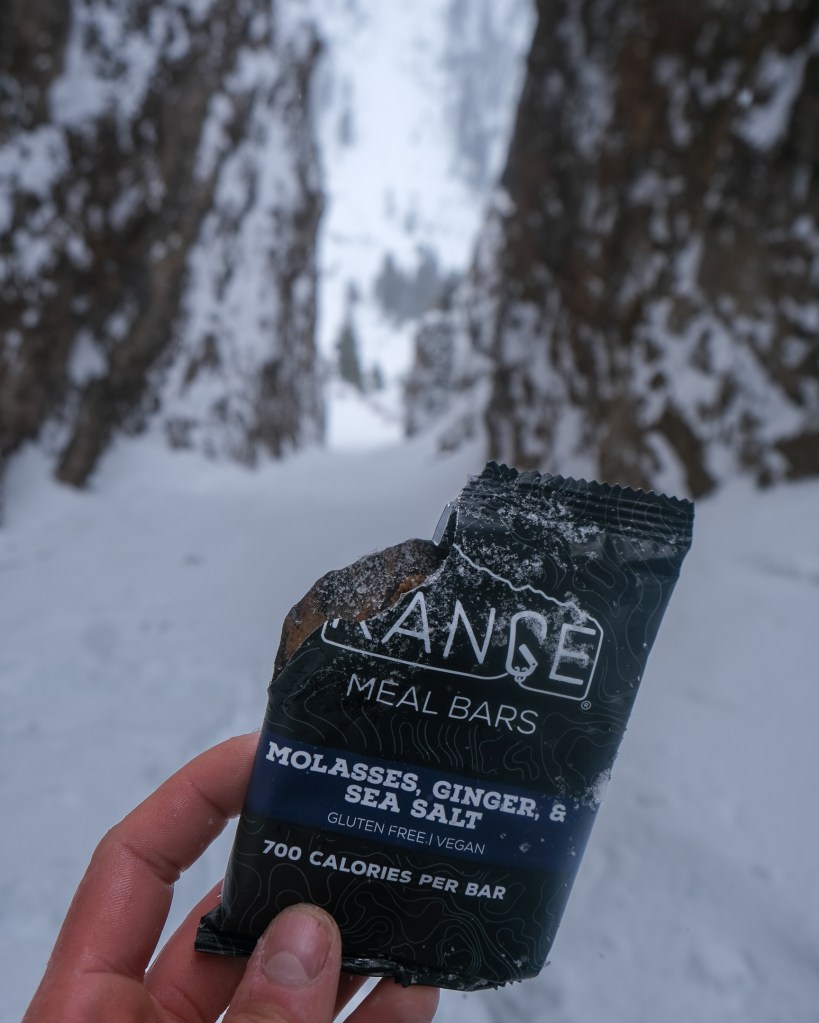
Ten Thousand Too Far is supported by Icelantic Skis, Range Meal Bars and Black Diamond Equipment.
Ten Thousand Too Far is also supported by reader donations. If you’ve used this website to plan an epic adventure, consider kicking in a few bucks. The hours spent writing these articles are fueled solely by the desire to enhance our vertical community.



DISCLAIMER
Ski mountaineering, rock climbing, ice climbing and all other forms of mountain recreation are inherently dangerous. Should you decide to attempt anything you read about in this article, you are doing so at your own risk! This article is written to the best possible level of accuracy and detail, but I am only human – information could be presented wrong. Furthermore, conditions in the mountains are subject to change at any time. Ten Thousand Too Far and Brandon Wanthal are not liable for any actions or repercussions acted upon or suffered from the result of this article’s reading.
 Ten Thousand Too Far
Leave a comment