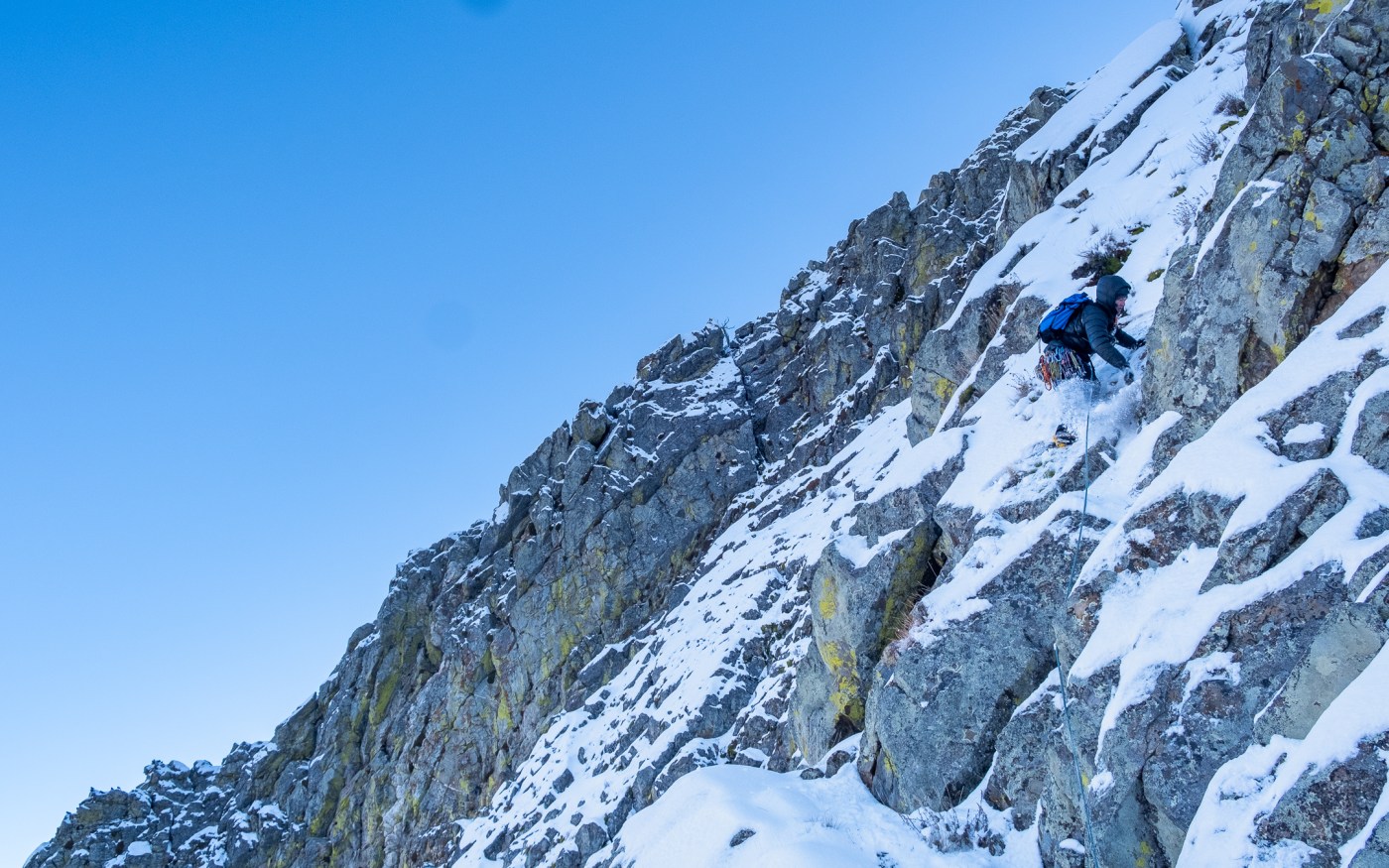
I returned to the Garden Creek Gap for the third time in 13 days to find the elusive Alpine Simulator route. Another wild quest up a 1200′ sea of river polished quartzite.

On Wednesday December 12th Erik Boomer and I packed up his mini van and made the pilgrimage 2.5 hours south to the Garden Creek Gap. I’ve become a bit obsessed with the Gap of late – my third trip in 13 days to climb a fully dry grade three winter route on a bizarre 1200 foot quartzite buttress that is just cool enough to dote over, but just strange enough to make one wonder what they’re doing with their life when things inevitably turn a little dicy. Jed Porter and I intended to climb this route on December 1st when we accidentally put up the first ascent of the more severe Agri-Alpinism (M5+, III). I’ve been keen ever since to catch the elusive Alpine Simulator and alas there I stood, new partner in tow, on the snow ramp bisecting the prominent, steepest, 800 foot buttress in the center of the north face. We had but 60 meters to decipher before joining Agri-Alpinism on the mellower upper face, yet all I saw was intimidating cracks that looked far harder than the proposed M4 grade. In typical Gap fashion I followed the golden Teton rule – “if it looks to hard it probably is” – and casted off to piece the puzzle together. Oh, I forgot to mention I got slapped in the face by a cantaloupe sized rock while climbing through the chockstone crux on pitch two. Turns out there was a loose block teetering on the edge of the chockstone, and as I pulled slack in on my micro-traxion (while following on a fixed line) the chunker rotated off its perch like a saw blade, contacting the bridge of my nose with the perfect force to crunch some cartilage while preserving bone structure. Met with only painful crunches when pinched, sounds of captain crunch cereal, I carried into my lead block with a few spits of blood. Last I checked, noses weren’t an essential body part to climbing.
Love Ten Thousand Too Far? Support independent mountain journalism with $5.10 per month through Patreon (and receive extra bonus content), or with a one-time donation. Any and all support is greatly appreciated.


Back to the crux pitches. We followed the terminus of the pitch three snow ramp before stepping back left five meters to avoid an overhang defending an obvious, broad and steep weakness trending back left with attractive jugs. The protection was just adequate to facilitate reasonable passage through these rock climbing jugs which I mostly climbed bare handed (M4), leading to the fourth pitch belay cave of Agri-Alpinism. From here I forked right up a gentle slab, beneath the crux dihedral of Agri-Alpinism, a splitter hand crack corner and a jagged snake-like finger crack to a meager belay ledge with a bush. Here we encountered the route finding crux, and I belayed Erik up for a second opinion. Feeling a bit frazzled from the rockfall I handed the rack to Erik, who valiantly tried to climb the finger crack with one tool, nearly pitched off, grabbed a cam and back cleaned the pitch – we were stumped. The hand crack wasn’t conducive to winter climbing and the tricky M5+ dihedral of Agri-Alpinism surely wasn’t the way. Faced with no other option I took the helm and committed to an irreversible series of side pulls out around a prominent arete on the right, blindly hoping easier terrain would manifest. Alas it did, with a tricky well-protected corner of steep dream hooks (M4) on the direct ridge crest with regal positioning. This crux rolled over into a brutally clean slab that required extreme patience, before breaking into blocky mountain terrain on the direct crest through two short chimneys stalking the path of least resistance towards the snowy upper prow. One last pitch, shared with Agri-Alpinism, climbed through steppy mountain terrain just right of the prow summit to the large flat saddle between the prow and true summit ridge. Here I got twisted up on an easy but awkward vertical step, lost balance and grabbed a cam out of instinct to arrest my fall – an interesting occurrence, likely born from well-protected complacency.


From the saddle Erik regained lead and climbed a cool open book dihedral on the ridge crest before leaning right to the finishing pitch shared with Agri-Alpinism and Ghetto Simulator (M4, III). He did a direct finish to the standard right trending slab ramp which involved three body lengths of impressively steep hooking and torquing to the literal summit boulder. He valiantly pushed this pitch 60 full meters, but I bet it’s best broken into two. I slipped once again following this pitch, and not even on the difficult section. Clearly focus wasn’t on my side today. Erik’s sheer determination to bang up such a bold finish was impressive for his third day of mixed climbing and speaks to his raw strength and ability as a mountain athlete. We topped the summit around 5.5 hours after tying in.


A Few Thoughts & Recommended Rack
On a personal note, I wonder why I left a clean onsight of Alpine Simulator on the table with two slips on easy terrain. Perhaps my lack of focus was due to forgetting my main food bag in the car. Or maybe I just got complacent after sending the two crux pitches. Or maybe that rock to the face, or the shoulder tweak I failed to mention on pitch five, tolled my mind. Gripes aside, I was happy to “do my part” and navigate through the cryptic and at times slightly runout crux pitches that were of the more insecure M4 varietal. As time goes by I’ve strived to be less hard on myself so long as I operate in a safe manner for both myself and my partners, but falling can be a tough pill to swallow when so much personal effort goes towards being a proficient climber. Alas, we took care of the business and lived to tell about it, which is really all that matters.
The primary lessons learned from our route finding intensive ascent is that often times it’s better to build an early belay and get a second opinion before blasting off into an uncertain zone. Poking around every corner can be time consuming and fraying to the mind. I also learned to be more thorough with preparation before a climb. Erik responded with a desire to climb at 10:00PM the night before, leaving me hastily and sleepily packing my bag for a spur outing, resulting in a botched food scenario, a forgotten breakfast and the absence of a headlamp. I need to uphold a higher preparation standard.
As for the route, I’d give about three stars. The climbing is a touch convoluted, but the positioning is incredible. In general the protection is adequate and the M4 grade is reliable so long as the correct path is chosen. Between Agri-Alpinism and this line there is potential for 1-2 single pitch deviations that would produce difficult ballpark M6 climbing, but otherwise the central buttress has been filled out. For a rack we carried a single rack of cams from #0.1 to three inches, with doubles from #0.5 to #1, a plentiful selection of wires, a few tri-cams and a few thin pitons. Due to the wandering nature of the route a few extra 120cm slings could be in order. We never used the tri-cams or pins, but the rest of the rack felt appropriate. Mountain Project and Ten Thousand Too Far are the only resources for Gap climbs.
Ten Thousand Too Far is supported by Icelantic Skis, Range Meal Bars and Black Diamond Equipment.
Ten Thousand Too Far is also supported by reader donations. If you’ve used this website to plan an epic adventure, consider kicking in a few bucks. The hours spent writing these articles are fueled solely by the desire to enhance our vertical community.
Enter your e-mail to subscribe to updates from Ten Thousand Too Far, only alerts from new posts, nothing else!



DISCLAIMER
Ski mountaineering, rock climbing, ice climbing and all other forms of mountain recreation are inherently dangerous. Should you decide to attempt anything you read about in this article, you are doing so at your own risk! This article is written to the best possible level of accuracy and detail, but I am only human – information could be presented wrong. Furthermore, conditions in the mountains are subject to change at any time. Ten Thousand Too Far and Brandon Wanthal are not liable for any actions or repercussions acted upon or suffered from the result of this article’s reading.
 Ten Thousand Too Far
Leave a comment