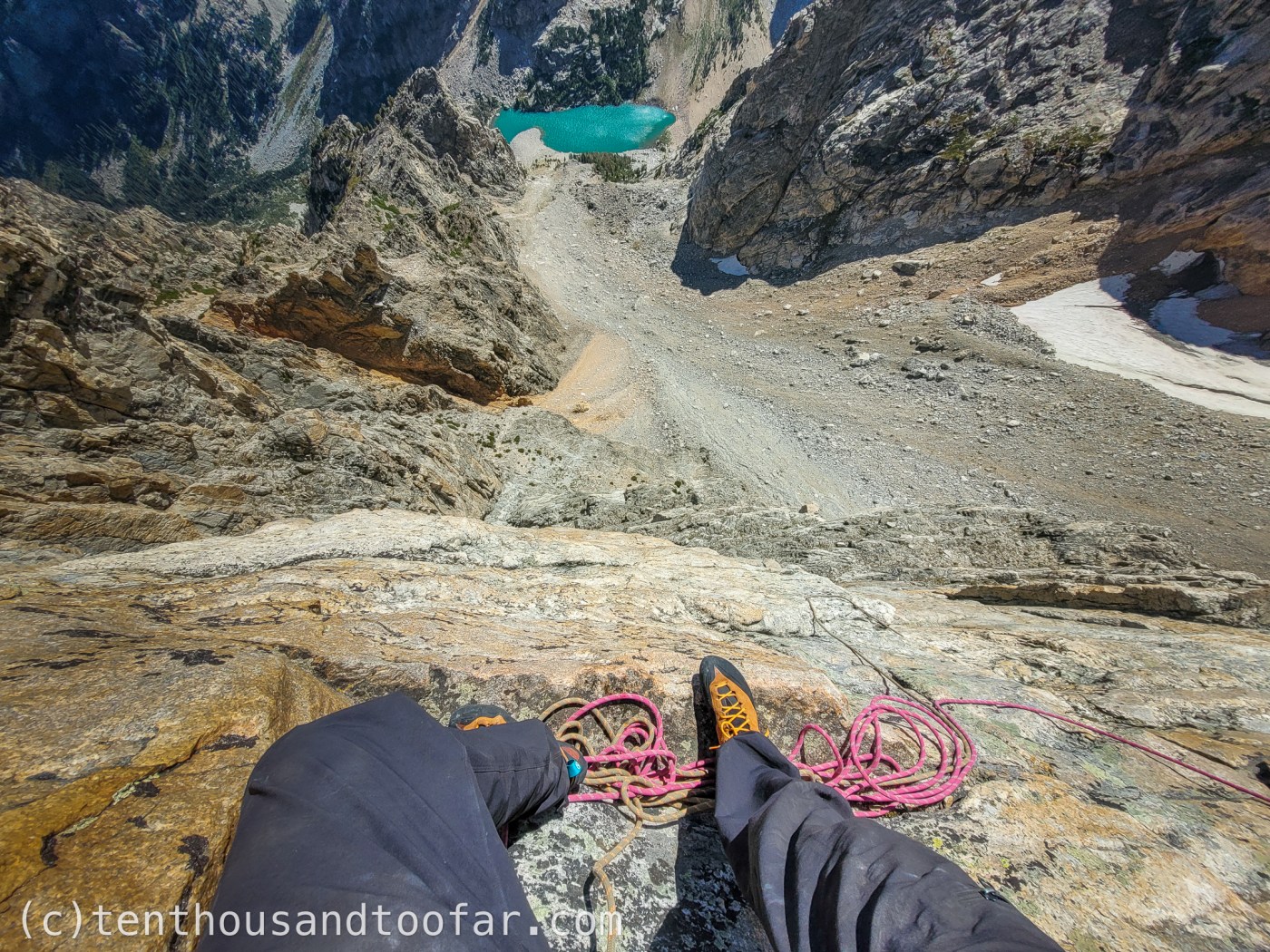
On Saturday September 9th, 2023, Liam Wylie and I climbed the sheer 1,000 foot South Face of Cloudveil Dome via the classic Armed Robbery (5.9, IV) route. This was by far my most efficient and seamless grade IV to date – a wonderful day out with a great friend.
Armed Robbery has captivated my mind for about two years. Every climber who drives into Grand Teton National Park from Moose spots the commanding south face of Cloudveil Dome. In the morning it’s shaded, and a half egg shaped silhouette evokes flits of Yosemite’s Half Dome. Armed Robbery tackles the 1,000 foot wall head on, straight up a sea of high quality Teton granite – from the lowest point to the summit – yep, the center line. For those interested in aesthetics, this route, along with it’s more challenging divergence Silver Lining (5.10, IV), are cream of the Teton crop. A 5,000 vertical foot approach with many hazards including early season snow, chossy fourth class scrambling, loose scree gullies, multiple couloir networks and no real climber’s trail bars crowds. The remoteness alone beckons caution – one of those faces where “bailing upwards” rather than retreat to terra firma is the more realistic form of self rescue. Then there’s the steepness, with the two crux pitches either sustained vertical or gently overhanging, extremely uncharacteristic of Teton climbing at the grade. Combine all of the above with high elevation – the route tops out at 12,000 feet – and one sparsely protected 5.9 pitch halfway up the wall, and you have a recipe for a tangible reprieve from densely populated, classic, Teton alpine climbing. For these two 5.10 climbers, Armed Robbery was seminal and empowering tick.
Love Ten Thousand Too Far? Support independent mountain journalism with $5.10 per month through Patreon (and receive extra bonus content), or with a one-time donation. Any and all support is greatly appreciated.
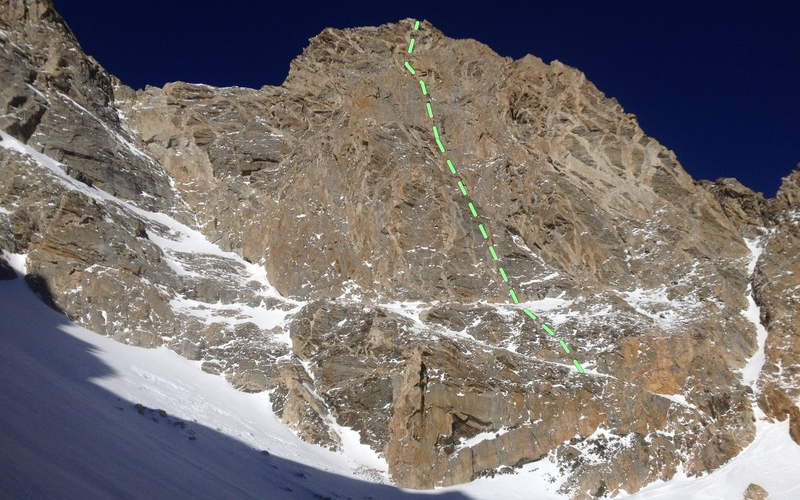
(photo credit: Greg Collins)
We began at 05:30 from the Lupine Meadows trailhead. Liam was sick and hadn’t slept a wink, and I was coming off a 70-something hour work week and four hours rest. The original intention was Silver Lining (5.10, IV), but we quickly realized that dream was a tad ambitious for our motley shape. Frankly, we’d be lucky if we got up anything of magnitude, and vowed to be realistic about our sleepless capabilities. Armed with excessive caffeine and some simple carbohydrates we impressed ourselves by blasting through The Meadows before 07:00, and nailing the approach to the Nez Perce/Cloudveil Dome Col just shy of 08:30. 4,500 feet of vertical with two ropes, a double rack and emergency winter bivy gear in three hours ain’t too shabby, and boosted our spirits for potential success. Reaching the base of the route was more difficult than expected. We descended the south facing couloir from the col (winter Nugget Ski Couloir) and forked right after about 300 feet into a narrower chute of red rock and kitty litter rubble. A fourth class escape to the west facilitated a traverse across another even narrower chute (Sneaker Ski Couloir?) and the base of Cloudveil’s tremendous south face. Finding the literal start of Armed Robbery amidst the nondescript sea of rolling granite is a task all to itself, and probably left to a guidebook author. The best advice I can give is to step back and locate the relatively prominent crux double roof, double traverse pitch, and subsequent dueling cracks of Armed Robbery and Silver Lining, vertically bisected by a protruding golden pillar halfway up the wall. Then locate the Matthews Ramp, a steep left trending ramp system that leads to the two aforementioned crux pitches. The goal is to reach the west-most tip and conclusion of the Matthews Ramp, right beneath the western edge of the first crux roof on the double roof pitch. The double roofs and 100M crack system west of the pillar define the climb, and the other six pitches, three below and three above, are filler faire up to interpretation – an exercise in first ascent mentality and alpine problem solving. We began climbing in a cleanly fractured 5.7 dihedral around 10:00.


To keep the narrative short, we believe we found the first pitch, but wandered askew on pitches two and three. Luckily, the lower slabs all seem about the same grade and facilitated a few easy warm-up rope lengths to the top of the Matthews Ramp. As pre-agreed from the car, I was point for the two crux pitches. The double roofs looked very imposing from below – steep, black, jagged and mean, like some psycho alpine bouldering cave. To avoid rope drag I vowed to place protection only when absolutely necessary, slinging a lone chockstone with a 240cm sling as my only protection for the first roof traverse, which cleanly climbed at balancy 5.7+. The second roof traverse back left provided the real spice. I fiddled in just enough protection, mostly off-set wires and small cams, between overhanging rests to feel reasonably safe, but the sad reality maintains that falling in this section could have catastrophic implications. Strenuous overhanging 5.8+ moves twenty feet left and ten feet above the last piece, with risk of a monster sheath threatening pendulum, at 11,500 feet, kept my head centered and technique precise. The guidebook says to set a hanging belay somewhere in the pillar crack pitch, but fears of rockfall ushered me to link the two. Steep and sustained jamming of all sizes, at the worst overhanging and at the best dead vertical, with occasionally sporty protection, continued for another 30M of challenging leading. At least four pieces of fixed protection told stories of many climbers getting over their heads. Liam needed to simul-climb through the first roof to let me reach a good belay stance at the top of the pillar with 50M half ropes. By the end, fearing more drag, I was severely runout – grateful to have a rock-solid partner I could trust not to rip me off the wall. This was perhaps the most demanding lead of my summer, fortunately on superb rock.

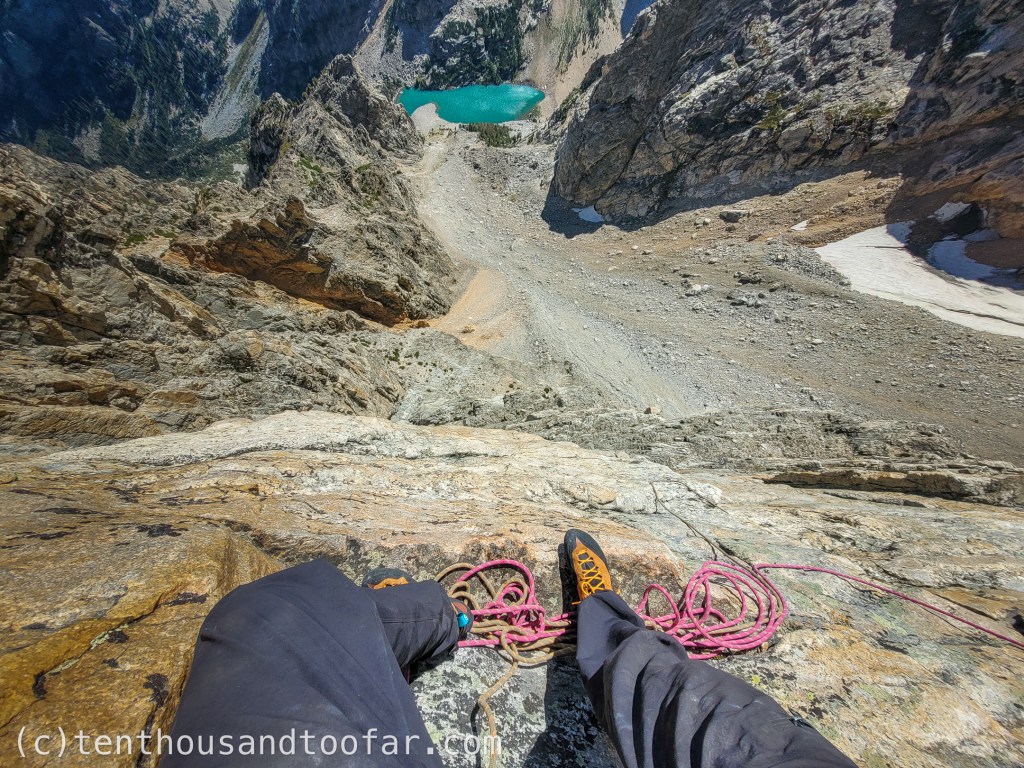
From the top of the pillar the angle eased to typical off-vertical fare. Liam finished the geologic extension of the pillar crack, leading left of two roofs on an exposed 5.8 varied crack to another low-angle ramp bisecting the upper face. Apparently the first ascent continued more or less directly up, but all we saw were off-widths and choss gullies. Guidebooks provide no guidance in this section, so we flipped into first ascent mentality. We scrambled easy slabs trending up and left for some 40 meters, until a minor roof pull and subsequent leftward traverse provided access to a fractured upper face. I continued through a short 5.9 finger crack on good quality stone, likely a first or unpopular ascent, to a final ledge above. Liam’s last lead was a 5.6 slab ending a spitball west of the summit block. We topped out around 17:00, about 6.5 hours after leaving the ground, amidst a brilliant golden backdrop of Mount Wister and Lake Taminah to the south, and the ever impressive core range to the north. The slightest nip of early winter chill kept our puffy jackets zipped tight. 12,031 feet – the summit of Cloudveil Dome.
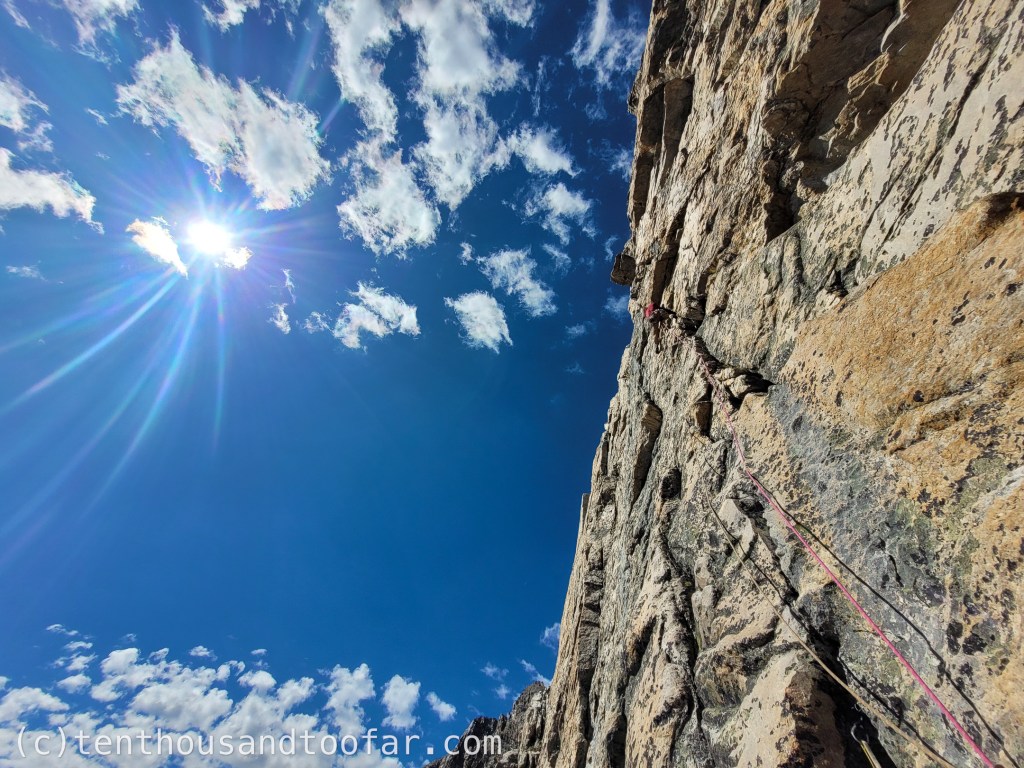
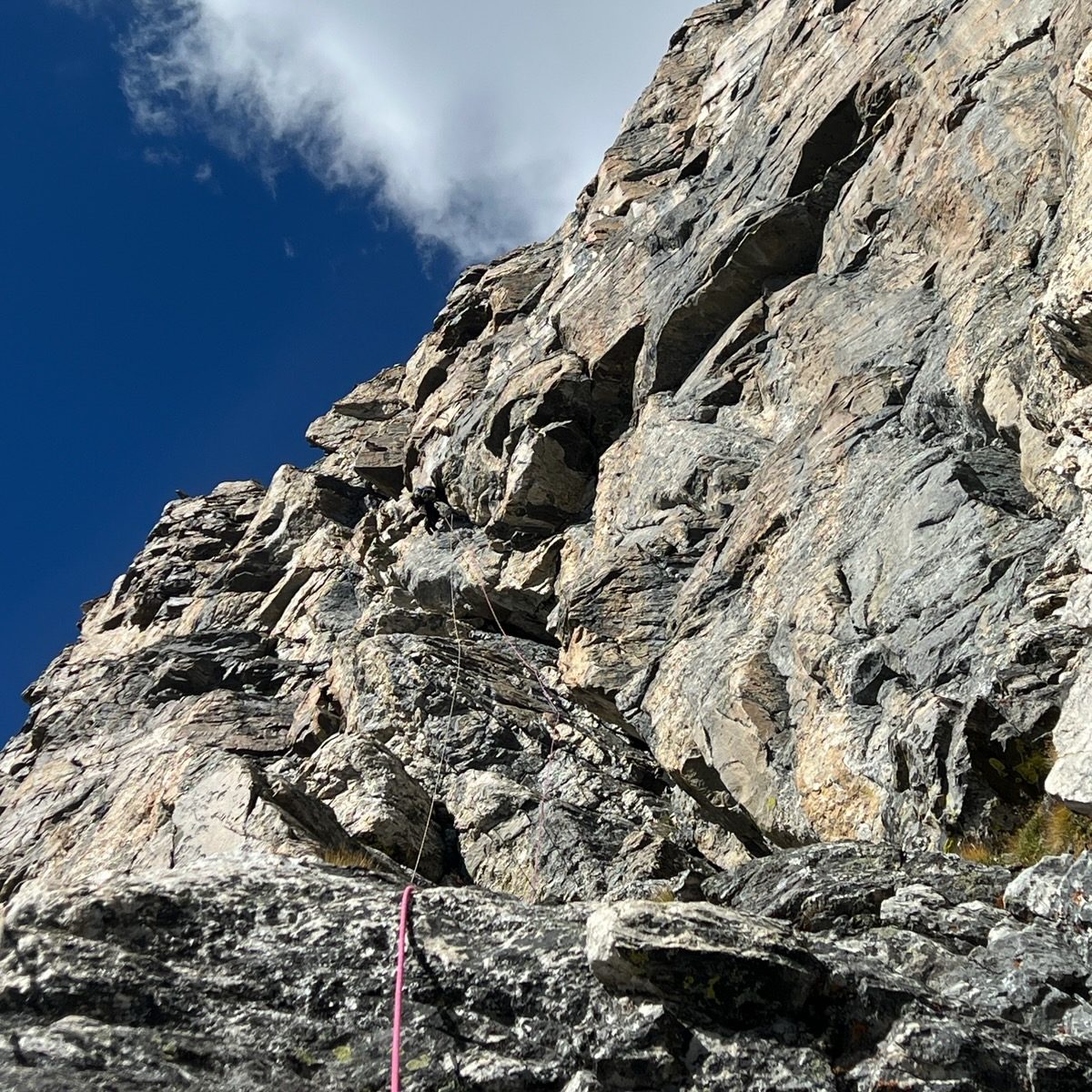
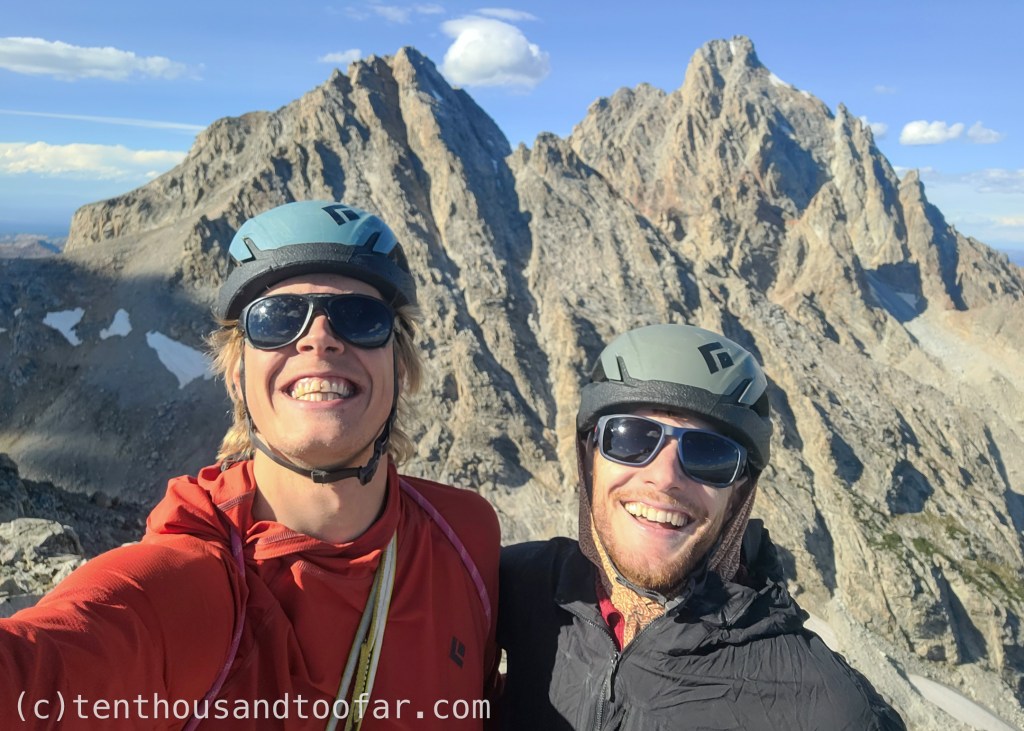

We followed the familiar East Ridge (5.1, 600 feet) for descent. Two years ago, after soloing the ascent, I needed to sling a chockstone to rappel the distinct 5.1 slab crux. I was happy to discover my improved climbing ability didn’t require a rope this time. We reached the packs by 18:00 and the cars by 20:15 – that’s right, lots of scree sprint-jump-jogging. This time of year I find it extremely difficult not to jog out of the Meadows, even if my knees resent me the next morning. No headlamps were needed, though by the time we reached the car even our shoelaces were a blur – winter is coming. Our story ended with a rearview mirror full of National Park Police lights. Apparently my license plate illuminators were out, and I tagged the yellow line a few times while Liam tried to distract me with mountain silhouettes on the horizon. Thankfully I’ve been sober for six years and the cop was a climber, so we skated without so much as a written warning – funny, because little did he know we just pulled off an Armed Robbery 🤭
A Quick Reflection & Rack
The Ortenburger-Jackson guide rated the first crux pitch “5.8 serious” and the second crux pitch “sustained 5.8+”, so I think it’s more than reasonable to call this route 5.9 – and while guidebooks declare six pitches, I think it takes most parties between seven and nine. The sentence above tells the bulk of the story – Armed Robbery is an adventure beyond the guidebook description. The climbing on the steep middle headwall is as classic as it gets, but the filler climbing above and below lacks definition. Should this route get transported to Death Canyon it would surely be forgotten, but the positioning alone on the most impressive road-visible face of Grand Teton National Park keeps it on the “must do” list. However, if you didn’t read the preceding trip report it’s worth noting that protection is at points severely lacking, and the willingness to climb sustained 5.8+, 20 feet out from your last off-set nut, at 11,500 feet, is paramount to success. That said, this climb has also been sent in sneakers mid-winter, so it is by no means a death climb. The rock is predominantly sound, and the true crux could be figuring out how to link the double roof and pillar pitch without tremendous rope drag, or how to set an intermediate hanging belay without endangering your belayer. With 6,000 vertical and some 10-15 miles in full, completing Armed Robbery in a day is a significant undertaking.
For a rack we brought a single set of cams from micros to four inches, a double set from fingers to three inches, a set of nuts and a set of offset nuts. This was probably overkill, and mostly because we were considering Silver Lining. If I were to repeat this route I would leave the four inch cam and a few smaller cams behind to comfort. A double set of thin-hand and hand sized cams will be enjoyed by most parties linking the double roof traverse and pillar pitches. Lastly, a 70M rope, or even better 60M half ropes, are probably optimal for linking pitches, we did quite a bit of simul-climbing.

Want to support? Consider a donation, subscribe, or simply throw some greenery at our sponsors listed below.
Ten Thousand Too Far is generously supported by Icelantic Skis from Golden Colorado, Barrels & Bins Natural Market in Driggs Idaho, Range Meal Bars from Bozeman Montana and Black Diamond Equipment.


subscribe for new article updates
DISCLAIMER
Ski mountaineering, rock climbing, ice climbing and all other forms of mountain recreation are inherently dangerous. Should you decide to attempt anything you read about in this article, you are doing so at your own risk! This article is written to the best possible level of accuracy and detail, but I am only human – information could be presented wrong. Furthermore, conditions in the mountains are subject to change at any time. Ten Thousand Too Far and Brandon Wanthal are not liable for any actions or repercussions acted upon or suffered from the result of this article’s reading.
 Ten Thousand Too Far