
On July 1st, 2023, Bobbi Clemmer and I found our flow on one of our favorite GTNP routes to date, the Corkscrew Arete on the Watchtower, one of the many freestanding spires between The Grand Teton and Disappointment Peak.
After many weekends of lowland park missions Bobbi and I were excited to launch into the true alpine – to get above the clouds, where the air is thinner, fat marmots abound and rock climbing just feels a bit more adventurous. A heavy snowpack still barred the high peaks so we aimed lower, towards a classic route that has caught my attention many times while thumbing through Aaron Gams’ Teton Rock Climbs – the Corkscrew Arete. Known for solid rock and a straightforward approach, with six pitches up to 5.8+ and incredible positioning on The Watchtower, one of the many freestanding spires between the Grand Teton and Disappointment Peak, “The Corkscrew” seemed a perfect half day plug after cacheing overnight gear in The Meadows for a second outing the following day.
Love Ten Thousand Too Far? Support independent mountain journalism with $5.10 per month through Patreon (and receive extra bonus content), or with a one-time donation. Any and all support is greatly appreciated.
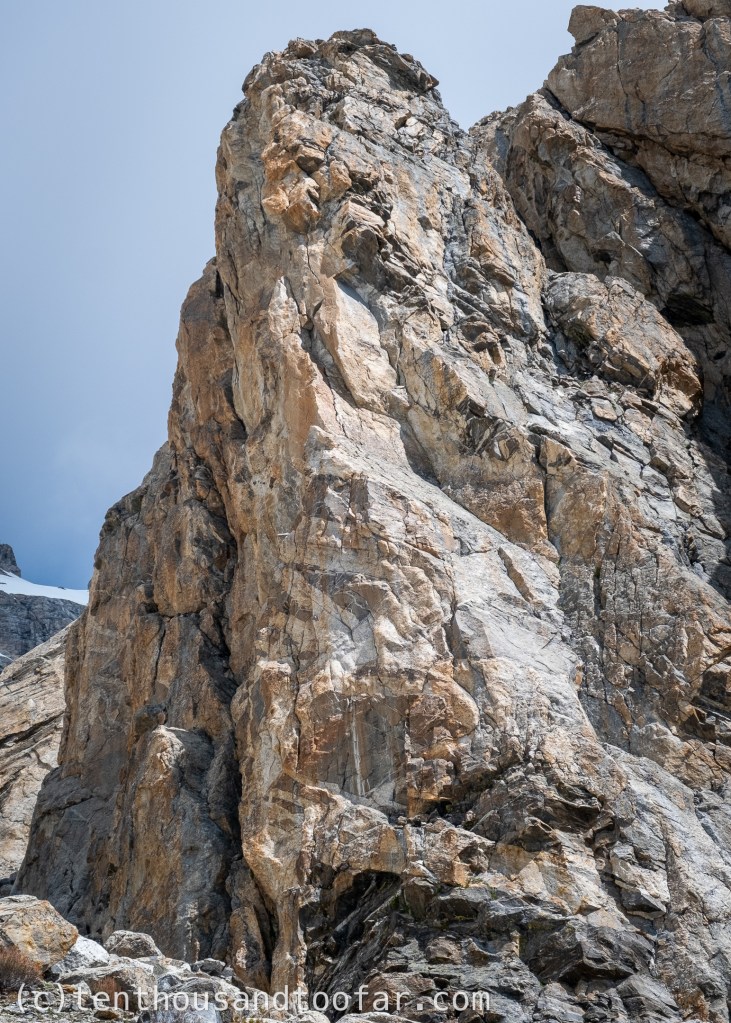
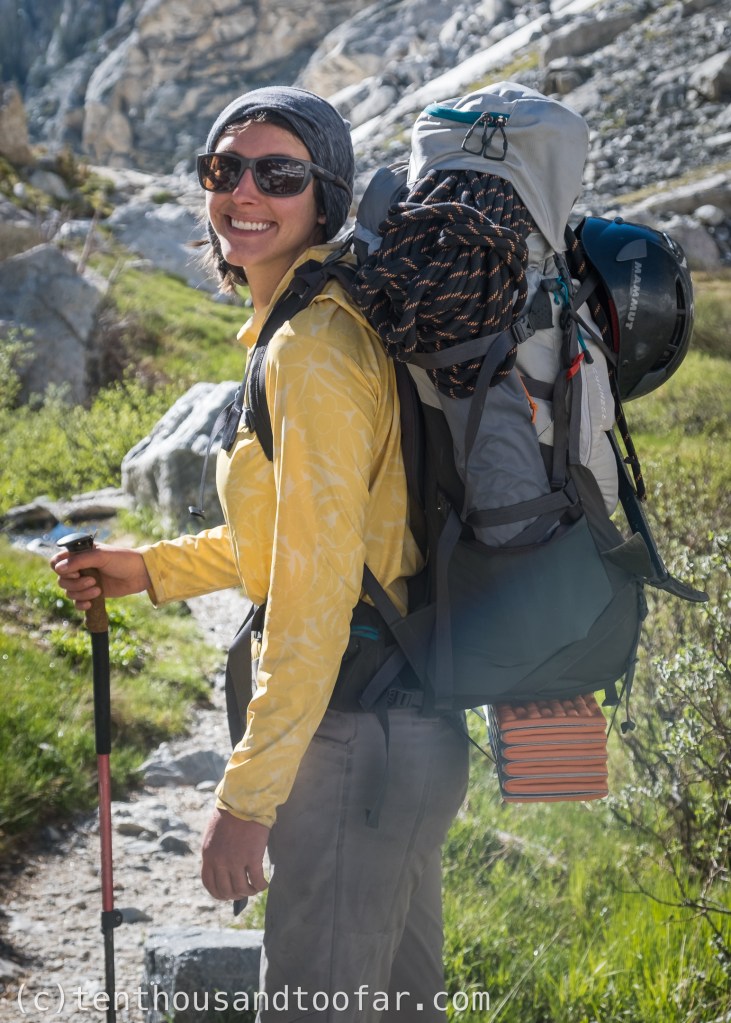
4:30AM wake-up, muesli with fresh strawberries on the road, Lupine Meadows by 5:45AM and walking by 6:01AM – we were on the move. This was Bobbi and I’s first respective overnights in GTNP this summer season, and we were psyched to escape the valley floor for a few days. Despite fully strapped bags we gained The Meadows by 8:30AM and were downsized for The Corkscrew, which lurked directly above our camp, by 9:30AM. With afternoon thunderstorms possible we intended a siege ascent, hiking into the North Fork with rope backpacks, ice axes, loaded harnesses and a small summit pack. Following suggestions from the Gams guidebook we stayed true to the main trail, passing the Petzoldt Caves camping zone, until a brief five minute horizontal contour could be made to the obvious base of the route. With many dramatic features and “dead ahead” visibility for the final hour of the approach, locating the base was a refreshing breeze and we were climbing by 11:00AM.

With budding clouds overhead and a slightly concerning breeze we planned to climb as quickly as possible, running the rope dry and simul-climbing if necessary to link pitches. On paper The Corkscrew is a six pitch affair, but we managed to summit in three 55-60M pulls and a brief scramble. Though the overall route grade seemed fair, many individual pitches felt quite sandbagged, making for a more sustained challenge than expected. Despite 5.8+ falling well below my alpine trad on-sight grade, running the rope 60 meters through such consistently difficult terrain required regular 10 meter runouts and special attention to gear conservation. Pitches one and two oscillated between 5.6 and 5.8 terrain, ascending faces and slabs on climber’s right of the south ridge, with a belay beneath the obvious southeast facing splitter fist crack in golden rock visible from The Meadows (save at least one #2 or #3 Camalot for this anchor). This 10-15 meter crack kicked off the start of our second mega pitch, with secure but committing jamming on the knife edge arete to an imposing roof, which is passed on the left, to the southwest face via a dead vertical 5.8 hand crack with no face holds and hundreds of feet of direct exposure. Generally I would consider myself a mediocre crack climber, who thieves away on crimps, side-pulls and smears whenever possible, so this “true crack pitch” was an especially meaningful on-sight. We wound like a corkscrew, dipping fully onto the west face, through the short but exciting pitch four finger crack crux (5.9), to a shaded alcove belay beneath an obvious broken chimney that grants passage back to the sunny south ridge. To be honest, I really thought Bobbi would have had a harder time on this challenging stretch of varied crack climbing – fists, hands and fingers in a single pitch, but much to her alpine nature she followed in no more than a jiffy.


Time was of the essence as we racked for the summit push. Puffy clouds were building, and a freestanding spire is nowhere to be during a Teton thunderstorm. Bobbi reported the pitch five chimney “definitely 5.7”, suggesting I may have been eating too much coconut milk ice cream the past few weeks. The first 10 meters involves strange squeeze climbing where I repeatedly got stuck, and needed several heel-toe cams, knee bars and grunts to escape. Above the chimney, I lowered a loop of rope to retrieve our bag before leading a long dance of endless 5.easy terrain on a splendidly exposed ridge to the summit crest. Slim Bobbi squeezed up fast, and we short roped to the true summit just before the three hour mark – not bad for six pitches and some 500 feet of technical terrain. The views from the summit were supreme – the snowy and always impressive Grand Teton to the west, a sprawling Jackson Hole plateau and Gros Ventre Range to the east, staggering granite peaks circling in every direction. I took a few photos of Bobbi from the descent ledges – this time they really did her bad ass vibe justice.

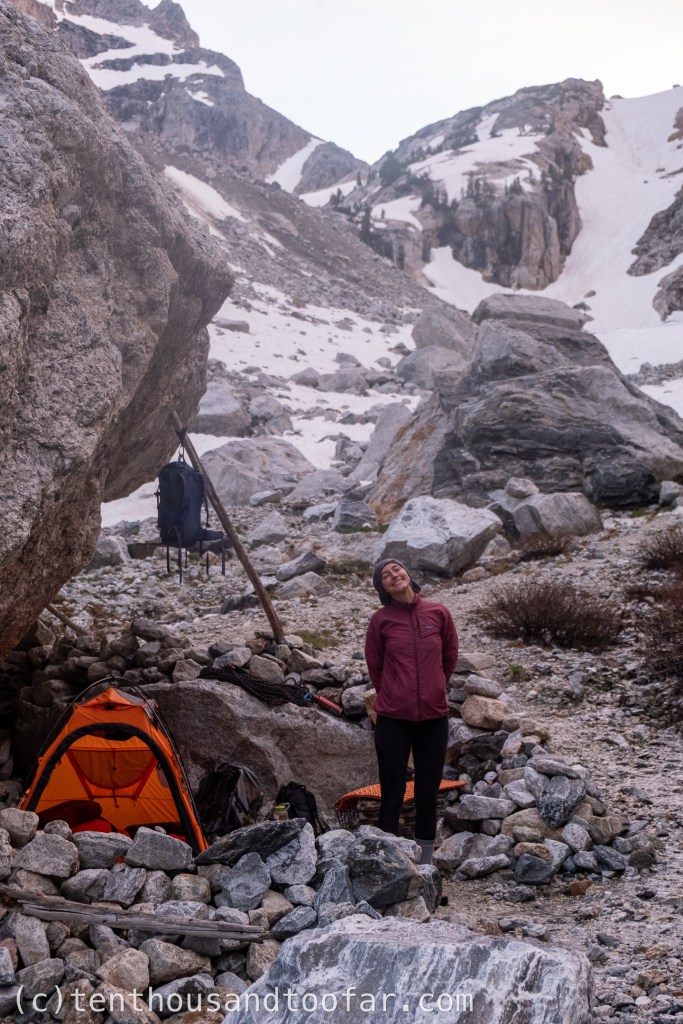
Keeping with the four star nature of the route, the descent was perhaps the coolest I’ve done in the Tetons. From the summit, a precarious ledge system leading to Teepe Glacier seems death defying, until just wide enough mini-sidewalks and nice handholds for balance facilitate a truly memorable, unlikely, highly exposed, yet reasonable goat path off the mountain’s north side – no ropes necessary. With seemingly steady weather we took a leisurely lunch break and paid for it by evening, when a nasty thunderstorm ripped through the canyon and forced a sloppy wet jog back to basecamp. As we stripped off wet clothes and huddled in our sturdy four season Nemo Tenshi two-person tent, smiles of gratitude adorned our faces. As beginner climbers used to prolonged ascents and tedious retreats, today was a welcomed reprieve. The Corkscrew may have been our most seamless and efficient alpine climb as a partnership, on some of the best Teton rock to boot!

A Few More Words
Our nightcap was a delicious meal of black bean soup with avocado, dried chipotle chilis and tortillas, washed down with ProBar protein bars. The storm cleared and provided an hour of twilight to enjoy, and fortunately our tent stayed dry as could be. The next day we woke up and attempted Open Book, a classic line on Disappointment Peak I climbed with Liam last summer, but after a poor night’s sleep and intense morning sun we opted to bail off the second pitch. The crux 5.9 corner above seemed wet and the initial 5.9 hand crack smacked Bobbi with a nefarious case of “flash pump”. We returned to the real world with eight great pitches in the bank, and a few more notches in Bobbi’s swelling alpine pyramid. Of the forty-some Teton rock routes I’ve climbed The Corkscrew easily lands top five, and is certainly a first tier Garnet Canyon classic – a bit far for it’s own day, but a worthy addition to any extended stay in the area.



Recommended Rack & Some Betas
I appreciated a full double rack of cams to from fingers to three inches, a single set of micro cams and a full set of nuts for linking pitches. The guidebook will tell you to bring a #4, but it’s definitely not necessary. I brought one and placed it only once, just above a great #3. The starting and finishing pitches wander a bit, so ample runners are useful. A 60 meter rope is the minimum to link pitches without simul climbing. If trimming the rack, consider double sets of cams from 1-3 inches the most important. No fixed gear was observed on route, and backpacks will not be your friend on pitch five. If climbing with a pack, consider tagging it up after the leader finishes the chimney unencumbered.
Resources
Teton Rock Climbs (Aaron Gams) and A Climber’s Guide to the Teton Range (Ortenburger, Jackson) both offer valuable topos for The Corkscrew and other variations/extensions.
Ten Thousand Too Far is generously supported by Icelantic Skis from Golden Colorado, Barrels & Bins Natural Market in Driggs Idaho, Range Meal Bars from Bozeman Montana and Black Diamond Equipment. Give these guys some business – who doesn’t need great skis, gear and wholesome food?




If you would like to support Ten Thousand Too Far, consider subscribing below and/or leaving a donation here. The hours spent writing these blogs is fueled solely and happily by passion, but if you use this site to plan or inspire your own epic adventure, consider kicking in. A couple bucks goes a long way in the cold world of adventure blogging. I also love to hear your thoughts, so don’t leave without dropping a comment! Thanks for the love.
Follow my photography at @brandon.wanthal.photography
enter your email to subscribe for new articles
DISCLAIMER
Ski mountaineering, rock climbing, ice climbing and all other forms of mountain recreation are inherently dangerous. Should you decide to attempt anything you read about in this article, you are doing so at your own risk! This article is written to the best possible level of accuracy and detail, but I am only human – information could be presented wrong. Furthermore, conditions in the mountains are subject to change at any time. Ten Thousand Too Far and Brandon Wanthal are not liable for any actions or repercussions acted upon or suffered from the result of this article’s reading.
 Ten Thousand Too Far