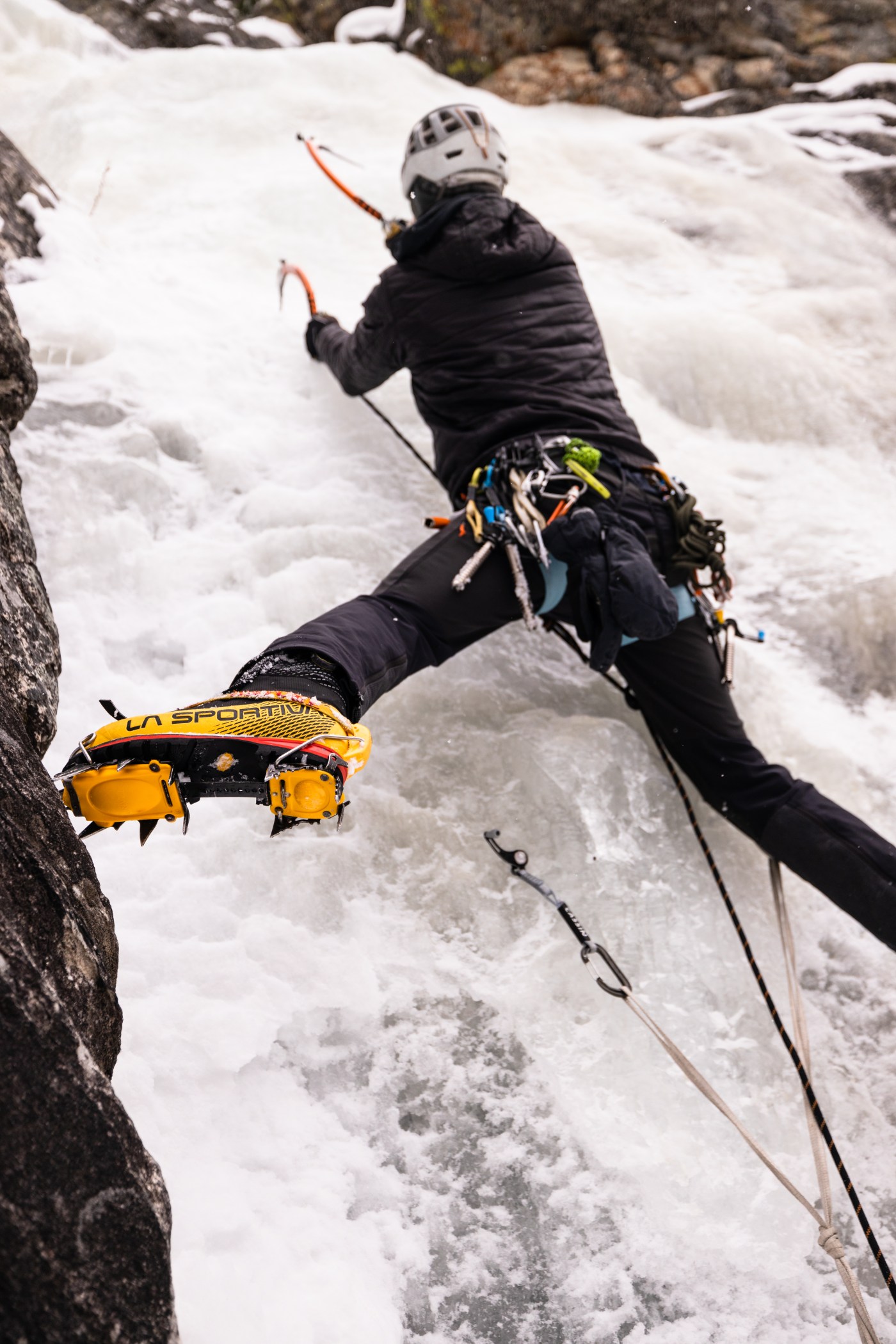
A diary reflection of my second year winter climbing, with five key takeaways.
I climbed in the vicinity of 100 pitches of ice, mixed and dry this winter across Northern Wyoming, Utah and Montana. My original goal for the season was to become comfortable on WI4 and begin leading WI5, and by the end of the year I had a handful of WI5 on-sights and traditional mixed leads up to M6. More importantly than grades, I got the chance to become a real “part of the team” on bigger, alpine, multi-pitch adventures, such as Ovisight (WI6, IV) Pillar Of Pain (WI5, III) and Mummy III & IV (WI6, M6+, III). In line with other “5 key” articles, I distilled my personal growth into five key takeaways.
Love Ten Thousand Too Far? Support independent mountain journalism with $5.10 per month through Patreon (and receive extra bonus content), or with a one-time donation. Any and all support is greatly appreciated.
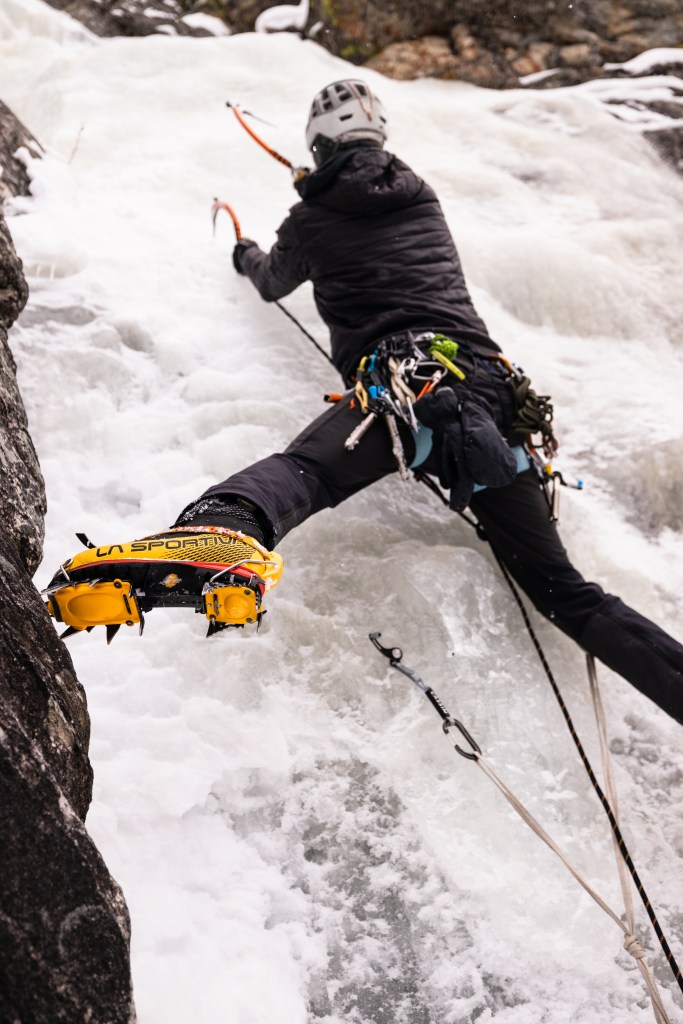
1. Dead Hangs and Dry-tooling for Early Season Fitness
Unlike last year, where I took straight to the ice and got deathly pumped on my first half dozen leads, I grabbed my tools a month early and starting building fitness. I began with simple single tool and double tool dead hangs from the smallest edges on my wooden hang board, using a chair for assistance if I wanted to hang longer and build endurance. I didn’t follow any protocol per say, just hung around until I felt reasonably fatigued and ready to do something else, a few times per week. Once the local cliffs really iced up I sampled some local dry-tooling and started getting my Euro on. Because I am not interested in pure dry-tooling and my goals were solely ice driven, I sought the steepest routes available and top-roped my heart out. I only logged a half dozen dry days before early ice called my name, but I felt a lot more comfortable and physiologically adapted to winter climbing by the time I took the sharp end.
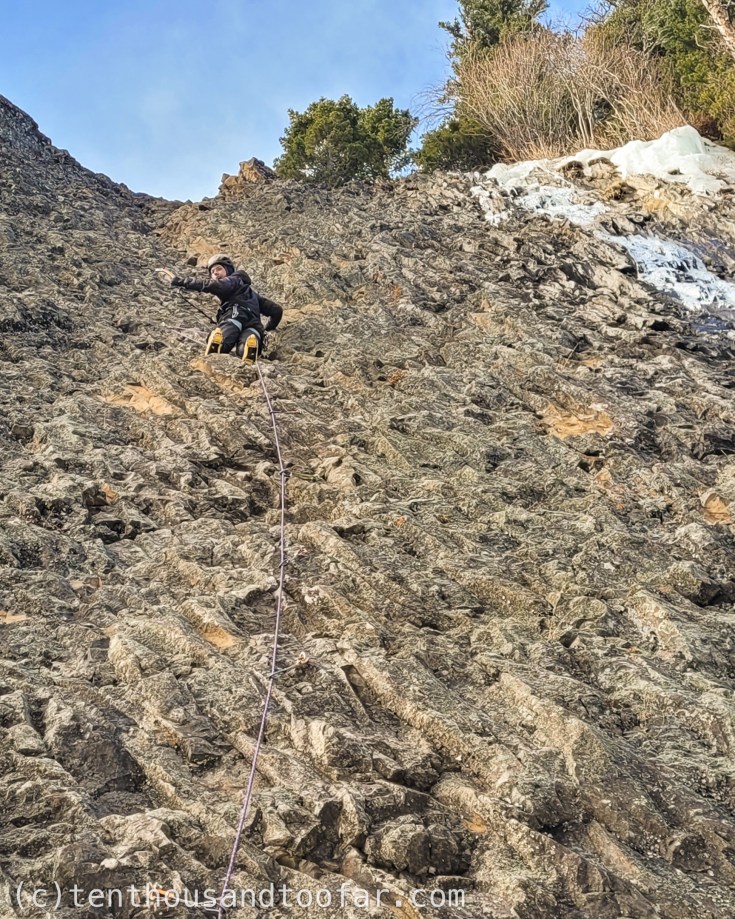
Moustrap (M4+) – Hyalite Canyon
2. Don’t Underestimate Mixed Leads, Especially Traditional
On my third trip to Hyalite Canyon, an experienced partner and I sized up Mummy III & IV, an adventurous three-pitch outing with difficulties to WI6, M6+, and nothing easier than WI5. Wanting to carry my load, I took the first WI5 pitch on Scepter, marched up a steep scree gully and tied in for Mummy III which carries the grade M5, WI3 in the guidebook. Having been leading mixed climbs up to M5 on bolts, M4+ on gear and climbing WI3 in my sleep, I figured this was a logical next step. However, not soon after leaving the ground I realized leading 50M of M5 on scratchy Hyalite andesite, covered in a few inches of snow and thousands of feet above the car, was going to be a little less than comfortable. We later found out, from local guides, the ice needs to form lower to cover an otherwise M6 crux, and instead of a comfortable onsight I found myself at a grade I’d never climbed before, 10M above a shallow Yellow C3 contemplating a surely ankle breaking whipper in the best scenario – let’s not think about the worst. Fortunately I was able to compose myself and pull the crux sequence, after which I was forced to run the rope another 15-20M on half-hilt, tied off, ice screws on a thinly covered vegetated slab – imagine having to on-sight your first ever 5.11 lead with ground fall potential. Obviously everything went okay, since I am writing this article, but the lesson I learned is that mixed grades are often less established than rock grades, since the grade depends on the amount of ice covering the route. This also means adequate protection can be elusive – if the cracks are iced up or, if the ice is too thin for good screws, you could be left soloing. Lastly, whipping on a dry rock face with crampons and axes is dangerous – even on small falls. I topped out sans bravado – no celebrations – grateful for safe passage and the opportunity to learn a harsh lesson within a healthy body. For the rest of the year I “held my horses” and stayed well within my mixed and dry comfort zone, especially when picking up the trad rack.

3. The Power Of A Mentor
In the early days of 2023 I connected with my first ever true climbing mentor. Chris, who has been climbing ice for over two decades and still hikes WI6 while thinking of his grocery list, became my primary partner. We climbed many weekends in Hyalite and even took a week long road-trip around the Northern Rockies seeking long, testing, multi-pitch classics. What I lacked in climbing ability I made up for in fitness, stoke and eagerness to learn, and we gelled as friends quickly. In climbing with Chris I received not only a first-person example of what proper technique, confidence and sheer ability looked like, but also, as we grew more comfortable, a respected voice that could offer suggestion and enable me to grow. I credit our relationship to me achieving my initial season goal of leading WI5, which I ended up doing a half-dozen times by March, and to many amazing memories along the way. Furthermore, without Chris I never would have been able to climb the rarefied grade of WI6, or my first Grade IV. I learned a tremendous amount on the 3-4 pitches of WI6 I followed him on this year, and now I have a glimpse of the direction I need to take my skillset in years to come.

4. “Keep Your Swagger!”
Piggy backing on the last point – Chris unknowingly offered a crucial mantra while watching me struggle up the dead vertical and virgin second pitch WI5 pillar of Ovisight, a long test piece in Cody, WY. The scene was kind of grim. Wet snow had us soaked to the bone, thousands of feet off the ground, and I was up on my most difficult lifetime lead with precipitation whizzing horizontally and not a single pick-hole for full rest – Cody high-country ain’t no hooked out Hyalite, this was real. I was intimidated, about halfway up the 30M monster and already pumped out of my tree, beginning to take small steps and weak swings, placing too many screws… the tried and true signs of demise. “Keep your swagger bro!” I heard Chris yell amidst the weather, immediately offering me a mantra for confidence. In that very moment I came to the sobering realization that if I didn’t climb like I belonged, I had no chance. I flipped the switch in that moment, swinging high, trusting my tools, kicking high and running the rope a few body lengths between screws. Most importantly I began to smile, to talk to myself, to enjoy the movement, to look down and appreciate the exposure… the tried and true signs of success. Before I knew it I was atop the hardest ice lead of my life.
The lesson learned here is that climbing scared serves no purpose. Once the decision to continue is made, the best advantage I can give myself is confidence and conviction. When pumped, or nervous, it is easy to climb timidly. In these moments I have learned to whisper to myself “keep your swagger” – reminding me to climb efficiently, like I belong, like the climber I know I can be.

5. Maybe You Can Fall?
Okay – this one’s a bit taboo, and maybe I shouldn’t even have written it. Not falling is a key tenant of ice climbing for a reason, and I am not suggesting that anyone goes out pushing their limits and taking whippers onto screws – it’s dangerous. That said, I do think the idea of “not falling” holds some climbers back from achieving their best. FULL DISCLOSURE – these are the thoughts and words of a second year ice climber, best taken with three grains of salt – and we continue. This winter I watched a few different ice veterans push their limits to the edge, fire in a screw and gently take a rest. I also personally got up on a WI5 with a weird overhanging blob, recognized there was a chance I could fall, fired in two screws below the lip and ended up pitching off for a peaceful, short fall into free space. Another day, though technically not a “fall”, I got a tool stuck in wet ice while leading another WI5 pitch, and instead of pumping out, panicking and taking a winger I clipped into the other tool, gently weighted it, removed my stuck tool and continued on.
I guess the important distinction here is that none of these examples were careening, reckless, run-out plunges down non-vertical ice, but they do highlight examples where it is possible to climb maximally on ice, not succeed and manage the consequences safely. I believe that so long as one has the presence of mind to recognize their limit, and the proper technique and mental control required to not take an inadvertent fall, then a lead climber should be able to fire a screw and/or clip to a tool before whipping, or even, in very special terrain circumstances (overhanging or mixed ice with a clean fall), double up on protection and go for the gold. To not leave the ground for fear of failure is only going to hold the aspiring ice climber, me, back.
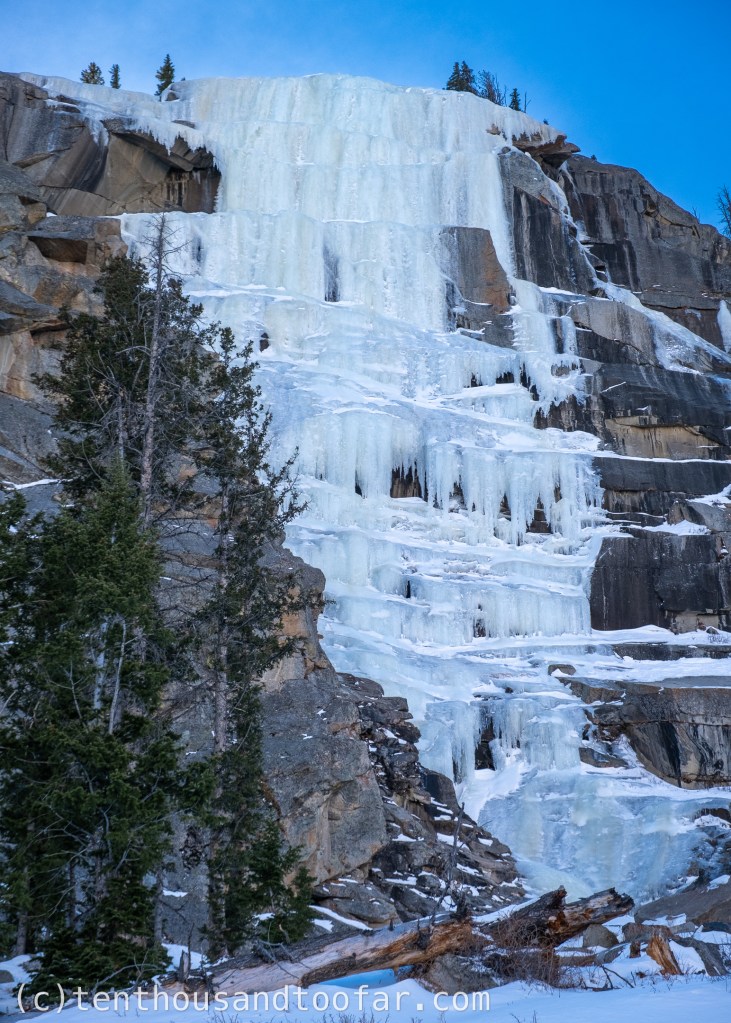
I hope you enjoyed this article, and perhaps found it useful. Really, it’s the piece I would have written in my climbing journal anyways, to look back on when the snow starts flying this fall. Winter climbing has opened my eyes to a whole new world, and next year I am looking forward to more true alpine adventures, with dreams of bigger ranges. If 2024 is anything like 2023, there will be a lot of smiles along the way too. A special thank you to all the friends that came along for the ride.
Notable Ascents 2022/23 Season
just a few of my proudest ascents in 2022/23
- Prospector Falls (WI4-, III) – GTNP, WY
- Squash Head (WI4+, II) – Santaquin Canyon, UT (first WI4+ lead)
- Backoff (WI4, II) – Santaquin Canyon, UT
- Through Four More (WI4) – Hyalite Canyon, MT
- Golden Tears (WI4+, III) – Wind River Range, WY (swung leads, led pitches 1 and 3)
- Magically Delicious (M4, WI3, R) – Hyalite Canyon, MT
- Mousetrap (M4+) – Hyalite Canyon, MT (first fully dry bolted lead)
- White Zombie (M5) – Hyalite Canyon, MT (first bolted M5 lead)
- Ketosis (M4, WI4) – Hyalite Canyon, MT
- Scepter (WI5) – Hyalite Canyon, MT (first Hyalite WI5 lead)
- Mummy III & IV (WI6, M6+, IV) – Hyalite Canyon, MT (first traditional M6 lead, first WI6 follow)
- Eagle Scout Pillar (WI5) – Teton Canyon, WY (led four separate times, original season project)
- Moratorium (WI4) – Cody, WY (longest continuous ice climb (100M), led WI4 pitch two)
- Pillar Of Pain, High On Boulder (WI5+, III) – Cody, WY (led four WI4 pitches, followed last WI5+)
- Ovisight (WI6, IV) – Cody, WY (led WI5 pitch two, followed WI6 pitch 1 and 3, first ice Grade IV)
- Mustache Ride (M4, WI4) – Hyalite Canyon, MT
- Cleopatra’s Needle (WI5, II) – Hyalite Canyon, MT (first full multi-pitch WI5 lead)
- Ford-Stettner, Grand Teton (WI3-) – GTNP, WY (second solo climb, fifth summit ski descent)
Ten Thousand Too Far is generously supported by Icelantic Skis from Golden Colorado, Barrels & Bins Natural Market in Driggs Idaho, Range Meal Bars from Bozeman Montana and Black Diamond Equipment. Give these guys some business – who doesn’t need great skis, gear and wholesome food?



If you would like to support Ten Thousand Too Far, consider subscribing below and/or leaving a donation here. The hours spent writing these blogs is fueled solely and happily by passion, but if you use this site to plan or inspire your own epic adventure, consider kicking in. A couple bucks goes a long way in the cold world of adventure blogging. I also love to hear your thoughts, so don’t leave without dropping a comment! Thanks for the love.
Follow my photography at @brandon.wanthal.photography
enter your email to subscribe for new articles
DISCLAIMER
Ski mountaineering, rock climbing, ice climbing and all other forms of mountain recreation are inherently dangerous. Should you decide to attempt anything you read about in this article, you are doing so at your own risk! This article is written to the best possible level of accuracy and detail, but I am only human – information could be presented wrong. Furthermore, conditions in the mountains are subject to change at any time. Ten Thousand Too Far and Brandon Wanthal are not liable for any actions or repercussions acted upon or suffered from the result of this article’s reading.
 Ten Thousand Too Far
Leave a comment